$35 billion creates a 157 defense line! Japan's "unlimited intervention" vs. institutional consensus: Buying alone is not enough.
2026-05-07 15:56:27
Japan's top currency diplomat, Atsushi Mimura, said on Thursday (May 7) that Japan faces "no limits" on the frequency of its intervention in the foreign exchange market, and revealed that Japanese and U.S. authorities maintain daily communication. This statement came ahead of U.S. Treasury Secretary Bessenter's visit to Tokyo next week, reinforcing the signal that Japan is ready to intervene to support the yen. However, market analysts point out that if Japan acts alone, the intervention will be far less effective than a joint operation.
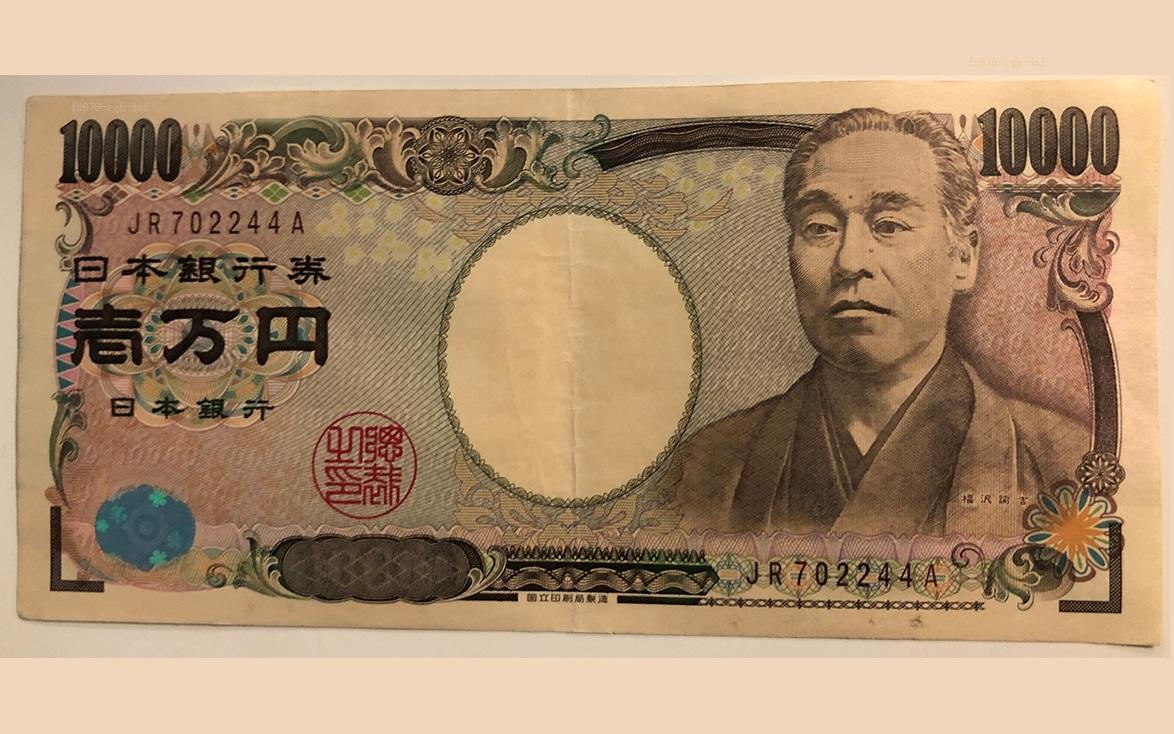
I. Jun Mimura: IMF rules do not limit the frequency of intervention
In response to the IMF's guidance that "more than three interventions in six months warrant attention," Jun Mimura clarified that the IMF classifies Japan as having a freely floating exchange rate regime and does not restrict the frequency of intervention by the authorities. He emphasized, "Our focus remains consistent and covers all directions," and noted that Tokyo continues to believe there are speculative fluctuations in the foreign exchange market.
Regarding coordination with the United States, Jun Mimura stated that they maintain daily communication with the US authorities and that the US "fully understands our thoughts and actions." He declined to comment on Bessant's visit next week but hinted that Japan's position has been fully conveyed.
II. Market Reaction: Three "Pulse-like" Surges, Suspected Intervention Reaching $35 Billion
Sources say authorities intervened last Thursday, with currency market data suggesting that approximately $35 billion may have been sold to support the yen. Since then, the yen has surged three more times up to Wednesday, reaching a high of 155.00. On Thursday, the USD/JPY pair traded in a narrow range during the Asian and European sessions, currently hovering around 156.20.
Jun Mimura declined to comment on whether there would be any intervention during Japan's Golden Week holiday (which lasts until Wednesday), saying only that he was "closely monitoring the currency market."
III. Joint Action? The Market Holds No Hope
A foreign exchange strategist at Mitsubishi UFJ Morgan Stanley Securities said, "The biggest focus in the market is whether the US will join Japan in a joint intervention. Currently, it seems highly likely that Japan will act alone, and its impact will be far less than a joint intervention." He added that the US may believe the yen's weakness is not due to speculation, but rather to the Bank of Japan's slow pace of interest rate hikes, and Bessant may informally call for the Bank of Japan to raise rates in June.
IV. Intervention tactics: Holiday light attacks + verbal cooperation, but with limited effectiveness.
SMBC Nikko Securities strategists analyzed that the Japanese authorities' timing in intervening on April 30—two days after the Bank of Japan kept interest rates unchanged and during the Golden Week holiday when market trading was thin—was extremely precise. Entering the market only about two hours after Finance Ministers Katayama and Mimura issued threats of action greatly amplified the effect of verbal intervention.
However, he also pointed out the limitations of intervention: "Although 158 is now regarded as the new red line for the authorities, the yen has continued to fall even after approaching 155, indicating that intervention alone cannot reverse the trend of yen weakness."
V. Policy Background: The Weak Yen Becomes a "Policy Nightmare"
The continued weakening of the yen is becoming a "policy nightmare" for Japan, with import costs rising across the board, from crude oil to food. Minutes from the March policy meeting showed that some central bank members had pressured for an early interest rate hike, reflecting their concerns about rising inflationary pressures. The Bank of Japan kept interest rates unchanged on April 30 but strongly hinted at a possible rate hike in June.
In conclusion, the Japanese authorities have made their bottom line clear: no limit on the frequency of intervention, daily communication with the US, and readiness to act at any time. The suspected intervention scale of $35 billion and the precise tactics during the gold cycle demonstrate Japan's determination to defend the yen. However, the market is not buying it—the yen quickly gave back its gains after approaching 155, indicating that intervention alone cannot reverse the fundamental trend driven by interest rate differentials.
The real turning point may depend on: ① whether Bessant's visit to Japan next week will signal coordinated US intervention; ② whether the Bank of Japan will actually raise interest rates in June, rather than just making verbal hints; and ③ whether the Federal Reserve's policy path will shift towards easing. Until then, the yen will remain caught in a tug-of-war between "intervention-driven rebound" and "weakening fundamentals."
Institutional View: Intervention Unlikely to Change Yen's Weakness
The Japanese yen is currently caught in a fierce battle between "intervention support" and "fundamental suppression." Japanese authorities have reportedly intervened with approximately $35 billion, successfully pulling the USD/JPY pair back from around 160 to the 156-157 range. However, most institutions believe that intervention alone cannot reverse the yen's weakening trend.
I. Short-term: The intervention effect diminishes, and 157 becomes a new line of defense.
TD Securities expects USD/JPY to consolidate around 157.00 in the second quarter. The market has already viewed 160 as an implicit watershed, which should limit speculators from re-establishing long positions. However, the pullback to the original level after intervention will be slower than in the past, as authorities are more inclined to combat speculative movements than to defend specific levels.
Maybank points out that the unpredictability of Japanese authorities' actions will limit the upside potential of USD/JPY in the short term. With three suspected interventions following the exchange rate's break above 157.00, the market will become increasingly wary of pushing the dollar above that level.
Mizuho Securities believes the yen is likely to remain weak ahead of the Bank of Japan's June meeting, with the prospect of narrowing interest rate differentials through rate hikes uncertain. However, the authorities' hints that they will not tolerate the exchange rate breaking through 160 effectively set a ceiling for the currency pair.
II. Medium term: Fundamental interest rate spread gap difficult to bridge
Bloomberg Intelligence strategists say that for the yen to strengthen, it mainly depends on a weaker dollar; its own fundamentals are unlikely to provide much support. The 150-250 basis point interest rate differential between the US and Japan is difficult to overcome. Intervention is essentially buying time for the Bank of Japan, but it cannot change the overall trend.
Analysts at MUFG warned that this round of intervention faces a greater risk of failure—the evolution of the situation in the Middle East will be key to whether the USD/JPY can reverse its upward trend. Despite market optimism about the peace process, the situation could change drastically at any time.
III. Long-term: The real turning point depends on interest rate hikes and a shift in the Federal Reserve's stance.
Fitch expects the Bank of Japan to continue raising interest rates, with the policy rate increasing by 75 basis points to 1.5% in 2026. The real policy rate remains deeply negative, and as the central bank further tightens policy and normalizes, it should drive the yen higher.
Goldman Sachs points out that, based on the current scale of intervention, Japan's reserves could support 30 similar operations, but the authorities are expected to be cautious in stockpiling ammunition and choose a more effective time to act.
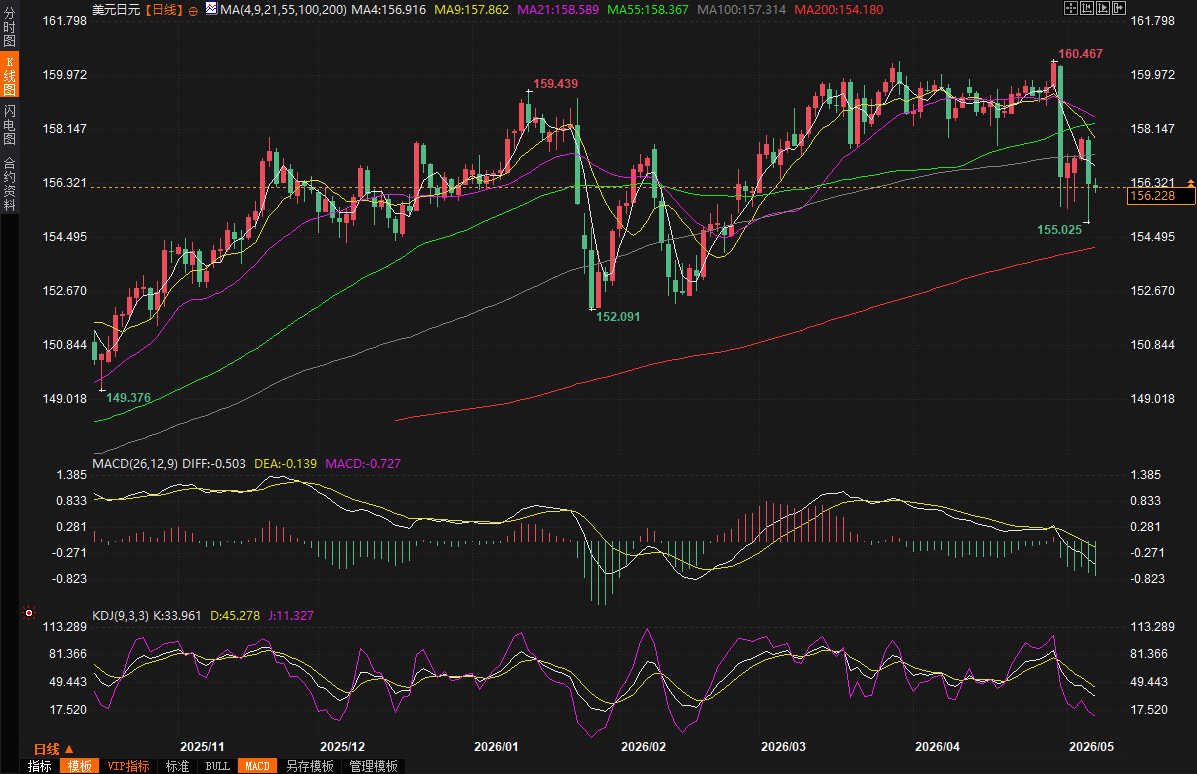
(USD/JPY daily chart, source: FX678)
From a technical perspective, the USD/JPY pair is generally bearish, but downside potential is temporarily limited by suspected intervention from Japanese authorities. The narrow range trading between 156.00 and 157.30 may be the calm before the storm; Friday's non-farm payroll report and progress in US-Iran negotiations will be key catalysts for breaking the deadlock. In terms of trading strategy, consider shorting in the 157.10-158.57 range, and watch for support around 154.18.
At 15:55 Beijing time on May 7, the USD/JPY exchange rate was 156.20/21.
Intervention is unrestricted, but its effectiveness is questionable.
I. Jun Mimura: IMF rules do not limit the frequency of intervention
In response to the IMF's guidance that "more than three interventions in six months warrant attention," Jun Mimura clarified that the IMF classifies Japan as having a freely floating exchange rate regime and does not restrict the frequency of intervention by the authorities. He emphasized, "Our focus remains consistent and covers all directions," and noted that Tokyo continues to believe there are speculative fluctuations in the foreign exchange market.
Regarding coordination with the United States, Jun Mimura stated that they maintain daily communication with the US authorities and that the US "fully understands our thoughts and actions." He declined to comment on Bessant's visit next week but hinted that Japan's position has been fully conveyed.
II. Market Reaction: Three "Pulse-like" Surges, Suspected Intervention Reaching $35 Billion
Sources say authorities intervened last Thursday, with currency market data suggesting that approximately $35 billion may have been sold to support the yen. Since then, the yen has surged three more times up to Wednesday, reaching a high of 155.00. On Thursday, the USD/JPY pair traded in a narrow range during the Asian and European sessions, currently hovering around 156.20.
Jun Mimura declined to comment on whether there would be any intervention during Japan's Golden Week holiday (which lasts until Wednesday), saying only that he was "closely monitoring the currency market."
III. Joint Action? The Market Holds No Hope
A foreign exchange strategist at Mitsubishi UFJ Morgan Stanley Securities said, "The biggest focus in the market is whether the US will join Japan in a joint intervention. Currently, it seems highly likely that Japan will act alone, and its impact will be far less than a joint intervention." He added that the US may believe the yen's weakness is not due to speculation, but rather to the Bank of Japan's slow pace of interest rate hikes, and Bessant may informally call for the Bank of Japan to raise rates in June.
IV. Intervention tactics: Holiday light attacks + verbal cooperation, but with limited effectiveness.
SMBC Nikko Securities strategists analyzed that the Japanese authorities' timing in intervening on April 30—two days after the Bank of Japan kept interest rates unchanged and during the Golden Week holiday when market trading was thin—was extremely precise. Entering the market only about two hours after Finance Ministers Katayama and Mimura issued threats of action greatly amplified the effect of verbal intervention.
However, he also pointed out the limitations of intervention: "Although 158 is now regarded as the new red line for the authorities, the yen has continued to fall even after approaching 155, indicating that intervention alone cannot reverse the trend of yen weakness."
V. Policy Background: The Weak Yen Becomes a "Policy Nightmare"
The continued weakening of the yen is becoming a "policy nightmare" for Japan, with import costs rising across the board, from crude oil to food. Minutes from the March policy meeting showed that some central bank members had pressured for an early interest rate hike, reflecting their concerns about rising inflationary pressures. The Bank of Japan kept interest rates unchanged on April 30 but strongly hinted at a possible rate hike in June.
Intervention can buffer the decline, but reversing the trend requires a concerted effort of policies.
In conclusion, the Japanese authorities have made their bottom line clear: no limit on the frequency of intervention, daily communication with the US, and readiness to act at any time. The suspected intervention scale of $35 billion and the precise tactics during the gold cycle demonstrate Japan's determination to defend the yen. However, the market is not buying it—the yen quickly gave back its gains after approaching 155, indicating that intervention alone cannot reverse the fundamental trend driven by interest rate differentials.
The real turning point may depend on: ① whether Bessant's visit to Japan next week will signal coordinated US intervention; ② whether the Bank of Japan will actually raise interest rates in June, rather than just making verbal hints; and ③ whether the Federal Reserve's policy path will shift towards easing. Until then, the yen will remain caught in a tug-of-war between "intervention-driven rebound" and "weakening fundamentals."
Institutional View: Intervention Unlikely to Change Yen's Weakness
The Japanese yen is currently caught in a fierce battle between "intervention support" and "fundamental suppression." Japanese authorities have reportedly intervened with approximately $35 billion, successfully pulling the USD/JPY pair back from around 160 to the 156-157 range. However, most institutions believe that intervention alone cannot reverse the yen's weakening trend.
I. Short-term: The intervention effect diminishes, and 157 becomes a new line of defense.
TD Securities expects USD/JPY to consolidate around 157.00 in the second quarter. The market has already viewed 160 as an implicit watershed, which should limit speculators from re-establishing long positions. However, the pullback to the original level after intervention will be slower than in the past, as authorities are more inclined to combat speculative movements than to defend specific levels.
Maybank points out that the unpredictability of Japanese authorities' actions will limit the upside potential of USD/JPY in the short term. With three suspected interventions following the exchange rate's break above 157.00, the market will become increasingly wary of pushing the dollar above that level.
Mizuho Securities believes the yen is likely to remain weak ahead of the Bank of Japan's June meeting, with the prospect of narrowing interest rate differentials through rate hikes uncertain. However, the authorities' hints that they will not tolerate the exchange rate breaking through 160 effectively set a ceiling for the currency pair.
II. Medium term: Fundamental interest rate spread gap difficult to bridge
Bloomberg Intelligence strategists say that for the yen to strengthen, it mainly depends on a weaker dollar; its own fundamentals are unlikely to provide much support. The 150-250 basis point interest rate differential between the US and Japan is difficult to overcome. Intervention is essentially buying time for the Bank of Japan, but it cannot change the overall trend.
Analysts at MUFG warned that this round of intervention faces a greater risk of failure—the evolution of the situation in the Middle East will be key to whether the USD/JPY can reverse its upward trend. Despite market optimism about the peace process, the situation could change drastically at any time.
III. Long-term: The real turning point depends on interest rate hikes and a shift in the Federal Reserve's stance.
Fitch expects the Bank of Japan to continue raising interest rates, with the policy rate increasing by 75 basis points to 1.5% in 2026. The real policy rate remains deeply negative, and as the central bank further tightens policy and normalizes, it should drive the yen higher.
Goldman Sachs points out that, based on the current scale of intervention, Japan's reserves could support 30 similar operations, but the authorities are expected to be cautious in stockpiling ammunition and choose a more effective time to act.
(USD/JPY daily chart, source: FX678)
From a technical perspective, the USD/JPY pair is generally bearish, but downside potential is temporarily limited by suspected intervention from Japanese authorities. The narrow range trading between 156.00 and 157.30 may be the calm before the storm; Friday's non-farm payroll report and progress in US-Iran negotiations will be key catalysts for breaking the deadlock. In terms of trading strategy, consider shorting in the 157.10-158.57 range, and watch for support around 154.18.
At 15:55 Beijing time on May 7, the USD/JPY exchange rate was 156.20/21.
- Risk Warning and Disclaimer
- The market involves risk, and trading may not be suitable for all investors. This article is for reference only and does not constitute personal investment advice, nor does it take into account certain users’ specific investment objectives, financial situation, or other needs. Any investment decisions made based on this information are at your own risk.