Gold Analysis: The interplay between peace expectations and inflation drives gold prices to fluctuate and seek direction.
2026-05-08 02:50:48
On Thursday (May 7), during the US trading session, international gold prices continued their volatile trend. Spot gold touched a near two-week high of $4,764 per ounce before retreating, ultimately closing near $4,700, a daily gain of approximately 0.3%. US gold futures closed up 0.4% at $4,710.90. Overall, gold prices maintained a bullish bias, but upward momentum was constrained by multiple factors.

Geopolitics: The Strait of Hormuz affects market sentiment
The situation in the Middle East remains the most crucial driving variable in the gold market. The US and Iran are currently negotiating a ceasefire agreement, and Trump stated at the White House that "the negotiations have progressed well in the past 24 hours, and the likelihood of reaching an agreement is very high," leading to a cautiously optimistic market sentiment.
However, Iran quickly poured cold water on the idea. Reports indicate that senior Iranian officials made it clear that they would not allow the United States to reopen the Strait of Hormuz with "unrealistic plans." At the same time, Iran implemented new regulations for merchant ships transiting the strait, requiring vessels to coordinate their passage with the Iranian military; some reports even suggest that the cost of each transit could be as high as $2 million.
The Strait of Hormuz carries about 20% of the world's oil shipments, and the continued tensions have directly driven up oil prices, which in turn has exacerbated market concerns about the inflation outlook.
Federal Reserve's stance: Expectations for rate cuts are cooling; interest rates may remain in place for longer.
On the monetary policy front, statements from Federal Reserve officials have generally leaned hawkish. Boston Fed President Susan Collins explicitly stated that current interest rates may need to remain unchanged for a longer period and warned that the risk of worsening inflation is rising, not ruling out the possibility of further rate hikes in the future, although she still expects an eventual rate cut.
With expectations that "high interest rates will persist for longer," the attractiveness of gold is suppressed—as a non-interest-bearing asset, a high-interest-rate environment will directly weaken its relative investment value.
Economic data: The job market remains resilient; the non-farm payroll report will be key.
Several US economic data released this week indicate that the job market remains resilient. The ADP Private Employment Report showed that 109,000 jobs were added in April, exceeding market expectations of 99,000 and representing a significant improvement from March's 61,000. Initial jobless claims were 200,000, slightly lower than market expectations of 205,000, remaining within a healthy range.
Market attention has now turned to Friday's non-farm payrolls report, which will provide a more important reference for the Federal Reserve's subsequent policy path and will also directly affect the short-term trend of gold prices.
Medium- to long-term support: Central bank gold purchases and continued bullish sentiment among institutions.
Despite short-term volatility pressures, the medium- to long-term fundamental support for gold prices remains solid. Data shows that the People's Bank of China has increased its gold reserves for the 18th consecutive month, signaling continued official reserve demand.
At the institutional level, TD Securities pointed out in its latest report that once the Middle East conflict eases, oil-driven inflationary pressures subside, the Federal Reserve shifts its policy focus to employment, the dollar weakens, and demand from investors and central banks rebounds in tandem, gold is expected to reignite its bull market, with a target price above $5,200 per ounce. RJO Futures strategists also stated that if a ceasefire agreement is implemented and normal navigation resumes in the Strait of Hormuz, a gold price increase to $5,000 is not out of reach.
Technical Analysis: Moving averages are providing resistance; the consolidation pattern remains intact.
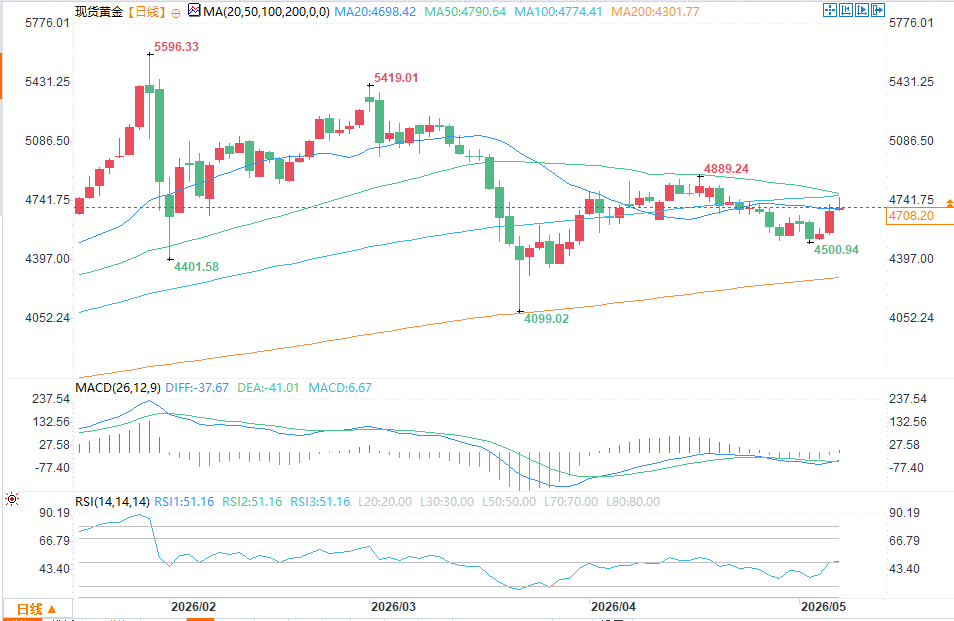
On the daily chart, gold is currently trading at $4,713, sandwiched between a group of moving averages. The 50-day moving average (MA50) (4,790) and the 100-day moving average (MA100) are close together, forming a resistance zone. The 200-day moving average (MA200) provides long-term support, while the short-term MA20 (MA20) is intertwined with the price, making the direction unclear.
The MACD has formed a golden cross but remains below the zero line, casting doubt on the authenticity of the rebound; the RSI is hovering around 51, showing neither overbought nor oversold conditions, indicating that the market is clearly waiting for direction.
Gold prices have fallen from a high of $5,596 in February to $4,099 before stabilizing and currently trading sideways between $4,500 and $4,800. Unless the upper limit of $4,790 is broken, this consolidation pattern is unlikely to be broken in the short term.
Comprehensive analysis
The gold market is currently driven by a confluence of three variables: progress in US-Iran peace talks, expectations for Federal Reserve policy, and energy price trends, making it difficult to determine its short-term direction. A substantial breakthrough in the peace agreement could propel gold prices towards $5,000; however, if negotiations stall again, persistently high oil prices will strengthen inflation expectations, thus exerting downward pressure on gold prices. Friday's non-farm payroll data will be the most important catalyst in the near term, and investors should remain flexible and closely monitor developments.
Geopolitics: The Strait of Hormuz affects market sentiment
The situation in the Middle East remains the most crucial driving variable in the gold market. The US and Iran are currently negotiating a ceasefire agreement, and Trump stated at the White House that "the negotiations have progressed well in the past 24 hours, and the likelihood of reaching an agreement is very high," leading to a cautiously optimistic market sentiment.
However, Iran quickly poured cold water on the idea. Reports indicate that senior Iranian officials made it clear that they would not allow the United States to reopen the Strait of Hormuz with "unrealistic plans." At the same time, Iran implemented new regulations for merchant ships transiting the strait, requiring vessels to coordinate their passage with the Iranian military; some reports even suggest that the cost of each transit could be as high as $2 million.
The Strait of Hormuz carries about 20% of the world's oil shipments, and the continued tensions have directly driven up oil prices, which in turn has exacerbated market concerns about the inflation outlook.
Federal Reserve's stance: Expectations for rate cuts are cooling; interest rates may remain in place for longer.
On the monetary policy front, statements from Federal Reserve officials have generally leaned hawkish. Boston Fed President Susan Collins explicitly stated that current interest rates may need to remain unchanged for a longer period and warned that the risk of worsening inflation is rising, not ruling out the possibility of further rate hikes in the future, although she still expects an eventual rate cut.
With expectations that "high interest rates will persist for longer," the attractiveness of gold is suppressed—as a non-interest-bearing asset, a high-interest-rate environment will directly weaken its relative investment value.
Economic data: The job market remains resilient; the non-farm payroll report will be key.
Several US economic data released this week indicate that the job market remains resilient. The ADP Private Employment Report showed that 109,000 jobs were added in April, exceeding market expectations of 99,000 and representing a significant improvement from March's 61,000. Initial jobless claims were 200,000, slightly lower than market expectations of 205,000, remaining within a healthy range.
Market attention has now turned to Friday's non-farm payrolls report, which will provide a more important reference for the Federal Reserve's subsequent policy path and will also directly affect the short-term trend of gold prices.
Medium- to long-term support: Central bank gold purchases and continued bullish sentiment among institutions.
Despite short-term volatility pressures, the medium- to long-term fundamental support for gold prices remains solid. Data shows that the People's Bank of China has increased its gold reserves for the 18th consecutive month, signaling continued official reserve demand.
At the institutional level, TD Securities pointed out in its latest report that once the Middle East conflict eases, oil-driven inflationary pressures subside, the Federal Reserve shifts its policy focus to employment, the dollar weakens, and demand from investors and central banks rebounds in tandem, gold is expected to reignite its bull market, with a target price above $5,200 per ounce. RJO Futures strategists also stated that if a ceasefire agreement is implemented and normal navigation resumes in the Strait of Hormuz, a gold price increase to $5,000 is not out of reach.
Technical Analysis: Moving averages are providing resistance; the consolidation pattern remains intact.
On the daily chart, gold is currently trading at $4,713, sandwiched between a group of moving averages. The 50-day moving average (MA50) (4,790) and the 100-day moving average (MA100) are close together, forming a resistance zone. The 200-day moving average (MA200) provides long-term support, while the short-term MA20 (MA20) is intertwined with the price, making the direction unclear.
The MACD has formed a golden cross but remains below the zero line, casting doubt on the authenticity of the rebound; the RSI is hovering around 51, showing neither overbought nor oversold conditions, indicating that the market is clearly waiting for direction.
Gold prices have fallen from a high of $5,596 in February to $4,099 before stabilizing and currently trading sideways between $4,500 and $4,800. Unless the upper limit of $4,790 is broken, this consolidation pattern is unlikely to be broken in the short term.
Comprehensive analysis
The gold market is currently driven by a confluence of three variables: progress in US-Iran peace talks, expectations for Federal Reserve policy, and energy price trends, making it difficult to determine its short-term direction. A substantial breakthrough in the peace agreement could propel gold prices towards $5,000; however, if negotiations stall again, persistently high oil prices will strengthen inflation expectations, thus exerting downward pressure on gold prices. Friday's non-farm payroll data will be the most important catalyst in the near term, and investors should remain flexible and closely monitor developments.
- Risk Warning and Disclaimer
- The market involves risk, and trading may not be suitable for all investors. This article is for reference only and does not constitute personal investment advice, nor does it take into account certain users’ specific investment objectives, financial situation, or other needs. Any investment decisions made based on this information are at your own risk.