The USD/JPY pair hovered around the 157 level, awaiting guidance from the US non-farm payroll data.
2026-05-08 10:15:04
During Friday's Asian trading session, the USD/JPY pair remained range-bound, fluctuating around 157.00. Following what appeared to be another intervention by the Japanese government in the foreign exchange market, which stabilized the yen, market caution regarding potential further actions by the Japanese authorities has clearly intensified.
The recent focus in the foreign exchange market remains on the interplay between several factors, including Japanese currency intervention, the Federal Reserve's interest rate policy, and changes in Middle East geopolitical risks. Previously, the USD/JPY exchange rate had risen rapidly to a high, primarily driven by the widening interest rate differential between the two countries. However, with Japanese authorities appearing to have intervened repeatedly to stabilize the exchange rate, short-term speculative funds in the market have begun to recede.

The Japanese government may have recently deployed approximately 10 trillion yen to support its currency. Jun Mimura, Japan's top foreign exchange official, stated that the government is prepared to address speculation in the foreign exchange market and will take measures to stabilize the market if necessary. However, he did not explicitly confirm whether foreign exchange market intervention has been implemented. The Japanese authorities' continued strong signals of maintaining a stable exchange rate are a significant factor limiting further appreciation of the USD/JPY. Due to market concerns about potential large-scale intervention by the Japanese government, some short-term funds have begun reducing their long USD positions, pushing USD/JPY into a period of high-level consolidation.
Meanwhile, information released by the United States indicates that tensions between the US and Iran have not been completely resolved. Market research shows that the US military previously launched strikes against Iranian military facilities in response to Iranian attacks on US warships near the Strait of Hormuz.
US President Trump stated that the US might take stronger measures if Iran refuses to sign the relevant agreement. However, the US government is still awaiting Iran's response to proposals regarding reopening the Strait of Hormuz and ending the conflict.
While market concerns about the risk of a full-blown conflict in the Middle East have eased somewhat, significant uncertainty remains in the region. Market analysts believe that if the situation in the Middle East escalates again, demand for the US dollar as a safe haven could rebound rapidly, driving the dollar higher against the yen.
Market activity remains cautious overall, with investors awaiting the release of the US April non-farm payroll data tonight. The market expects approximately 62,000 new non-farm jobs to be added in April, while the unemployment rate is projected to remain around 4.3%.
If US employment data is stronger than market expectations, it means the US economy and labor market remain resilient, and the Federal Reserve may continue to maintain high interest rates for a longer period. This will further widen the US-Japan interest rate differential and support the USD/JPY exchange rate to remain high. Conversely, if employment data is significantly weak, it may strengthen market expectations for future Fed rate cuts, thereby weakening the dollar and pushing USD/JPY into a temporary correction.
From the perspective of the Japanese economy, although the Bank of Japan has gradually ended its long-term ultra-loose policy, its overall monetary policy remains significantly loose. Currently, long-term interest rates in Japan are still far lower than US Treasury yields, meaning the yen still faces some depreciation pressure in the medium to long term. The US-Japan interest rate differential remains the core logic determining the medium- to long-term trend of USD/JPY. As long as the US maintains high interest rates and the Bank of Japan's rate hikes are limited, the USD/JPY exchange rate is likely to remain at a high level overall.
From the daily chart, USD/JPY currently maintains a clear medium- to long-term bullish structure, but the pace of the rise has begun to slow. After several attempts to break through the 160 level, suspected intervention by Japanese authorities caused a rapid pullback, indicating that the 160 area has become an extremely sensitive policy defense zone for the market. Technically, the daily MACD is still above the zero line, but the red bars are continuously shortening, indicating that bullish momentum is weakening. Meanwhile, the RSI indicator, which previously entered overbought territory, has gradually fallen back to around 60, showing that market sentiment for chasing higher prices is cooling. Looking at the moving average structure, the 5-day and 10-day moving averages are beginning to flatten, while the 20-day moving average has moved up to around 154.80, becoming a key medium-term support area. If the exchange rate subsequently stabilizes above 158.00, it may retest the 159.50 and 160.00 areas; however, if the US dollar experiences a significant pullback, USD/JPY may further decline to around 155.50 or even 154.00.
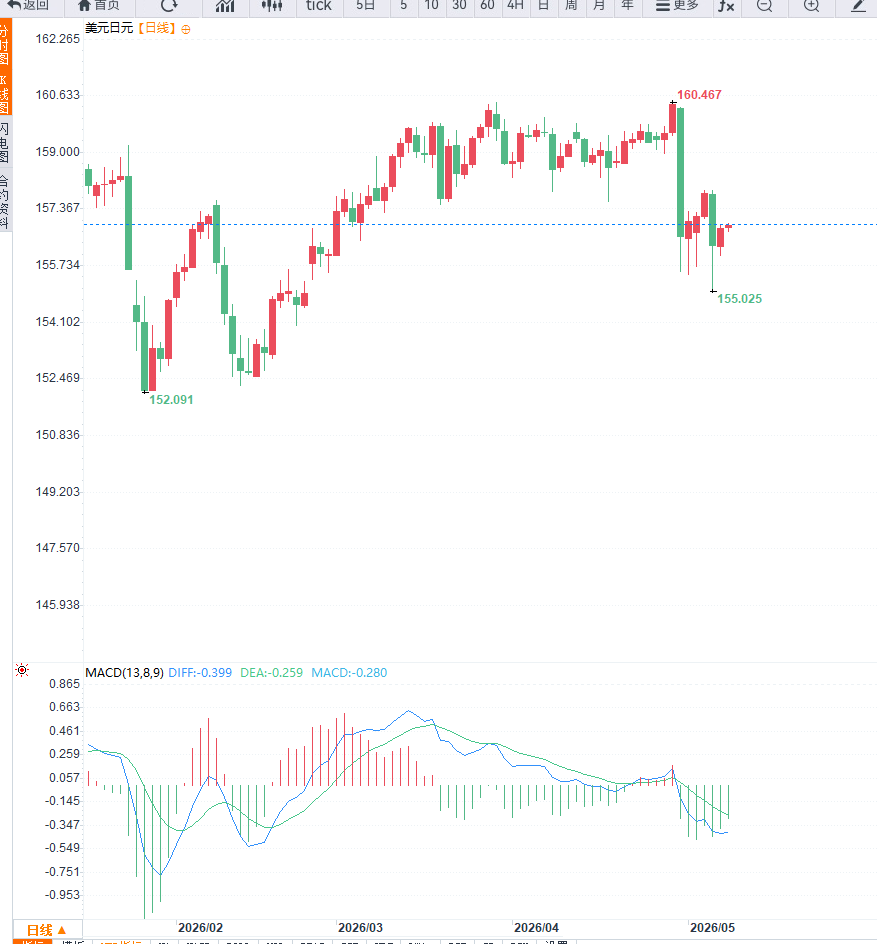
Editor's Summary : The USD/JPY pair is currently in a sensitive phase at high levels. While the USD/JPY interest rate differential continues to support the dollar's medium- to long-term strength, the Japanese government's ongoing signals of exchange rate stabilization have significantly dampened market sentiment to push USD/JPY higher. Technically, the USD/JPY daily chart maintains an uptrend, but the 4-hour chart has entered a high-level consolidation phase. If US employment data remains strong, expectations of higher Federal Reserve interest rates could push the exchange rate to retest the 160 area; however, if the Japanese government further strengthens its intervention, short-term market volatility could increase significantly.
The recent focus in the foreign exchange market remains on the interplay between several factors, including Japanese currency intervention, the Federal Reserve's interest rate policy, and changes in Middle East geopolitical risks. Previously, the USD/JPY exchange rate had risen rapidly to a high, primarily driven by the widening interest rate differential between the two countries. However, with Japanese authorities appearing to have intervened repeatedly to stabilize the exchange rate, short-term speculative funds in the market have begun to recede.
The Japanese government may have recently deployed approximately 10 trillion yen to support its currency. Jun Mimura, Japan's top foreign exchange official, stated that the government is prepared to address speculation in the foreign exchange market and will take measures to stabilize the market if necessary. However, he did not explicitly confirm whether foreign exchange market intervention has been implemented. The Japanese authorities' continued strong signals of maintaining a stable exchange rate are a significant factor limiting further appreciation of the USD/JPY. Due to market concerns about potential large-scale intervention by the Japanese government, some short-term funds have begun reducing their long USD positions, pushing USD/JPY into a period of high-level consolidation.
Meanwhile, information released by the United States indicates that tensions between the US and Iran have not been completely resolved. Market research shows that the US military previously launched strikes against Iranian military facilities in response to Iranian attacks on US warships near the Strait of Hormuz.
US President Trump stated that the US might take stronger measures if Iran refuses to sign the relevant agreement. However, the US government is still awaiting Iran's response to proposals regarding reopening the Strait of Hormuz and ending the conflict.
While market concerns about the risk of a full-blown conflict in the Middle East have eased somewhat, significant uncertainty remains in the region. Market analysts believe that if the situation in the Middle East escalates again, demand for the US dollar as a safe haven could rebound rapidly, driving the dollar higher against the yen.
Market activity remains cautious overall, with investors awaiting the release of the US April non-farm payroll data tonight. The market expects approximately 62,000 new non-farm jobs to be added in April, while the unemployment rate is projected to remain around 4.3%.
If US employment data is stronger than market expectations, it means the US economy and labor market remain resilient, and the Federal Reserve may continue to maintain high interest rates for a longer period. This will further widen the US-Japan interest rate differential and support the USD/JPY exchange rate to remain high. Conversely, if employment data is significantly weak, it may strengthen market expectations for future Fed rate cuts, thereby weakening the dollar and pushing USD/JPY into a temporary correction.
From the perspective of the Japanese economy, although the Bank of Japan has gradually ended its long-term ultra-loose policy, its overall monetary policy remains significantly loose. Currently, long-term interest rates in Japan are still far lower than US Treasury yields, meaning the yen still faces some depreciation pressure in the medium to long term. The US-Japan interest rate differential remains the core logic determining the medium- to long-term trend of USD/JPY. As long as the US maintains high interest rates and the Bank of Japan's rate hikes are limited, the USD/JPY exchange rate is likely to remain at a high level overall.
From the daily chart, USD/JPY currently maintains a clear medium- to long-term bullish structure, but the pace of the rise has begun to slow. After several attempts to break through the 160 level, suspected intervention by Japanese authorities caused a rapid pullback, indicating that the 160 area has become an extremely sensitive policy defense zone for the market. Technically, the daily MACD is still above the zero line, but the red bars are continuously shortening, indicating that bullish momentum is weakening. Meanwhile, the RSI indicator, which previously entered overbought territory, has gradually fallen back to around 60, showing that market sentiment for chasing higher prices is cooling. Looking at the moving average structure, the 5-day and 10-day moving averages are beginning to flatten, while the 20-day moving average has moved up to around 154.80, becoming a key medium-term support area. If the exchange rate subsequently stabilizes above 158.00, it may retest the 159.50 and 160.00 areas; however, if the US dollar experiences a significant pullback, USD/JPY may further decline to around 155.50 or even 154.00.
Editor's Summary : The USD/JPY pair is currently in a sensitive phase at high levels. While the USD/JPY interest rate differential continues to support the dollar's medium- to long-term strength, the Japanese government's ongoing signals of exchange rate stabilization have significantly dampened market sentiment to push USD/JPY higher. Technically, the USD/JPY daily chart maintains an uptrend, but the 4-hour chart has entered a high-level consolidation phase. If US employment data remains strong, expectations of higher Federal Reserve interest rates could push the exchange rate to retest the 160 area; however, if the Japanese government further strengthens its intervention, short-term market volatility could increase significantly.
- Risk Warning and Disclaimer
- The market involves risk, and trading may not be suitable for all investors. This article is for reference only and does not constitute personal investment advice, nor does it take into account certain users’ specific investment objectives, financial situation, or other needs. Any investment decisions made based on this information are at your own risk.