Soaring oil prices hit India! Modi urgently calls on the nation to "tighten their belts" and temporarily refrain from buying gold.
2026-05-11 15:43:35
Indian Prime Minister Narendra Modi on Sunday (May 10) urged Indians to reduce fuel consumption, decrease the frequency of overseas travel, and suspend gold purchases, emphasizing the severe economic impact of the war with Iran. In a public address in the southern city of Hyderabad, Modi stated that global fuel costs have risen sharply, and he urged Indians to use public transportation, work from home, and carpool to conserve fuel.
As tensions in the Middle East push up energy costs, India becomes the latest in a growing number of Asian countries encouraging fuel conservation. On Sunday, US President Trump stated that Iran's proposal to end the war was "completely unacceptable," dashing hopes for peace and pushing global oil prices higher. Brent crude rose more than 4% on Monday, nearing $106 a barrel.
India relies on imports for nearly 85% of its fuel needs, including approximately 50% of its crude oil imports, 60% of its liquefied natural gas (LNG) imports, and almost all of its liquefied petroleum gas (LPG) supply, all of which are transported via the Strait of Hormuz. Rising energy costs are expected to significantly widen India's trade deficit and current account deficit. The rupee is also under pressure, currently trading near a historic low against the US dollar.
Modi stated that reducing overseas travel and gold imports would help conserve foreign exchange reserves, as rising oil prices are increasing pressure on India's import bills. On Monday, shares of Indian jewelry companies fell by as much as 10%, with Titan, a jeweler owned by the Tata Group, dropping nearly 6% in early trading. Shares of Indian airline IndiGo also fell 2.8%. According to local media reports, the airline is expanding its international routes, expecting overseas flights to account for 40% of its daily capacity by 2030.
In the fiscal year ending March 2026, India spent $174.9 billion on crude oil and petroleum products, accounting for 22% of its total imports, highlighting the country's economic dependence on foreign commodities. India is the world's second-largest buyer of gold, after China, with gold import spending approaching $72 billion. In 2025, approximately 32.7 million Indians traveled abroad, with over 14 million being leisure travelers.
In a report dated May 4, global brokerage firm UBS Securities stated, "The Middle East conflict represents a historic energy shock and brings asymmetric macroeconomic risks." The firm lowered its economic growth forecast for India to the fiscal year ending March 2027 from 6.7% to 6.2%. Former Indian Ambassador to the United States, Nirupama Rao, said on Monday, "I don't think the (economic) shock is imminent." However, she indicated that India will face "difficult times" unless the Middle East crisis is peacefully resolved or a reconciliation is reached.
Despite economic pressures, the Indian government has maintained stable retail fuel prices and opted to ease the burden on oil companies through tax cuts. Fuel demand remained unaffected as pump prices remained stable. Analysts had anticipated stricter economic measures following the recent elections in several key states led by Modi's Bharatiya Janata Party (BJP), but these policy changes have not yet materialized. In March, India's chief economic advisor, V. Ananta Nagseran, warned that India's trade deficit would "increase significantly" in the next fiscal year ending March 2027. He stated, "Keeping the deficit under control requires government fiscal absorption and burden-sharing among households and businesses."
ING Group offered a relatively optimistic assessment in its analysis on May 8th. The firm believes that while India is vulnerable to rising international oil prices, the likelihood of the Reserve Bank of India raising interest rates in the second half of 2026 is low.
The core reason is that the cost of rising oil prices in India is largely borne by the government and oil companies, with limited passing on the burden to end consumers, effectively alleviating inflationary pressures. Currently, India's inflation level is in the middle of the 3% range, and institutions predict that annual inflation is likely to remain below 5%. Furthermore, the Reserve Bank of India maintained its benchmark interest rate at 5.25% at its April policy meeting, keeping monetary policy neutral and reserving ample flexibility for future adjustments.
In its latest assessment on May 9, the Asian Development Bank pointed out that crude oil prices will remain high as the Middle East crisis lasts longer than expected—the average price is expected to be $96 per barrel in 2026 and will remain at around $80 per barrel in 2027.
The bank explicitly stated that this round of oil price shocks will significantly drag down the Indian economy: GDP growth for fiscal year 2027 (ending March 2027) will be revised down by 0.6 percentage points to 6.3%, while inflation will rise by 2.4 percentage points to 6.9%. Notably, Parker specifically emphasized that the inflation shock to India is higher than the Asia-Pacific average due to India's greater dependence on imported oil and gas.
However, the bank also pointed out that this negative impact is mainly concentrated in the current fiscal year, and the Indian economy is expected to "rebound" in the next fiscal year. Furthermore, it warned that El Niño and rising fertilizer prices could further exacerbate the risk of food inflation.
In summary, Modi's public appeal reflects the severe impact of the Iranian war on the Indian economy. As a country heavily reliant on energy and gold imports, India faces a significant risk of widening trade deficits and current account deficits amid soaring oil prices and a weakening rupee. The Modi government's current approach of urging the public to conserve resources, rather than directly adjusting fuel prices, indicates limited policy tools at its disposal. The future trajectory of the Middle East situation and whether the Indian government implements more systematic economic measures will be crucial in determining whether its economy can weather this energy shock.
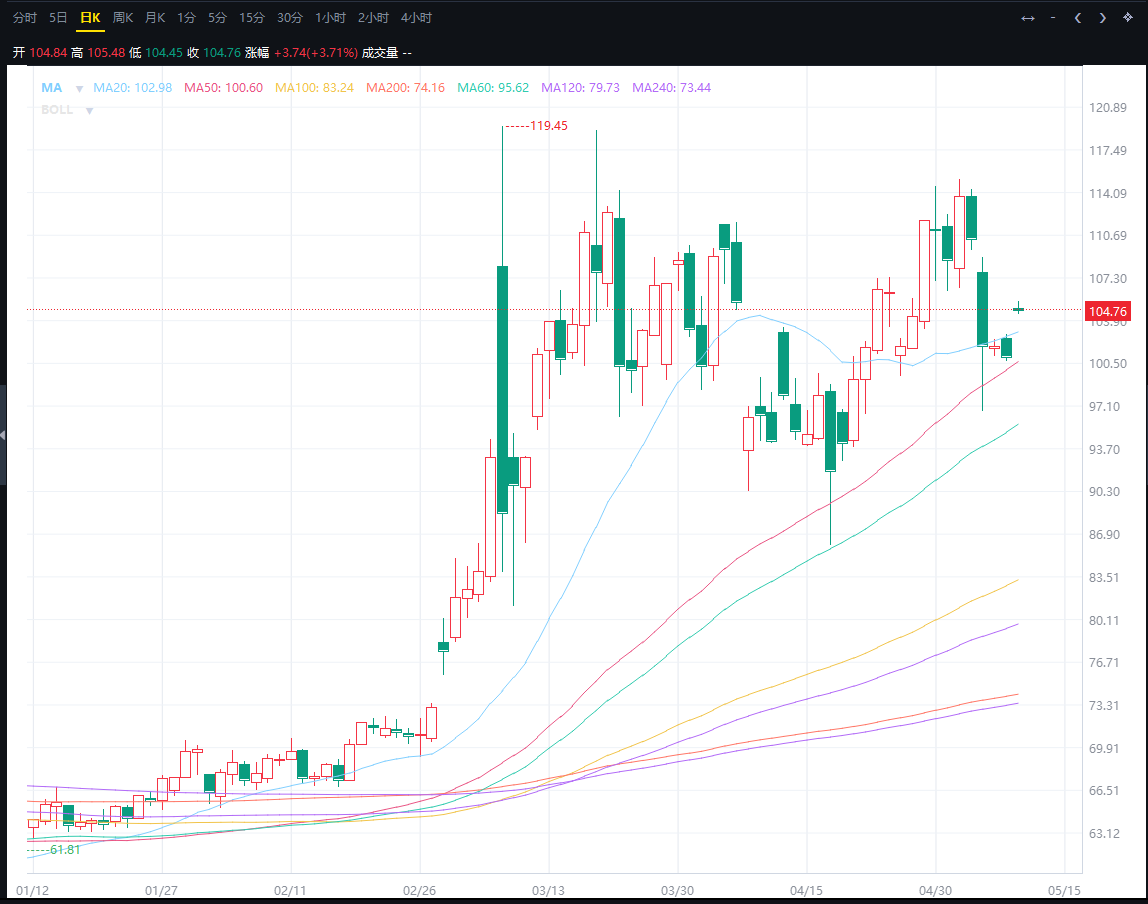
(Brent crude oil futures daily chart, source: FX678)
At 15:40 Beijing time on May 11, Brent crude oil futures were trading at $104.79 per barrel.
As tensions in the Middle East push up energy costs, India becomes the latest in a growing number of Asian countries encouraging fuel conservation. On Sunday, US President Trump stated that Iran's proposal to end the war was "completely unacceptable," dashing hopes for peace and pushing global oil prices higher. Brent crude rose more than 4% on Monday, nearing $106 a barrel.
India relies on imports for nearly 85% of its fuel needs, including approximately 50% of its crude oil imports, 60% of its liquefied natural gas (LNG) imports, and almost all of its liquefied petroleum gas (LPG) supply, all of which are transported via the Strait of Hormuz. Rising energy costs are expected to significantly widen India's trade deficit and current account deficit. The rupee is also under pressure, currently trading near a historic low against the US dollar.
Modi stated that reducing overseas travel and gold imports would help conserve foreign exchange reserves, as rising oil prices are increasing pressure on India's import bills. On Monday, shares of Indian jewelry companies fell by as much as 10%, with Titan, a jeweler owned by the Tata Group, dropping nearly 6% in early trading. Shares of Indian airline IndiGo also fell 2.8%. According to local media reports, the airline is expanding its international routes, expecting overseas flights to account for 40% of its daily capacity by 2030.
economic difficulties
In the fiscal year ending March 2026, India spent $174.9 billion on crude oil and petroleum products, accounting for 22% of its total imports, highlighting the country's economic dependence on foreign commodities. India is the world's second-largest buyer of gold, after China, with gold import spending approaching $72 billion. In 2025, approximately 32.7 million Indians traveled abroad, with over 14 million being leisure travelers.
In a report dated May 4, global brokerage firm UBS Securities stated, "The Middle East conflict represents a historic energy shock and brings asymmetric macroeconomic risks." The firm lowered its economic growth forecast for India to the fiscal year ending March 2027 from 6.7% to 6.2%. Former Indian Ambassador to the United States, Nirupama Rao, said on Monday, "I don't think the (economic) shock is imminent." However, she indicated that India will face "difficult times" unless the Middle East crisis is peacefully resolved or a reconciliation is reached.
Despite economic pressures, the Indian government has maintained stable retail fuel prices and opted to ease the burden on oil companies through tax cuts. Fuel demand remained unaffected as pump prices remained stable. Analysts had anticipated stricter economic measures following the recent elections in several key states led by Modi's Bharatiya Janata Party (BJP), but these policy changes have not yet materialized. In March, India's chief economic advisor, V. Ananta Nagseran, warned that India's trade deficit would "increase significantly" in the next fiscal year ending March 2027. He stated, "Keeping the deficit under control requires government fiscal absorption and burden-sharing among households and businesses."
India's slowing growth and policy space under the impact of oil prices
ING Group offered a relatively optimistic assessment in its analysis on May 8th. The firm believes that while India is vulnerable to rising international oil prices, the likelihood of the Reserve Bank of India raising interest rates in the second half of 2026 is low.
The core reason is that the cost of rising oil prices in India is largely borne by the government and oil companies, with limited passing on the burden to end consumers, effectively alleviating inflationary pressures. Currently, India's inflation level is in the middle of the 3% range, and institutions predict that annual inflation is likely to remain below 5%. Furthermore, the Reserve Bank of India maintained its benchmark interest rate at 5.25% at its April policy meeting, keeping monetary policy neutral and reserving ample flexibility for future adjustments.
In its latest assessment on May 9, the Asian Development Bank pointed out that crude oil prices will remain high as the Middle East crisis lasts longer than expected—the average price is expected to be $96 per barrel in 2026 and will remain at around $80 per barrel in 2027.
The bank explicitly stated that this round of oil price shocks will significantly drag down the Indian economy: GDP growth for fiscal year 2027 (ending March 2027) will be revised down by 0.6 percentage points to 6.3%, while inflation will rise by 2.4 percentage points to 6.9%. Notably, Parker specifically emphasized that the inflation shock to India is higher than the Asia-Pacific average due to India's greater dependence on imported oil and gas.
However, the bank also pointed out that this negative impact is mainly concentrated in the current fiscal year, and the Indian economy is expected to "rebound" in the next fiscal year. Furthermore, it warned that El Niño and rising fertilizer prices could further exacerbate the risk of food inflation.
Summarize
In summary, Modi's public appeal reflects the severe impact of the Iranian war on the Indian economy. As a country heavily reliant on energy and gold imports, India faces a significant risk of widening trade deficits and current account deficits amid soaring oil prices and a weakening rupee. The Modi government's current approach of urging the public to conserve resources, rather than directly adjusting fuel prices, indicates limited policy tools at its disposal. The future trajectory of the Middle East situation and whether the Indian government implements more systematic economic measures will be crucial in determining whether its economy can weather this energy shock.
(Brent crude oil futures daily chart, source: FX678)
At 15:40 Beijing time on May 11, Brent crude oil futures were trading at $104.79 per barrel.
- Risk Warning and Disclaimer
- The market involves risk, and trading may not be suitable for all investors. This article is for reference only and does not constitute personal investment advice, nor does it take into account certain users’ specific investment objectives, financial situation, or other needs. Any investment decisions made based on this information are at your own risk.