May 12th Financial Breakfast: Bargain buying pushes gold prices above $4750; awaiting inflation data; US may consider resuming military action against Iran; oil prices surge nearly 4%.
2026-05-12 07:29:15
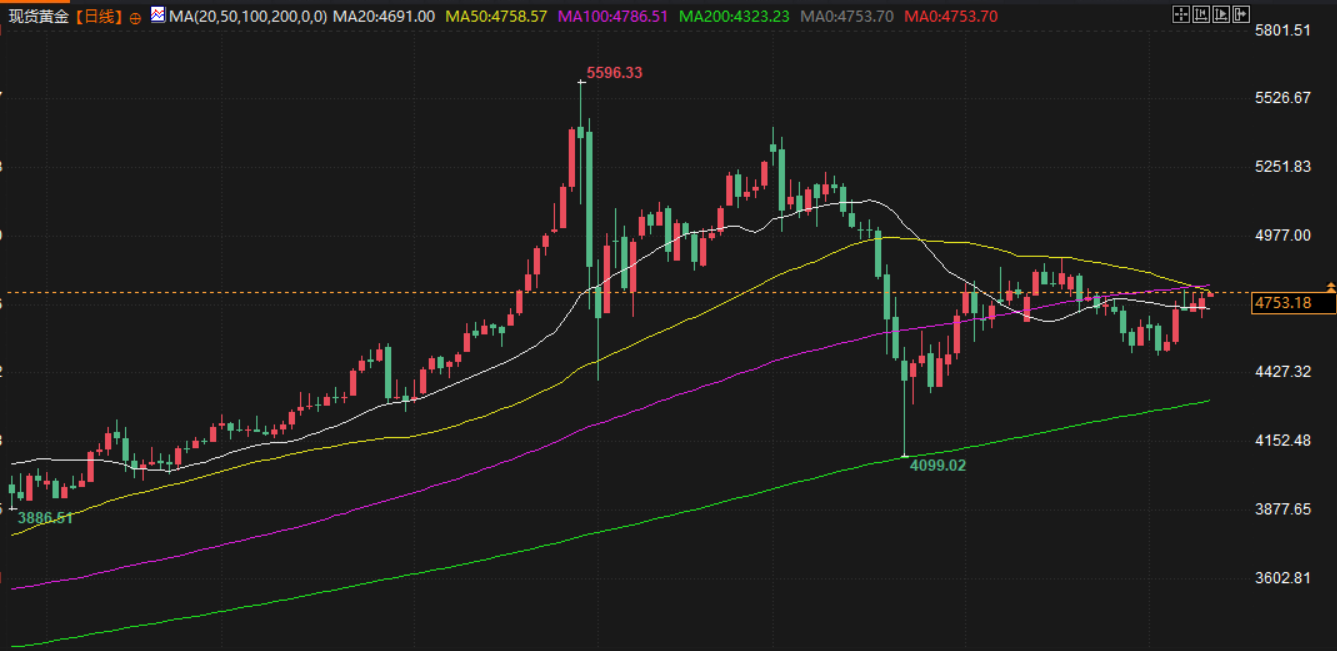
On Tuesday (May 12, Beijing time) in early Asian trading, spot gold was trading around $4,753 per ounce. Gold prices rose slightly on Monday as investors digested the latest developments in the US-Iran situation and awaited key US inflation data, while bargain hunting emerged in the market. US crude oil was trading around $98.22 per barrel. Oil prices rose nearly 4% on Monday after US President Trump said the ceasefire agreement with Iran was "at risk" and that he might consider resuming military action.

U.S. stocks closed slightly higher on Monday amid a tug-of-war between the AI boom and the stalemate in U.S.-Iran talks. While the earnings-driven rally cooled somewhat as the earnings season drew to a close and rising oil prices exacerbated inflation concerns, optimism surrounding AI-related sectors provided upward momentum, with all three major indexes closing higher. The S&P 500 and Nasdaq both hit new closing record highs, while the Philadelphia Semiconductor Index surged 2.6%.
Baird analysts say that semiconductor and AI infrastructure deals have become a distinct sector with strong momentum almost detached from specific news; however, investor Michael Burry warns that the stock market may be about to experience a deep correction, saying "the market has entered a dead end."
In terms of earnings reports, 83% of S&P 500 companies reported earnings that beat expectations, with overall first-quarter earnings growth expected to reach 28.6% year-over-year, almost double the initial estimate at the beginning of the month. Analysts at Bank of America Wealth Management pointed out that the rebound stemmed from strong earnings, and the market will focus on retail earnings reports to determine whether high oil prices will impact consumption.
With earnings season coming to a close, market focus has returned to macroeconomics and geopolitics: Trump's rejection of Iran talks pushed up oil prices and exacerbated inflationary pressures; this week, the market is focused on data such as CPI, retail sales and PPI, with the energy sector leading the S&P 500, while communication services were the weakest.
In terms of individual stocks, Intel rose 3.6% after Apple reportedly reached a preliminary chip agreement; Qualcomm surged 8.4% to a new high; Fox rose 7.6%; airline stocks generally fell 2.9%-4.4% due to higher oil prices.
Spot gold rose slightly by 0.41% to $4,734.68 an ounce in volatile trading on Monday, after falling more than 1% at one point during the session, as investors digested the latest developments in the US-Iran situation and awaited key US inflation data.
US gold market analyst Jim Wyckoff said that there was bargain hunting in the market, while investors were adjusting their positions in preparation for Tuesday's Consumer Price Index (CPI) and Wednesday's Producer Price Index (PPI).
Geopolitically, Trump's swift rejection of Iran's response to a peace proposal has exacerbated concerns about a protracted conflict, continued paralysis of the Strait of Hormuz, and rising oil prices. ING analysts point out that this setback has created uncertainty surrounding the ceasefire timetable, and persistently high inflation risks have reinforced expectations of persistently high interest rates, which has been putting pressure on gold prices throughout the conflict. They add that they expect gold prices to rise to $5,000 per ounce by the end of the year, but the stalled peace negotiations have increased short-term uncertainty.
Indian Prime Minister Narendra Modi urged the public to refrain from buying gold for the next year to protect foreign exchange reserves, causing a sharp drop in the stock prices of Indian jewelry retailers. India is the world's second-largest gold consumer. In other precious metals, spot silver surged over 7% to $85.20, platinum rose 3%, and palladium gained 0.8%.
Oil prices rose nearly 4% on Monday after U.S. President Trump said the ceasefire agreement with Iran was "in jeopardy," the Strait of Hormuz remained largely closed, and there were no clear signs of the war ending.
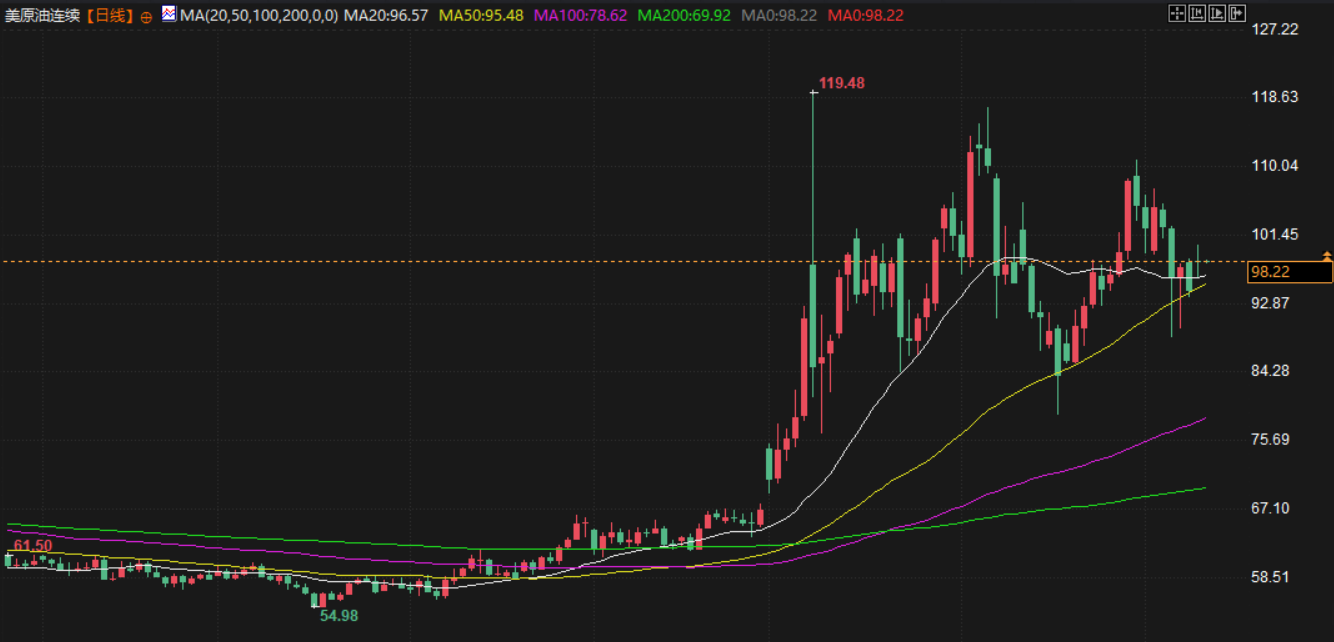
Brent crude rose more than 3.7% to $104.27 a barrel on Monday, hitting a high of $105.95 per barrel during the session; WTI crude rose 3.77% to $98.25 a barrel, hitting a high of $100.37 during the session. Tensions escalated again after Trump denounced Iran's response to US peace proposals as "stupid" and "completely unacceptable." Iran's response included demands for an end to the war on all fronts, war reparations from the US, respect for its sovereignty over the Strait of Hormuz, and the lifting of sanctions and the oil sales ban.
Rabobank energy strategists said the situation shifted from easing to escalating within days, and while the oil market reacted somewhat, the magnitude was not significant.
The CEO of Saudi Aramco warned that global oil production has fallen by about 1 billion barrels in the past two months, and that even if supply recovers, the market will need time to stabilize.
The investigation found that OPEC oil production fell to its lowest level in more than 20 years in April. Furthermore, Kpler data showed that three oil tankers carrying crude oil left the Strait of Hormuz last week and Sunday without their trackers being turned off; one of them was carrying Iraqi crude oil destined for Vietnam.
The dollar index rose slightly on Monday, gaining 0.07% to 97.917, after briefly touching 98.156 during the session. However, it retreated from its earlier high as Trump's rejection of Iran's response to the US peace proposal kept market concerns about a continued war alive and pushed up oil prices.
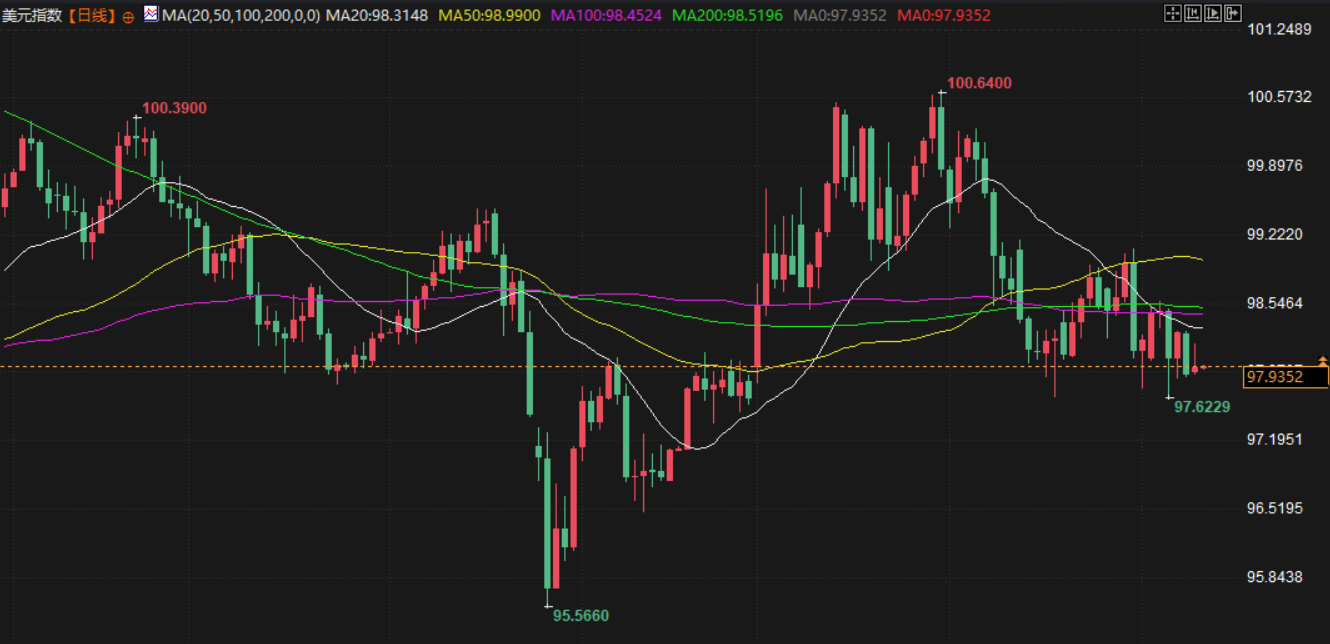
Trump said the ceasefire with Iran was "on the verge of collapse" and called Iran's proposal "unacceptable." The chief market strategist at Bannockburn Capital Markets pointed out that the market seems to be waiting for a signal and it is difficult to reach a consensus at present.
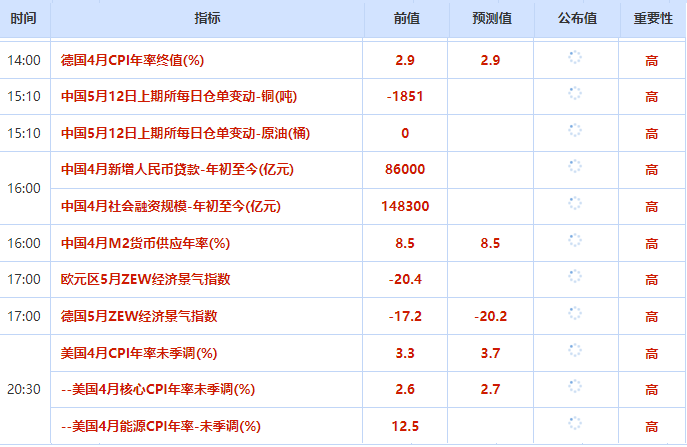
US April CPI and PPI will be released on Tuesday and Wednesday respectively. Last Friday's strong jobs report (April non-farm payrolls increased by 115,000, almost double the expected figure) further strengthened market expectations that the Federal Reserve is unlikely to cut interest rates this year. The pound rose slightly by 0.04% to $1.3637, but British Prime Minister Starmer faces political pressure; the dollar rose 0.29% against the yen to 157.11 yen.
The probability of the Federal Reserve keeping interest rates unchanged in June is 97.7%, and the probability of a rate hike this year is approximately 26.3%.
According to CME's "FedWatch": The probability of the Federal Reserve keeping interest rates unchanged by June is 97.7%, with a 2.3% probability of a cumulative rate cut of 25 basis points. The probability of the Federal Reserve keeping interest rates unchanged by July is 94.6%, with a 5.4% probability of a cumulative rate cut of 25 basis points and a 0.1% probability of a cumulative rate cut of 50 basis points. The probability of the Federal Reserve keeping interest rates unchanged by December is 69.7%, with a 3.9% probability of at least a 25 basis point rate cut and a 26.3% probability of a 25 basis point rate hike.
Trump says the US-Iran ceasefire agreement is hanging by a thread, considering the possibility of resuming military operations.
The US-Iran ceasefire entered a particularly fragile phase on Monday, with Trump rejecting Tehran's latest peace proposal and calling it "deadly dependent on life support." Speaking to reporters in the Oval Office on Monday, Trump said Iran's latest response was "a pile of garbage" that he "didn't even finish reading." A source familiar with the matter said Iran is demanding Washington lift its maritime blockade and ease sanctions, while insisting on retaining some control over shipping in the Strait of Hormuz. Trump did not specify whether the US would resume military strikes against Iran, but he had previously threatened action if the Iranian leadership did not accept its conditions. Earlier on Monday, he said he was considering resuming escort programs to assist ships passing through the Strait of Hormuz. Three US officials revealed that after negotiations with Iran stalled on Sunday, Trump will meet with his national security team on Monday to discuss the next steps in the war with Iran, including the possibility of resuming military action.
Iranian Parliament Speaker: Iranian Armed Forces are prepared to respond to any act of aggression
On March 11 local time, Iranian Parliament Speaker Mohammad Ghalibaf announced on social media that the Iranian armed forces are prepared to respond to any act of aggression. He pointed out that the world understands that "wrong strategies and wrong decisions inevitably lead to wrong results." (CCTV News)
Iranian officials: Serious disagreements exist between Iran and the US regarding the disposal of enriched uranium.
On the 11th local time, an Iranian official stated that negotiations between Iran and the United States have serious disagreements on issues such as the disposal of enriched uranium, the duration of the suspension of uranium enrichment activities, and war reparations. The Iranian official stated that the US proposal demands 60% enriched uranium from Iran and opposes transferring the enriched uranium to Russia, instead proposing its transfer to a third country. The official also stated that Iran opposes shipping enriched uranium abroad but is prepared to dilute it under the supervision of the International Atomic Energy Agency. (CCTV News)
Trump considers military action against Cuba
Trump is "increasingly frustrated" that the Cuban government has not collapsed despite continued U.S. pressure, and has repeatedly questioned his advisors about why the Cuban leadership has been able to maintain power. Reportedly, Trump's impatience has prompted the Pentagon to accelerate planning for possible military action against Cuba, although no final decision has been made.
US media reports that the UAE launched an airstrike on an Iranian oil refinery in early April.
According to The Wall Street Journal, multiple sources familiar with the matter said the United Arab Emirates (UAE) has launched military strikes against Iran. The UAE has been Iran's primary target in the conflict. These attacks demonstrate the UAE's increased willingness to utilize its Western-made fighter jets and surveillance networks to protect its economic power and growing influence in the Middle East. The sources said the UAE has not publicly acknowledged these strikes, including the attack on an Iranian oil refinery on Rawan Island in the Persian Gulf. The attack, which occurred in early April, around the time Trump announced a ceasefire agreement following five weeks of air operations, caused a fire and shut down most of the refinery's capacity. Iran claimed the refinery was attacked and responded with a barrage of missile and drone strikes against the UAE and Kuwait. One source said the US was not unhappy about the attack because the ceasefire was not yet truly stable, and the US privately welcomed the UAE and any other Gulf states wishing to join the war against Iran.
OPEC production fell to its lowest point in 20 years as the Strait of Hormuz crisis hampered exports.
OPEC's oil production fell by 830,000 barrels per day in April to 20.04 million barrels per day, the lowest level in more than 20 years, affected by the conflict with Iran and the disruption of the Strait of Hormuz. Kuwait saw the largest drop in production after a full month of export disruptions, while Saudi Arabia and Iraq also reduced output. The UAE was the only oil producer in the Gulf region to increase production, as its export routes bypass the Strait of Hormuz. Venezuela and Libya also increased production.
The US plans to release 53.5 million barrels of strategic crude oil between June and August.
To alleviate oil price pressures caused by the Iran-Iraq War, the U.S. Strategic Petroleum Reserve (SPR) has allocated 53.5 million barrels of crude oil to companies such as commodity trader Trafigura and U.S. refiner Marathon Oil. This batch of crude oil will be released to the market between June and August. This comes ahead of the peak summer driving season in the U.S., when refineries will increase production to cope with surging gasoline demand, and the government hopes this move will lower oil prices. This release is the second largest in history and is part of a global coordinated effort to lower oil prices led by the International Energy Agency. Last week, the U.S. released a record 1.22 million barrels of crude oil per day under the same framework. The Trump administration has pledged to release a total of 172 million barrels of crude oil through the so-called "exchange program" (where companies borrow crude oil and subsequently return it in kind). To date, the U.S. has agreed to release 133.1 million barrels.
Iranian Parliament Speaker: The "14-Point Proposal" is Irreplaceable
Early on the morning of the 12th local time, Iranian Parliament Speaker Ghalibaf posted a message on social media stating that there is no alternative to accepting the rights of the Iranian people as stipulated in Iran's "14-point proposal." He stated that any other approach would be fruitless and would only lead to repeated failures. He also pointed out that the longer the situation drags on, the more American taxpayers will pay. (CCTV News)
India is reportedly considering restricting gold imports in order to salvage its foreign exchange reserves.
According to foreign media citing sources familiar with the matter, India is considering emergency measures to support its foreign exchange reserves, including restricting non-essential imports such as gold and consumer electronics, and raising fuel prices to help the economy cushion the impact of the war with Iran. Sources said that officials from the Prime Minister's Office and the Ministry of Finance have discussed several possible measures with the Reserve Bank of India to limit the damage to the economy caused by soaring oil prices. One of the options currently under discussion, according to sources, is raising fuel prices. This would be India's first fuel price increase since the outbreak of the war with Iran, and it comes after Prime Minister Modi's recent landslide victory in local elections. However, no final decision has been made on the emergency measures. One source said that gold and consumer electronics are considered non-essential imports, and the government may take measures to restrict their imports. Sources indicated that officials are concerned about a widening current account deficit, and therefore these measures aim to curb imports and preserve foreign exchange reserves.
China's construction machinery exports exceeded 112.4 billion yuan in the first quarter of this year, a year-on-year increase of 21.3%.
From 2020 to 2025, the export scale of the construction machinery industry will nearly triple. In the first quarter of this year, cumulative exports exceeded 112.4 billion yuan, a year-on-year increase of 21.3%. Chinese construction machinery holds leading positions in several sub-sectors: its global market share in concrete machinery exceeds 40%, ranking first in the world for many consecutive years; its global market share in tunnel boring machines has exceeded 70%; and its market share in truck cranes, aerial work platforms, and electric forklifts all remain among the top globally. (CCTV Finance)
Key Focus Today
stock market
U.S. stocks closed slightly higher on Monday amid a tug-of-war between the AI boom and the stalemate in U.S.-Iran talks. While the earnings-driven rally cooled somewhat as the earnings season drew to a close and rising oil prices exacerbated inflation concerns, optimism surrounding AI-related sectors provided upward momentum, with all three major indexes closing higher. The S&P 500 and Nasdaq both hit new closing record highs, while the Philadelphia Semiconductor Index surged 2.6%.
Baird analysts say that semiconductor and AI infrastructure deals have become a distinct sector with strong momentum almost detached from specific news; however, investor Michael Burry warns that the stock market may be about to experience a deep correction, saying "the market has entered a dead end."
In terms of earnings reports, 83% of S&P 500 companies reported earnings that beat expectations, with overall first-quarter earnings growth expected to reach 28.6% year-over-year, almost double the initial estimate at the beginning of the month. Analysts at Bank of America Wealth Management pointed out that the rebound stemmed from strong earnings, and the market will focus on retail earnings reports to determine whether high oil prices will impact consumption.
With earnings season coming to a close, market focus has returned to macroeconomics and geopolitics: Trump's rejection of Iran talks pushed up oil prices and exacerbated inflationary pressures; this week, the market is focused on data such as CPI, retail sales and PPI, with the energy sector leading the S&P 500, while communication services were the weakest.
In terms of individual stocks, Intel rose 3.6% after Apple reportedly reached a preliminary chip agreement; Qualcomm surged 8.4% to a new high; Fox rose 7.6%; airline stocks generally fell 2.9%-4.4% due to higher oil prices.
Gold Market
Spot gold rose slightly by 0.41% to $4,734.68 an ounce in volatile trading on Monday, after falling more than 1% at one point during the session, as investors digested the latest developments in the US-Iran situation and awaited key US inflation data.
US gold market analyst Jim Wyckoff said that there was bargain hunting in the market, while investors were adjusting their positions in preparation for Tuesday's Consumer Price Index (CPI) and Wednesday's Producer Price Index (PPI).
Geopolitically, Trump's swift rejection of Iran's response to a peace proposal has exacerbated concerns about a protracted conflict, continued paralysis of the Strait of Hormuz, and rising oil prices. ING analysts point out that this setback has created uncertainty surrounding the ceasefire timetable, and persistently high inflation risks have reinforced expectations of persistently high interest rates, which has been putting pressure on gold prices throughout the conflict. They add that they expect gold prices to rise to $5,000 per ounce by the end of the year, but the stalled peace negotiations have increased short-term uncertainty.
Indian Prime Minister Narendra Modi urged the public to refrain from buying gold for the next year to protect foreign exchange reserves, causing a sharp drop in the stock prices of Indian jewelry retailers. India is the world's second-largest gold consumer. In other precious metals, spot silver surged over 7% to $85.20, platinum rose 3%, and palladium gained 0.8%.
oil market
Oil prices rose nearly 4% on Monday after U.S. President Trump said the ceasefire agreement with Iran was "in jeopardy," the Strait of Hormuz remained largely closed, and there were no clear signs of the war ending.
Brent crude rose more than 3.7% to $104.27 a barrel on Monday, hitting a high of $105.95 per barrel during the session; WTI crude rose 3.77% to $98.25 a barrel, hitting a high of $100.37 during the session. Tensions escalated again after Trump denounced Iran's response to US peace proposals as "stupid" and "completely unacceptable." Iran's response included demands for an end to the war on all fronts, war reparations from the US, respect for its sovereignty over the Strait of Hormuz, and the lifting of sanctions and the oil sales ban.
Rabobank energy strategists said the situation shifted from easing to escalating within days, and while the oil market reacted somewhat, the magnitude was not significant.
The CEO of Saudi Aramco warned that global oil production has fallen by about 1 billion barrels in the past two months, and that even if supply recovers, the market will need time to stabilize.
The investigation found that OPEC oil production fell to its lowest level in more than 20 years in April. Furthermore, Kpler data showed that three oil tankers carrying crude oil left the Strait of Hormuz last week and Sunday without their trackers being turned off; one of them was carrying Iraqi crude oil destined for Vietnam.
Foreign exchange market
The dollar index rose slightly on Monday, gaining 0.07% to 97.917, after briefly touching 98.156 during the session. However, it retreated from its earlier high as Trump's rejection of Iran's response to the US peace proposal kept market concerns about a continued war alive and pushed up oil prices.
Trump said the ceasefire with Iran was "on the verge of collapse" and called Iran's proposal "unacceptable." The chief market strategist at Bannockburn Capital Markets pointed out that the market seems to be waiting for a signal and it is difficult to reach a consensus at present.
US April CPI and PPI will be released on Tuesday and Wednesday respectively. Last Friday's strong jobs report (April non-farm payrolls increased by 115,000, almost double the expected figure) further strengthened market expectations that the Federal Reserve is unlikely to cut interest rates this year. The pound rose slightly by 0.04% to $1.3637, but British Prime Minister Starmer faces political pressure; the dollar rose 0.29% against the yen to 157.11 yen.
International News
The probability of the Federal Reserve keeping interest rates unchanged in June is 97.7%, and the probability of a rate hike this year is approximately 26.3%.
According to CME's "FedWatch": The probability of the Federal Reserve keeping interest rates unchanged by June is 97.7%, with a 2.3% probability of a cumulative rate cut of 25 basis points. The probability of the Federal Reserve keeping interest rates unchanged by July is 94.6%, with a 5.4% probability of a cumulative rate cut of 25 basis points and a 0.1% probability of a cumulative rate cut of 50 basis points. The probability of the Federal Reserve keeping interest rates unchanged by December is 69.7%, with a 3.9% probability of at least a 25 basis point rate cut and a 26.3% probability of a 25 basis point rate hike.
Trump says the US-Iran ceasefire agreement is hanging by a thread, considering the possibility of resuming military operations.
The US-Iran ceasefire entered a particularly fragile phase on Monday, with Trump rejecting Tehran's latest peace proposal and calling it "deadly dependent on life support." Speaking to reporters in the Oval Office on Monday, Trump said Iran's latest response was "a pile of garbage" that he "didn't even finish reading." A source familiar with the matter said Iran is demanding Washington lift its maritime blockade and ease sanctions, while insisting on retaining some control over shipping in the Strait of Hormuz. Trump did not specify whether the US would resume military strikes against Iran, but he had previously threatened action if the Iranian leadership did not accept its conditions. Earlier on Monday, he said he was considering resuming escort programs to assist ships passing through the Strait of Hormuz. Three US officials revealed that after negotiations with Iran stalled on Sunday, Trump will meet with his national security team on Monday to discuss the next steps in the war with Iran, including the possibility of resuming military action.
Iranian Parliament Speaker: Iranian Armed Forces are prepared to respond to any act of aggression
On March 11 local time, Iranian Parliament Speaker Mohammad Ghalibaf announced on social media that the Iranian armed forces are prepared to respond to any act of aggression. He pointed out that the world understands that "wrong strategies and wrong decisions inevitably lead to wrong results." (CCTV News)
Iranian officials: Serious disagreements exist between Iran and the US regarding the disposal of enriched uranium.
On the 11th local time, an Iranian official stated that negotiations between Iran and the United States have serious disagreements on issues such as the disposal of enriched uranium, the duration of the suspension of uranium enrichment activities, and war reparations. The Iranian official stated that the US proposal demands 60% enriched uranium from Iran and opposes transferring the enriched uranium to Russia, instead proposing its transfer to a third country. The official also stated that Iran opposes shipping enriched uranium abroad but is prepared to dilute it under the supervision of the International Atomic Energy Agency. (CCTV News)
Trump considers military action against Cuba
Trump is "increasingly frustrated" that the Cuban government has not collapsed despite continued U.S. pressure, and has repeatedly questioned his advisors about why the Cuban leadership has been able to maintain power. Reportedly, Trump's impatience has prompted the Pentagon to accelerate planning for possible military action against Cuba, although no final decision has been made.
US media reports that the UAE launched an airstrike on an Iranian oil refinery in early April.
According to The Wall Street Journal, multiple sources familiar with the matter said the United Arab Emirates (UAE) has launched military strikes against Iran. The UAE has been Iran's primary target in the conflict. These attacks demonstrate the UAE's increased willingness to utilize its Western-made fighter jets and surveillance networks to protect its economic power and growing influence in the Middle East. The sources said the UAE has not publicly acknowledged these strikes, including the attack on an Iranian oil refinery on Rawan Island in the Persian Gulf. The attack, which occurred in early April, around the time Trump announced a ceasefire agreement following five weeks of air operations, caused a fire and shut down most of the refinery's capacity. Iran claimed the refinery was attacked and responded with a barrage of missile and drone strikes against the UAE and Kuwait. One source said the US was not unhappy about the attack because the ceasefire was not yet truly stable, and the US privately welcomed the UAE and any other Gulf states wishing to join the war against Iran.
OPEC production fell to its lowest point in 20 years as the Strait of Hormuz crisis hampered exports.
OPEC's oil production fell by 830,000 barrels per day in April to 20.04 million barrels per day, the lowest level in more than 20 years, affected by the conflict with Iran and the disruption of the Strait of Hormuz. Kuwait saw the largest drop in production after a full month of export disruptions, while Saudi Arabia and Iraq also reduced output. The UAE was the only oil producer in the Gulf region to increase production, as its export routes bypass the Strait of Hormuz. Venezuela and Libya also increased production.
The US plans to release 53.5 million barrels of strategic crude oil between June and August.
To alleviate oil price pressures caused by the Iran-Iraq War, the U.S. Strategic Petroleum Reserve (SPR) has allocated 53.5 million barrels of crude oil to companies such as commodity trader Trafigura and U.S. refiner Marathon Oil. This batch of crude oil will be released to the market between June and August. This comes ahead of the peak summer driving season in the U.S., when refineries will increase production to cope with surging gasoline demand, and the government hopes this move will lower oil prices. This release is the second largest in history and is part of a global coordinated effort to lower oil prices led by the International Energy Agency. Last week, the U.S. released a record 1.22 million barrels of crude oil per day under the same framework. The Trump administration has pledged to release a total of 172 million barrels of crude oil through the so-called "exchange program" (where companies borrow crude oil and subsequently return it in kind). To date, the U.S. has agreed to release 133.1 million barrels.
Iranian Parliament Speaker: The "14-Point Proposal" is Irreplaceable
Early on the morning of the 12th local time, Iranian Parliament Speaker Ghalibaf posted a message on social media stating that there is no alternative to accepting the rights of the Iranian people as stipulated in Iran's "14-point proposal." He stated that any other approach would be fruitless and would only lead to repeated failures. He also pointed out that the longer the situation drags on, the more American taxpayers will pay. (CCTV News)
India is reportedly considering restricting gold imports in order to salvage its foreign exchange reserves.
According to foreign media citing sources familiar with the matter, India is considering emergency measures to support its foreign exchange reserves, including restricting non-essential imports such as gold and consumer electronics, and raising fuel prices to help the economy cushion the impact of the war with Iran. Sources said that officials from the Prime Minister's Office and the Ministry of Finance have discussed several possible measures with the Reserve Bank of India to limit the damage to the economy caused by soaring oil prices. One of the options currently under discussion, according to sources, is raising fuel prices. This would be India's first fuel price increase since the outbreak of the war with Iran, and it comes after Prime Minister Modi's recent landslide victory in local elections. However, no final decision has been made on the emergency measures. One source said that gold and consumer electronics are considered non-essential imports, and the government may take measures to restrict their imports. Sources indicated that officials are concerned about a widening current account deficit, and therefore these measures aim to curb imports and preserve foreign exchange reserves.
Domestic News
China's construction machinery exports exceeded 112.4 billion yuan in the first quarter of this year, a year-on-year increase of 21.3%.
From 2020 to 2025, the export scale of the construction machinery industry will nearly triple. In the first quarter of this year, cumulative exports exceeded 112.4 billion yuan, a year-on-year increase of 21.3%. Chinese construction machinery holds leading positions in several sub-sectors: its global market share in concrete machinery exceeds 40%, ranking first in the world for many consecutive years; its global market share in tunnel boring machines has exceeded 70%; and its market share in truck cranes, aerial work platforms, and electric forklifts all remain among the top globally. (CCTV Finance)
- Risk Warning and Disclaimer
- The market involves risk, and trading may not be suitable for all investors. This article is for reference only and does not constitute personal investment advice, nor does it take into account certain users’ specific investment objectives, financial situation, or other needs. Any investment decisions made based on this information are at your own risk.