Gold prices come under pressure and pull back: Has the safe-haven demand failed or is it poised for a breakout?
2026-05-13 02:06:12
On Tuesday (May 12), the precious metals market was under pressure in early US trading, with both gold and silver recording significant declines. Spot gold was trading at approximately $4,678.66 per ounce, down 1.18%; spot silver fell to $85.222 per ounce, a single-day drop of 0.97%, significantly underperforming gold. From a technical perspective, the precious metals market did not experience a systemic sell-off, but rather multiple macroeconomic headwinds materialized on the same trading day, collectively suppressing bullish sentiment.

The sharp pullback in silver was within expectations. On Monday, silver futures for the previous month surged over 6%, reaching a near two-month high, with clear short-term overbought signals accumulating. This correction is essentially a technical profit-taking move and does not represent a reversal of the medium-term trend for silver. From a longer-term perspective, the overall upward channel structure for silver remains intact, and this consolidation is more of a healthy correction.
Key pressure: Higher-than-expected CPI, further cooling expectations for interest rate cuts.
The most significant macroeconomic shock of the day came from the US April CPI data. Overall inflation recorded 3.8% year-on-year, significantly higher than the market expectation of 3.7%, further confirming the assessment that inflation is sticky and stubborn. The unexpected nature of this data lies not only in the number itself, but also in the underlying structure—the transmission of energy prices to the consumption end continues, and the downward slope of core inflation has failed to accelerate as the market had hoped.
Following the release of the CPI data, market expectations for the Federal Reserve's rate-cutting path throughout the year have narrowed further. Previously, the market generally anticipated two rate cuts in 2026, but this consensus has now diverged significantly, with some institutions beginning to include "zero rate cuts this year" in their baseline scenario. The waning expectations of rate cuts mean that real interest rates will remain high for a longer period, and real interest rates are one of the most important anchors in gold pricing. The tightening interest rate environment directly weakens the relative attractiveness of gold, a non-interest-bearing asset, making it difficult for bulls to exert further upward pressure at higher levels.
Meanwhile, the US dollar index strengthened in line with interest rate expectations, and the 10-year US Treasury yield held steady around 4.4%. For gold, the combined effect of a strong dollar and high real interest rates constitutes the two heaviest obstacles in the short term.
Geopolitical game: The logic of risk aversion encounters distortion in transmission
Geopolitically, tensions between the US and Iran continue to escalate, with no signs of abating. President Trump explicitly rejected Iran's latest response to the peace talks, characterizing it as "completely unacceptable," casting a further shadow over the prospects of a ceasefire agreement. The ongoing risks to passage through the Strait of Hormuz continue to disrupt global energy supply expectations, with Nymex WTI crude oil prices rising to $101.61 per barrel and Brent crude oil approaching $107.14, clearly demonstrating the tense atmosphere in the energy market.
However, this round of geopolitical risks did not translate into upward momentum for gold as traditionally expected. The main transmission path of the crisis was not to drive a direct influx of funds into gold as a safe haven, but rather to continuously strengthen inflation expectations through rising oil prices, thereby supporting higher nominal interest rates. In short, geopolitical risks have taken a "circumvention" route for gold—the safe-haven premium has been absorbed by the inflationary path, ultimately transforming into interest rate pressure that puts downward pressure on gold prices. This unique internal hedging between safe-haven demand and interest rate suppression has significantly limited the upside potential of gold prices.
Until the situation in Hormuz is substantially eased, high energy prices will continue to fuel inflation, while rising inflation expectations will repeatedly suppress the safe-haven premium of gold, forming a negative cycle that is difficult to break in the short term.
Technical Analysis: Gold has broken out of its downtrend channel, and the bulls have strengthened, leading to an upward trend.
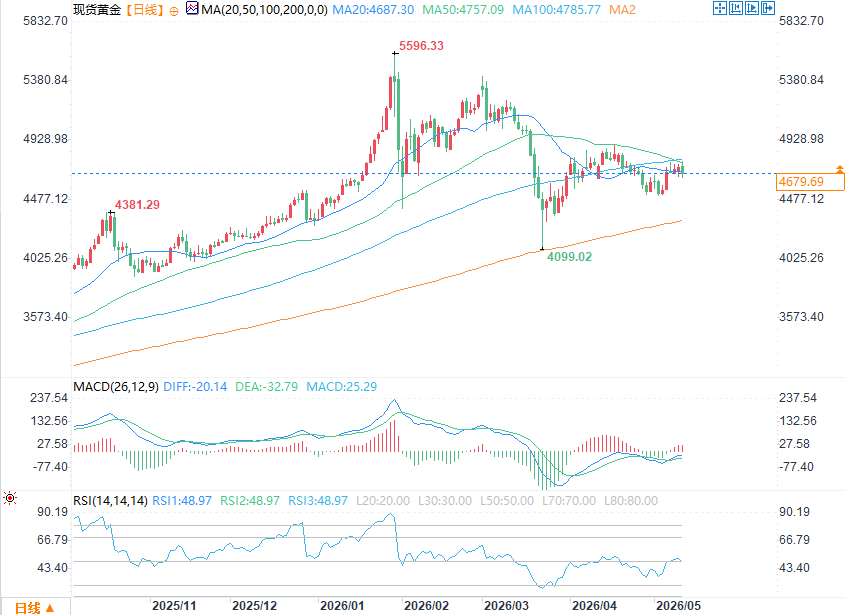
(Spot gold daily chart source: FX678)
From a technical perspective, gold prices have effectively broken through the upper trendline of the multi-week descending channel, completely reversing the medium-term weakness and entering a bullish consolidation pattern. The immediate priority for bulls is to hold the near-term support at $4675 and attempt to retest the resistance zone of $4715 to $4722. If this area is effectively broken and held, gold prices are expected to further test previous highs, opening up new upward potential. Conversely, if $4675 is breached, $4652 will become the next key support level, and the lower trendline of the previous channel will re-enter traders' focus.
For silver, $84.70 is a key short-term support level. After stabilizing above this level, the next targets are $86.00 and $87.26. On the upside, the first resistance level to watch is $85.80, with a further break above that level targeting $87.26. It's worth noting that the gold-silver ratio is currently at a historically high level, approaching 60. Historically, this level suggests that silver has significant upside potential relative to gold, making its medium- to long-term investment value undeniable.
Today, market focus will be on the 10-year US Treasury auction at 1 PM ET, the monthly fiscal budget report at 2 PM ET, and the API crude oil inventory data. The strength of demand at the Treasury auction will directly impact yield trends, thus influencing gold's short-term performance, and is worth close monitoring.
Long-term structure: The bull market logic remains unshaken.
Despite short-term pressure, the medium- to long-term bullish logic for gold has not been fundamentally shaken, and structural support remains solid.
From an institutional perspective, JPMorgan Chase maintains a strong bullish stance on gold prices, believing that combined investor and central bank demand in 2026 is expected to average 585 tons per quarter, a level sufficient to support gold prices towards $5,000 per ounce. The bank even suggests that if only 0.5% of global foreign-held U.S. assets flow into gold, it would be enough to push gold prices to a long-term target of $6,000.
From a demand structure perspective, the global central bank gold-buying trend remains the strongest support for the gold market. In recent years, gold has surpassed US Treasury bonds for the first time to become the world's largest reserve asset, and a 2025 survey shows that 95% of central banks expect global gold reserves to continue growing in 2026. This structural demand is independent of short-term interest rate fluctuations, providing a long-term, rigid price floor for gold.
Furthermore, Western investors' allocation to gold remains relatively low, with gold ETFs accounting for only about 0.17% of US private financial assets, far below the peak levels of the early 2010s. This means that once there is a systemic shift in market risk appetite, the replenishment of positions by both institutional and retail investors will bring significant incremental demand to gold prices.
Market Outlook: Awaiting catalysts, focusing on two main themes
In summary, gold is currently in a tug-of-war pattern, with both short-term pressure and long-term support present. Macroeconomic headwinds will dominate the pace in the short term, but the foundation of the structural bull market remains intact.
Looking ahead, a directional breakout in gold prices depends on the evolution of two main factors: First, marginal changes in expectations regarding Federal Reserve policy. Wednesday's PPI data will be a key verification window. If it exceeds expectations again, the room for interest rate cuts will be further compressed, putting additional pressure on gold in the short term. If the data is moderate, interest rate expectations may see a marginal correction, and gold is expected to regain upward momentum. Second, substantial progress in the Middle East situation. Once there are signs of easing tensions in the Strait of Hormuz, the decline in oil prices will simultaneously release inflationary pressures. At that time, the hedging relationship between geopolitical risk aversion and inflationary paths may be dissolved, and gold's safe-haven attributes will once again dominate.
Before these two variables become clear, gold is likely to maintain a high-level, wide-range fluctuation pattern—with interest rates and a strong dollar as ceilings above, and geopolitical risks and central bank gold purchases as support below. The formation of a one-sided trend still needs to wait for a clearer directional catalyst.
The sharp pullback in silver was within expectations. On Monday, silver futures for the previous month surged over 6%, reaching a near two-month high, with clear short-term overbought signals accumulating. This correction is essentially a technical profit-taking move and does not represent a reversal of the medium-term trend for silver. From a longer-term perspective, the overall upward channel structure for silver remains intact, and this consolidation is more of a healthy correction.
Key pressure: Higher-than-expected CPI, further cooling expectations for interest rate cuts.
The most significant macroeconomic shock of the day came from the US April CPI data. Overall inflation recorded 3.8% year-on-year, significantly higher than the market expectation of 3.7%, further confirming the assessment that inflation is sticky and stubborn. The unexpected nature of this data lies not only in the number itself, but also in the underlying structure—the transmission of energy prices to the consumption end continues, and the downward slope of core inflation has failed to accelerate as the market had hoped.
Following the release of the CPI data, market expectations for the Federal Reserve's rate-cutting path throughout the year have narrowed further. Previously, the market generally anticipated two rate cuts in 2026, but this consensus has now diverged significantly, with some institutions beginning to include "zero rate cuts this year" in their baseline scenario. The waning expectations of rate cuts mean that real interest rates will remain high for a longer period, and real interest rates are one of the most important anchors in gold pricing. The tightening interest rate environment directly weakens the relative attractiveness of gold, a non-interest-bearing asset, making it difficult for bulls to exert further upward pressure at higher levels.
Meanwhile, the US dollar index strengthened in line with interest rate expectations, and the 10-year US Treasury yield held steady around 4.4%. For gold, the combined effect of a strong dollar and high real interest rates constitutes the two heaviest obstacles in the short term.
Geopolitical game: The logic of risk aversion encounters distortion in transmission
Geopolitically, tensions between the US and Iran continue to escalate, with no signs of abating. President Trump explicitly rejected Iran's latest response to the peace talks, characterizing it as "completely unacceptable," casting a further shadow over the prospects of a ceasefire agreement. The ongoing risks to passage through the Strait of Hormuz continue to disrupt global energy supply expectations, with Nymex WTI crude oil prices rising to $101.61 per barrel and Brent crude oil approaching $107.14, clearly demonstrating the tense atmosphere in the energy market.
However, this round of geopolitical risks did not translate into upward momentum for gold as traditionally expected. The main transmission path of the crisis was not to drive a direct influx of funds into gold as a safe haven, but rather to continuously strengthen inflation expectations through rising oil prices, thereby supporting higher nominal interest rates. In short, geopolitical risks have taken a "circumvention" route for gold—the safe-haven premium has been absorbed by the inflationary path, ultimately transforming into interest rate pressure that puts downward pressure on gold prices. This unique internal hedging between safe-haven demand and interest rate suppression has significantly limited the upside potential of gold prices.
Until the situation in Hormuz is substantially eased, high energy prices will continue to fuel inflation, while rising inflation expectations will repeatedly suppress the safe-haven premium of gold, forming a negative cycle that is difficult to break in the short term.
Technical Analysis: Gold has broken out of its downtrend channel, and the bulls have strengthened, leading to an upward trend.
(Spot gold daily chart source: FX678)
From a technical perspective, gold prices have effectively broken through the upper trendline of the multi-week descending channel, completely reversing the medium-term weakness and entering a bullish consolidation pattern. The immediate priority for bulls is to hold the near-term support at $4675 and attempt to retest the resistance zone of $4715 to $4722. If this area is effectively broken and held, gold prices are expected to further test previous highs, opening up new upward potential. Conversely, if $4675 is breached, $4652 will become the next key support level, and the lower trendline of the previous channel will re-enter traders' focus.
For silver, $84.70 is a key short-term support level. After stabilizing above this level, the next targets are $86.00 and $87.26. On the upside, the first resistance level to watch is $85.80, with a further break above that level targeting $87.26. It's worth noting that the gold-silver ratio is currently at a historically high level, approaching 60. Historically, this level suggests that silver has significant upside potential relative to gold, making its medium- to long-term investment value undeniable.
Today, market focus will be on the 10-year US Treasury auction at 1 PM ET, the monthly fiscal budget report at 2 PM ET, and the API crude oil inventory data. The strength of demand at the Treasury auction will directly impact yield trends, thus influencing gold's short-term performance, and is worth close monitoring.
Long-term structure: The bull market logic remains unshaken.
Despite short-term pressure, the medium- to long-term bullish logic for gold has not been fundamentally shaken, and structural support remains solid.
From an institutional perspective, JPMorgan Chase maintains a strong bullish stance on gold prices, believing that combined investor and central bank demand in 2026 is expected to average 585 tons per quarter, a level sufficient to support gold prices towards $5,000 per ounce. The bank even suggests that if only 0.5% of global foreign-held U.S. assets flow into gold, it would be enough to push gold prices to a long-term target of $6,000.
From a demand structure perspective, the global central bank gold-buying trend remains the strongest support for the gold market. In recent years, gold has surpassed US Treasury bonds for the first time to become the world's largest reserve asset, and a 2025 survey shows that 95% of central banks expect global gold reserves to continue growing in 2026. This structural demand is independent of short-term interest rate fluctuations, providing a long-term, rigid price floor for gold.
Furthermore, Western investors' allocation to gold remains relatively low, with gold ETFs accounting for only about 0.17% of US private financial assets, far below the peak levels of the early 2010s. This means that once there is a systemic shift in market risk appetite, the replenishment of positions by both institutional and retail investors will bring significant incremental demand to gold prices.
Market Outlook: Awaiting catalysts, focusing on two main themes
In summary, gold is currently in a tug-of-war pattern, with both short-term pressure and long-term support present. Macroeconomic headwinds will dominate the pace in the short term, but the foundation of the structural bull market remains intact.
Looking ahead, a directional breakout in gold prices depends on the evolution of two main factors: First, marginal changes in expectations regarding Federal Reserve policy. Wednesday's PPI data will be a key verification window. If it exceeds expectations again, the room for interest rate cuts will be further compressed, putting additional pressure on gold in the short term. If the data is moderate, interest rate expectations may see a marginal correction, and gold is expected to regain upward momentum. Second, substantial progress in the Middle East situation. Once there are signs of easing tensions in the Strait of Hormuz, the decline in oil prices will simultaneously release inflationary pressures. At that time, the hedging relationship between geopolitical risk aversion and inflationary paths may be dissolved, and gold's safe-haven attributes will once again dominate.
Before these two variables become clear, gold is likely to maintain a high-level, wide-range fluctuation pattern—with interest rates and a strong dollar as ceilings above, and geopolitical risks and central bank gold purchases as support below. The formation of a one-sided trend still needs to wait for a clearer directional catalyst.
- Risk Warning and Disclaimer
- The market involves risk, and trading may not be suitable for all investors. This article is for reference only and does not constitute personal investment advice, nor does it take into account certain users’ specific investment objectives, financial situation, or other needs. Any investment decisions made based on this information are at your own risk.