One chart: The Baltic Dry Index rises, benefiting all shipping sectors.
2026-05-12 23:36:21
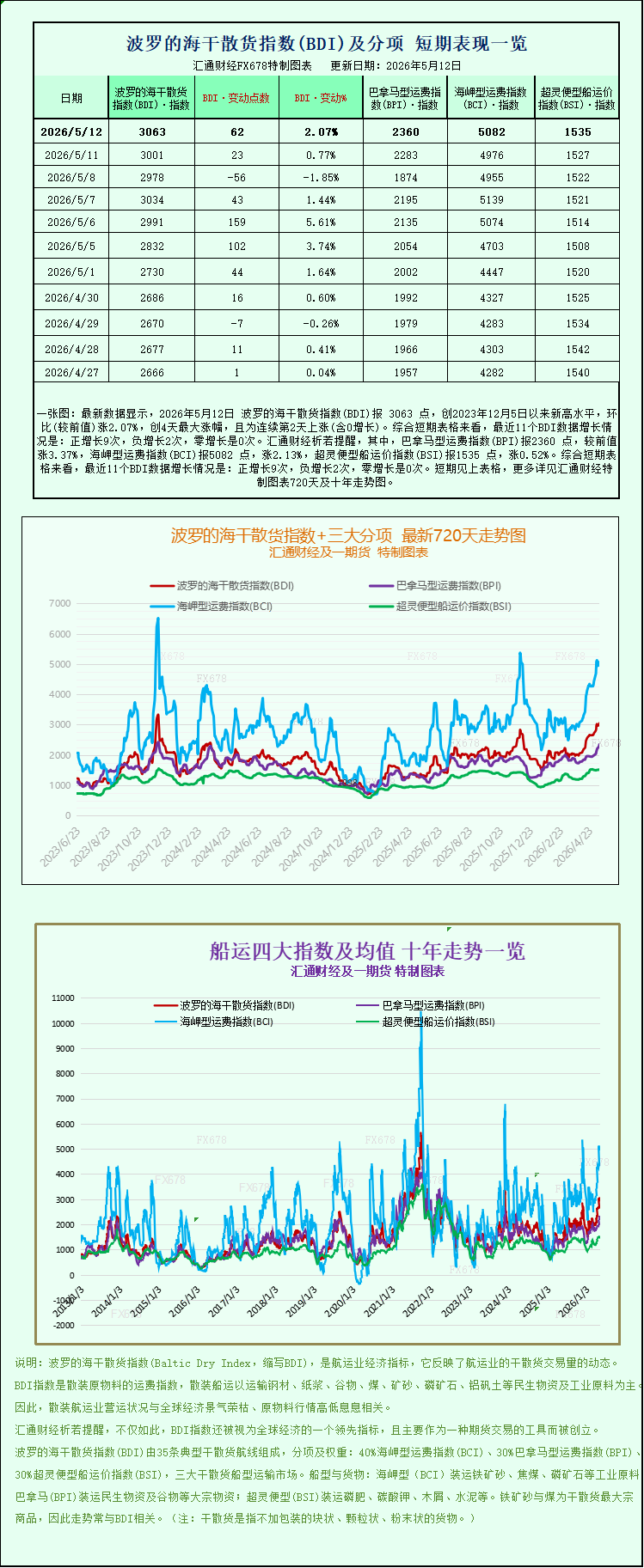
Latest data shows that on May 12, 2026, the Baltic Dry Index (BDI) reached 3063 points, a new high since December 5, 2023, up 2.07% month-on-month, marking the largest increase in four days and the second consecutive day of increase (including zero growth). Looking at the short-term charts, the recent 11 BDI data points show: 9 positive increases, 2 negative increases, and 0 zero increases. Specifically, the Panamax Freight Index (BPI) was 2360 points, up 3.37% from the previous value; the Capesize Freight Index (BCI) was 5082 points, up 2.13%; and the Supramax Freight Index (BSI) was 1535 points, up 0.52%. For detailed 720-day and 10-year trend charts of the Baltic Dry Index and its three main sub-indices, please refer to the specially designed charts.
The Baltic Dry Index, published by the London Stock Exchange, saw a significant increase on Tuesday. This key shipping indicator shows a comprehensive positive trend, with freight rates rising across all core dry bulk vessel types, including Capesize, Panamax, and Supramax. This directly benefits the global shipping sector as a whole, demonstrating the current recovery vitality of the dry bulk shipping market.
As an authoritative index for measuring international dry bulk shipping prices, the Baltic Dry Index directly reflects the shipping costs of industrial raw materials and consumer goods such as grains, coal, and iron ore worldwide, and its changes are an important indicator of the global trade climate.
Among them, the Baltic Dry Index, which tracks freight rates for the three core vessel types of Capesize, Panamax and Supramax, performed well, rising 62 points, or 2.1%, to close at 3,063 points.
The index is published daily by the London Baltic Exchange and is calculated based on a weighted average of freight rates on 20 representative global shipping routes, covering core trade routes for the three main vessel types. Its rise directly reflects the overall recovery in demand in the global dry bulk shipping market.
Specifically, the Capesize index also rose, gaining 106 points, or 2.1%, to close at 5,082 points.
Capesize vessels, as a large type of ship in dry bulk shipping, are mainly used to transport bulk industrial raw materials such as iron ore and coal. The deadweight of a single ship is usually over 80,000 tons. They are named after the Cape of Good Hope or Cape Horn because their huge size prevents them from passing through the Suez Canal.
Correspondingly, Capesize vessels carrying 150,000 tons of cargo (mainly including core industrial raw materials such as iron ore and coal) saw their average daily revenue increase by $958, eventually reaching $42,588, resulting in a significant improvement in shipowner profitability.
It is worth noting that although Capesize freight rates and daily earnings rose in tandem, iron ore futures prices corrected on Tuesday, ending a six-day winning streak.
It is understood that this fluctuation is mainly due to market changes in China, the world's largest consumer of iron ore. Currently, China's iron ore inventory is at a high level, and the market is under great pressure to digest it. At the same time, domestic blast furnaces are operating at near full capacity, which has slowed down the new demand for iron ore, thus affecting short-term iron ore transportation expectations.
In the medium-sized vessel category, the Panamax index performed even better, rising 77 points, or 3.4%, to close at 2,360 points, making it the best-performing sub-category index of the day.
Panamax vessels, with a deadweight tonnage between 60,000 and 70,000 tons, can pass smoothly through the Panama Canal and the Suez Canal. They are the main type of vessel for long-haul dry bulk shipping worldwide, mainly carrying bulk commodities such as coal and grain, and their route network covers major trade regions around the world.
Correspondingly, the average daily revenue of Panamax vessels also increased, with an increase of US$693.
The Baltic Dry Index, published by the London Stock Exchange, saw a significant increase on Tuesday. This key shipping indicator shows a comprehensive positive trend, with freight rates rising across all core dry bulk vessel types, including Capesize, Panamax, and Supramax. This directly benefits the global shipping sector as a whole, demonstrating the current recovery vitality of the dry bulk shipping market.
As an authoritative index for measuring international dry bulk shipping prices, the Baltic Dry Index directly reflects the shipping costs of industrial raw materials and consumer goods such as grains, coal, and iron ore worldwide, and its changes are an important indicator of the global trade climate.
Among them, the Baltic Dry Index, which tracks freight rates for the three core vessel types of Capesize, Panamax and Supramax, performed well, rising 62 points, or 2.1%, to close at 3,063 points.
The index is published daily by the London Baltic Exchange and is calculated based on a weighted average of freight rates on 20 representative global shipping routes, covering core trade routes for the three main vessel types. Its rise directly reflects the overall recovery in demand in the global dry bulk shipping market.
Specifically, the Capesize index also rose, gaining 106 points, or 2.1%, to close at 5,082 points.
Capesize vessels, as a large type of ship in dry bulk shipping, are mainly used to transport bulk industrial raw materials such as iron ore and coal. The deadweight of a single ship is usually over 80,000 tons. They are named after the Cape of Good Hope or Cape Horn because their huge size prevents them from passing through the Suez Canal.
Correspondingly, Capesize vessels carrying 150,000 tons of cargo (mainly including core industrial raw materials such as iron ore and coal) saw their average daily revenue increase by $958, eventually reaching $42,588, resulting in a significant improvement in shipowner profitability.
It is worth noting that although Capesize freight rates and daily earnings rose in tandem, iron ore futures prices corrected on Tuesday, ending a six-day winning streak.
It is understood that this fluctuation is mainly due to market changes in China, the world's largest consumer of iron ore. Currently, China's iron ore inventory is at a high level, and the market is under great pressure to digest it. At the same time, domestic blast furnaces are operating at near full capacity, which has slowed down the new demand for iron ore, thus affecting short-term iron ore transportation expectations.
In the medium-sized vessel category, the Panamax index performed even better, rising 77 points, or 3.4%, to close at 2,360 points, making it the best-performing sub-category index of the day.
Panamax vessels, with a deadweight tonnage between 60,000 and 70,000 tons, can pass smoothly through the Panama Canal and the Suez Canal. They are the main type of vessel for long-haul dry bulk shipping worldwide, mainly carrying bulk commodities such as coal and grain, and their route network covers major trade regions around the world.
Correspondingly, the average daily revenue of Panamax vessels also increased, with an increase of US$693.
- Risk Warning and Disclaimer
- The market involves risk, and trading may not be suitable for all investors. This article is for reference only and does not constitute personal investment advice, nor does it take into account certain users’ specific investment objectives, financial situation, or other needs. Any investment decisions made based on this information are at your own risk.