Gold prices remained range-bound as expectations of a hawkish stance from the Federal Reserve strengthened.
2026-05-13 10:05:21
International gold prices remained range-bound during Asian trading hours on Wednesday, with spot gold (XAU/USD) trading around $4720. Despite persistent geopolitical risks, unexpectedly strong US inflation data led to a readjustment of market expectations for the Federal Reserve's monetary policy, putting downward pressure on gold prices in the short term. Data released by the US Bureau of Labor Statistics on Tuesday showed that the US Consumer Price Index (CPI) rose to 3.8% year-on-year in April, higher than the previous reading of 3.3% and exceeding market expectations of 3.7%, reaching its highest level since May 2023. This indicates that inflationary pressures in the US remain persistent, particularly in the service sector and housing costs.

From a monthly perspective, the US overall CPI rose 0.6% in April, in line with market expectations, but still indicating that price levels are maintaining a relatively rapid growth pace. Meanwhile, the core CPI, excluding food and energy prices, rose 0.4% month-on-month, reaching an annual rate of 2.8% , indicating that core inflation has not cooled significantly. Influenced by the inflation data, the market is repricing its expectations for the Federal Reserve's policy path. According to the CME FedWatch tool, traders have raised the probability of another Fed rate hike this year to approximately 30% . As a result, US Treasury yields have remained high, and the US dollar index has also received support.
Gold, as a traditional safe-haven asset, typically attracts capital during periods of heightened geopolitical risk. However, gold itself does not offer interest income, thus its appeal tends to diminish in a high-interest-rate environment. The current market is in a balancing act between "safe-haven demand" and "high-interest-rate pressure," which is a key reason for the recent high-level fluctuations in gold prices. Some precious metals analysts suggest that the resurgence of US inflation means the Federal Reserve is unlikely to shift to an easing policy in the short term, and the high-interest-rate environment may limit gold's ability to further break through historical highs.
Meanwhile, the situation in the Middle East continues to provide potential support for the gold market. As the risks associated with shipping through the Strait of Hormuz have not been fully eliminated, the market remains wary of global energy supply and inflation risks. Against this backdrop, some funds continue to allocate to gold to hedge against global market uncertainty.
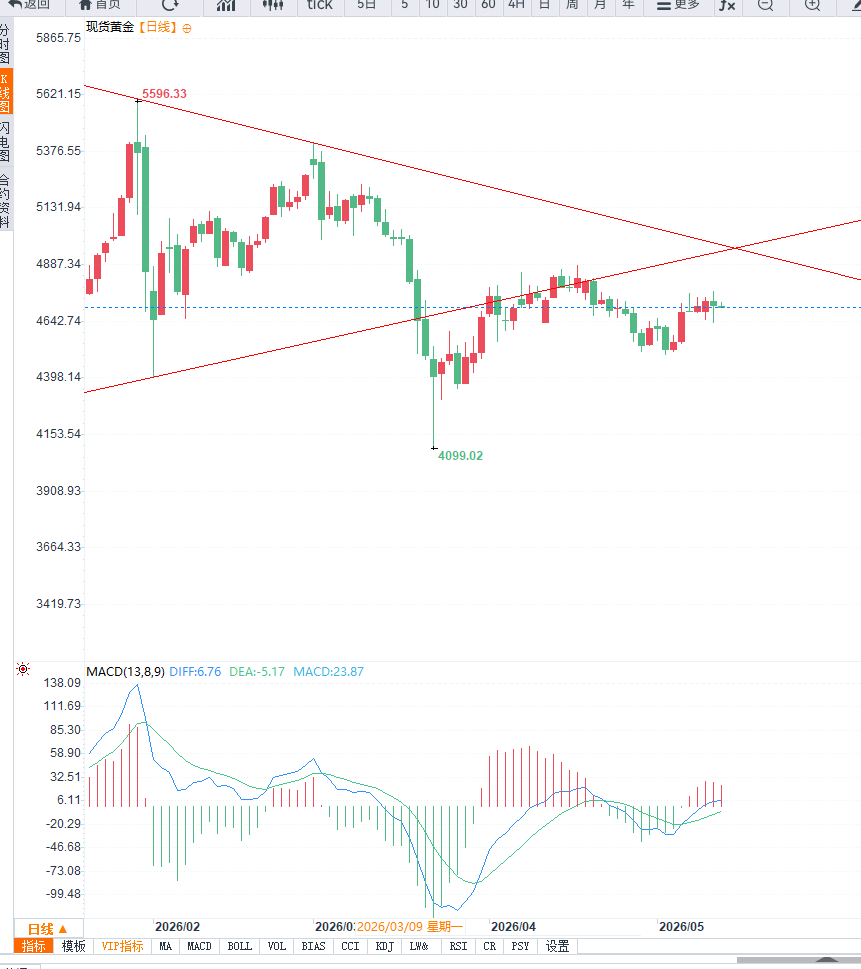
From a technical perspective, the daily chart for gold maintains a clear bullish trend. The current price remains above major moving averages, indicating that the medium- to long-term uptrend has not been broken. Gold is currently hovering around $4710, above the 50-day EMA, showing that overall market buying support remains solid. However, after the recent rapid rise in gold prices, which have entered a high-level area, technical indicators are beginning to show signs of slowing momentum. The Stochastic Relative Strength Index (SRSI) is gradually declining, indicating some profit-taking pressure in the short term.
Initial support is around $4680; a break below this level could lead to a further test of the $4600 area. On the upside, the $4750-$4800 area will be a significant technical resistance level at this stage. Looking at the 4-hour chart, gold is currently consolidating at higher levels, with short-term volatility gradually narrowing. The market is awaiting US PPI data and subsequent policy signals from the Federal Reserve. If the PPI data continues to exceed expectations, US Treasury yields may rise further, thus limiting the upside potential of gold.
However, if geopolitical risks escalate again, or market risk aversion intensifies rapidly, gold may regain buying momentum and continue to challenge historical highs. Overall, the core logic of the gold market is gradually shifting from simple safe-haven demand to a dynamic balance between "high interest rate suppression" and "global uncertainty support."
Editor's Summary : The gold market is currently at a critical juncture, balancing macroeconomic interest rate pressures and safe-haven demand. Better-than-expected US inflation data has reinforced market expectations that the Federal Reserve will maintain high interest rates or even raise them further, putting significant pressure on gold. However, at the same time, uncertainties surrounding the Middle East situation, global energy risks, and international relations continue to provide support for gold. The key to future market trends will depend on subsequent US inflation data, the Federal Reserve's policy stance, and changes in global risk sentiment. If US inflation remains high, gold may face short-term pressure for high-level fluctuations or even a correction; however, if geopolitical risks escalate further, gold's attractiveness as a safe-haven asset could still drive prices to remain strong.
From a monthly perspective, the US overall CPI rose 0.6% in April, in line with market expectations, but still indicating that price levels are maintaining a relatively rapid growth pace. Meanwhile, the core CPI, excluding food and energy prices, rose 0.4% month-on-month, reaching an annual rate of 2.8% , indicating that core inflation has not cooled significantly. Influenced by the inflation data, the market is repricing its expectations for the Federal Reserve's policy path. According to the CME FedWatch tool, traders have raised the probability of another Fed rate hike this year to approximately 30% . As a result, US Treasury yields have remained high, and the US dollar index has also received support.
Gold, as a traditional safe-haven asset, typically attracts capital during periods of heightened geopolitical risk. However, gold itself does not offer interest income, thus its appeal tends to diminish in a high-interest-rate environment. The current market is in a balancing act between "safe-haven demand" and "high-interest-rate pressure," which is a key reason for the recent high-level fluctuations in gold prices. Some precious metals analysts suggest that the resurgence of US inflation means the Federal Reserve is unlikely to shift to an easing policy in the short term, and the high-interest-rate environment may limit gold's ability to further break through historical highs.
Meanwhile, the situation in the Middle East continues to provide potential support for the gold market. As the risks associated with shipping through the Strait of Hormuz have not been fully eliminated, the market remains wary of global energy supply and inflation risks. Against this backdrop, some funds continue to allocate to gold to hedge against global market uncertainty.
From a technical perspective, the daily chart for gold maintains a clear bullish trend. The current price remains above major moving averages, indicating that the medium- to long-term uptrend has not been broken. Gold is currently hovering around $4710, above the 50-day EMA, showing that overall market buying support remains solid. However, after the recent rapid rise in gold prices, which have entered a high-level area, technical indicators are beginning to show signs of slowing momentum. The Stochastic Relative Strength Index (SRSI) is gradually declining, indicating some profit-taking pressure in the short term.
Initial support is around $4680; a break below this level could lead to a further test of the $4600 area. On the upside, the $4750-$4800 area will be a significant technical resistance level at this stage. Looking at the 4-hour chart, gold is currently consolidating at higher levels, with short-term volatility gradually narrowing. The market is awaiting US PPI data and subsequent policy signals from the Federal Reserve. If the PPI data continues to exceed expectations, US Treasury yields may rise further, thus limiting the upside potential of gold.
However, if geopolitical risks escalate again, or market risk aversion intensifies rapidly, gold may regain buying momentum and continue to challenge historical highs. Overall, the core logic of the gold market is gradually shifting from simple safe-haven demand to a dynamic balance between "high interest rate suppression" and "global uncertainty support."
Editor's Summary : The gold market is currently at a critical juncture, balancing macroeconomic interest rate pressures and safe-haven demand. Better-than-expected US inflation data has reinforced market expectations that the Federal Reserve will maintain high interest rates or even raise them further, putting significant pressure on gold. However, at the same time, uncertainties surrounding the Middle East situation, global energy risks, and international relations continue to provide support for gold. The key to future market trends will depend on subsequent US inflation data, the Federal Reserve's policy stance, and changes in global risk sentiment. If US inflation remains high, gold may face short-term pressure for high-level fluctuations or even a correction; however, if geopolitical risks escalate further, gold's attractiveness as a safe-haven asset could still drive prices to remain strong.
- Risk Warning and Disclaimer
- The market involves risk, and trading may not be suitable for all investors. This article is for reference only and does not constitute personal investment advice, nor does it take into account certain users’ specific investment objectives, financial situation, or other needs. Any investment decisions made based on this information are at your own risk.