The US dollar is holding above the 98 mark! The Warsh fund is poised to turn positive this week, while Morgan Stanley is predicting a drop to 95.
2026-05-13 11:35:13
Kevin Warsh is expected to be formally confirmed as Chairman of the Federal Reserve this week. He has previously signaled a willingness to cut interest rates—whether due to the president's wishes or his belief that the current economic situation necessitates it. However, this is not entirely his decision, and the market has gradually lost confidence in the effectiveness of this policy. But the bigger question is: even if rates are cut, will it truly be effective?
The U.S. economy is less sensitive to interest rates than it once was. The long-term shift in economic structure from manufacturing (significantly affected by high borrowing costs) to services (which are less sensitive to interest rates) has weakened one of the Federal Reserve's most powerful policy levers. Meanwhile, the ultra-wealthy, with their soaring spending, are not concerned about the cost of capital; similarly, the tech companies driving the AI boom are equally insensitive—they see AI as a crucial, unmissable opportunity.
Guggenheim macro investment expert Anne Walsh points out, "Most of the economic models we use today...were designed in a completely different economic era. I think they are outdated." This explains why the Federal Reserve's traditional policy toolbox is facing limitations in dealing with current inflation.
Another obstacle to policy transmission is that the Federal Reserve can only control overnight rates, not the true long-term cost of capital in the real economy. Both pessimistic expectations of inflation and optimistic expectations of growth have led to long-term borrowing costs exceeding what should be expected after six rate cuts.
Meanwhile, as journalist Joe Wesenthal has pointed out, the current economy is being driven by supply shocks—which central banks cannot control—rather than demand shocks that they can address. The Iran war is impacting oil supply, artificial intelligence is impacting knowledge supply, and the Trump administration is impacting expectations of certainty. The combined effect of these three factors significantly diminishes the effectiveness of central bank policies, and interest rate tools are experiencing diminishing marginal returns.
Data from the Federal Reserve itself also shows that current financial conditions are even looser than when interest rate hikes began 38 months ago, meaning it is easier (even if not cheaper) for people to borrow money to start a business, build a factory, or leverage their investments in stocks.
Against this backdrop, Warsh's appointment becomes an intriguing choice. Guggenheim's Warsh commented, "He's more like a monetarist." Warsh prioritizes the availability of funds over their cost. He has stated that shrinking the Federal Reserve's balance sheet and "keeping the printing press quiet"—a criticism of bipartisan stimulus advocates—is just as important as interest rate policy. Furthermore, it's a more politically viable path, as quantitative tightening is unlikely to provoke the same fierce reaction from the White House as refusing to cut interest rates.
Walsh concluded that his "view on monetary policy differs from Powell's and even previous chairmen's," and that interest rates "are at best a crude tool, insufficient to address the more complex economic situation we face today."
Overall, as Warsh took over as Federal Reserve Chairman, the effectiveness of traditional interest rate tools faced unprecedented challenges. Economic structural changes, supply shocks, and impaired policy transmission all contributed to weakening the Fed's control over the real economy. Warsh's monetarist tendencies, focusing more on money supply than interest rates, may signify a significant shift in the Fed's policy paradigm. In the future, quantitative tightening and balance sheet management may be more worthy of market attention than interest rate adjustments themselves.
As of press time on May 13, the US dollar index was trading around 98.32, up slightly by 0.03% on the day. The index reached a high of 98.36 and a low of 98.26 during the session, with a range of only 0.1%, indicating that the market is in a typical narrow range trading pattern, with bulls and bears temporarily reaching a balance at key levels.
The current price of 98.32 is below all major medium- and long-term moving averages, especially the 20-day moving average (MA20) (98.34), which has now become near-term resistance. This means that short-term bears still hold a technical advantage. However, the price is not far from the moving average system and is not far from the 100-day moving average (MA100) (98.46) and the 200-day moving average (MA200) (98.52), so there is still room for a rebound if there is a positive catalyst. The 50-day moving average (MA50) (98.99) is near the 99 level, forming a key medium-term resistance level; while the previous low of 96.90 provides strong support.
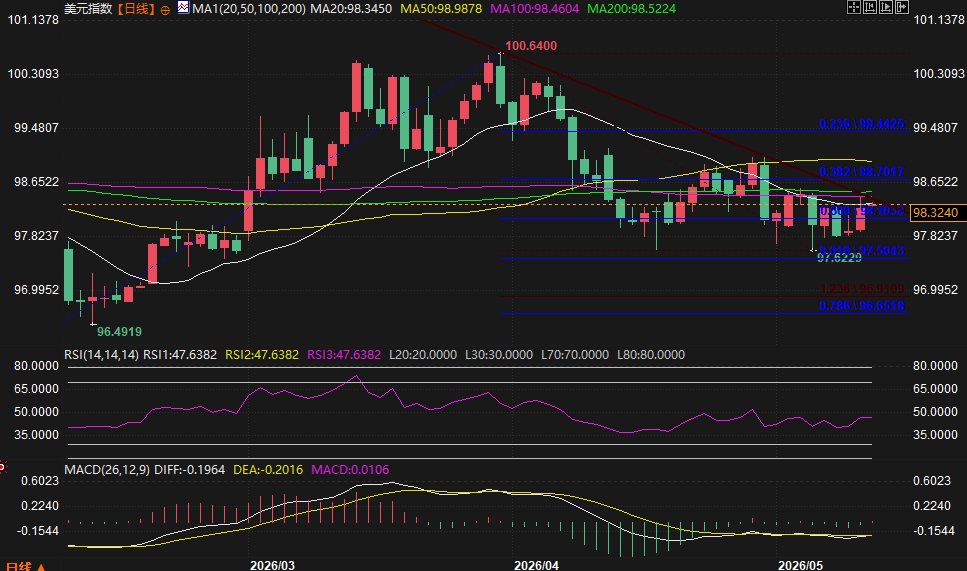
(US Dollar Index Daily Chart, Source: FX678)
Morgan Stanley has completely reversed its stance on the US dollar in its recent G10 FX strategy report, downgrading its position on the US dollar index from neutral to bearish to "outright bearish," with a target of falling to 95 in the coming months. The bank characterizes this expected decline as cyclical rather than structural, with limited magnitude and duration.
ING points out that the US dollar is benefiting from the Federal Reserve's hawkish narrative, and the market has begun pricing in a slight tightening in 2026. High oil prices and Gulf tensions continue to support short-term US Treasury yields, and the Fed's focus is shifting towards price stability. ING expects the US dollar index to rise to the 99.00-99.50 range.
At 11:34 AM Beijing time on May 13, the US dollar index was at 98.30.
The US economy has become significantly less sensitive to interest rates.
The U.S. economy is less sensitive to interest rates than it once was. The long-term shift in economic structure from manufacturing (significantly affected by high borrowing costs) to services (which are less sensitive to interest rates) has weakened one of the Federal Reserve's most powerful policy levers. Meanwhile, the ultra-wealthy, with their soaring spending, are not concerned about the cost of capital; similarly, the tech companies driving the AI boom are equally insensitive—they see AI as a crucial, unmissable opportunity.
Guggenheim macro investment expert Anne Walsh points out, "Most of the economic models we use today...were designed in a completely different economic era. I think they are outdated." This explains why the Federal Reserve's traditional policy toolbox is facing limitations in dealing with current inflation.
Policy transmission mechanisms fail, and supply shocks dominate economic fluctuations.
Another obstacle to policy transmission is that the Federal Reserve can only control overnight rates, not the true long-term cost of capital in the real economy. Both pessimistic expectations of inflation and optimistic expectations of growth have led to long-term borrowing costs exceeding what should be expected after six rate cuts.
Meanwhile, as journalist Joe Wesenthal has pointed out, the current economy is being driven by supply shocks—which central banks cannot control—rather than demand shocks that they can address. The Iran war is impacting oil supply, artificial intelligence is impacting knowledge supply, and the Trump administration is impacting expectations of certainty. The combined effect of these three factors significantly diminishes the effectiveness of central bank policies, and interest rate tools are experiencing diminishing marginal returns.
Warsh's unique perspective: focusing more on money supply than interest rates
Data from the Federal Reserve itself also shows that current financial conditions are even looser than when interest rate hikes began 38 months ago, meaning it is easier (even if not cheaper) for people to borrow money to start a business, build a factory, or leverage their investments in stocks.
Against this backdrop, Warsh's appointment becomes an intriguing choice. Guggenheim's Warsh commented, "He's more like a monetarist." Warsh prioritizes the availability of funds over their cost. He has stated that shrinking the Federal Reserve's balance sheet and "keeping the printing press quiet"—a criticism of bipartisan stimulus advocates—is just as important as interest rate policy. Furthermore, it's a more politically viable path, as quantitative tightening is unlikely to provoke the same fierce reaction from the White House as refusing to cut interest rates.
Walsh concluded that his "view on monetary policy differs from Powell's and even previous chairmen's," and that interest rates "are at best a crude tool, insufficient to address the more complex economic situation we face today."
Interest rate cuts are no longer a panacea; Walsh may bring about a policy paradigm shift.
Overall, as Warsh took over as Federal Reserve Chairman, the effectiveness of traditional interest rate tools faced unprecedented challenges. Economic structural changes, supply shocks, and impaired policy transmission all contributed to weakening the Fed's control over the real economy. Warsh's monetarist tendencies, focusing more on money supply than interest rates, may signify a significant shift in the Fed's policy paradigm. In the future, quantitative tightening and balance sheet management may be more worthy of market attention than interest rate adjustments themselves.
The US dollar index is currently holding above 98, with Morgan Stanley bearish on it to 95 and ING targeting 99-99.50.
As of press time on May 13, the US dollar index was trading around 98.32, up slightly by 0.03% on the day. The index reached a high of 98.36 and a low of 98.26 during the session, with a range of only 0.1%, indicating that the market is in a typical narrow range trading pattern, with bulls and bears temporarily reaching a balance at key levels.
The current price of 98.32 is below all major medium- and long-term moving averages, especially the 20-day moving average (MA20) (98.34), which has now become near-term resistance. This means that short-term bears still hold a technical advantage. However, the price is not far from the moving average system and is not far from the 100-day moving average (MA100) (98.46) and the 200-day moving average (MA200) (98.52), so there is still room for a rebound if there is a positive catalyst. The 50-day moving average (MA50) (98.99) is near the 99 level, forming a key medium-term resistance level; while the previous low of 96.90 provides strong support.
(US Dollar Index Daily Chart, Source: FX678)
Morgan Stanley has completely reversed its stance on the US dollar in its recent G10 FX strategy report, downgrading its position on the US dollar index from neutral to bearish to "outright bearish," with a target of falling to 95 in the coming months. The bank characterizes this expected decline as cyclical rather than structural, with limited magnitude and duration.
ING points out that the US dollar is benefiting from the Federal Reserve's hawkish narrative, and the market has begun pricing in a slight tightening in 2026. High oil prices and Gulf tensions continue to support short-term US Treasury yields, and the Fed's focus is shifting towards price stability. ING expects the US dollar index to rise to the 99.00-99.50 range.
At 11:34 AM Beijing time on May 13, the US dollar index was at 98.30.
- Risk Warning and Disclaimer
- The market involves risk, and trading may not be suitable for all investors. This article is for reference only and does not constitute personal investment advice, nor does it take into account certain users’ specific investment objectives, financial situation, or other needs. Any investment decisions made based on this information are at your own risk.