Institutions: Rising oil prices and inflation caused gold prices to plummet by 12%, but are expected to reach $5,000 by the end of the year.
2026-05-13 11:37:10
Since the outbreak of the conflict between the US and Iran, international gold prices have fallen by about 12%, and the market has questioned whether gold's safe-haven properties have failed.
Ewa Manthey, a commodities strategist at ING, points out that the recent decline in gold prices is not due to a collapse in gold's safe-haven function, but rather a result of a macroeconomic chain reaction triggered by oil prices. Energy shocks pushing up inflation, a stronger dollar, and rising US Treasury yields have all contributed to suppressing gold prices; however, continued gold purchases by global central banks and the return of funds to ETFs have created bottom support. Coupled with expectations of a Fed rate cut in the second half of the year, the medium- to long-term upward trend for gold remains unchanged, and institutions are optimistic that gold prices will reach the $5,000 mark by the end of the year.
Mantey stated that gold's safe-haven advantage typically becomes apparent during financial crises and periods of slowing economic growth. In such environments, lower real yields and a weaker dollar are most conducive to rising gold prices. However, the current energy price shock, driven by the supply side, presents the opposite scenario. Soaring oil prices have raised inflation, forcing central banks to maintain high interest rates, while the dollar has strengthened simultaneously. These multiple factors have put downward pressure on gold. Furthermore, ample liquidity in the gold market has made it a target for investors to liquidate losses from other investments, further amplifying the pullback.
She reviewed market performance during the Russia-Ukraine conflict in 2022, noting that gold prices briefly surged in the initial stages of geopolitical risk, but subsequent energy price increases pushed up US Treasury yields and the US dollar index, gradually putting downward pressure on gold prices. The current US-Iran conflict exhibits a highly similar market logic, with a faster price adjustment, indicating a typical macroeconomic-driven trend rather than a weakening of gold's safe-haven status.
Gold is currently facing a confluence of negative factors. The Federal Reserve kept interest rates unchanged in April, and Fed Chairman Jerome Powell's statements were cautious. The US-Iran conflict has fueled renewed inflation, significantly cooling market expectations for short-term rate cuts. While institutional economists still predict rate cuts in the second half of the year, the timing may be delayed if energy tensions persist. Real yields and a strong dollar remain the core factors limiting gold price increases.
Gold prices gave back earlier gains after US President Trump rejected Iran's latest peace proposal. The failure of geopolitical ceasefire expectations has kept inflation risks high, reinforcing the market consensus that interest rates will remain high for a longer period.
The latest US employment data was robust, with continued job growth and a stable unemployment rate. The Federal Reserve lacks a reason to cut interest rates immediately, and in the short term, US Treasury yields and the US dollar will continue to suppress gold prices. This week's inflation data will further solidify the Fed's cautious policy stance, and coupled with Powell's term expiring this week, the Fed's future policy direction will become increasingly uncertain.
Despite short-term downward pressure on gold prices, continued demand for gold from global central banks is providing solid support to the market.
Central banks in major Asian countries increased their gold holdings again in April, marking the highest monthly increase since December 2024. This marks the 15th consecutive month of gold purchases, with total reserves steadily climbing. Global central banks generally maintained a net purchase stance in the first quarter. Turkey moderately reduced its gold holdings to replenish foreign exchange liquidity, while countries like Poland continued to steadily increase their reserves. The demand for diversified reserve allocation is a long-term positive factor for gold.
Positive changes have also emerged in the funding landscape. Following the outbreak of the US-Iran conflict, gold ETFs experienced continuous outflows, but in April, global gold ETFs saw net inflows, with European funds leading the return, highlighting market concerns about shipping risks in the Strait of Hormuz. Current ETF holdings remain far below historical peaks, indicating significant room for further increases. Furthermore, speculative institutions maintain a stable investment sentiment, without exhibiting excessively pessimistic one-sided bets.
ING remains optimistic about the medium- to long-term outlook for gold. While the stalemate in US-Iran talks brings short-term uncertainty, the upward path for gold prices is clear, requiring three conditions to be met: a decline in energy prices, cooling inflation, and a Fed rate cut in the second half of the year. Continued central bank gold purchases and ETF inflows will provide additional support. Analysts predict that international gold prices could reach $5,000 per ounce by the end of the year. The biggest downside risk lies in the continued geopolitical stalemate and persistently high energy prices, forcing the Fed to maintain interest rates unchanged throughout the year.
Manteh emphasized that short-term gold price fluctuations are dominated by real yields, the strength of the US dollar, and expectations of Federal Reserve policies. However, the underlying logic of gold as a safe haven and hedge against inflation remains unchanged. Once macroeconomic headwinds gradually subside, gold's own supporting forces will once again dominate market trends.
Overall, the 12% pullback in gold prices is a result of the combined effects of energy shocks, a stronger dollar, and a high-interest-rate environment, rather than a failure of its safe-haven appeal. In the short term, gold is subject to fluctuations and adjustments due to inflation, Federal Reserve policy, and geopolitical tensions, but continued gold hoarding by global central banks and marginal improvements in capital flows provide bottom support. As inflation subsequently declines and expectations of interest rate cuts in the second half of the year take hold, the medium- to long-term upward trend for gold remains unchanged, with the potential to reach new highs by the end of the year.
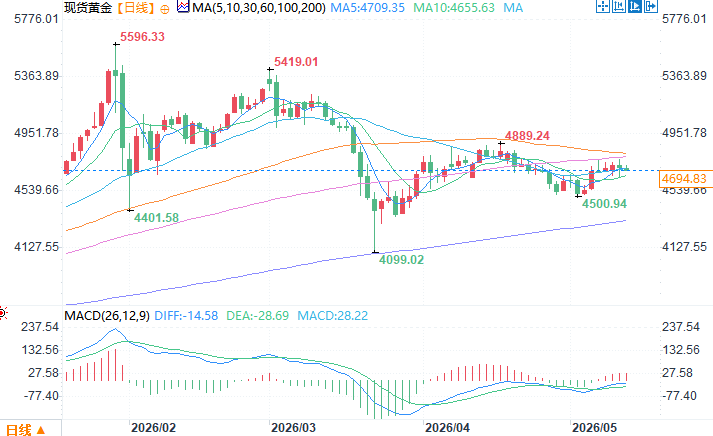
Spot gold daily chart source: EasyForex
At 11:36 AM Beijing time on May 13, spot gold was trading at $4704.33 per ounce.
Ewa Manthey, a commodities strategist at ING, points out that the recent decline in gold prices is not due to a collapse in gold's safe-haven function, but rather a result of a macroeconomic chain reaction triggered by oil prices. Energy shocks pushing up inflation, a stronger dollar, and rising US Treasury yields have all contributed to suppressing gold prices; however, continued gold purchases by global central banks and the return of funds to ETFs have created bottom support. Coupled with expectations of a Fed rate cut in the second half of the year, the medium- to long-term upward trend for gold remains unchanged, and institutions are optimistic that gold prices will reach the $5,000 mark by the end of the year.
The decline in gold prices has a unique logic and does not indicate a failure of its safe-haven attribute.
Mantey stated that gold's safe-haven advantage typically becomes apparent during financial crises and periods of slowing economic growth. In such environments, lower real yields and a weaker dollar are most conducive to rising gold prices. However, the current energy price shock, driven by the supply side, presents the opposite scenario. Soaring oil prices have raised inflation, forcing central banks to maintain high interest rates, while the dollar has strengthened simultaneously. These multiple factors have put downward pressure on gold. Furthermore, ample liquidity in the gold market has made it a target for investors to liquidate losses from other investments, further amplifying the pullback.
She reviewed market performance during the Russia-Ukraine conflict in 2022, noting that gold prices briefly surged in the initial stages of geopolitical risk, but subsequent energy price increases pushed up US Treasury yields and the US dollar index, gradually putting downward pressure on gold prices. The current US-Iran conflict exhibits a highly similar market logic, with a faster price adjustment, indicating a typical macroeconomic-driven trend rather than a weakening of gold's safe-haven status.
Multiple headwinds are suppressing gold prices; Federal Reserve policy becomes a key variable.
Gold is currently facing a confluence of negative factors. The Federal Reserve kept interest rates unchanged in April, and Fed Chairman Jerome Powell's statements were cautious. The US-Iran conflict has fueled renewed inflation, significantly cooling market expectations for short-term rate cuts. While institutional economists still predict rate cuts in the second half of the year, the timing may be delayed if energy tensions persist. Real yields and a strong dollar remain the core factors limiting gold price increases.
Gold prices gave back earlier gains after US President Trump rejected Iran's latest peace proposal. The failure of geopolitical ceasefire expectations has kept inflation risks high, reinforcing the market consensus that interest rates will remain high for a longer period.
The latest US employment data was robust, with continued job growth and a stable unemployment rate. The Federal Reserve lacks a reason to cut interest rates immediately, and in the short term, US Treasury yields and the US dollar will continue to suppress gold prices. This week's inflation data will further solidify the Fed's cautious policy stance, and coupled with Powell's term expiring this week, the Fed's future policy direction will become increasingly uncertain.
The central bank's gold purchases have provided a floor for market liquidity, and market fund flows are showing signs of marginal recovery.
Despite short-term downward pressure on gold prices, continued demand for gold from global central banks is providing solid support to the market.
Central banks in major Asian countries increased their gold holdings again in April, marking the highest monthly increase since December 2024. This marks the 15th consecutive month of gold purchases, with total reserves steadily climbing. Global central banks generally maintained a net purchase stance in the first quarter. Turkey moderately reduced its gold holdings to replenish foreign exchange liquidity, while countries like Poland continued to steadily increase their reserves. The demand for diversified reserve allocation is a long-term positive factor for gold.
Positive changes have also emerged in the funding landscape. Following the outbreak of the US-Iran conflict, gold ETFs experienced continuous outflows, but in April, global gold ETFs saw net inflows, with European funds leading the return, highlighting market concerns about shipping risks in the Strait of Hormuz. Current ETF holdings remain far below historical peaks, indicating significant room for further increases. Furthermore, speculative institutions maintain a stable investment sentiment, without exhibiting excessively pessimistic one-sided bets.
Institutions are optimistic about the market outlook and set a year-end target of $5,000.
ING remains optimistic about the medium- to long-term outlook for gold. While the stalemate in US-Iran talks brings short-term uncertainty, the upward path for gold prices is clear, requiring three conditions to be met: a decline in energy prices, cooling inflation, and a Fed rate cut in the second half of the year. Continued central bank gold purchases and ETF inflows will provide additional support. Analysts predict that international gold prices could reach $5,000 per ounce by the end of the year. The biggest downside risk lies in the continued geopolitical stalemate and persistently high energy prices, forcing the Fed to maintain interest rates unchanged throughout the year.
Manteh emphasized that short-term gold price fluctuations are dominated by real yields, the strength of the US dollar, and expectations of Federal Reserve policies. However, the underlying logic of gold as a safe haven and hedge against inflation remains unchanged. Once macroeconomic headwinds gradually subside, gold's own supporting forces will once again dominate market trends.
Summarize
Overall, the 12% pullback in gold prices is a result of the combined effects of energy shocks, a stronger dollar, and a high-interest-rate environment, rather than a failure of its safe-haven appeal. In the short term, gold is subject to fluctuations and adjustments due to inflation, Federal Reserve policy, and geopolitical tensions, but continued gold hoarding by global central banks and marginal improvements in capital flows provide bottom support. As inflation subsequently declines and expectations of interest rate cuts in the second half of the year take hold, the medium- to long-term upward trend for gold remains unchanged, with the potential to reach new highs by the end of the year.
Spot gold daily chart source: EasyForex
At 11:36 AM Beijing time on May 13, spot gold was trading at $4704.33 per ounce.
- Risk Warning and Disclaimer
- The market involves risk, and trading may not be suitable for all investors. This article is for reference only and does not constitute personal investment advice, nor does it take into account certain users’ specific investment objectives, financial situation, or other needs. Any investment decisions made based on this information are at your own risk.