Rising US inflation and tensions in the Middle East have boosted the US dollar, with the USD/JPY pair rising for the third consecutive day and approaching the 158 mark.
2026-05-13 11:38:22
The US dollar continued its upward trend against the Japanese yen (USD/JPY) during Wednesday's Asian trading session, trading around 157.70, marking its third consecutive day of gains. The dollar was supported by high US inflation data and global risk aversion, while the yen continued to be pressured amid fluctuating market risk appetite. Data released by Japan's Ministry of Finance showed that Japan's current account surplus rose to 4.6815 trillion yen in March, higher than the 3.6253 trillion yen in the same period last year, and significantly exceeding market expectations of 3.879 trillion yen, setting a new record high.
Typically, a widening current account surplus helps support the yen, as it signifies increased foreign capital inflows into the Japanese economy. However, the market remains cautious about Japan's economic growth prospects and the pace of monetary policy normalization, resulting in a limited yen reaction after the data release. Meanwhile, the Bank of Japan's April policy summary indicated that some policymakers have begun discussing the possibility of a further interest rate hike as early as the next meeting. Officials generally believe that the risk of imported inflation from rising international oil prices could push Japan's future inflation levels higher.
Some Bank of Japan board members stated that if energy prices remain high, Japan's core inflation may deviate further from the target range, thus necessitating continued policy normalization.
Furthermore, the OECD has recommended that the Japanese government increase fiscal revenue by raising the consumption tax and predicts that the Bank of Japan may raise short-term interest rates to around 2% by the end of 2027. However, despite the Bank of Japan's hawkish signals, the market still believes that Japanese interest rates are significantly lower than those in the United States, and therefore the interest rate differential between the US dollar and the Japanese yen continues to support the USD/JPY exchange rate at high levels.
Regarding the US dollar, better-than-expected US inflation data in April was a significant factor driving the exchange rate higher. Data from the US Bureau of Labor Statistics showed that the US CPI rose 0.6% month-on-month in April, reaching an annual rate of 3.8% , the highest level since May 2023. At the same time, the US core CPI reached an annual rate of 2.8% , indicating that core inflation in the US remains stubbornly persistent. As a result, the market has renewed its expectations that the Federal Reserve will maintain high interest rates or even raise rates further.
US Treasury yields remained high, supporting the US dollar index. Funds flowed back into dollar assets, further pushing up the USD/JPY exchange rate. Besides inflationary factors, continued tensions in the Middle East also fueled risk aversion in the market. US President Trump recently stated that there are only two outcomes regarding Iran: a new agreement or a "complete defeat." Iran, however, insists on the lifting of US sanctions and recognition of sovereignty over the Strait of Hormuz. Market concerns are growing that the Middle East conflict could escalate further, impacting global energy supplies and financial market stability. Against this backdrop of heightened risk aversion, the US dollar, as one of the world's major safe-haven currencies, received additional support.
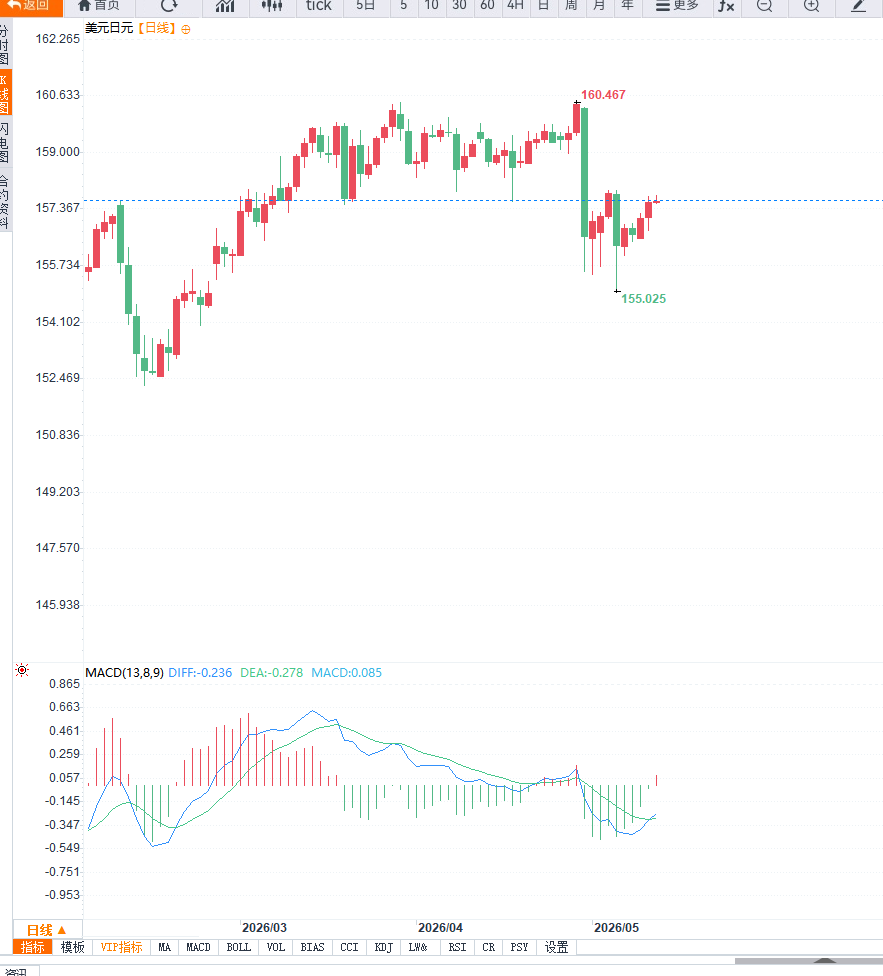
From the daily chart, USD/JPY maintains a clear bullish structure. The exchange rate is currently trading firmly above both the 50-day and 200-day EMAs, indicating that the medium- to long-term uptrend remains intact. As the price approaches the 158.00 area again, the market is testing resistance near previous highs. Technically, the daily MACD indicator continues above the zero line, with the red histogram expanding, showing that the bullish trend remains dominant. The Stochastic Relative Strength Index (RSI) is approaching overbought territory again, suggesting increased short-term buying sentiment but also hinting at increased risk of volatility at higher levels. The key daily resistance level is initially at the psychological level of 158.00 . A successful break above this level could lead to further testing of the 159.50 area, and even a retest of the important psychological level of 160.00. On the downside, the 156.80 area provides initial support, followed by the 50-day EMA support area around 155.50. If the US dollar experiences a short-term pullback, these areas could attract some buying interest.
Overall, the core logic behind the current USD/JPY movement remains the interest rate arbitrage between "expectations of high interest rates from the Federal Reserve" and "the Bank of Japan's gradual normalization policy." As long as US interest rates remain high and Japan's rate hikes proceed relatively slowly, the USD/JPY is likely to maintain a generally strong trend.
Editor's Summary : The core driver of the current USD/JPY rise remains the high-interest-rate environment in the US and the interest rate differential between Japan and the US. Although Japan's current account surplus has reached a record high and the Bank of Japan has gradually signaled further interest rate hikes, the market still believes that Japan's policy normalization pace is relatively slow and unlikely to quickly change the long-term low-interest-rate environment. Meanwhile, renewed inflation in the US has strengthened market expectations that the Federal Reserve will maintain high interest rates, continuing to support the US dollar. From a technical perspective, USD/JPY remains strong overall, but as the exchange rate approaches the 158-160 area, the risk of official intervention by Japan and short-term profit-taking pressure may gradually increase.
Typically, a widening current account surplus helps support the yen, as it signifies increased foreign capital inflows into the Japanese economy. However, the market remains cautious about Japan's economic growth prospects and the pace of monetary policy normalization, resulting in a limited yen reaction after the data release. Meanwhile, the Bank of Japan's April policy summary indicated that some policymakers have begun discussing the possibility of a further interest rate hike as early as the next meeting. Officials generally believe that the risk of imported inflation from rising international oil prices could push Japan's future inflation levels higher.
Some Bank of Japan board members stated that if energy prices remain high, Japan's core inflation may deviate further from the target range, thus necessitating continued policy normalization.
Furthermore, the OECD has recommended that the Japanese government increase fiscal revenue by raising the consumption tax and predicts that the Bank of Japan may raise short-term interest rates to around 2% by the end of 2027. However, despite the Bank of Japan's hawkish signals, the market still believes that Japanese interest rates are significantly lower than those in the United States, and therefore the interest rate differential between the US dollar and the Japanese yen continues to support the USD/JPY exchange rate at high levels.
Regarding the US dollar, better-than-expected US inflation data in April was a significant factor driving the exchange rate higher. Data from the US Bureau of Labor Statistics showed that the US CPI rose 0.6% month-on-month in April, reaching an annual rate of 3.8% , the highest level since May 2023. At the same time, the US core CPI reached an annual rate of 2.8% , indicating that core inflation in the US remains stubbornly persistent. As a result, the market has renewed its expectations that the Federal Reserve will maintain high interest rates or even raise rates further.
US Treasury yields remained high, supporting the US dollar index. Funds flowed back into dollar assets, further pushing up the USD/JPY exchange rate. Besides inflationary factors, continued tensions in the Middle East also fueled risk aversion in the market. US President Trump recently stated that there are only two outcomes regarding Iran: a new agreement or a "complete defeat." Iran, however, insists on the lifting of US sanctions and recognition of sovereignty over the Strait of Hormuz. Market concerns are growing that the Middle East conflict could escalate further, impacting global energy supplies and financial market stability. Against this backdrop of heightened risk aversion, the US dollar, as one of the world's major safe-haven currencies, received additional support.
From the daily chart, USD/JPY maintains a clear bullish structure. The exchange rate is currently trading firmly above both the 50-day and 200-day EMAs, indicating that the medium- to long-term uptrend remains intact. As the price approaches the 158.00 area again, the market is testing resistance near previous highs. Technically, the daily MACD indicator continues above the zero line, with the red histogram expanding, showing that the bullish trend remains dominant. The Stochastic Relative Strength Index (RSI) is approaching overbought territory again, suggesting increased short-term buying sentiment but also hinting at increased risk of volatility at higher levels. The key daily resistance level is initially at the psychological level of 158.00 . A successful break above this level could lead to further testing of the 159.50 area, and even a retest of the important psychological level of 160.00. On the downside, the 156.80 area provides initial support, followed by the 50-day EMA support area around 155.50. If the US dollar experiences a short-term pullback, these areas could attract some buying interest.
Overall, the core logic behind the current USD/JPY movement remains the interest rate arbitrage between "expectations of high interest rates from the Federal Reserve" and "the Bank of Japan's gradual normalization policy." As long as US interest rates remain high and Japan's rate hikes proceed relatively slowly, the USD/JPY is likely to maintain a generally strong trend.
Editor's Summary : The core driver of the current USD/JPY rise remains the high-interest-rate environment in the US and the interest rate differential between Japan and the US. Although Japan's current account surplus has reached a record high and the Bank of Japan has gradually signaled further interest rate hikes, the market still believes that Japan's policy normalization pace is relatively slow and unlikely to quickly change the long-term low-interest-rate environment. Meanwhile, renewed inflation in the US has strengthened market expectations that the Federal Reserve will maintain high interest rates, continuing to support the US dollar. From a technical perspective, USD/JPY remains strong overall, but as the exchange rate approaches the 158-160 area, the risk of official intervention by Japan and short-term profit-taking pressure may gradually increase.
- Risk Warning and Disclaimer
- The market involves risk, and trading may not be suitable for all investors. This article is for reference only and does not constitute personal investment advice, nor does it take into account certain users’ specific investment objectives, financial situation, or other needs. Any investment decisions made based on this information are at your own risk.