Mining industry tycoon: Gold will replace the US dollar as the ultimate reserve currency, rising to $17,250 within three years.
2026-05-13 12:24:58
The global financial system is undergoing a profound structural restructuring. Pierre Lassonde, a legendary figure in the mining industry, stated that gold will gradually replace the US dollar as the ultimate global reserve currency, with gold prices potentially climbing to $17,250 per ounce in the medium to long term. The current economic environment mirrors the stagflation of the 1970s, coupled with massive US debt, weakening dollar credibility, and continued gold hoarding by central banks worldwide, laying a solid foundation for a long-term bull market in gold. Meanwhile, the mining sector is severely undervalued, with potential for several times profit expansion, and the lack of domestic allocation by Canadian pension funds is a major point of criticism within the industry.
Pierre Lassonde, co-founder of Franco Nevada and former president of Newmont Mining, stated that the current macroeconomic landscape is highly similar to the stagflation of the 1970s, when rising inflation and interest rates drove a decade-long surge in gold prices. However, global debt leverage is now far greater than it was then, and market volatility and risks are also much higher.
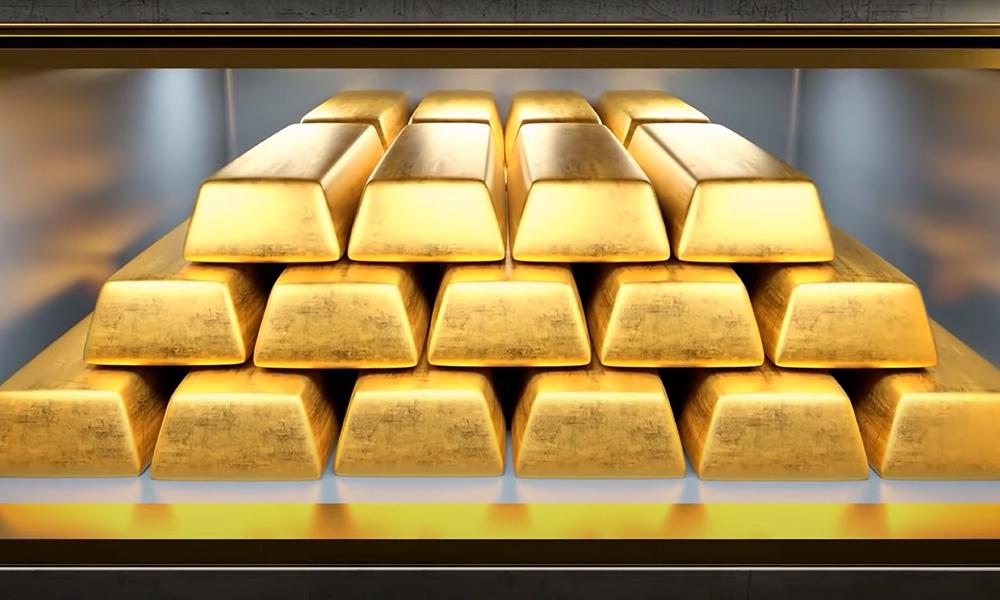
He analyzed that in 1981, the US federal debt was only $1 trillion, while today the US annual interest payments have reached that level, and the total national debt is approaching $40 trillion. As of early May 2026, the total US national debt is close to $39 trillion, and the proportion of interest payments crowding out federal fiscal spending continues to rise. The US fiscal deficit as a percentage of GDP has exceeded 7.9%. Lasson believes that the Federal Reserve is essentially printing money through debt monetization, providing long-term upward momentum for gold, and is confident that gold prices will reach a high of $17,250 within the next three years.
The global trade settlement landscape is undergoing a quiet but significant transformation, with the de-dollarization process continuing to advance.
Lassonde pointed out that major Asian countries have established independent cross-border payment systems to circumvent US sanctions and restrictions, with the system's size growing by 50% to double every six months. He stated that gold is mostly a common commodity, but becomes the ultimate safe-haven asset during special periods; when the US dollar can no longer fulfill its function as a reserve currency, gold naturally takes its place.
Central banks worldwide have become the core driving force in the gold market, continuously reducing their holdings of dollar assets and increasing the proportion of gold in their foreign exchange reserves from less than 10% to over 20%. As of the end of April 2026, the gold reserves of major Asian central banks had increased for 18 consecutive months, with the total amount steadily rising. Currently, the proportion of gold in foreign exchange reserves remains relatively low, indicating ample room for further increases. Simultaneously, gold pricing power is gradually shifting to the country's gold exchange, and domestic physical demand is beginning to influence international gold price trends.
Despite gold and silver prices being at historical highs, mining stocks remain significantly undervalued by the market.
Larsson stated that the overall production cost for leading gold mining companies is generally maintained at $1,500 to $1,600 per ounce, with the industry average cost at approximately $1,450. This translates to extremely high profit margins at the current gold price. If the gold price surges to $17,250, mining companies' operating profits could expand fivefold. Even if it only rises to $7,000, profits would double, and current stock prices have not fully reflected this expectation.
He highly approves of the rational capital allocation strategies of current mining company management, abandoning the drawbacks of blind mergers and acquisitions in the past and shifting towards organic growth, dividend returns, and share buybacks—a rarity in the industry's fifty-year history. While leading companies have exceeded profit expectations and implemented large-scale buybacks, he disagrees with Barrick Gold's plan to spin off its assets for a separate listing. He also bluntly states that mining companies unable to profit at current gold prices and failing to reward shareholders have lost their value in the industry.
Lassonde harshly criticized the current state of institutional investing in Canada, arguing that large pension funds have failed in their asset allocation responsibilities and that there is a serious lack of domestic investment. Only 2% of Canada Pension Plans' assets are allocated to the domestic stock market, with the mining sector receiving an even smaller share. A significant portion of the country's pension funds are invested in US stocks and overseas markets, while the domestic resource sector has been neglected for a long time.
He believes that overseas diversification is not the only way to obtain stable returns, and that domestically operated pension funds can perform just as well. He also calls on the federal government to introduce tax incentives, drawing on Australia's tax-free dividend mechanism, to guide funds back to the domestic capital market and revitalize the resource industry. In his view, this round of gold price increases is not just a short-term rise, but the beginning of a complete mining cycle, and investors who remain on the sidelines are missing out on a golden opportunity.
Overall, the restructuring of the global financial landscape, the immense pressure of US debt, and the accelerated pace of de-dollarization are jointly supporting a long-term bull market for gold, with prices potentially reaching a high of $17,250. Central banks worldwide are continuing to accumulate gold to solidify support levels, and the mining sector has significant potential for valuation recovery and profit expansion. Furthermore, the imbalance in global capital allocation is becoming increasingly apparent. In the future, driven by monetary system reforms, central bank gold purchases, and a convergence of industry profitability, the long-term investment value of gold and the mining sector will be further highlighted.
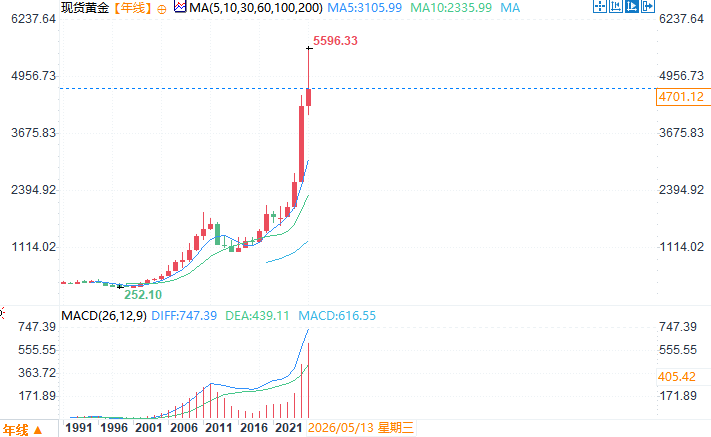
Spot gold annual chart source: EasyForex
At 12:24 PM Beijing time on May 13, spot gold was trading at $4701.12 per ounce.
The resurgence of stagflation and the $40 trillion in US debt have fueled a long bull market in gold.
Pierre Lassonde, co-founder of Franco Nevada and former president of Newmont Mining, stated that the current macroeconomic landscape is highly similar to the stagflation of the 1970s, when rising inflation and interest rates drove a decade-long surge in gold prices. However, global debt leverage is now far greater than it was then, and market volatility and risks are also much higher.
He analyzed that in 1981, the US federal debt was only $1 trillion, while today the US annual interest payments have reached that level, and the total national debt is approaching $40 trillion. As of early May 2026, the total US national debt is close to $39 trillion, and the proportion of interest payments crowding out federal fiscal spending continues to rise. The US fiscal deficit as a percentage of GDP has exceeded 7.9%. Lasson believes that the Federal Reserve is essentially printing money through debt monetization, providing long-term upward momentum for gold, and is confident that gold prices will reach a high of $17,250 within the next three years.
The weakening of the US dollar settlement system has led to gold's rise as the ultimate reserve currency.
The global trade settlement landscape is undergoing a quiet but significant transformation, with the de-dollarization process continuing to advance.
Lassonde pointed out that major Asian countries have established independent cross-border payment systems to circumvent US sanctions and restrictions, with the system's size growing by 50% to double every six months. He stated that gold is mostly a common commodity, but becomes the ultimate safe-haven asset during special periods; when the US dollar can no longer fulfill its function as a reserve currency, gold naturally takes its place.
Central banks worldwide have become the core driving force in the gold market, continuously reducing their holdings of dollar assets and increasing the proportion of gold in their foreign exchange reserves from less than 10% to over 20%. As of the end of April 2026, the gold reserves of major Asian central banks had increased for 18 consecutive months, with the total amount steadily rising. Currently, the proportion of gold in foreign exchange reserves remains relatively low, indicating ample room for further increases. Simultaneously, gold pricing power is gradually shifting to the country's gold exchange, and domestic physical demand is beginning to influence international gold price trends.
Mining stocks are severely undervalued and profits are expected to expand fivefold.
Despite gold and silver prices being at historical highs, mining stocks remain significantly undervalued by the market.
Larsson stated that the overall production cost for leading gold mining companies is generally maintained at $1,500 to $1,600 per ounce, with the industry average cost at approximately $1,450. This translates to extremely high profit margins at the current gold price. If the gold price surges to $17,250, mining companies' operating profits could expand fivefold. Even if it only rises to $7,000, profits would double, and current stock prices have not fully reflected this expectation.
He highly approves of the rational capital allocation strategies of current mining company management, abandoning the drawbacks of blind mergers and acquisitions in the past and shifting towards organic growth, dividend returns, and share buybacks—a rarity in the industry's fifty-year history. While leading companies have exceeded profit expectations and implemented large-scale buybacks, he disagrees with Barrick Gold's plan to spin off its assets for a separate listing. He also bluntly states that mining companies unable to profit at current gold prices and failing to reward shareholders have lost their value in the industry.
Canadian pension funds are experiencing an imbalance in their asset allocation; industry insiders are calling for policy guidance.
Lassonde harshly criticized the current state of institutional investing in Canada, arguing that large pension funds have failed in their asset allocation responsibilities and that there is a serious lack of domestic investment. Only 2% of Canada Pension Plans' assets are allocated to the domestic stock market, with the mining sector receiving an even smaller share. A significant portion of the country's pension funds are invested in US stocks and overseas markets, while the domestic resource sector has been neglected for a long time.
He believes that overseas diversification is not the only way to obtain stable returns, and that domestically operated pension funds can perform just as well. He also calls on the federal government to introduce tax incentives, drawing on Australia's tax-free dividend mechanism, to guide funds back to the domestic capital market and revitalize the resource industry. In his view, this round of gold price increases is not just a short-term rise, but the beginning of a complete mining cycle, and investors who remain on the sidelines are missing out on a golden opportunity.
Summarize
Overall, the restructuring of the global financial landscape, the immense pressure of US debt, and the accelerated pace of de-dollarization are jointly supporting a long-term bull market for gold, with prices potentially reaching a high of $17,250. Central banks worldwide are continuing to accumulate gold to solidify support levels, and the mining sector has significant potential for valuation recovery and profit expansion. Furthermore, the imbalance in global capital allocation is becoming increasingly apparent. In the future, driven by monetary system reforms, central bank gold purchases, and a convergence of industry profitability, the long-term investment value of gold and the mining sector will be further highlighted.
Spot gold annual chart source: EasyForex
At 12:24 PM Beijing time on May 13, spot gold was trading at $4701.12 per ounce.
- Risk Warning and Disclaimer
- The market involves risk, and trading may not be suitable for all investors. This article is for reference only and does not constitute personal investment advice, nor does it take into account certain users’ specific investment objectives, financial situation, or other needs. Any investment decisions made based on this information are at your own risk.