Rising US inflation and industrial demand drove silver prices higher, with XAG/USD rising for the sixth consecutive day and approaching $87.
2026-05-13 13:12:28
On Wednesday during Asian trading hours, spot silver (XAG/USD) continued its recent strong performance, trading around $86.80 per ounce, marking its sixth consecutive day of gains. With the continued expansion of global demand from the new energy and electronics industries, silver's industrial attributes have regained market attention, driving a sustained inflow of funds into the precious metals market. The market generally believes that global demand for silver from the solar energy, electric vehicle, and electronics manufacturing industries is continuously growing. As an important industrial metal, silver is widely used in solar panels, semiconductors, electronic components, and automobile manufacturing; therefore, the global green energy transition is constantly increasing long-term demand expectations for silver.
Some precious metals institutions point out that the expansion of the global new energy industry is gradually changing the supply and demand structure of the silver market, and industrial demand may become an important core factor supporting silver prices in the next few years.
Driven by industrial demand, silver has recently outperformed some traditional precious metals. Especially against the backdrop of a gradual recovery in global manufacturing and increased investment in new energy, the market remains optimistic about future silver consumption growth. However, the current rise in silver prices still faces significant macroeconomic pressure.
With persistent shipping risks in the Strait of Hormuz keeping international crude oil prices high, market concerns are growing that tight global energy supplies could further push up inflation. Rising energy prices will not only increase global manufacturing costs but may also prompt major central banks worldwide to maintain high interest rates for an extended period.
For silver, a high-interest-rate environment is generally unfavorable for sustained price increases. This is because, like gold, silver does not offer interest income. Therefore, during periods of high interest rates, some funds may shift to higher-yielding dollar assets and the bond market.
US President Trump's recent hardline statements on Iran have continued to exacerbate risk aversion in the market. Trump stated that there are only two possible outcomes regarding Iran: a deal or a "complete defeat." Iran, on the other hand, insists that the US lift sanctions and recognize its sovereignty over the Strait of Hormuz.
Uncertainty surrounding the Middle East is fueling increased volatility in global markets and further reinforcing risk premiums in energy markets. While risk aversion typically favors precious metals, continued high energy prices could further strengthen market expectations that the Federal Reserve will maintain high interest rates.
Data released by the U.S. Bureau of Labor Statistics on Tuesday showed that the U.S. Consumer Price Index (CPI) rose 0.6% month-on-month in April, reaching an annualized rate of 3.8% , the highest level since May 2023. Meanwhile, the core CPI rose to an annualized rate of 2.8% , indicating that core inflation in the U.S. remains stubborn. This has reinforced market expectations that the Federal Reserve will maintain its high interest rate policy.
U.S. Treasury yields and the dollar index have therefore remained high, putting some downward pressure on silver. The market currently widely expects the Federal Reserve to maintain its tight monetary policy for an extended period to address persistent inflation risks.
From the daily chart, XAG/USD maintains a clear bullish structure. Silver prices are currently trading firmly above both the 50-day and 200-day EMAs, indicating that the medium- to long-term uptrend remains intact. Technically, the daily MACD indicator continues above the zero line, with the red histogram expanding, showing that the current market is still dominated by bullish trends. Meanwhile, the Stochastic Relative Strength Index (SRSI) has entered high territory, indicating strong short-term buying sentiment but also suggesting increasing overbought risk. The first key resistance level on the daily chart is at the psychological level of $88.00 ; a successful break above this level could lead to a test of the $90.00 area. Further important medium- to long-term resistance lies around $92.50. On the downside, the $85.20 area forms initial support, followed by the 50-day EMA support area around $83.50. If profit-taking occurs, these areas could become key defensive levels.
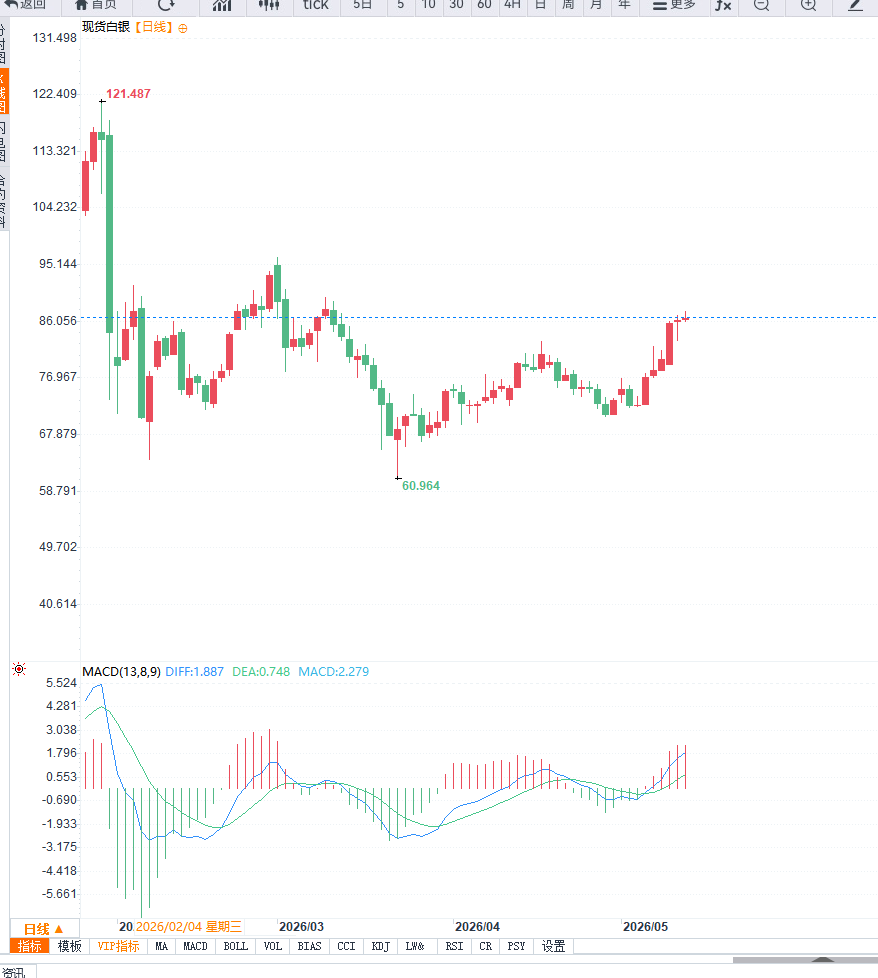
Overall, the core logic of the current silver market has gradually shifted from traditional safe-haven demand to a dynamic interplay between "industrial demand growth" and the "global high-interest-rate environment." As long as demand from the new energy industry remains strong, the overall medium- to long-term trend of silver will still be supported, but the risk of short-term high-level volatility is also increasing.
Editor's Summary : The silver market is currently entering a new phase driven by industrial demand. Continued growth in demand for silver from the new energy, electronics, and automotive manufacturing industries is reinforcing market expectations of future supply and demand tensions, a key reason for the continuous rise in silver prices. However, renewed inflation in the US and the persistent high-interest-rate environment globally are also exerting some downward pressure on silver. Especially given the possibility that the Federal Reserve may maintain high interest rates for an extended period, short-term volatility in silver may intensify further. From a technical perspective, silver maintains a strong upward trend overall, but as prices continue to approach key psychological levels, the risk of short-term overbought conditions is increasing. The future market direction will depend on changes in global industrial demand, the Federal Reserve's policy path, and the trends in the international energy market.
Some precious metals institutions point out that the expansion of the global new energy industry is gradually changing the supply and demand structure of the silver market, and industrial demand may become an important core factor supporting silver prices in the next few years.
Driven by industrial demand, silver has recently outperformed some traditional precious metals. Especially against the backdrop of a gradual recovery in global manufacturing and increased investment in new energy, the market remains optimistic about future silver consumption growth. However, the current rise in silver prices still faces significant macroeconomic pressure.
With persistent shipping risks in the Strait of Hormuz keeping international crude oil prices high, market concerns are growing that tight global energy supplies could further push up inflation. Rising energy prices will not only increase global manufacturing costs but may also prompt major central banks worldwide to maintain high interest rates for an extended period.
For silver, a high-interest-rate environment is generally unfavorable for sustained price increases. This is because, like gold, silver does not offer interest income. Therefore, during periods of high interest rates, some funds may shift to higher-yielding dollar assets and the bond market.
US President Trump's recent hardline statements on Iran have continued to exacerbate risk aversion in the market. Trump stated that there are only two possible outcomes regarding Iran: a deal or a "complete defeat." Iran, on the other hand, insists that the US lift sanctions and recognize its sovereignty over the Strait of Hormuz.
Uncertainty surrounding the Middle East is fueling increased volatility in global markets and further reinforcing risk premiums in energy markets. While risk aversion typically favors precious metals, continued high energy prices could further strengthen market expectations that the Federal Reserve will maintain high interest rates.
Data released by the U.S. Bureau of Labor Statistics on Tuesday showed that the U.S. Consumer Price Index (CPI) rose 0.6% month-on-month in April, reaching an annualized rate of 3.8% , the highest level since May 2023. Meanwhile, the core CPI rose to an annualized rate of 2.8% , indicating that core inflation in the U.S. remains stubborn. This has reinforced market expectations that the Federal Reserve will maintain its high interest rate policy.
U.S. Treasury yields and the dollar index have therefore remained high, putting some downward pressure on silver. The market currently widely expects the Federal Reserve to maintain its tight monetary policy for an extended period to address persistent inflation risks.
From the daily chart, XAG/USD maintains a clear bullish structure. Silver prices are currently trading firmly above both the 50-day and 200-day EMAs, indicating that the medium- to long-term uptrend remains intact. Technically, the daily MACD indicator continues above the zero line, with the red histogram expanding, showing that the current market is still dominated by bullish trends. Meanwhile, the Stochastic Relative Strength Index (SRSI) has entered high territory, indicating strong short-term buying sentiment but also suggesting increasing overbought risk. The first key resistance level on the daily chart is at the psychological level of $88.00 ; a successful break above this level could lead to a test of the $90.00 area. Further important medium- to long-term resistance lies around $92.50. On the downside, the $85.20 area forms initial support, followed by the 50-day EMA support area around $83.50. If profit-taking occurs, these areas could become key defensive levels.
Overall, the core logic of the current silver market has gradually shifted from traditional safe-haven demand to a dynamic interplay between "industrial demand growth" and the "global high-interest-rate environment." As long as demand from the new energy industry remains strong, the overall medium- to long-term trend of silver will still be supported, but the risk of short-term high-level volatility is also increasing.
Editor's Summary : The silver market is currently entering a new phase driven by industrial demand. Continued growth in demand for silver from the new energy, electronics, and automotive manufacturing industries is reinforcing market expectations of future supply and demand tensions, a key reason for the continuous rise in silver prices. However, renewed inflation in the US and the persistent high-interest-rate environment globally are also exerting some downward pressure on silver. Especially given the possibility that the Federal Reserve may maintain high interest rates for an extended period, short-term volatility in silver may intensify further. From a technical perspective, silver maintains a strong upward trend overall, but as prices continue to approach key psychological levels, the risk of short-term overbought conditions is increasing. The future market direction will depend on changes in global industrial demand, the Federal Reserve's policy path, and the trends in the international energy market.
- Risk Warning and Disclaimer
- The market involves risk, and trading may not be suitable for all investors. This article is for reference only and does not constitute personal investment advice, nor does it take into account certain users’ specific investment objectives, financial situation, or other needs. Any investment decisions made based on this information are at your own risk.