Is now the right time to go long on the Japanese yen? OECD predicts Japanese interest rates will rise to 2%: the end of the 30-year era of zero inflation.
2026-05-13 13:51:29
The Organization for Economic Cooperation and Development (OECD) projected in a report released Wednesday (May 13) that the Bank of Japan will raise its short-term policy rate from the current 0.75% to 2% by the end of 2027. The OECD believes that strong domestic demand will help the Japanese economy withstand external shocks such as the Middle East conflict. This assessment provides strong support for the Bank of Japan's hawkish stance ahead of its June policy meeting.
The OECD points out that Japan is currently in a period of transition: from a state of near-zero inflation over the past 30 years to an economic model in which prices and wages rise in tandem, supported by domestic demand.
The report states that inflation initially reflected external factors such as rising commodity prices, but subsequently, labor shortages pushed up nominal wages, and endogenous pressures gradually accumulated.
The OECD believes that despite the need to be cautious about external uncertainties, the Bank of Japan should continue to raise interest rates given rising inflation expectations, robust nominal wage growth, and the closing of the output gap.
The OECD forecasts that Japan's economy will grow by 0.7% and 0.9% in 2026 and 2027, respectively, a slowdown from 1.2% in 2025. The report notes that, supported by strong domestic demand, inflation is expected to gradually converge to the Bank of Japan's 2% target level between 2026 and 2027.
The OECD's recommendations come as the Bank of Japan prepares for further interest rate hikes. Market expectations for action at its June 15-16 meeting are rising. While the Bank of Japan has offered little indication of the final magnitude of the rate hike, its latest estimates suggest a natural interest rate of approximately -0.9% to +0.5%. The OECD states that, assuming inflation at 2%, the current policy rate of 0.75% is close to the lower bound of the nominal neutral rate and is projected to rise to 2% by the end of 2027.
The OECD welcomed the Bank of Japan's gradual reduction in government bond purchases, considering it an important step in weaning the economy off massive stimulus. The report noted that tapering has improved market function, but risks remain due to the declining share of government bonds held by banks, insurance companies, and pension funds after years of low interest rates. The OECD recommended that the Bank of Japan be prepared to adjust the pace and maturity structure of its bond purchases should financial or bond market conditions become volatile.
It is worth noting that some analysts attribute the recent increased volatility in the Japanese government bond market to the Bank of Japan's slower pace of bond purchases. At its June policy meeting, the Bank of Japan will review its bond-buying tapering plan up to March 2027 and formulate a new plan for beyond April 2027.
The OECD highly praised the resilience of Japan's domestic demand, believing that Japan has entered a sustainable positive cycle of "prices-wages-growth." The expectation of raising interest rates to 2% by the end of 2027 clarifies the path for the Bank of Japan to gradually exit its ultra-loose policy. However, the market volatility risks brought about by the reduction in bond purchases, as well as the uncertainty of external shocks, remain variables that need to be monitored in future policy implementation.
The OECD explicitly predicts that the Bank of Japan will continue to raise interest rates to 2% by the end of 2027, while at the same time, major central banks such as the Federal Reserve and the European Central Bank may have already entered a rate-cutting cycle or maintained their rates unchanged. This divergence in monetary policy paths directly points to the continued narrowing of interest rate differentials between Japan and the US, and between Japan and Europe, thus providing structural support for the yen.
Specifically, the USD/JPY pair came under pressure and declined amid strengthening expectations of interest rate hikes. Technically, it may test the previous low of 155.03. If it breaks through the key support level, the downside potential will open up further.
The euro against the yen and the pound against the yen also face similar pressure, especially given the weak European economic data and the ongoing political turmoil in the UK, which makes the downside risks for cross-currency pairs more significant.
From a market performance perspective, if investors gradually price in the Bank of Japan's interest rate hike path, the yen is expected to gradually strengthen between 2026 and 2027, reversing the depreciation trend caused by the ultra-loose monetary policy over the past few years. This shift will not happen overnight, but will be gradually strengthened with each interest rate hike and each confirmation of inflation data.
It's worth noting that the pace of the yen's appreciation is also influenced by external factors, including the impact of the Middle East conflict on oil prices, whether the US economy achieves a soft landing, and changes in global risk sentiment. If global risk aversion intensifies, the yen, as a traditional safe-haven currency, will further benefit, accelerating its appreciation. Conversely, if the Bank of Japan raises interest rates more slowly than the market expects, or if the Federal Reserve maintains high interest rates for a longer period due to persistent inflation, the magnitude and speed of the yen's appreciation may be limited.
Looking at the daily moving averages for USD/JPY, the current price of 157.71 shows a clear breakdown and complex arrangement of moving averages. Specifically, the price has fallen below the short-term moving average MA20 (158.24) and the medium-term moving average MA50 (158.69), indicating that both short-term and medium-term momentum are bearish. However, at the same time, the price remains above MA100 (157.35) and is significantly higher than the long-term moving average MA200 (154.36), suggesting that there is still medium- and long-term support below. This pattern of "price below MA20/MA50, above MA100/MA200" typically occurs during a pullback phase in an uptrend, rather than at the beginning of a trend reversal. It is worth noting that the four moving averages have not formed a classic bullish or bearish alignment: MA20 is lower than MA50, indicating that the short-term is weaker than the medium-term; however, MA50 (158.69) is significantly higher than MA100 (157.35) and MA200 (154.36), indicating that the medium-term structure is still bullish.
In summary, the USD/JPY pair is currently in a sensitive position, undergoing a technical correction but not breaking its long-term uptrend. If the price breaks below the 100-day moving average (MA100) (157.35), the short-term correction may escalate into a signal of trend weakening; conversely, if it recovers above the 20-day moving average (MA20) (158.24), the correction may be over.
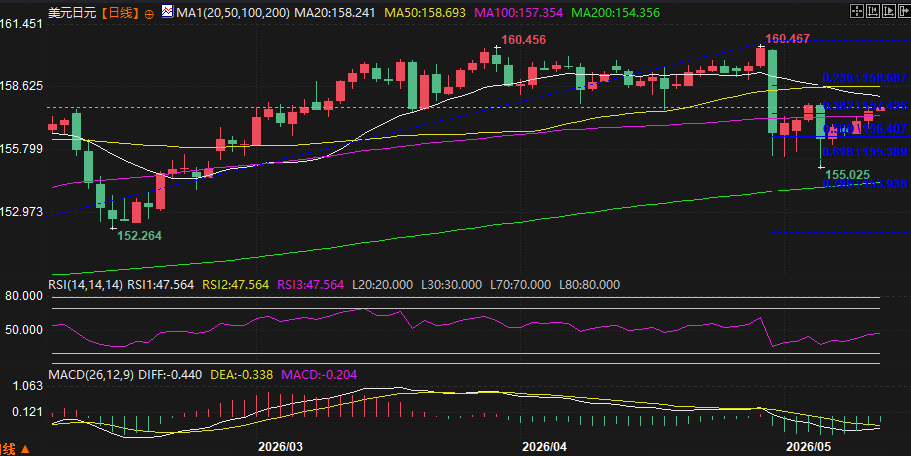
(USD/JPY daily chart, source: FX678)
At 13:51 Beijing time on May 13, the USD/JPY exchange rate was 157.71/72.
Inflation and wages are supporting interest rate hikes; Japan is bidding farewell to the "era of zero inflation."
The OECD points out that Japan is currently in a period of transition: from a state of near-zero inflation over the past 30 years to an economic model in which prices and wages rise in tandem, supported by domestic demand.
The report states that inflation initially reflected external factors such as rising commodity prices, but subsequently, labor shortages pushed up nominal wages, and endogenous pressures gradually accumulated.
The OECD believes that despite the need to be cautious about external uncertainties, the Bank of Japan should continue to raise interest rates given rising inflation expectations, robust nominal wage growth, and the closing of the output gap.
Economic growth has slowed slightly, and inflation is expected to reach the target in 2026-2027.
The OECD forecasts that Japan's economy will grow by 0.7% and 0.9% in 2026 and 2027, respectively, a slowdown from 1.2% in 2025. The report notes that, supported by strong domestic demand, inflation is expected to gradually converge to the Bank of Japan's 2% target level between 2026 and 2027.
The Bank of Japan's policy rate is expected to rise to 2%, near the lower end of the neutral interest rate range.
The OECD's recommendations come as the Bank of Japan prepares for further interest rate hikes. Market expectations for action at its June 15-16 meeting are rising. While the Bank of Japan has offered little indication of the final magnitude of the rate hike, its latest estimates suggest a natural interest rate of approximately -0.9% to +0.5%. The OECD states that, assuming inflation at 2%, the current policy rate of 0.75% is close to the lower bound of the nominal neutral rate and is projected to rise to 2% by the end of 2027.
The OECD will definitely reduce its bond purchases, but warns of market volatility risks.
The OECD welcomed the Bank of Japan's gradual reduction in government bond purchases, considering it an important step in weaning the economy off massive stimulus. The report noted that tapering has improved market function, but risks remain due to the declining share of government bonds held by banks, insurance companies, and pension funds after years of low interest rates. The OECD recommended that the Bank of Japan be prepared to adjust the pace and maturity structure of its bond purchases should financial or bond market conditions become volatile.
It is worth noting that some analysts attribute the recent increased volatility in the Japanese government bond market to the Bank of Japan's slower pace of bond purchases. At its June policy meeting, the Bank of Japan will review its bond-buying tapering plan up to March 2027 and formulate a new plan for beyond April 2027.
The Bank of Japan's interest rate hike path is becoming clearer, with resilient domestic demand proving a key support.
The OECD highly praised the resilience of Japan's domestic demand, believing that Japan has entered a sustainable positive cycle of "prices-wages-growth." The expectation of raising interest rates to 2% by the end of 2027 clarifies the path for the Bank of Japan to gradually exit its ultra-loose policy. However, the market volatility risks brought about by the reduction in bond purchases, as well as the uncertainty of external shocks, remain variables that need to be monitored in future policy implementation.
Is now the right time to go long on the Japanese yen?
The OECD explicitly predicts that the Bank of Japan will continue to raise interest rates to 2% by the end of 2027, while at the same time, major central banks such as the Federal Reserve and the European Central Bank may have already entered a rate-cutting cycle or maintained their rates unchanged. This divergence in monetary policy paths directly points to the continued narrowing of interest rate differentials between Japan and the US, and between Japan and Europe, thus providing structural support for the yen.
Specifically, the USD/JPY pair came under pressure and declined amid strengthening expectations of interest rate hikes. Technically, it may test the previous low of 155.03. If it breaks through the key support level, the downside potential will open up further.
The euro against the yen and the pound against the yen also face similar pressure, especially given the weak European economic data and the ongoing political turmoil in the UK, which makes the downside risks for cross-currency pairs more significant.
From a market performance perspective, if investors gradually price in the Bank of Japan's interest rate hike path, the yen is expected to gradually strengthen between 2026 and 2027, reversing the depreciation trend caused by the ultra-loose monetary policy over the past few years. This shift will not happen overnight, but will be gradually strengthened with each interest rate hike and each confirmation of inflation data.
It's worth noting that the pace of the yen's appreciation is also influenced by external factors, including the impact of the Middle East conflict on oil prices, whether the US economy achieves a soft landing, and changes in global risk sentiment. If global risk aversion intensifies, the yen, as a traditional safe-haven currency, will further benefit, accelerating its appreciation. Conversely, if the Bank of Japan raises interest rates more slowly than the market expects, or if the Federal Reserve maintains high interest rates for a longer period due to persistent inflation, the magnitude and speed of the yen's appreciation may be limited.
Looking at the daily moving averages for USD/JPY, the current price of 157.71 shows a clear breakdown and complex arrangement of moving averages. Specifically, the price has fallen below the short-term moving average MA20 (158.24) and the medium-term moving average MA50 (158.69), indicating that both short-term and medium-term momentum are bearish. However, at the same time, the price remains above MA100 (157.35) and is significantly higher than the long-term moving average MA200 (154.36), suggesting that there is still medium- and long-term support below. This pattern of "price below MA20/MA50, above MA100/MA200" typically occurs during a pullback phase in an uptrend, rather than at the beginning of a trend reversal. It is worth noting that the four moving averages have not formed a classic bullish or bearish alignment: MA20 is lower than MA50, indicating that the short-term is weaker than the medium-term; however, MA50 (158.69) is significantly higher than MA100 (157.35) and MA200 (154.36), indicating that the medium-term structure is still bullish.
In summary, the USD/JPY pair is currently in a sensitive position, undergoing a technical correction but not breaking its long-term uptrend. If the price breaks below the 100-day moving average (MA100) (157.35), the short-term correction may escalate into a signal of trend weakening; conversely, if it recovers above the 20-day moving average (MA20) (158.24), the correction may be over.
(USD/JPY daily chart, source: FX678)
At 13:51 Beijing time on May 13, the USD/JPY exchange rate was 157.71/72.
- Risk Warning and Disclaimer
- The market involves risk, and trading may not be suitable for all investors. This article is for reference only and does not constitute personal investment advice, nor does it take into account certain users’ specific investment objectives, financial situation, or other needs. Any investment decisions made based on this information are at your own risk.