The Canadian dollar faces a test from the MA50: the oil boom and the looming shadow of the trade war.
2026-05-13 15:02:10
A new survey released by the Bank of Canada on Monday (May 11) shows that geopolitical tensions in the Middle East and trade risks with the United States have replaced tariffs as the biggest threats to the Canadian economy. High oil prices have, on the one hand, driven a significant increase in Canadian exports, government revenue, and the trade surplus; on the other hand, they have exacerbated domestic inflationary pressures and may force the central bank to raise interest rates. Meanwhile, uncertainty surrounding the USMCA agreement and the potential for a new round of US tariffs could drag down economic growth, and even push Canada into recession if trade relations deteriorate. The Canadian economy is caught in a classic "oil paradox": its rise and fall are both tied to oil prices.

A Bank of Canada survey of market participants showed that geopolitical risks stemming from the Middle East war were listed as the biggest downside risk by 82% of respondents, followed by trade tensions at 79% and tightening global financial conditions at 57%. The Iranian conflict disrupted the transport of oil, gas, and fertilizers through the Strait of Hormuz, replacing the trade tension narrative of the Trump tariff era.
Bank of Canada Governor Tiff Macklem warned that if energy prices remain high, it may be necessary to raise interest rates to maintain the 2% inflation target. However, like other oil-producing countries, Canada is experiencing the "oil paradox": high oil prices have driven up domestic fuel costs and inflation, while also generating substantial government revenue.
Canada recorded its first trade surplus in six months in March, reaching C$1.78 billion, far exceeding the expected deficit of C$2.88 billion. Total exports rose 8.5% to C$72.8 billion, the second-highest level on record. Energy exports surged 15.6% to C$17.1 billion, the highest since September 2022, with crude oil exports increasing by 18.9% in volume and prices soaring 33.1%. Metal exports rose 24.0% to a record C$15.3 billion, with gold exports increasing by C$3 billion driven by safe-haven demand. Total imports fell 1.6% to C$71 billion.
Notably, the U.S. share of Canadian exports fell to 66.7%, the lowest level on record. Canada's trade surplus with the U.S. widened to C$7.1 billion, the highest since September 2025, primarily driven by an 8.3% increase in exports of passenger cars and light trucks. Meanwhile, imports from the U.S. declined by 1.2% to C$41.44 billion.
The prospects for a reconsideration of the USMCA (United States-Mexico-Canada Agreement) are fraught with uncertainty. The Trump administration needs to clarify its new position by July 1, but negotiations could drag on into the fall due to the US midterm elections. The baseline scenario is a 16-year extension, but there is a risk scenario where the US imposes tariffs of up to 35% on all Canadian exports, which could plunge Canada into recession. Furthermore, reports indicate that the White House is considering splitting the trilateral agreement into two bilateral agreements.
The United States has imposed multiple tariffs on Canadian goods: 50% on steel and aluminum, 35.2% combined for anti-dumping and countervailing duties on softwood lumber, 25% on automobile exports, and 50% on copper and copper products, among others. Canada initially announced retaliatory tariffs on $30 billion worth of U.S. goods, but many were lifted after the U.S. granted partial exemptions in September 2025. However, retaliatory tariffs remain on certain steel, aluminum, and automobile products.
In his spring economic update, Canadian Finance Minister François-Philippe Champagne predicted that GDP growth would slow to 1.1% in 2026 from 1.7% in 2025, but would rebound to 1.9% in 2027. Thanks to increased oil revenues, the deficit for fiscal year 2025/26 is projected to decrease by C$11.5 billion to C$66.9 billion (2.1% of GDP).
Last month, Canada launched its first sovereign wealth fund, the Strong Canada Fund, with the federal government pledging to inject C$25 billion in cash over three years. The fund will focus on co-investing with private capital in strategic sectors such as clean energy, fossil fuels, transportation infrastructure, telecommunications, advanced manufacturing, and critical minerals. Its unique feature is the plan to offer retail investment products, allowing Canadian citizens to invest directly and share in the financial returns.
The Canadian economy faces a paradoxical situation: high oil prices bring short-term fiscal and trade benefits, but also exacerbate the risks of inflation and interest rate hikes; the trade surplus with the US is widening, but dependence on US exports has fallen to a historic low, reflecting a reshaping of trade relations. The outcome of the USMCA review will be a key variable determining the direction of the Canadian economy—if the trade war escalates, the risk of recession will increase significantly. Canada's response strategies include maintaining retaliatory tariffs and launching a sovereign wealth fund to enhance economic resilience. In the coming months, the situation in the Middle East, US trade policy, and central bank interest rate decisions will jointly determine the ultimate fate of the Canadian economy.
From the perspective of the Canadian dollar exchange rate, the Canadian economy is currently facing a dual struggle between the "positive impact of high oil prices" and the "negative impact of the trade war," with the USD/CAD exchange rate depending on which force prevails. On the one hand, the ongoing conflict in the Middle East continues to push up international oil prices. As a major oil-producing country, Canada has seen a significant increase in energy export revenue, with crude oil export prices surging 33.1% in March, driving overall exports to the second-highest level on record. This provides structural support for the Canadian dollar. Historical experience shows that for every $10 increase in oil prices, the Canadian dollar typically appreciates by about 2-3% against the US dollar. On the other hand, US trade protectionism continues to escalate. The Trump administration has imposed high tariffs on Canadian steel, aluminum, softwood lumber, automobiles, and copper products, and the prospects for the USMCA reconsideration are unclear, posing a risk of the US imposing a 35% tariff on all Canadian exports. If this potential shock materializes, it will severely damage the Canadian economy and could even trigger a recession, leading to a significant depreciation of the Canadian dollar.
From the perspective of market performance expectations, the USD/CAD pair is more likely to exhibit a range-bound trading pattern in the short term, as the support from oil prices and trade risks offset each other in terms of strength – oil prices remaining above $70-80 provide bottom support for the Canadian dollar, while trade war uncertainty limits the upside potential of the Canadian dollar.
The USD/CAD pair has been rebounding recently, reaching a high of 1.3723 on Tuesday, precisely where the 50-day moving average resistance lies, before closing near 1.3695. On Wednesday in Asian trading, the pair continued its upward trend, currently trading around 1.3702. Looking at the daily moving average system for USD/CAD, the current price of 1.3700 exhibits a typical pattern of "moving average penetration and complex arrangement."
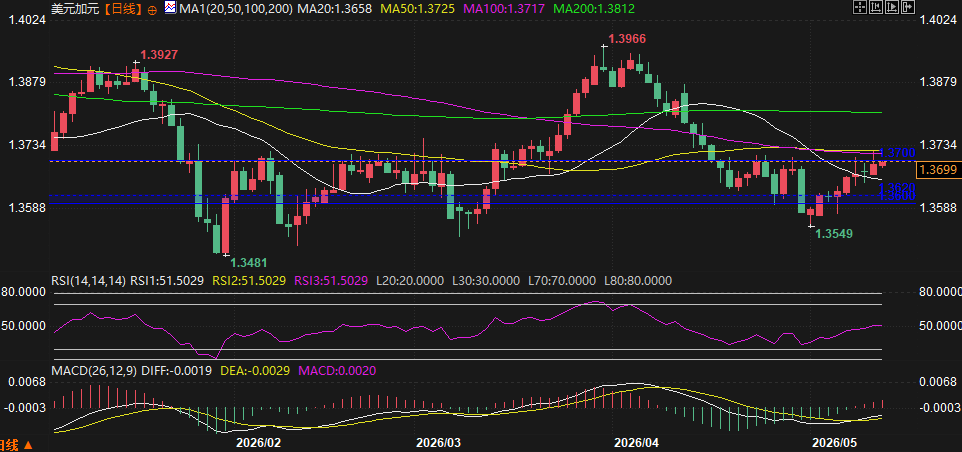
(USD/CAD daily chart, source: EasyForex)
Specifically, the price is above the 20-day moving average (MA20) (1.3658), but below the 50-day moving average (MA50) (1.3725) and the 200-day moving average (MA200) (1.3812). This is a mixed structure of "short-term moving average support and medium- and long-term moving average resistance." Looking at the order of the moving averages, MA20 (1.3658) < MA50 (1.3725) < MA200 (1.3812), with the short-term moving average at the bottom, the medium-term moving average in the middle, and the long-term moving average at the top. This is a standard bearish pattern, indicating that the medium- to long-term downtrend has not yet reversed.
In summary, the USD/CAD pair is currently at a critical juncture, having risen above the 20-day moving average (MA20) but being capped by the 50-day moving average (MA50). Technically, it is bullish in the short term but under pressure in the medium term. It is recommended to use the MA20 as a defensive level and the MA50 as a breakout level for range trading, waiting for the moving average system to provide a clearer directional signal.
At 15:01 Beijing time on May 13, the USD/CAD exchange rate was 1.3703/04.
Geopolitical and trade risks are the primary threat, and high oil prices are forcing central banks to be vigilant.
A Bank of Canada survey of market participants showed that geopolitical risks stemming from the Middle East war were listed as the biggest downside risk by 82% of respondents, followed by trade tensions at 79% and tightening global financial conditions at 57%. The Iranian conflict disrupted the transport of oil, gas, and fertilizers through the Strait of Hormuz, replacing the trade tension narrative of the Trump tariff era.
Bank of Canada Governor Tiff Macklem warned that if energy prices remain high, it may be necessary to raise interest rates to maintain the 2% inflation target. However, like other oil-producing countries, Canada is experiencing the "oil paradox": high oil prices have driven up domestic fuel costs and inflation, while also generating substantial government revenue.
Behind the impressive trade data, dependence on the US has fallen to a historic low.
Canada recorded its first trade surplus in six months in March, reaching C$1.78 billion, far exceeding the expected deficit of C$2.88 billion. Total exports rose 8.5% to C$72.8 billion, the second-highest level on record. Energy exports surged 15.6% to C$17.1 billion, the highest since September 2022, with crude oil exports increasing by 18.9% in volume and prices soaring 33.1%. Metal exports rose 24.0% to a record C$15.3 billion, with gold exports increasing by C$3 billion driven by safe-haven demand. Total imports fell 1.6% to C$71 billion.
Notably, the U.S. share of Canadian exports fell to 66.7%, the lowest level on record. Canada's trade surplus with the U.S. widened to C$7.1 billion, the highest since September 2025, primarily driven by an 8.3% increase in exports of passenger cars and light trucks. Meanwhile, imports from the U.S. declined by 1.2% to C$41.44 billion.
The USMCA reconsideration remains unresolved, and the risk of recession cannot be ignored.
The prospects for a reconsideration of the USMCA (United States-Mexico-Canada Agreement) are fraught with uncertainty. The Trump administration needs to clarify its new position by July 1, but negotiations could drag on into the fall due to the US midterm elections. The baseline scenario is a 16-year extension, but there is a risk scenario where the US imposes tariffs of up to 35% on all Canadian exports, which could plunge Canada into recession. Furthermore, reports indicate that the White House is considering splitting the trilateral agreement into two bilateral agreements.
The United States has imposed multiple tariffs on Canadian goods: 50% on steel and aluminum, 35.2% combined for anti-dumping and countervailing duties on softwood lumber, 25% on automobile exports, and 50% on copper and copper products, among others. Canada initially announced retaliatory tariffs on $30 billion worth of U.S. goods, but many were lifted after the U.S. granted partial exemptions in September 2025. However, retaliatory tariffs remain on certain steel, aluminum, and automobile products.
Improved fiscal outlook leads to the debut of sovereign wealth funds.
In his spring economic update, Canadian Finance Minister François-Philippe Champagne predicted that GDP growth would slow to 1.1% in 2026 from 1.7% in 2025, but would rebound to 1.9% in 2027. Thanks to increased oil revenues, the deficit for fiscal year 2025/26 is projected to decrease by C$11.5 billion to C$66.9 billion (2.1% of GDP).
Last month, Canada launched its first sovereign wealth fund, the Strong Canada Fund, with the federal government pledging to inject C$25 billion in cash over three years. The fund will focus on co-investing with private capital in strategic sectors such as clean energy, fossil fuels, transportation infrastructure, telecommunications, advanced manufacturing, and critical minerals. Its unique feature is the plan to offer retail investment products, allowing Canadian citizens to invest directly and share in the financial returns.
With oil prices acting as a double-edged sword, the Canadian economy stands at a crossroads.
The Canadian economy faces a paradoxical situation: high oil prices bring short-term fiscal and trade benefits, but also exacerbate the risks of inflation and interest rate hikes; the trade surplus with the US is widening, but dependence on US exports has fallen to a historic low, reflecting a reshaping of trade relations. The outcome of the USMCA review will be a key variable determining the direction of the Canadian economy—if the trade war escalates, the risk of recession will increase significantly. Canada's response strategies include maintaining retaliatory tariffs and launching a sovereign wealth fund to enhance economic resilience. In the coming months, the situation in the Middle East, US trade policy, and central bank interest rate decisions will jointly determine the ultimate fate of the Canadian economy.
From the perspective of the Canadian dollar exchange rate, the Canadian economy is currently facing a dual struggle between the "positive impact of high oil prices" and the "negative impact of the trade war," with the USD/CAD exchange rate depending on which force prevails. On the one hand, the ongoing conflict in the Middle East continues to push up international oil prices. As a major oil-producing country, Canada has seen a significant increase in energy export revenue, with crude oil export prices surging 33.1% in March, driving overall exports to the second-highest level on record. This provides structural support for the Canadian dollar. Historical experience shows that for every $10 increase in oil prices, the Canadian dollar typically appreciates by about 2-3% against the US dollar. On the other hand, US trade protectionism continues to escalate. The Trump administration has imposed high tariffs on Canadian steel, aluminum, softwood lumber, automobiles, and copper products, and the prospects for the USMCA reconsideration are unclear, posing a risk of the US imposing a 35% tariff on all Canadian exports. If this potential shock materializes, it will severely damage the Canadian economy and could even trigger a recession, leading to a significant depreciation of the Canadian dollar.
From the perspective of market performance expectations, the USD/CAD pair is more likely to exhibit a range-bound trading pattern in the short term, as the support from oil prices and trade risks offset each other in terms of strength – oil prices remaining above $70-80 provide bottom support for the Canadian dollar, while trade war uncertainty limits the upside potential of the Canadian dollar.
After breaking above the 20-day moving average (MA20), can the USD/CAD pair challenge the 50-day moving average (MA50)?
The USD/CAD pair has been rebounding recently, reaching a high of 1.3723 on Tuesday, precisely where the 50-day moving average resistance lies, before closing near 1.3695. On Wednesday in Asian trading, the pair continued its upward trend, currently trading around 1.3702. Looking at the daily moving average system for USD/CAD, the current price of 1.3700 exhibits a typical pattern of "moving average penetration and complex arrangement."
(USD/CAD daily chart, source: EasyForex)
Specifically, the price is above the 20-day moving average (MA20) (1.3658), but below the 50-day moving average (MA50) (1.3725) and the 200-day moving average (MA200) (1.3812). This is a mixed structure of "short-term moving average support and medium- and long-term moving average resistance." Looking at the order of the moving averages, MA20 (1.3658) < MA50 (1.3725) < MA200 (1.3812), with the short-term moving average at the bottom, the medium-term moving average in the middle, and the long-term moving average at the top. This is a standard bearish pattern, indicating that the medium- to long-term downtrend has not yet reversed.
In summary, the USD/CAD pair is currently at a critical juncture, having risen above the 20-day moving average (MA20) but being capped by the 50-day moving average (MA50). Technically, it is bullish in the short term but under pressure in the medium term. It is recommended to use the MA20 as a defensive level and the MA50 as a breakout level for range trading, waiting for the moving average system to provide a clearer directional signal.
At 15:01 Beijing time on May 13, the USD/CAD exchange rate was 1.3703/04.
- Risk Warning and Disclaimer
- The market involves risk, and trading may not be suitable for all investors. This article is for reference only and does not constitute personal investment advice, nor does it take into account certain users’ specific investment objectives, financial situation, or other needs. Any investment decisions made based on this information are at your own risk.