Spot silver is approaching the $88 mark, with supply and demand dynamics dominating price movements.
2026-05-13 19:53:48
On Wednesday (May 13), during the European session, spot silver reached a high of $87.78 overnight before slightly retreating due to short-term profit-taking. Since the closing price of $80.34 on May 8, silver prices have easily risen by more than 7% in just a few trading days, demonstrating strong upward momentum.
It is worth noting that the US dollar index is currently maintaining a strong trend, and the yield on US Treasury bonds has not shown any obvious signs of decline. According to past market patterns, these two factors should have suppressed silver prices. However, silver has bucked the trend and experienced a strong upward trend. This phenomenon is enough to show that the current tight supply and demand in the silver market and the rigid demand in the industrial sector have completely overshadowed the macroeconomic negative factors that would have suppressed silver prices, becoming the core driving force for the rise in silver prices.

Technical Analysis
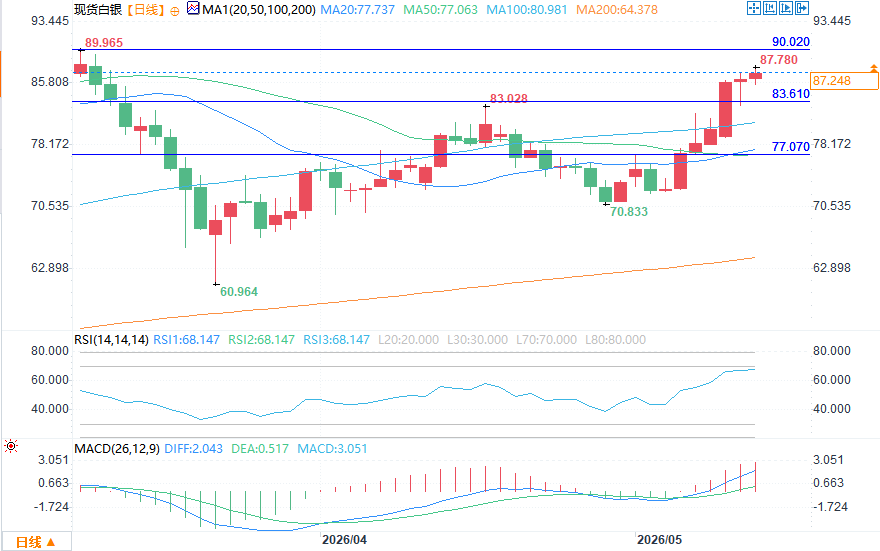
On Wednesday, spot silver prices rose initially before falling back, giving back some of the gains accumulated earlier. During overnight trading, silver prices briefly touched a high of $87.81, a new high since March 11th, before turning downwards due to short-term profit-taking, entering a brief consolidation phase.
The core focus of today's market trading is whether it can continue Monday's breakout and successfully hold the swing high of $83.06 and the long-term 50% Fibonacci retracement level of $83.61. These two key levels have now successfully transformed into important support levels for silver prices, playing a crucial supporting role in subsequent price movements.
Following this breakout rally, the next high of $90.02 has officially come into the market's view, becoming a key target for investors. If silver prices can effectively break through this level, they are expected to further challenge the significant retracement range of $91.34 to $98.49. This range is calculated based on silver's historical high of $121.67 and the low of $61.00 reached on March 23rd. The resistance within this range is relatively strong and will be a crucial test for further price increases.
(Spot silver daily chart source: EasyTrade)
On the downside, if silver prices fail to hold support and fall below the long-term 50% Fibonacci retracement level of $83.61, the short-term upward momentum will reverse, and there is a high probability that prices will subsequently test the 50-day moving average at $77.07. This level is the starting point of the current five-day upward trend and has strong support significance for silver prices.
Currently, market investors generally face two different trading strategies: one is to patiently wait for silver prices to retrace to the 50% Fibonacci retracement level of $79.33 before entering a long position to reduce the risk of a short-term pullback; the other is to wait for the price to break through the previous high of $87.81 before going long to capture the subsequent upward momentum. These two strategies each have their own emphasis and corresponding risk-reward ratios. However, the biggest positive news for investors at present is that both the trend of the 50-day moving average and the wave structure have clearly confirmed that the overall trend of silver has turned upward, providing a clear directional guide for subsequent operations.
Inflation data influences the Federal Reserve's expectations for interest rate hikes and cuts.
The U.S. Consumer Price Index (CPI) rose 3.8% year-on-year in April. Looking at the data, this inflation increase was mainly driven by rising energy prices. The high inflation data further delayed market expectations for a Federal Reserve interest rate cut, keeping U.S. Treasury yields at high levels, and the U.S. dollar index also showed no signs of weakening.
According to conventional market logic, the convergence of multiple negative factors should have significantly suppressed silver prices. However, this week, silver defied the trend, breaking through these resistances and experiencing a strong upward surge. This is the core signal of the current strength in the silver market. When silver can withstand macroeconomic negative factors that should drag down prices, it means that the market's fundamental supply and demand logic has completely dominated the current market trend. The current shortage of physical silver, coupled with continued strong industrial demand, has successfully overshadowed the market impact of interest rate trends, becoming the core force driving silver price increases.
On Wednesday, the US Producer Price Index (PPI) will be officially released before the US stock market opens. This data will be a significant short-term factor influencing silver's price movement that day. If the PPI data is weak, it suggests that market inflationary pressures may ease, potentially suppressing safe-haven buying of silver. Conversely, if the data is high, market risk aversion will intensify, providing additional support for silver prices. However, it's important to emphasize that changes in a single wholesale inflation figure will not alter my overall assessment of the silver market. Currently, the global silver supply gap remains as high as 46 million ounces, and demand for silver from the photovoltaic and new energy vehicle industries continues to grow steadily. These core fundamental factors will not change due to the release of a single PPI data point.
Geopolitical risks provide further support for silver prices.
The ongoing tensions between the US and Iran show no signs of easing, and the Strait of Hormuz, as one of the world's most important energy transport routes, remains a crucial shipping lane in the global energy market. This geopolitical uncertainty has persisted for months, prompting safe-haven funds to actively seek safe havens. Silver, as a traditional safe-haven asset, has become a significant destination for these funds, providing additional support for silver prices.
Historically, persistent geopolitical risks do not typically trigger sudden surges in silver prices, but they do create sustained buying pressure at the bottom, preventing funds from easily leaving the market. The current silver market is already benefiting from tight supply and surging industrial demand. Coupled with geopolitical risk aversion, these three positive factors resonate, allowing the silver market to sustain its upward trend without the need for additional catalysts.
Supply shortage is the core reason for the rise in silver prices.
The global silver market has been in a state of supply and demand imbalance for many years, and this situation has not improved in 2026. According to market forecasts, the silver supply gap for the whole year is expected to be close to 46 million ounces. At the same time, silver inventories in major storage centers are also continuing to shrink, further exacerbating the tight supply situation in the market.
As the supply of physical silver becomes increasingly tight, buyers in the market have no choice but to actively raise prices to compete for existing resources in order to secure sufficient raw silver. This fierce competition has directly driven up silver market prices. It is important to clarify that the tight supply and demand of silver is not a short-term phenomenon, but rather the result of gradual accumulation over many years. This supply and demand pattern has now become a solid support level for each round of silver price increases, providing strong assurance for the continued rise in silver prices.
Industrial demand is rigidly supported and irreplaceable.
Amidst the rapid expansion of the global technology industry, silver's industrial demand exhibits irreplaceable characteristics. For instance, the production of photovoltaic panels requires silver, not by choice, but because no other material can currently match silver's superior electrical conductivity at the same cost. Beyond photovoltaics, numerous other sectors, including new energy vehicles, artificial intelligence data centers, semiconductors, medical equipment, and consumer electronics, also rely heavily on silver. This demand is typical of inelastic needs and is unlikely to decrease significantly due to short-term market fluctuations.
Whether it's building photovoltaic power plants or expanding artificial intelligence data centers, silver is indispensable as a core consumable. Globally, every gigawatt of new renewable energy installed capacity generates a fixed demand for silver, a demand that is mandatory and cannot be artificially reduced or replaced.
This is the core reason for the current significant divergence between silver and gold prices: gold's price movement is mainly driven by market risk aversion and interest rate expectations, making its price fluctuations relatively easy to predict; while silver, in addition to being affected by the aforementioned factors, is backed by the trillion-dollar capital-driven demand curve of the manufacturing sector, providing more solid demand support. Currently, the global deployment of renewable energy is no longer merely a market expectation; most related projects have completed signing, implementation, and approval processes, entering the substantive construction phase. Regardless of market investment enthusiasm, the industrial consumption demand for silver is a foregone conclusion. In recent years, very few commodities have possessed such robust structural demand support.
Key points to watch in the future
The long-term 50% Fibonacci retracement level of $83.61 is a key watershed in this round of silver's upward trend, and its support role is crucial. After silver prices strongly broke through this level and the swing high of $83.06 on Monday, these two price levels have successfully transformed into strong support levels for silver. As long as silver prices can hold this support range, the upward channel to $90.02 will remain open; once silver prices can effectively break through the $90.02 mark, they can further target the significant retracement range of $91.34–$98.49, and further upside potential is expected.
If silver prices fail to hold the key support level of $83.61, the next important support level will be the 50-day moving average at $77.07. This level also marks the starting point of the current five-day rally and provides strong support for silver prices. Currently, both the 50-day moving average and the wave structure confirm that silver is in an upward trend. Until this trend clearly reverses, buying on dips remains a more advantageous trading strategy and is more in line with the overall market trend logic.
It is worth noting that the US dollar index is currently maintaining a strong trend, and the yield on US Treasury bonds has not shown any obvious signs of decline. According to past market patterns, these two factors should have suppressed silver prices. However, silver has bucked the trend and experienced a strong upward trend. This phenomenon is enough to show that the current tight supply and demand in the silver market and the rigid demand in the industrial sector have completely overshadowed the macroeconomic negative factors that would have suppressed silver prices, becoming the core driving force for the rise in silver prices.
Technical Analysis
On Wednesday, spot silver prices rose initially before falling back, giving back some of the gains accumulated earlier. During overnight trading, silver prices briefly touched a high of $87.81, a new high since March 11th, before turning downwards due to short-term profit-taking, entering a brief consolidation phase.
The core focus of today's market trading is whether it can continue Monday's breakout and successfully hold the swing high of $83.06 and the long-term 50% Fibonacci retracement level of $83.61. These two key levels have now successfully transformed into important support levels for silver prices, playing a crucial supporting role in subsequent price movements.
Following this breakout rally, the next high of $90.02 has officially come into the market's view, becoming a key target for investors. If silver prices can effectively break through this level, they are expected to further challenge the significant retracement range of $91.34 to $98.49. This range is calculated based on silver's historical high of $121.67 and the low of $61.00 reached on March 23rd. The resistance within this range is relatively strong and will be a crucial test for further price increases.
(Spot silver daily chart source: EasyTrade)
On the downside, if silver prices fail to hold support and fall below the long-term 50% Fibonacci retracement level of $83.61, the short-term upward momentum will reverse, and there is a high probability that prices will subsequently test the 50-day moving average at $77.07. This level is the starting point of the current five-day upward trend and has strong support significance for silver prices.
Currently, market investors generally face two different trading strategies: one is to patiently wait for silver prices to retrace to the 50% Fibonacci retracement level of $79.33 before entering a long position to reduce the risk of a short-term pullback; the other is to wait for the price to break through the previous high of $87.81 before going long to capture the subsequent upward momentum. These two strategies each have their own emphasis and corresponding risk-reward ratios. However, the biggest positive news for investors at present is that both the trend of the 50-day moving average and the wave structure have clearly confirmed that the overall trend of silver has turned upward, providing a clear directional guide for subsequent operations.
Inflation data influences the Federal Reserve's expectations for interest rate hikes and cuts.
The U.S. Consumer Price Index (CPI) rose 3.8% year-on-year in April. Looking at the data, this inflation increase was mainly driven by rising energy prices. The high inflation data further delayed market expectations for a Federal Reserve interest rate cut, keeping U.S. Treasury yields at high levels, and the U.S. dollar index also showed no signs of weakening.
According to conventional market logic, the convergence of multiple negative factors should have significantly suppressed silver prices. However, this week, silver defied the trend, breaking through these resistances and experiencing a strong upward surge. This is the core signal of the current strength in the silver market. When silver can withstand macroeconomic negative factors that should drag down prices, it means that the market's fundamental supply and demand logic has completely dominated the current market trend. The current shortage of physical silver, coupled with continued strong industrial demand, has successfully overshadowed the market impact of interest rate trends, becoming the core force driving silver price increases.
On Wednesday, the US Producer Price Index (PPI) will be officially released before the US stock market opens. This data will be a significant short-term factor influencing silver's price movement that day. If the PPI data is weak, it suggests that market inflationary pressures may ease, potentially suppressing safe-haven buying of silver. Conversely, if the data is high, market risk aversion will intensify, providing additional support for silver prices. However, it's important to emphasize that changes in a single wholesale inflation figure will not alter my overall assessment of the silver market. Currently, the global silver supply gap remains as high as 46 million ounces, and demand for silver from the photovoltaic and new energy vehicle industries continues to grow steadily. These core fundamental factors will not change due to the release of a single PPI data point.
Geopolitical risks provide further support for silver prices.
The ongoing tensions between the US and Iran show no signs of easing, and the Strait of Hormuz, as one of the world's most important energy transport routes, remains a crucial shipping lane in the global energy market. This geopolitical uncertainty has persisted for months, prompting safe-haven funds to actively seek safe havens. Silver, as a traditional safe-haven asset, has become a significant destination for these funds, providing additional support for silver prices.
Historically, persistent geopolitical risks do not typically trigger sudden surges in silver prices, but they do create sustained buying pressure at the bottom, preventing funds from easily leaving the market. The current silver market is already benefiting from tight supply and surging industrial demand. Coupled with geopolitical risk aversion, these three positive factors resonate, allowing the silver market to sustain its upward trend without the need for additional catalysts.
Supply shortage is the core reason for the rise in silver prices.
The global silver market has been in a state of supply and demand imbalance for many years, and this situation has not improved in 2026. According to market forecasts, the silver supply gap for the whole year is expected to be close to 46 million ounces. At the same time, silver inventories in major storage centers are also continuing to shrink, further exacerbating the tight supply situation in the market.
As the supply of physical silver becomes increasingly tight, buyers in the market have no choice but to actively raise prices to compete for existing resources in order to secure sufficient raw silver. This fierce competition has directly driven up silver market prices. It is important to clarify that the tight supply and demand of silver is not a short-term phenomenon, but rather the result of gradual accumulation over many years. This supply and demand pattern has now become a solid support level for each round of silver price increases, providing strong assurance for the continued rise in silver prices.
Industrial demand is rigidly supported and irreplaceable.
Amidst the rapid expansion of the global technology industry, silver's industrial demand exhibits irreplaceable characteristics. For instance, the production of photovoltaic panels requires silver, not by choice, but because no other material can currently match silver's superior electrical conductivity at the same cost. Beyond photovoltaics, numerous other sectors, including new energy vehicles, artificial intelligence data centers, semiconductors, medical equipment, and consumer electronics, also rely heavily on silver. This demand is typical of inelastic needs and is unlikely to decrease significantly due to short-term market fluctuations.
Whether it's building photovoltaic power plants or expanding artificial intelligence data centers, silver is indispensable as a core consumable. Globally, every gigawatt of new renewable energy installed capacity generates a fixed demand for silver, a demand that is mandatory and cannot be artificially reduced or replaced.
This is the core reason for the current significant divergence between silver and gold prices: gold's price movement is mainly driven by market risk aversion and interest rate expectations, making its price fluctuations relatively easy to predict; while silver, in addition to being affected by the aforementioned factors, is backed by the trillion-dollar capital-driven demand curve of the manufacturing sector, providing more solid demand support. Currently, the global deployment of renewable energy is no longer merely a market expectation; most related projects have completed signing, implementation, and approval processes, entering the substantive construction phase. Regardless of market investment enthusiasm, the industrial consumption demand for silver is a foregone conclusion. In recent years, very few commodities have possessed such robust structural demand support.
Key points to watch in the future
The long-term 50% Fibonacci retracement level of $83.61 is a key watershed in this round of silver's upward trend, and its support role is crucial. After silver prices strongly broke through this level and the swing high of $83.06 on Monday, these two price levels have successfully transformed into strong support levels for silver. As long as silver prices can hold this support range, the upward channel to $90.02 will remain open; once silver prices can effectively break through the $90.02 mark, they can further target the significant retracement range of $91.34–$98.49, and further upside potential is expected.
If silver prices fail to hold the key support level of $83.61, the next important support level will be the 50-day moving average at $77.07. This level also marks the starting point of the current five-day rally and provides strong support for silver prices. Currently, both the 50-day moving average and the wave structure confirm that silver is in an upward trend. Until this trend clearly reverses, buying on dips remains a more advantageous trading strategy and is more in line with the overall market trend logic.
- Risk Warning and Disclaimer
- The market involves risk, and trading may not be suitable for all investors. This article is for reference only and does not constitute personal investment advice, nor does it take into account certain users’ specific investment objectives, financial situation, or other needs. Any investment decisions made based on this information are at your own risk.