Crude oil analysis: Upward trend under pressure; meeting between Chinese and US leaders may be key in the short term.
2026-05-13 20:39:26
On Wednesday (May 13th) during the European session, a detailed observation of the 240-minute (4-hour) candlestick chart for crude oil shows that the US crude oil futures contract is currently in a clear upward channel. The upward trend line connecting recent lows shows a steady upward trend, with short-term lows continuously rising and highs gradually moving upwards, clearly indicating that bullish funds still have a certain degree of control over the market, and the foundation of the medium-term upward trend has not been broken. However, at the same time, the upward pressure on prices is also quite significant. The current price is gradually approaching the vicinity of previous important highs, and at the same time, it is under pressure from the long-term downward trend line, forming a double resistance pattern. Combining recent trading data, the current price is consolidating in a narrow range within the key Fibonacci retracement level of 0.5 (corresponding to 99.79) to 0.618 (corresponding to 102.42), with trading volume remaining at a moderate level and no obvious signs of a breakout or breakdown. This phenomenon fully illustrates that the bulls and bears are engaged in fierce competition for chips at this key price level, and are temporarily in a state of equilibrium.

Regarding the moving average (MA) system, the four core moving averages—MA20, MA50, MA100, and MA200—show a standard bullish alignment, with each moving average diverging upwards sequentially. This aligns with the technical characteristics of a medium-term upward trend and implies that the average market cost is gradually rising from the short to the long term, providing effective support for the medium- to long-term bullish pattern. However, it's worth noting that the short-term MA (MA20) has begun to show signs of flattening, with the gap between it and the medium- to long-term moving averages gradually narrowing. This signal suggests that short-term upward momentum is weakening, and bullish forces are gradually accumulating, making it difficult for prices to maintain a sustained upward trend in the short term.
In terms of indicators, the RSI (Relative Strength Index) is currently operating in the 50-60 range, which is within a reasonable range of relative neutral to strong. There has not yet been a clear overbought signal exceeding 70, indicating that although there is bullish sentiment in the market, it is not excessively enthusiastic and there is still some room for upward movement. As for the MACD indicator, the DIFF line and DEA line are slowly converging. Although the red bars continue to be maintained, the height of the bars is gradually decreasing, and the energy release is limited. Considering the logic that the insufficient momentum of the MACD red bars reflects the weakening of upward momentum, this phenomenon suggests that the short-term bullish and bearish forces are undergoing a subtle shift, and the sustainability of the bullish momentum needs further observation.
From an overall technical perspective, crude oil is currently in a consolidation phase within an upward trend. The previous high near 110.93, along with the multiple trendline resistance zones formed by the upper edge of the upward trendline and the lower edge of the downward trendline, will be crucial points to observe in the short-term price movement. From a trading perspective, if the price can effectively break through and hold above the Fibonacci 0.618 level (102.42), accompanied by a moderate increase in trading volume, it may break the current consolidation pattern and open up further upward potential. Conversely, if the price is resisted by multiple resistance levels and falls below the Fibonacci 0.5 level (99.79), the risk of a pullback to the 0.382 level (97.17) or even lower should be noted, and the short-term trend may shift to a downward consolidation.
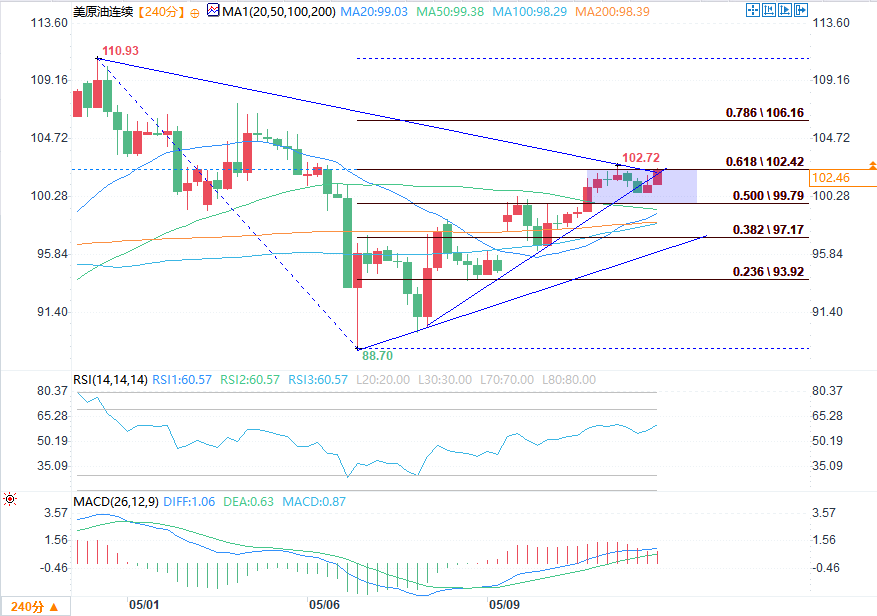
(WTI crude oil 4-hour chart source: EasyForex)
Fundamentals: The meeting between the Chinese and US leaders will dominate short-term expectations, with cooperation and differences coexisting.
The current short-term sentiment and price expectations in the global crude oil market are primarily driven by the upcoming meeting between the leaders of China and the United States. Market participants are paying close attention to this meeting, with most institutions considering it a core factor influencing short-term oil price movements. The outcome will directly impact risk appetite in global financial markets, as well as trade expectations and market confidence related to the energy sector. Several well-known international investment banks and energy analysis institutions point out that the results of this meeting will directly determine the short-term flow of funds and sentiment in the crude oil market, especially given the continued uncertainty in the global energy supply chain. The signals released at the meeting will have a direct guiding effect on oil prices.
In an optimistic scenario, the market anticipates that China and the US may reach phased commercial cooperation and order agreements in specific areas such as semiconductors and soybeans. This expectation would not only inject positive signals into the stability of the global supply chain and alleviate market concerns about supply chain disruptions, but also effectively boost global market risk appetite, driving the overall strength of the commodity market and thus providing upward support for crude oil prices. Such cooperation aligns with the respective interests of both China and the US, satisfying their cooperation needs in specific areas, easing trade frictions between the two countries, indirectly promoting positive interaction in the energy sector, and positively impacting oil prices.
However, despite optimistic expectations, the market remains cautious about the core points of contention at the meeting, particularly on tariffs and the Iran issue, with a consensus that significant breakthroughs are unlikely in the short term. The tariff issue involves a complex web of interests between China and the US, affecting multiple aspects such as industrial development, employment, and trade balance. The core demands of both sides differ, making a comprehensive consensus difficult to achieve in the short term. Regarding Iran, Iran's stance on core issues such as nuclear weapons and energy exports is less influenced by external factors, consistently upholding its sovereign position. China's foreign policy consistently emphasizes respect for the sovereignty and independent choices of all countries and avoids easy interference in other countries' internal affairs. This also determines that substantial consensus on the Iran issue is unlikely. These factors combined suggest that the outcome of this meeting between the Chinese and US leaders will likely be characterized by "cooperation and disagreement," without a clear unilateral positive or negative outcome. Close attention should be paid to the specific cooperative signals and expressions of disagreement released during the meeting.
Overall assessment: Maintain a generally optimistic outlook, but be wary of the risk of a pullback.
A comprehensive analysis of both technical and fundamental factors suggests that the short-term crude oil market will maintain a slightly bullish, oscillating trend, with no clear signals of a trend reversal. From a fundamental perspective, if the meeting between the Chinese and US leaders releases positive signals of cooperation, particularly in the area of energy trade, it will directly inject upward momentum into oil prices, pushing them out of the current trading range. Even if the meeting's outcome is as expected—limited cooperation and remaining differences—the overall market sentiment will remain optimistic and will not significantly suppress oil prices.
However, a high degree of caution is also necessary. Crude oil prices have been fluctuating narrowly within a key range for several days, and the balance between bulls and bears could be broken at any time. Narrow fluctuations are often followed by a clear directional choice. At this point, two risks need to be closely monitored: First, profit-taking from earlier gains could lead to a pullback. As oil prices gradually approach previous highs, some short-term funds may choose to lock in profits, causing a temporary price decline. Second, there is the risk of news falling short of expectations. If the meeting between the Chinese and US leaders fails to release any positive signals of cooperation, or even if disagreements widen further, it will dampen market risk appetite and trigger a correction in crude oil prices.
Based on the above analysis, investors are advised to closely monitor the real-time progress of the meeting between the Chinese and US leaders, paying particular attention to statements regarding energy trade and global supply chains. They should also closely monitor oil prices' breakouts or breakdowns of key Fibonacci levels (0.5, 0.618) and trend lines, rationally manage their positions, implement risk control measures, avoid blindly chasing rallies or easily becoming bearish, and flexibly respond to short-term market direction changes.
Regarding the moving average (MA) system, the four core moving averages—MA20, MA50, MA100, and MA200—show a standard bullish alignment, with each moving average diverging upwards sequentially. This aligns with the technical characteristics of a medium-term upward trend and implies that the average market cost is gradually rising from the short to the long term, providing effective support for the medium- to long-term bullish pattern. However, it's worth noting that the short-term MA (MA20) has begun to show signs of flattening, with the gap between it and the medium- to long-term moving averages gradually narrowing. This signal suggests that short-term upward momentum is weakening, and bullish forces are gradually accumulating, making it difficult for prices to maintain a sustained upward trend in the short term.
In terms of indicators, the RSI (Relative Strength Index) is currently operating in the 50-60 range, which is within a reasonable range of relative neutral to strong. There has not yet been a clear overbought signal exceeding 70, indicating that although there is bullish sentiment in the market, it is not excessively enthusiastic and there is still some room for upward movement. As for the MACD indicator, the DIFF line and DEA line are slowly converging. Although the red bars continue to be maintained, the height of the bars is gradually decreasing, and the energy release is limited. Considering the logic that the insufficient momentum of the MACD red bars reflects the weakening of upward momentum, this phenomenon suggests that the short-term bullish and bearish forces are undergoing a subtle shift, and the sustainability of the bullish momentum needs further observation.
From an overall technical perspective, crude oil is currently in a consolidation phase within an upward trend. The previous high near 110.93, along with the multiple trendline resistance zones formed by the upper edge of the upward trendline and the lower edge of the downward trendline, will be crucial points to observe in the short-term price movement. From a trading perspective, if the price can effectively break through and hold above the Fibonacci 0.618 level (102.42), accompanied by a moderate increase in trading volume, it may break the current consolidation pattern and open up further upward potential. Conversely, if the price is resisted by multiple resistance levels and falls below the Fibonacci 0.5 level (99.79), the risk of a pullback to the 0.382 level (97.17) or even lower should be noted, and the short-term trend may shift to a downward consolidation.
(WTI crude oil 4-hour chart source: EasyForex)
Fundamentals: The meeting between the Chinese and US leaders will dominate short-term expectations, with cooperation and differences coexisting.
The current short-term sentiment and price expectations in the global crude oil market are primarily driven by the upcoming meeting between the leaders of China and the United States. Market participants are paying close attention to this meeting, with most institutions considering it a core factor influencing short-term oil price movements. The outcome will directly impact risk appetite in global financial markets, as well as trade expectations and market confidence related to the energy sector. Several well-known international investment banks and energy analysis institutions point out that the results of this meeting will directly determine the short-term flow of funds and sentiment in the crude oil market, especially given the continued uncertainty in the global energy supply chain. The signals released at the meeting will have a direct guiding effect on oil prices.
In an optimistic scenario, the market anticipates that China and the US may reach phased commercial cooperation and order agreements in specific areas such as semiconductors and soybeans. This expectation would not only inject positive signals into the stability of the global supply chain and alleviate market concerns about supply chain disruptions, but also effectively boost global market risk appetite, driving the overall strength of the commodity market and thus providing upward support for crude oil prices. Such cooperation aligns with the respective interests of both China and the US, satisfying their cooperation needs in specific areas, easing trade frictions between the two countries, indirectly promoting positive interaction in the energy sector, and positively impacting oil prices.
However, despite optimistic expectations, the market remains cautious about the core points of contention at the meeting, particularly on tariffs and the Iran issue, with a consensus that significant breakthroughs are unlikely in the short term. The tariff issue involves a complex web of interests between China and the US, affecting multiple aspects such as industrial development, employment, and trade balance. The core demands of both sides differ, making a comprehensive consensus difficult to achieve in the short term. Regarding Iran, Iran's stance on core issues such as nuclear weapons and energy exports is less influenced by external factors, consistently upholding its sovereign position. China's foreign policy consistently emphasizes respect for the sovereignty and independent choices of all countries and avoids easy interference in other countries' internal affairs. This also determines that substantial consensus on the Iran issue is unlikely. These factors combined suggest that the outcome of this meeting between the Chinese and US leaders will likely be characterized by "cooperation and disagreement," without a clear unilateral positive or negative outcome. Close attention should be paid to the specific cooperative signals and expressions of disagreement released during the meeting.
Overall assessment: Maintain a generally optimistic outlook, but be wary of the risk of a pullback.
A comprehensive analysis of both technical and fundamental factors suggests that the short-term crude oil market will maintain a slightly bullish, oscillating trend, with no clear signals of a trend reversal. From a fundamental perspective, if the meeting between the Chinese and US leaders releases positive signals of cooperation, particularly in the area of energy trade, it will directly inject upward momentum into oil prices, pushing them out of the current trading range. Even if the meeting's outcome is as expected—limited cooperation and remaining differences—the overall market sentiment will remain optimistic and will not significantly suppress oil prices.
However, a high degree of caution is also necessary. Crude oil prices have been fluctuating narrowly within a key range for several days, and the balance between bulls and bears could be broken at any time. Narrow fluctuations are often followed by a clear directional choice. At this point, two risks need to be closely monitored: First, profit-taking from earlier gains could lead to a pullback. As oil prices gradually approach previous highs, some short-term funds may choose to lock in profits, causing a temporary price decline. Second, there is the risk of news falling short of expectations. If the meeting between the Chinese and US leaders fails to release any positive signals of cooperation, or even if disagreements widen further, it will dampen market risk appetite and trigger a correction in crude oil prices.
Based on the above analysis, investors are advised to closely monitor the real-time progress of the meeting between the Chinese and US leaders, paying particular attention to statements regarding energy trade and global supply chains. They should also closely monitor oil prices' breakouts or breakdowns of key Fibonacci levels (0.5, 0.618) and trend lines, rationally manage their positions, implement risk control measures, avoid blindly chasing rallies or easily becoming bearish, and flexibly respond to short-term market direction changes.
- Risk Warning and Disclaimer
- The market involves risk, and trading may not be suitable for all investors. This article is for reference only and does not constitute personal investment advice, nor does it take into account certain users’ specific investment objectives, financial situation, or other needs. Any investment decisions made based on this information are at your own risk.