Why didn't the euro rise against the pound despite UK data exceeding expectations?
2026-05-14 17:07:12
On Thursday (May 14), the euro traded slightly higher against the pound around 0.8663 during the European session. The pair had stabilized earlier in the week after retreating from the 0.8700 area. Better-than-expected UK GDP and manufacturing output data for March eased market concerns about a sharp economic downturn caused by the Middle East conflict, but increasing political uncertainty in the UK limited further downside for the euro against the pound. Market focus shifted to ECB President Lagarde's speech today.
Preliminary data released by the UK Office for National Statistics on Thursday showed that GDP grew by 0.6% quarter-on-quarter in the first quarter of this year, in line with expectations and significantly faster than the previous figure of 0.2%. Monthly GDP figures provided a pleasant surprise – March saw a 0.3% month-on-month increase, far exceeding market expectations of a 0.2% contraction, easing concerns that the war with Iran could trigger a sharp economic downturn.
Meanwhile, manufacturing output rebounded sharply to 1.2% growth in March, after February's figure was revised down to a contraction of 0.2%, also far exceeding market expectations of a further contraction of 0.2%. Service sector activity (measured by the services index) also accelerated to 0.8% in March from 0.5% in February, higher than market expectations of 0.6%. These three sets of data together indicate that the UK economy demonstrated strong resilience in March.
Despite better-than-expected economic data, the euro did not fall further against the pound. The underlying reason is the increasing political uncertainty in the UK – following the Labour Party's crushing defeat in local elections, Prime Minister Starmer faces pressure from over 80 MPs calling for him to set a timetable for his departure, and four junior ministers have already resigned. Political turmoil is offsetting the positive economic data, providing support for the exchange rate around 0.8660.
In the Eurozone, Spain's harmonized consumer price index (HCI) accelerated to 3.5% year-on-year in April from 3.4% in March, confirming the inflationary pressures brought about by the energy shock.
The market focus today will be on Lagarde's speech in Aachen, Germany. She may provide clues about the timing of the next rate hike—the market is currently pricing in the ECB taking tightening action in June or at the latest July. Any hawkish signals could provide support for the euro, limiting the downside for EUR/GBP.
Overall, the UK's March GDP and manufacturing data exceeded expectations, easing market concerns about the economic impact of the Middle East conflict and providing fundamental support for the pound. However, political turmoil in the UK (Starmer facing a potential resignation) is offsetting this positive factor, causing the euro to find support against the pound around 0.8660. The focus today shifts to Lagarde's speech. If the ECB releases hawkish signals (hinting at a rate hike in June or July), the euro may be boosted, pushing the exchange rate towards 0.8700; if Lagarde's wording is cautious, the exchange rate may continue to fluctuate between 0.8600 and 0.8700. Traders should also pay close attention to further developments in the UK political situation.
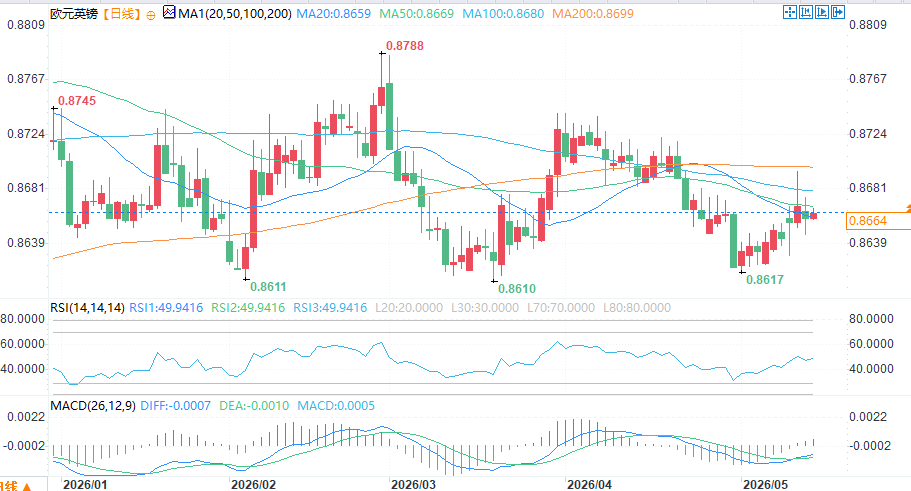
Looking at the EUR/GBP daily chart, the current exchange rate of 0.8663 is at a crucial technical juncture, which could be described as a "moving average weaving bag" or a "minefield for bulls and bears." From a structural perspective, the price has only managed a slight advantage of 4 minimum bid/ask units (MPB) above the MA20 (0.8659), but encountered resistance from the MA50 (0.8669) after just 6 pips upwards. Further up, there is a dense resistance zone formed by the MA100 (0.8680) and MA200 (0.8699). This means that within the mere 40 pips between 0.8660 and 0.8700, four important moving averages are densely packed, forming a complex resistance zone. Conversely, below, apart from the MA20, there is almost no significant moving average support up to the previous low of 0.8606. A break below the MA20 would open up a wide downtrend.
(Euro/Pound Sterling daily chart, source: FX678)
Looking at the daily moving average pattern for the EUR/GBP pair, the four moving averages are in a standard bullish alignment (MA20 < MA50 < MA100 < MA200). However, this is not a bullish signal—quite the opposite. Because the price has been trading below all moving averages for an extended period, it is currently only barely clinging to the lower MA20, creating a divergence structure of "bearish price alignment versus bullish moving average alignment." The typical characteristic of this structure is that the moving average system itself is trending upwards, but the price is struggling at the bottom of the moving average band, reflecting the contradiction between an oversold rebound after a prolonged decline and the lagging nature of medium- to long-term moving averages.
At this stage, any valid breakout in any direction requires confirmation from the daily closing price; intraday spikes are not meaningful. From a risk-reward perspective, it's not advisable to chase the price higher at the 0.8663 level (the upside potential is only about 30 points before encountering four moving averages), nor is it suitable to aggressively short (there's only the MA20 as a support level below). The most rational strategy is to wait for the closing signal in the aforementioned scenario before taking any action.
At 16:46 Beijing time on May 14, the euro was trading at 0.8663/64 against the pound.
UK data exceeded expectations across the board.
Preliminary data released by the UK Office for National Statistics on Thursday showed that GDP grew by 0.6% quarter-on-quarter in the first quarter of this year, in line with expectations and significantly faster than the previous figure of 0.2%. Monthly GDP figures provided a pleasant surprise – March saw a 0.3% month-on-month increase, far exceeding market expectations of a 0.2% contraction, easing concerns that the war with Iran could trigger a sharp economic downturn.
Meanwhile, manufacturing output rebounded sharply to 1.2% growth in March, after February's figure was revised down to a contraction of 0.2%, also far exceeding market expectations of a further contraction of 0.2%. Service sector activity (measured by the services index) also accelerated to 0.8% in March from 0.5% in February, higher than market expectations of 0.6%. These three sets of data together indicate that the UK economy demonstrated strong resilience in March.
Political uncertainty weighs on the pound
Despite better-than-expected economic data, the euro did not fall further against the pound. The underlying reason is the increasing political uncertainty in the UK – following the Labour Party's crushing defeat in local elections, Prime Minister Starmer faces pressure from over 80 MPs calling for him to set a timetable for his departure, and four junior ministers have already resigned. Political turmoil is offsetting the positive economic data, providing support for the exchange rate around 0.8660.
Eurozone focuses on Lagarde's speech
In the Eurozone, Spain's harmonized consumer price index (HCI) accelerated to 3.5% year-on-year in April from 3.4% in March, confirming the inflationary pressures brought about by the energy shock.
The market focus today will be on Lagarde's speech in Aachen, Germany. She may provide clues about the timing of the next rate hike—the market is currently pricing in the ECB taking tightening action in June or at the latest July. Any hawkish signals could provide support for the euro, limiting the downside for EUR/GBP.
Data and political maneuvering suggest the exchange rate may remain range-bound in the short term.
Overall, the UK's March GDP and manufacturing data exceeded expectations, easing market concerns about the economic impact of the Middle East conflict and providing fundamental support for the pound. However, political turmoil in the UK (Starmer facing a potential resignation) is offsetting this positive factor, causing the euro to find support against the pound around 0.8660. The focus today shifts to Lagarde's speech. If the ECB releases hawkish signals (hinting at a rate hike in June or July), the euro may be boosted, pushing the exchange rate towards 0.8700; if Lagarde's wording is cautious, the exchange rate may continue to fluctuate between 0.8600 and 0.8700. Traders should also pay close attention to further developments in the UK political situation.
Strategic response: Closing price determines direction; remain on the sidelines and observe.
Looking at the EUR/GBP daily chart, the current exchange rate of 0.8663 is at a crucial technical juncture, which could be described as a "moving average weaving bag" or a "minefield for bulls and bears." From a structural perspective, the price has only managed a slight advantage of 4 minimum bid/ask units (MPB) above the MA20 (0.8659), but encountered resistance from the MA50 (0.8669) after just 6 pips upwards. Further up, there is a dense resistance zone formed by the MA100 (0.8680) and MA200 (0.8699). This means that within the mere 40 pips between 0.8660 and 0.8700, four important moving averages are densely packed, forming a complex resistance zone. Conversely, below, apart from the MA20, there is almost no significant moving average support up to the previous low of 0.8606. A break below the MA20 would open up a wide downtrend.
(Euro/Pound Sterling daily chart, source: FX678)
Looking at the daily moving average pattern for the EUR/GBP pair, the four moving averages are in a standard bullish alignment (MA20 < MA50 < MA100 < MA200). However, this is not a bullish signal—quite the opposite. Because the price has been trading below all moving averages for an extended period, it is currently only barely clinging to the lower MA20, creating a divergence structure of "bearish price alignment versus bullish moving average alignment." The typical characteristic of this structure is that the moving average system itself is trending upwards, but the price is struggling at the bottom of the moving average band, reflecting the contradiction between an oversold rebound after a prolonged decline and the lagging nature of medium- to long-term moving averages.
At this stage, any valid breakout in any direction requires confirmation from the daily closing price; intraday spikes are not meaningful. From a risk-reward perspective, it's not advisable to chase the price higher at the 0.8663 level (the upside potential is only about 30 points before encountering four moving averages), nor is it suitable to aggressively short (there's only the MA20 as a support level below). The most rational strategy is to wait for the closing signal in the aforementioned scenario before taking any action.
At 16:46 Beijing time on May 14, the euro was trading at 0.8663/64 against the pound.
- Risk Warning and Disclaimer
- The market involves risk, and trading may not be suitable for all investors. This article is for reference only and does not constitute personal investment advice, nor does it take into account certain users’ specific investment objectives, financial situation, or other needs. Any investment decisions made based on this information are at your own risk.