Are gold holdings facing the risk of going to zero? Short-selling signals are strengthening amid accelerating inflation.
2026-05-14 17:34:33
On Thursday, May 14, spot gold prices fluctuated around $4,700 per ounce in early European trading. The latest US wholesale price index showed accelerated inflation in April, while the ongoing situation in the Middle East continued to impact energy prices, with gasoline prices rising by about 50% since the beginning of the conflict. This, coupled with rising costs in sectors such as aviation, housing, clothing, and food, collectively shaped the current trading environment for gold.
Data shows that the U.S. Consumer Price Index (CPI) rose 3.8% year-on-year in April, the highest level since 2023, and rose 0.6% month-on-month. The Producer Price Index (PPI) jumped 1.4% month-on-month and increased by 6% year-on-year, the largest increase since the end of 2022, mainly driven by energy prices.
This rebound in inflation has directly weakened market expectations for significant easing by the Federal Reserve this year. Traders are currently pricing in limited rate cuts by the Fed for the remainder of 2026, and the high-interest-rate environment may continue to suppress the cost advantage of holding gold.
The following is a comparison of key inflation indicators in recent times.
While core inflation remains relatively moderate, the spillover effects of energy consumption have spread to multiple consumer categories. In this context, the attractiveness of gold as a hedging tool depends on the path of real interest rates, rather than simply on safe-haven sentiment.
Following Warsh's confirmation as Federal Reserve Chairman, the market immediately assessed his impact on the direction of monetary policy. Gold prices hit record highs in January, partly due to concerns about the Fed's independence. Traders are now focused on whether Warsh will adhere to the traditional decision-making framework to avoid external pressures interfering with the interest rate path.
Historical experience shows that personnel changes at the Federal Reserve often trigger short-term fluctuations, but long-term gold price trends remain dominated by real interest rates and the dollar's performance. In the current environment, any signal hinting at a policy framework adjustment could amplify gold's sensitivity, especially given fluctuating inflation data.
The Middle East conflict has created uncertainty for shipping through the Strait of Hormuz, pushing up energy costs and indirectly supporting some commodity prices. Gold prices fell sharply at the beginning of the conflict, subsequently entering a narrow trading range, reflecting investors' weighing of inflation risks and growth concerns.
Silver saw significant gains in May, partly due to technical breakouts and a correlation with industrial demand. The recovery in copper prices and supply concerns drove silver prices higher, and silver, as a byproduct of copper mining, benefited from this trend. Traders observed strong trend signals in silver, zinc, and copper, with increased mechanical activity in open positions.
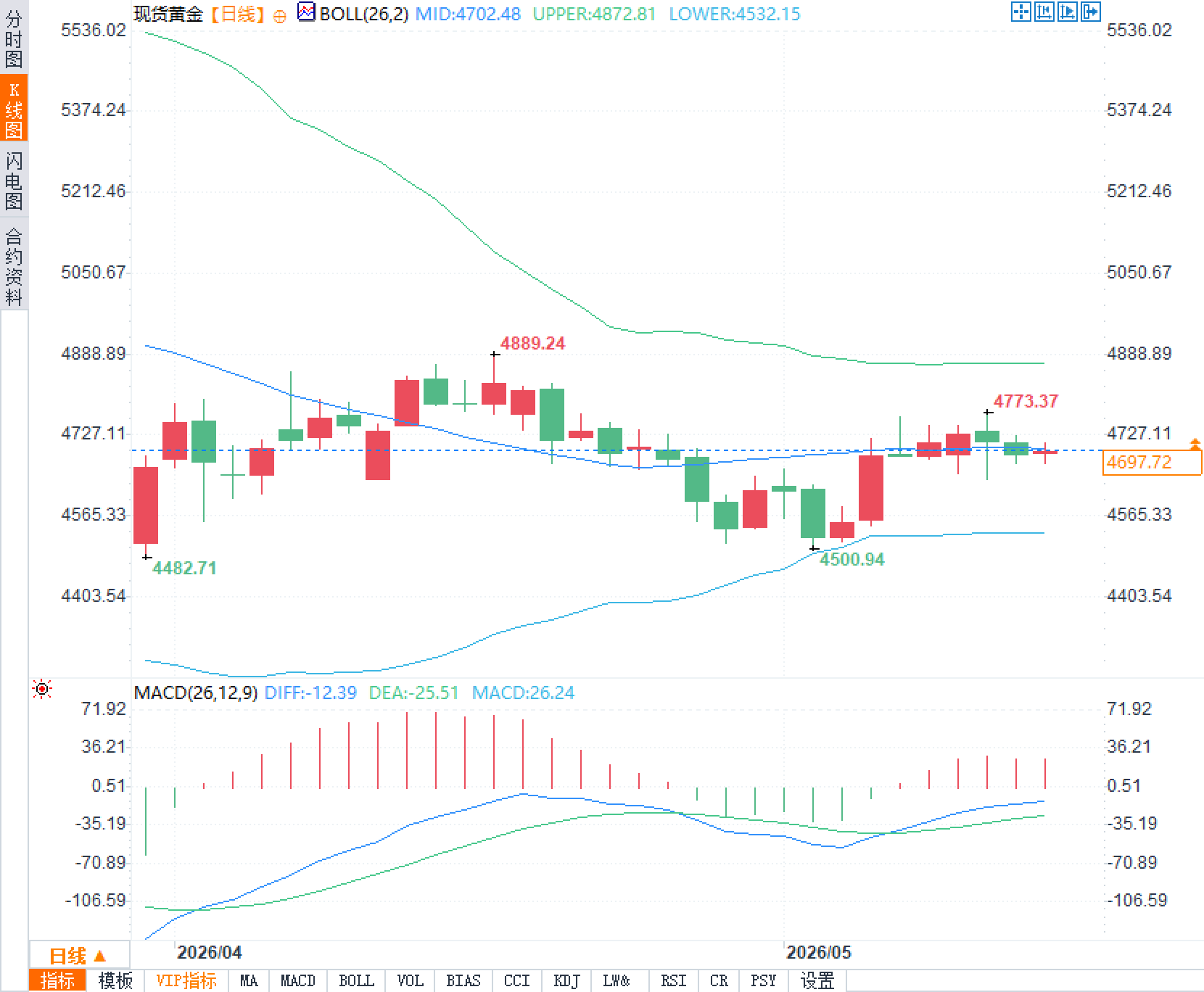
Spot gold is currently trading around $4,700 per ounce, while silver is around $87. The US dollar index is holding steady above 98, which may further limit the upside potential for gold.
Better-than-expected inflation data reinforces bets on high interest rates
Data shows that the U.S. Consumer Price Index (CPI) rose 3.8% year-on-year in April, the highest level since 2023, and rose 0.6% month-on-month. The Producer Price Index (PPI) jumped 1.4% month-on-month and increased by 6% year-on-year, the largest increase since the end of 2022, mainly driven by energy prices.
This rebound in inflation has directly weakened market expectations for significant easing by the Federal Reserve this year. Traders are currently pricing in limited rate cuts by the Fed for the remainder of 2026, and the high-interest-rate environment may continue to suppress the cost advantage of holding gold.
The following is a comparison of key inflation indicators in recent times.
| index | April year-on-year | Previous value | change |
|---|---|---|---|
| Consumer Price Index | 3.8% | 3.3% | +0.5 percentage points |
| Producer Price Index | 6.0% | Approximately 4.3% | Significant acceleration |
| Energy sub-item | 17.9% | 12.5% | accelerate |
Federal Reserve leadership changes and policy independence considerations
Following Warsh's confirmation as Federal Reserve Chairman, the market immediately assessed his impact on the direction of monetary policy. Gold prices hit record highs in January, partly due to concerns about the Fed's independence. Traders are now focused on whether Warsh will adhere to the traditional decision-making framework to avoid external pressures interfering with the interest rate path.
Historical experience shows that personnel changes at the Federal Reserve often trigger short-term fluctuations, but long-term gold price trends remain dominated by real interest rates and the dollar's performance. In the current environment, any signal hinting at a policy framework adjustment could amplify gold's sensitivity, especially given fluctuating inflation data.
Geopolitical factors and commodity linkage
The Middle East conflict has created uncertainty for shipping through the Strait of Hormuz, pushing up energy costs and indirectly supporting some commodity prices. Gold prices fell sharply at the beginning of the conflict, subsequently entering a narrow trading range, reflecting investors' weighing of inflation risks and growth concerns.
Silver saw significant gains in May, partly due to technical breakouts and a correlation with industrial demand. The recovery in copper prices and supply concerns drove silver prices higher, and silver, as a byproduct of copper mining, benefited from this trend. Traders observed strong trend signals in silver, zinc, and copper, with increased mechanical activity in open positions.
Spot gold is currently trading around $4,700 per ounce, while silver is around $87. The US dollar index is holding steady above 98, which may further limit the upside potential for gold.
Frequently Asked Questions
Question 1: Why has gold failed to maintain its upward trend in the current environment of high inflation?
A: While rising inflation is generally good for gold, the simultaneous increase in real interest rates and Treasury yields raises the opportunity cost of holding positions. The latest PPI and CPI data reinforced expectations of high interest rates from the Federal Reserve, causing gold to fluctuate under pressure around $4,700 per ounce. Geopolitical conflicts, while pushing up energy prices, have not fully translated into a safe-haven premium for gold.
Question 2: How will the appointment of the new Federal Reserve Chairman, Warsh, affect gold prices?
A: Following Warsh's confirmation, market focus has shifted to his policy independence and strategies for dealing with inflation. If his decision-making framework remains consistent, gold price fluctuations will likely be primarily data-driven; unexpected signals could amplify short-term uncertainty. However, in the long term, real interest rates remain the dominant variable.
Question 3: What is the logic behind silver's strong performance while gold's stagnation?
A: Silver possesses both monetary and industrial attributes. Its 19% gain in May was primarily driven by technical breakthroughs and concerns about copper supply. Gold, on the other hand, is more influenced by its financial attributes and has been relatively cautious in a high-interest-rate environment. Traders pay attention to the gold-silver ratio as an indicator of market risk appetite.
- Risk Warning and Disclaimer
- The market involves risk, and trading may not be suitable for all investors. This article is for reference only and does not constitute personal investment advice, nor does it take into account certain users’ specific investment objectives, financial situation, or other needs. Any investment decisions made based on this information are at your own risk.