The certainty of a June rate hike by the European Central Bank has decreased, and the euro/dollar exchange rate is trapped in a moving average range.
2026-05-14 18:07:04
Just two weeks after Christine Lagarde reminded investors that the European Central Bank was moving toward raising interest rates, the certainty of a June rate hike is waning. With oil prices not surging as much as many feared, rising energy costs have yet to trigger broader inflationary spillovers, and the economies of the 20 eurozone are stagnating, officials' stances appear to be shifting.
Previously, ECB officials had stated that monetary policy tightening would be necessary unless price pressures eased and the Middle East conflict ended. Now, they indicate that the inflation outlook must deteriorate further before they will take action.
This shift contrasts sharply with Lagarde's unexpected remarks after the last ECB meeting—"I know where we're going"—driven by the ongoing uncertainty surrounding Iran. This factor has also kept other central banks around the world on hold, hoping that a resolution to the war might prevent them from taking measures that would harm economic growth through interest rate hikes.
EFG Bank's chief economist and former deputy governor of the Central Bank of Ireland, Stefan Gerlach, said: "A rate hike in June is still possible and may ultimately prove necessary, but the possibility of holding rates steady also exists. This option deserves more serious consideration than the current market consensus allows."
Recent data supports the view that higher borrowing costs priced in by the market are not inevitable. Surveys indicate that inflation is accelerating in the short term, but medium- and long-term expectations remain stable. Similarly, wage growth appears to be under control, with the rate of increase still well below previous peaks.
Finnish central bank governor Olli Rehn said on Wednesday that inflation expectations "remain anchored" and that wage dynamics in the eurozone are "reassuring." Even Isabel Schnabel, the ECB's most hawkish executive board member, said this month that while the risks of tightening monetary policy have increased, action would only be needed if "energy price shocks escalate."
Furthermore, the eurozone economy barely expanded in the first quarter, followed by a decline in the service sector. Further weakness could offset upward inflationary pressures and provide justification for the ECB to hold rates steady.
The retiring vice governor, Louis de Guindos, urged caution, citing the impact of growth—an impact he believes will "become more apparent in the coming weeks." Meanwhile, Greece's Yannis Stornaras stated that concerns about a recession are "real and reasonable."
Anatoly Anenkov, senior economist at Société Générale, said: "We have already seen some weakness in the economy. This will curb inflationary pressures and reduce the risk of a second round of effects. Therefore, policy tightening should not be a foregone conclusion."
However, for some officials, rate hikes are still in the works. Traders are betting on three rate hikes starting in June, while economists surveyed by Bloomberg predict 25 basis point increases in both June and September.
Their assessment likely stems from hawkish figures within the ECB, such as Joachim Nagel of Germany, Martin Kocher of Austria, and Peter Kazimir of Slovakia. They have all indicated that only positive news regarding the war situation could prevent a rate hike at the next meeting.
Paul Hollingsworth of BNP Paribas said: "Recent communications from the ECB suggest that a rate hike is either inevitable or the default option—unless there is a major surprise. If energy prices rise significantly further, we might even see discussions about a larger rate hike."
However, a larger rate hike seems unlikely. When asked about the idea, Nagel responded, "Dream on." But policymakers face a difficult choice: demonstrate resolve by raising rates but risk a swift policy reversal, or wait longer and potentially be forced to catch up.
Lagarde astutely recognized that the ECB had made both mistakes in the past. "We have been caught between the risks of reacting too quickly and reacting too late," she told Spanish television last week.
Katherine Nais, chief European economist for fixed income at Prudential, summarized: "The situation in the Middle East is likely to remain highly uncertain for some time to come. Therefore, the ECB will want to avoid locking itself onto a particular policy path."
Overall, the certainty of a June rate hike by the European Central Bank is declining due to weaker-than-expected oil price increases, limited inflation spillover effects, a weak Eurozone economy, and ongoing uncertainty surrounding the war with Iran. While some hawkish officials still advocate for a rate hike, and the market is still pricing in the possibility of a June action, mounting data and economic weakness support the option of "holding steady." Lagarde and ECB officials are attempting to strike a balance between the historical risks of "overreacting" and "overreacting." In the coming weeks, developments in the Middle East, energy price trends, and Eurozone economic data will be key variables in determining whether a rate hike will occur in June.
The fading expectations of interest rate hikes directly suppressed the euro's upward momentum, which was particularly evident in the euro's exchange rate against the US dollar.
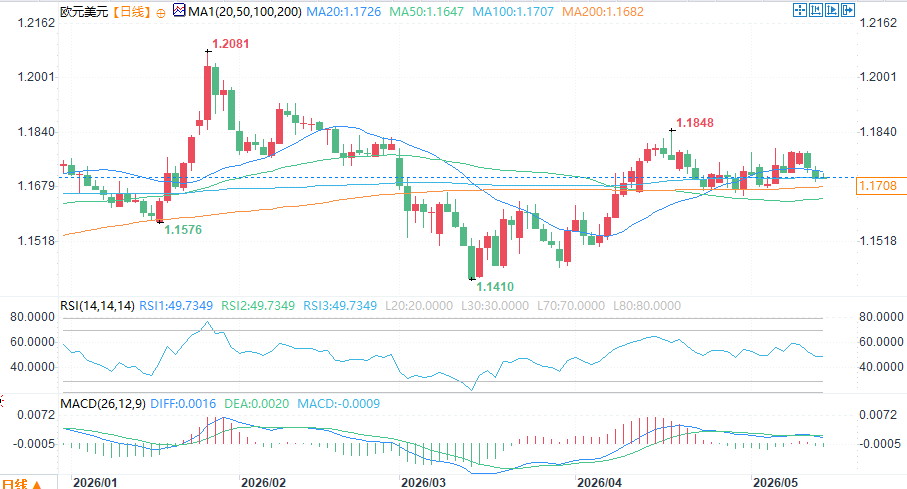
(Euro/USD daily chart, source: FX678)
According to the daily chart of the euro against the US dollar, the current technical pattern shows typical weak and volatile characteristics, with the bulls and bears repeatedly tug-of-war near key moving averages.
Regarding the moving average system, the exchange rate is currently trading between multiple moving averages. If the current price is around 1.1710, it's positioned between the 20-day moving average (MA20) (1.1726) and the 100-day moving average (MA100) (1.1707). Resistance is located in the 1.1726-1.1730 area (MA20 and recent high), while support is concentrated in the 1.1680-1.1700 range (where the MA100 and MA200 intersect). Strategically, it's advisable to remain on the sidelines within the 1.1680-1.1730 range and wait for a closing price breakout to confirm the direction.
At 17:59 Beijing time on May 14, the euro was trading at 1.1708/09 against the US dollar.
From "clear direction" to "condition triggering"
Previously, ECB officials had stated that monetary policy tightening would be necessary unless price pressures eased and the Middle East conflict ended. Now, they indicate that the inflation outlook must deteriorate further before they will take action.
This shift contrasts sharply with Lagarde's unexpected remarks after the last ECB meeting—"I know where we're going"—driven by the ongoing uncertainty surrounding Iran. This factor has also kept other central banks around the world on hold, hoping that a resolution to the war might prevent them from taking measures that would harm economic growth through interest rate hikes.
EFG Bank's chief economist and former deputy governor of the Central Bank of Ireland, Stefan Gerlach, said: "A rate hike in June is still possible and may ultimately prove necessary, but the possibility of holding rates steady also exists. This option deserves more serious consideration than the current market consensus allows."
Data supports the rationale for "holding back".
Recent data supports the view that higher borrowing costs priced in by the market are not inevitable. Surveys indicate that inflation is accelerating in the short term, but medium- and long-term expectations remain stable. Similarly, wage growth appears to be under control, with the rate of increase still well below previous peaks.
Finnish central bank governor Olli Rehn said on Wednesday that inflation expectations "remain anchored" and that wage dynamics in the eurozone are "reassuring." Even Isabel Schnabel, the ECB's most hawkish executive board member, said this month that while the risks of tightening monetary policy have increased, action would only be needed if "energy price shocks escalate."
Weak economy becomes an obstacle to interest rate hikes
Furthermore, the eurozone economy barely expanded in the first quarter, followed by a decline in the service sector. Further weakness could offset upward inflationary pressures and provide justification for the ECB to hold rates steady.
The retiring vice governor, Louis de Guindos, urged caution, citing the impact of growth—an impact he believes will "become more apparent in the coming weeks." Meanwhile, Greece's Yannis Stornaras stated that concerns about a recession are "real and reasonable."
Anatoly Anenkov, senior economist at Société Générale, said: "We have already seen some weakness in the economy. This will curb inflationary pressures and reduce the risk of a second round of effects. Therefore, policy tightening should not be a foregone conclusion."
Hawks insist a rate hike is imminent, but market disagreement persists.
However, for some officials, rate hikes are still in the works. Traders are betting on three rate hikes starting in June, while economists surveyed by Bloomberg predict 25 basis point increases in both June and September.
Their assessment likely stems from hawkish figures within the ECB, such as Joachim Nagel of Germany, Martin Kocher of Austria, and Peter Kazimir of Slovakia. They have all indicated that only positive news regarding the war situation could prevent a rate hike at the next meeting.
Paul Hollingsworth of BNP Paribas said: "Recent communications from the ECB suggest that a rate hike is either inevitable or the default option—unless there is a major surprise. If energy prices rise significantly further, we might even see discussions about a larger rate hike."
However, a larger rate hike seems unlikely. When asked about the idea, Nagel responded, "Dream on." But policymakers face a difficult choice: demonstrate resolve by raising rates but risk a swift policy reversal, or wait longer and potentially be forced to catch up.
Lagarde's Dilemma: Historical Lessons and Middle East Uncertainty
Lagarde astutely recognized that the ECB had made both mistakes in the past. "We have been caught between the risks of reacting too quickly and reacting too late," she told Spanish television last week.
Katherine Nais, chief European economist for fixed income at Prudential, summarized: "The situation in the Middle East is likely to remain highly uncertain for some time to come. Therefore, the ECB will want to avoid locking itself onto a particular policy path."
Overall, the certainty of a June rate hike by the European Central Bank is declining due to weaker-than-expected oil price increases, limited inflation spillover effects, a weak Eurozone economy, and ongoing uncertainty surrounding the war with Iran. While some hawkish officials still advocate for a rate hike, and the market is still pricing in the possibility of a June action, mounting data and economic weakness support the option of "holding steady." Lagarde and ECB officials are attempting to strike a balance between the historical risks of "overreacting" and "overreacting." In the coming weeks, developments in the Middle East, energy price trends, and Eurozone economic data will be key variables in determining whether a rate hike will occur in June.
Strategy: Remain inactive until the closing price breaks through.
The fading expectations of interest rate hikes directly suppressed the euro's upward momentum, which was particularly evident in the euro's exchange rate against the US dollar.
(Euro/USD daily chart, source: FX678)
According to the daily chart of the euro against the US dollar, the current technical pattern shows typical weak and volatile characteristics, with the bulls and bears repeatedly tug-of-war near key moving averages.
Regarding the moving average system, the exchange rate is currently trading between multiple moving averages. If the current price is around 1.1710, it's positioned between the 20-day moving average (MA20) (1.1726) and the 100-day moving average (MA100) (1.1707). Resistance is located in the 1.1726-1.1730 area (MA20 and recent high), while support is concentrated in the 1.1680-1.1700 range (where the MA100 and MA200 intersect). Strategically, it's advisable to remain on the sidelines within the 1.1680-1.1730 range and wait for a closing price breakout to confirm the direction.
At 17:59 Beijing time on May 14, the euro was trading at 1.1708/09 against the US dollar.
- Risk Warning and Disclaimer
- The market involves risk, and trading may not be suitable for all investors. This article is for reference only and does not constitute personal investment advice, nor does it take into account certain users’ specific investment objectives, financial situation, or other needs. Any investment decisions made based on this information are at your own risk.