Is Japan's summer price surge imminent, and is the yen nearing a turning point?
2026-05-15 14:08:11
The Bank of Japan said on Friday (May 15) that Japan may face another round of widespread price increases around summer as businesses ranging from food manufacturers to hot spring resorts consider passing on soaring energy costs caused by the Middle East conflict. The report, based on a survey of local businesses conducted from January to April, noted that many service sector companies are abandoning their long-standing practice of maintaining low prices and steadily passing on rising raw material and labor costs.
The report states that rising energy costs due to the Middle East conflict are also prompting businesses to accelerate price increases in their operating plans for the current fiscal year (starting in April). Some businesses, including those in the food industry, restaurants, and spa facilities, have already decided to raise prices at a faster pace. The report also notes, "Other businesses have indicated they will soon decide whether to raise prices. As for the specific timing, some businesses say they will make a decision around or after the summer."
The report highlights the Bank of Japan's growing concern about escalating inflationary pressures in the economy, providing further justification for a near-term interest rate hike. Further emphasizing the cost pressures faced by businesses is the fact that the annual wholesale inflation rate hit a three-year high of 4.9% in April, driven by the war in Iran that has pushed up prices for oil and chemical products.
The report states that Japanese service companies are taking less time to decide on price increases compared to when raw material prices surged at the start of the Russia-Ukraine conflict in 2022. "Previously, companies needed to spend a lot of time on internal discussions and negotiations with customers. Some companies indicated that this time the process was relatively quick because they had already been raising prices for some time."
The Bank of Japan's report sent a clear signal: soaring energy costs triggered by the Middle East conflict are accelerating the price transmission mechanism within Japan. Service sector companies are breaking with their "low-price conventions" and passing on costs to consumers more quickly, meaning that inflationary pressures in Japan may be more persistent than expected. With wholesale inflation at a three-year high, coupled with companies raising prices across a wider range of services from food to spa facilities, the probability of a Bank of Japan interest rate hike is rising. Market expectations of a new wave of price increases around summer will further strengthen the central bank's case for adjusting monetary policy sooner rather than later.
The Bank of Japan's report explicitly stated its "growing concern" about inflationary pressures, noting that companies are making price increase decisions faster than during the 2022 Russia-Ukraine conflict. This indicates that the price transmission mechanism is accelerating, increasing the urgency for the Bank of Japan to raise interest rates to achieve a "virtuous cycle of wages and inflation." Currently, the market is pricing in a 25 basis point rate hike by the Bank of Japan in June, up from 55% to 60%.
As a result, the yen has shown relative resilience recently. On Friday, the USD/JPY pair was trading around 158.60, up slightly by about 0.15% on the day, reaching a high of 158.64 and a low of 158.25, a range of about 0.25%. Previously, the USD/JPY had risen for four consecutive trading days, climbing from around 156.50 to around 158.60, a cumulative increase of about 1.3%, marking its longest winning streak since May. Despite the US dollar index strongly rising above 99, the USD/JPY encountered significant resistance near the 160.00 level and has not yet broken through the high of 160.47 reached at the end of April. The current exchange rate is trading around 158.63. This indicates that the market is reassessing the outlook for the USD/JPY interest rate differential—if the Bank of Japan does indeed raise interest rates in June while the Federal Reserve remains on hold, the USD/JPY interest rate differential will begin to narrow, and the yen may be approaching a trend reversal.
According to the USD/JPY daily chart, the current technical pattern shows a high-level consolidation with unclear direction. The price is trading between multiple moving averages: the 20-day moving average (MA20) at 158.209, the 50-day moving average (MA50) at 158.73, the 100-day moving average (MA100) at 157.403, and the 200-day moving average (MA200) at 154.467. The current price is trading around 158.56, having broken above the MA20 (158.209) and is challenging the MA50 (158.728), but has not yet achieved a significant breakout, currently positioned in the upper edge of the moving average consolidation zone.
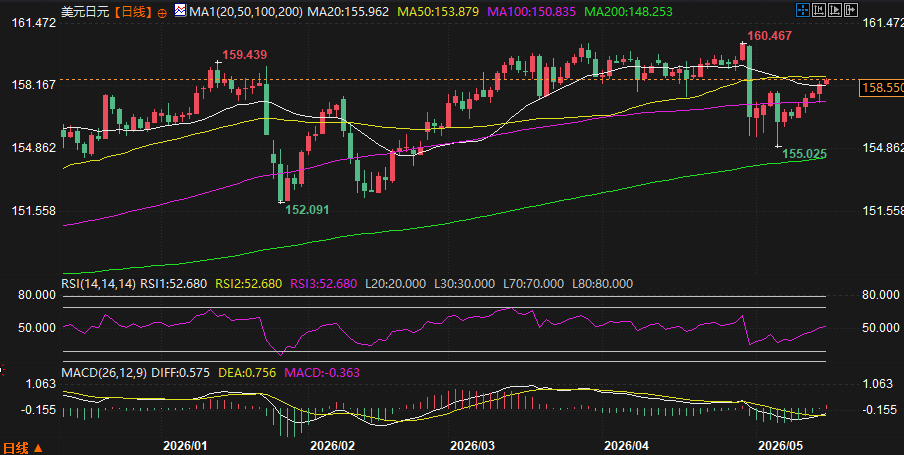
(USD/JPY daily chart, source: FX678)
The short-term direction depends on whether 158.73 is breached: a decisive break and hold above this level could lead to tests of 159.44 and even 160.47; conversely, a pullback below 157.40 (MA100) could see further declines towards the 155.00-154.86 range. Strategically, it's advisable to remain on the sidelines until the direction becomes clearer, or maintain a buy-low-sell-high strategy within the 158.00-158.73 range, and then follow the trend after a breakout.
At 14:06 Beijing time on May 15, the USD/JPY exchange rate was 158.63/64.
Energy costs are driving companies to accelerate price increases.
The report states that rising energy costs due to the Middle East conflict are also prompting businesses to accelerate price increases in their operating plans for the current fiscal year (starting in April). Some businesses, including those in the food industry, restaurants, and spa facilities, have already decided to raise prices at a faster pace. The report also notes, "Other businesses have indicated they will soon decide whether to raise prices. As for the specific timing, some businesses say they will make a decision around or after the summer."
Wholesale inflation hits a three-year high, prompting faster price increase decisions.
The report highlights the Bank of Japan's growing concern about escalating inflationary pressures in the economy, providing further justification for a near-term interest rate hike. Further emphasizing the cost pressures faced by businesses is the fact that the annual wholesale inflation rate hit a three-year high of 4.9% in April, driven by the war in Iran that has pushed up prices for oil and chemical products.
The report states that Japanese service companies are taking less time to decide on price increases compared to when raw material prices surged at the start of the Russia-Ukraine conflict in 2022. "Previously, companies needed to spend a lot of time on internal discussions and negotiations with customers. Some companies indicated that this time the process was relatively quick because they had already been raising prices for some time."
The Bank of Japan's report sent a clear signal: soaring energy costs triggered by the Middle East conflict are accelerating the price transmission mechanism within Japan. Service sector companies are breaking with their "low-price conventions" and passing on costs to consumers more quickly, meaning that inflationary pressures in Japan may be more persistent than expected. With wholesale inflation at a three-year high, coupled with companies raising prices across a wider range of services from food to spa facilities, the probability of a Bank of Japan interest rate hike is rising. Market expectations of a new wave of price increases around summer will further strengthen the central bank's case for adjusting monetary policy sooner rather than later.
Rising inflation strengthens expectations of interest rate hikes, providing fundamental support for the yen.
The Bank of Japan's report explicitly stated its "growing concern" about inflationary pressures, noting that companies are making price increase decisions faster than during the 2022 Russia-Ukraine conflict. This indicates that the price transmission mechanism is accelerating, increasing the urgency for the Bank of Japan to raise interest rates to achieve a "virtuous cycle of wages and inflation." Currently, the market is pricing in a 25 basis point rate hike by the Bank of Japan in June, up from 55% to 60%.
As a result, the yen has shown relative resilience recently. On Friday, the USD/JPY pair was trading around 158.60, up slightly by about 0.15% on the day, reaching a high of 158.64 and a low of 158.25, a range of about 0.25%. Previously, the USD/JPY had risen for four consecutive trading days, climbing from around 156.50 to around 158.60, a cumulative increase of about 1.3%, marking its longest winning streak since May. Despite the US dollar index strongly rising above 99, the USD/JPY encountered significant resistance near the 160.00 level and has not yet broken through the high of 160.47 reached at the end of April. The current exchange rate is trading around 158.63. This indicates that the market is reassessing the outlook for the USD/JPY interest rate differential—if the Bank of Japan does indeed raise interest rates in June while the Federal Reserve remains on hold, the USD/JPY interest rate differential will begin to narrow, and the yen may be approaching a trend reversal.
High-level fluctuations, moving average sandwiched between layers
According to the USD/JPY daily chart, the current technical pattern shows a high-level consolidation with unclear direction. The price is trading between multiple moving averages: the 20-day moving average (MA20) at 158.209, the 50-day moving average (MA50) at 158.73, the 100-day moving average (MA100) at 157.403, and the 200-day moving average (MA200) at 154.467. The current price is trading around 158.56, having broken above the MA20 (158.209) and is challenging the MA50 (158.728), but has not yet achieved a significant breakout, currently positioned in the upper edge of the moving average consolidation zone.
(USD/JPY daily chart, source: FX678)
The short-term direction depends on whether 158.73 is breached: a decisive break and hold above this level could lead to tests of 159.44 and even 160.47; conversely, a pullback below 157.40 (MA100) could see further declines towards the 155.00-154.86 range. Strategically, it's advisable to remain on the sidelines until the direction becomes clearer, or maintain a buy-low-sell-high strategy within the 158.00-158.73 range, and then follow the trend after a breakout.
At 14:06 Beijing time on May 15, the USD/JPY exchange rate was 158.63/64.
- Risk Warning and Disclaimer
- The market involves risk, and trading may not be suitable for all investors. This article is for reference only and does not constitute personal investment advice, nor does it take into account certain users’ specific investment objectives, financial situation, or other needs. Any investment decisions made based on this information are at your own risk.