The euro suffered its biggest weekly drop since mid-March, with the 1.16 level looming in danger.
2026-05-15 17:50:53
On Friday (May 15) during the European session, the euro weakened against a basket of global currencies and fell for the fifth consecutive trading day against the dollar, hitting its weakest level in five weeks.

The euro is on track for its biggest weekly drop since mid-March this week, as investors continue to favor the dollar as the best investment option, especially as market expectations rise that the Federal Reserve may raise interest rates this year to curb growing inflationary pressures in the United States. The market also increased its pricing in a June rate hike by the European Central Bank this week, while traders continue to await more economic data from the eurozone to reassess these expectations.
On Friday, the euro continued its recent weakness against the dollar, currently trading around 1.1624, down 0.38% on the day. It touched a low of 1.1616, a five-week low since April 8th, before rebounding to a high of 1.1672 before encountering resistance and falling back. Previously, on Thursday, the euro had already closed down 0.35% against the dollar, marking its fourth consecutive day of decline.
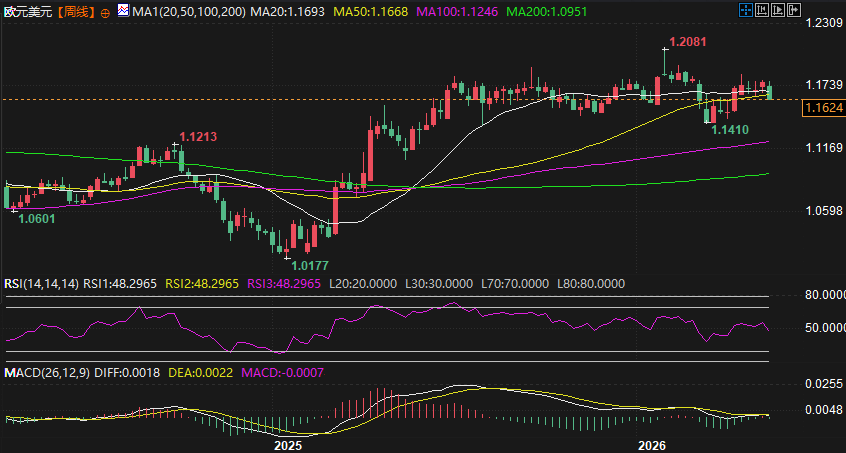
(Euro/USD weekly chart, source: FX678)
Looking at the overall performance this week, the euro has fallen by more than 1.2% against the US dollar, and is on track for its first weekly decline in the past three weeks, as well as its largest weekly drop since mid-March.
A strong US dollar – indices rise for the fifth consecutive day, and the probability of an interest rate hike rises to 45%.
The dollar index is currently up 0.37%, marking its fifth consecutive day of gains and reaching its highest level in five weeks, reflecting the continued broad-based strengthening of the dollar against a basket of global currencies. The dollar also received additional support from rising US Treasury yields as investors increased their bets on at least one rate hike by the Federal Reserve this year.
Data released this week showed that U.S. consumer prices rose at their fastest pace in three years in April, while producer prices recorded their largest increase in four years, highlighting a new wave of inflationary pressures facing Federal Reserve policymakers. According to the CME Group's FedWatch tool, the market is currently pricing in a 45% probability of a Fed rate hike in December, compared to just over 16% a week ago.
With global oil prices rising this week, the money market has raised its pricing of a 25-basis-point rate hike by the European Central Bank in June from 45% to 50%. Investors are now awaiting more data on eurozone inflation, unemployment, and wages to further reassess these expectations.
Overall, the euro/dollar is currently facing multiple pressures: better-than-expected US inflation data has pushed the market's pricing of a Fed rate hike probability to 45%, and the dollar index has risen for five consecutive weeks; meanwhile, although the market's pricing of a June rate hike by the European Central Bank has increased, its magnitude is far less than the hawkish expectations on the dollar side. Against the backdrop of widening expectations of divergence in US and European monetary policies, the euro has fallen against the dollar for five consecutive days, with a cumulative weekly decline of over 1.2%, marking the largest weekly drop since mid-March. In the short term, the euro may continue to be under pressure, and market focus will shift to subsequent Eurozone economic data and the further impact of the Middle East situation on energy prices. The 1.1600 level will become a crucial psychological defense line for euro bulls; a breach of this level could lead to further declines towards previous lows.
Commerzbank analyst Volkmar Baur offers a relatively optimistic perspective. He believes the market is more sensitive to the European Central Bank's interest rate expectations than the Federal Reserve's to changes in oil prices. If the US-Iran conflict ends and the Strait of Hormuz reopens, leading to a drop in oil prices, inflation expectations in the Eurozone will decline more sharply than in the US, thus shifting the Eurozone's real interest rate differential in favor of the euro, which would boost the euro-dollar exchange rate.
Rabobank senior FX strategist Jane Foley holds a more restrained view. She anticipates that interest rate differentials will provide an upward bias for EUR/USD in the second half of the year, but believes the upside will be limited. The core reason is that, as an energy-import-dependent economy, the Eurozone is currently experiencing a more severe impact on growth from supply shocks than the United States.
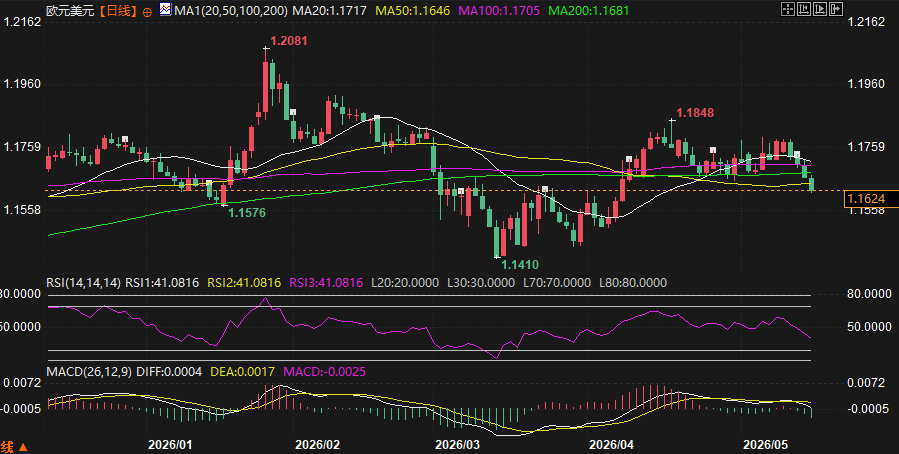
From a technical perspective, according to the EUR/USD daily chart, the current technical pattern clearly shows a bearish dominance, with the price effectively breaking below multiple key moving averages, and the downward trend is accelerating. Specifically, the 20-day moving average (MA20) is at 1.1717, the 50-day moving average (MA50) is at 1.1646, the 100-day moving average (MA100) is at 1.1705, and the 200-day moving average (MA200) is at 1.1681. The current exchange rate is trading around 1.1624 (with an intraday low of 1.1576), significantly lower than the MA20, MA100, MA200, and MA50. Furthermore, the MA50 has crossed below the MA100 and MA200, forming a typical "death cross" bearish signal. Observing recent price action, EUR/USD has been declining continuously since peaking around 1.2081, successively breaking through multiple support levels such as 1.1960, 1.1848, and 1.1759, forming a clear downward channel structure with lower highs and lower lows. The price is currently testing short-term support around 1.1624. If this level is broken, the next target will be 1.1576 and even the 1.1410-1.1398 area – the latter being the lower support level marked on the chart.
The euro is on track for its biggest weekly drop since mid-March this week, as investors continue to favor the dollar as the best investment option, especially as market expectations rise that the Federal Reserve may raise interest rates this year to curb growing inflationary pressures in the United States. The market also increased its pricing in a June rate hike by the European Central Bank this week, while traders continue to await more economic data from the eurozone to reassess these expectations.
This week's performance – marking the largest weekly drop since mid-March.
On Friday, the euro continued its recent weakness against the dollar, currently trading around 1.1624, down 0.38% on the day. It touched a low of 1.1616, a five-week low since April 8th, before rebounding to a high of 1.1672 before encountering resistance and falling back. Previously, on Thursday, the euro had already closed down 0.35% against the dollar, marking its fourth consecutive day of decline.
(Euro/USD weekly chart, source: FX678)
Looking at the overall performance this week, the euro has fallen by more than 1.2% against the US dollar, and is on track for its first weekly decline in the past three weeks, as well as its largest weekly drop since mid-March.
A strong US dollar – indices rise for the fifth consecutive day, and the probability of an interest rate hike rises to 45%.
The dollar index is currently up 0.37%, marking its fifth consecutive day of gains and reaching its highest level in five weeks, reflecting the continued broad-based strengthening of the dollar against a basket of global currencies. The dollar also received additional support from rising US Treasury yields as investors increased their bets on at least one rate hike by the Federal Reserve this year.
Data released this week showed that U.S. consumer prices rose at their fastest pace in three years in April, while producer prices recorded their largest increase in four years, highlighting a new wave of inflationary pressures facing Federal Reserve policymakers. According to the CME Group's FedWatch tool, the market is currently pricing in a 45% probability of a Fed rate hike in December, compared to just over 16% a week ago.
European interest rates – June rate hike priced in to reach 50%
With global oil prices rising this week, the money market has raised its pricing of a 25-basis-point rate hike by the European Central Bank in June from 45% to 50%. Investors are now awaiting more data on eurozone inflation, unemployment, and wages to further reassess these expectations.
Overall, the euro/dollar is currently facing multiple pressures: better-than-expected US inflation data has pushed the market's pricing of a Fed rate hike probability to 45%, and the dollar index has risen for five consecutive weeks; meanwhile, although the market's pricing of a June rate hike by the European Central Bank has increased, its magnitude is far less than the hawkish expectations on the dollar side. Against the backdrop of widening expectations of divergence in US and European monetary policies, the euro has fallen against the dollar for five consecutive days, with a cumulative weekly decline of over 1.2%, marking the largest weekly drop since mid-March. In the short term, the euro may continue to be under pressure, and market focus will shift to subsequent Eurozone economic data and the further impact of the Middle East situation on energy prices. The 1.1600 level will become a crucial psychological defense line for euro bulls; a breach of this level could lead to further declines towards previous lows.
Can falling oil prices save the euro?
Commerzbank analyst Volkmar Baur offers a relatively optimistic perspective. He believes the market is more sensitive to the European Central Bank's interest rate expectations than the Federal Reserve's to changes in oil prices. If the US-Iran conflict ends and the Strait of Hormuz reopens, leading to a drop in oil prices, inflation expectations in the Eurozone will decline more sharply than in the US, thus shifting the Eurozone's real interest rate differential in favor of the euro, which would boost the euro-dollar exchange rate.
Rabobank senior FX strategist Jane Foley holds a more restrained view. She anticipates that interest rate differentials will provide an upward bias for EUR/USD in the second half of the year, but believes the upside will be limited. The core reason is that, as an energy-import-dependent economy, the Eurozone is currently experiencing a more severe impact on growth from supply shocks than the United States.
From a technical perspective, according to the EUR/USD daily chart, the current technical pattern clearly shows a bearish dominance, with the price effectively breaking below multiple key moving averages, and the downward trend is accelerating. Specifically, the 20-day moving average (MA20) is at 1.1717, the 50-day moving average (MA50) is at 1.1646, the 100-day moving average (MA100) is at 1.1705, and the 200-day moving average (MA200) is at 1.1681. The current exchange rate is trading around 1.1624 (with an intraday low of 1.1576), significantly lower than the MA20, MA100, MA200, and MA50. Furthermore, the MA50 has crossed below the MA100 and MA200, forming a typical "death cross" bearish signal. Observing recent price action, EUR/USD has been declining continuously since peaking around 1.2081, successively breaking through multiple support levels such as 1.1960, 1.1848, and 1.1759, forming a clear downward channel structure with lower highs and lower lows. The price is currently testing short-term support around 1.1624. If this level is broken, the next target will be 1.1576 and even the 1.1410-1.1398 area – the latter being the lower support level marked on the chart.
- Risk Warning and Disclaimer
- The market involves risk, and trading may not be suitable for all investors. This article is for reference only and does not constitute personal investment advice, nor does it take into account certain users’ specific investment objectives, financial situation, or other needs. Any investment decisions made based on this information are at your own risk.