A chart shows that the Baltic Dry Index is weakening, leading to a decrease in Capesize freight rates.
2026-05-16 00:24:52
Latest data shows that on May 15, 2026, the Baltic Dry Index (BDI) was 3151 points, a three-day low, down 1.38% from the previous day, the largest drop since May 8, 2026. Looking at the short-term charts, the BDI has seen positive growth 9 times, negative growth 2 times, and zero growth in the last 11 BDI readings. Specifically, the Panamax Freight Index (BPI) was 2521 points, up 0.72% from the previous day; the Capesize Freight Index (BCI) was 5173 points, down 2.69%; and the Supramax Freight Index (BSI) was 1565 points, up 0.45%. For detailed 720-day and 10-year trend charts of the Baltic Dry Index and its three main sub-indices, please refer to the specially designed charts.
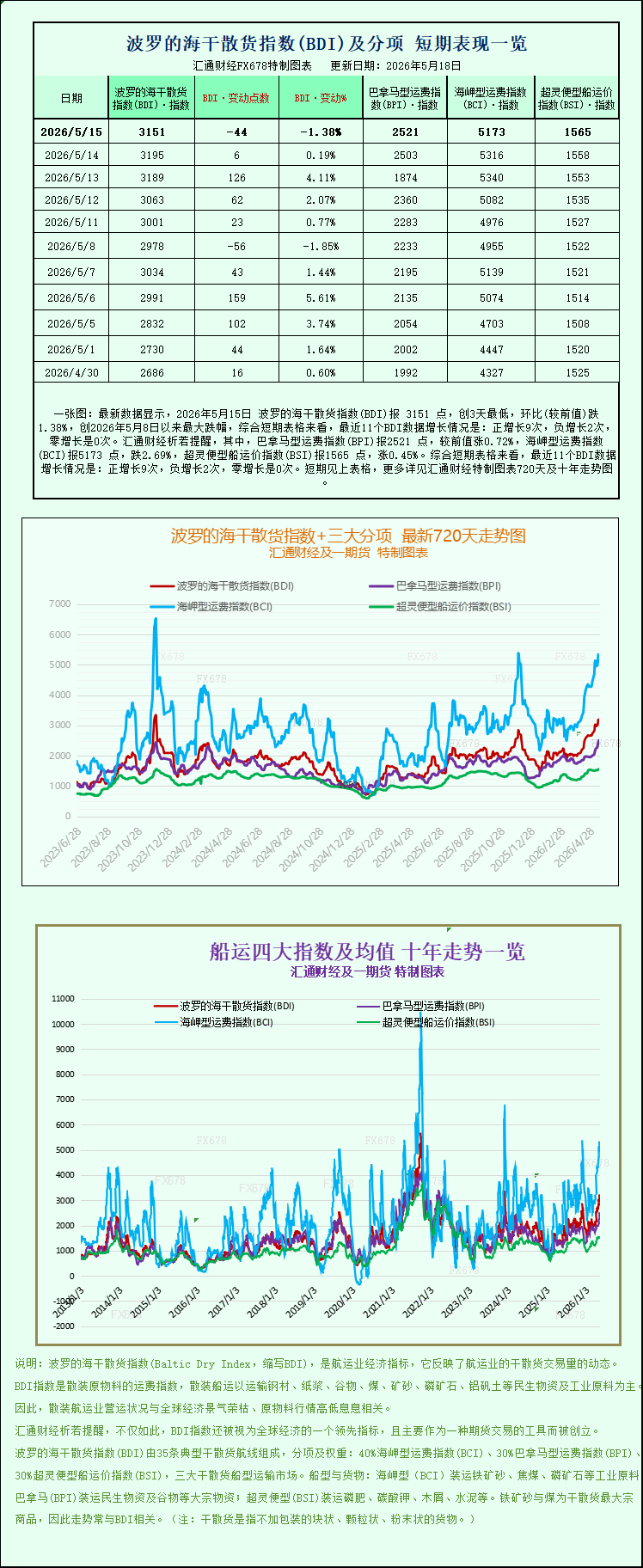
As the authoritative measure of global dry bulk shipping prices, the Baltic Dry Index (BDI) saw a slight decline this Friday. The main drag came from a significant drop in Capesize vessel freight rates, which completely offset the gains in Panamax and Supramax vessel rates during the same period, leading to an overall weakening trend in the index. As a barometer reflecting the global dry bulk shipping market, the BDI's fluctuations are closely related to global economic conditions and raw material prices. This divergence in price movements among different vessel types reflects the current structural differences in the dry bulk shipping market.
Specifically, the Baltic Dry Index, which tracks freight rates for the three main vessel types—Capesize, Panamax, and Supramax—fell 44 points, or 1.4%, to close at 3151. Despite the single-day pullback, the index still achieved a cumulative weekly gain of 5.8%, continuing the recent overall positive trend in the dry bulk shipping market. This aligns with the general assessment of stable growth in the dry bulk shipping industry since 2026.
Among the three major ship types, Capesize vessels were the main drag on the market that day. The Capesize index fell sharply by 143 points, a drop of 2.3%, closing at 5173 points, marking the largest single-day decline in nearly a week and ending the previous days of moderate gains. However, thanks to the strong performance in the first few trading days of the week, the index still achieved a cumulative increase of 4.4% this week, maintaining its overall upward trend. Capesize vessels, as large bulk carriers with a tonnage of over 80,000 tons, mainly undertake the transportation of industrial raw materials such as coking coal and iron ore, and their freight rates are closely related to global demand for industrial raw materials.
In terms of actual operating revenue, Capesize vessels carrying 150,000 tons of cargo (mainly core industrial raw materials such as iron ore and coal) saw their average daily revenue decrease by $1,293 to $43,413 on that day. This revenue decline is directly related to the sluggish performance of the iron ore market. It is reported that on Friday, dragged down by high iron ore inventories at Chinese ports, iron ore futures prices fell for the fourth consecutive trading day. As a major global importer of iron ore, China's port inventory levels directly affect global iron ore transportation demand, which in turn impacts the freight rates and revenue levels of Capesize vessels.
In stark contrast to the sluggish performance of Capesize vessels, Panamax vessels shone brightly, becoming a significant force supporting the overall index. The Panamax index rose 18 points, or 0.7%, to close at 2521. Notably, the index has accumulated a gain of nearly 13% this week, marking its best weekly performance since July 2025, demonstrating a strong recovery momentum. Panamax vessels, ranging from 50,000 to 80,000 tons, primarily transport essential goods and commodities such as coal and grain. The rise in their freight rates reflects the steady increase in global demand for food and coal transportation.
In terms of revenue, the average daily earnings of Panamax vessels also increased. These vessels typically carry 60,000 to 70,000 tons of coal or grain, and their average daily earnings increased by $163 to $22,691, further confirming the strong demand for this type of vessel. Industry analysts believe that the strong performance of Panamax vessels is closely related to the approaching peak season for global grain shipping and a slight rebound in coal demand, while also benefiting from the overall environment of tight shipping capacity and supply-demand imbalance in the industry.
In the small vessel sector, the Supramax market remained stable, showing a slight upward trend. The Supramax index rose 7 points, or 0.5%, to close at 1565 points, with a cumulative increase of 2.8% this week, continuing its moderate upward trend. Supramax vessels, as small bulk carriers under 50,000 tons, mainly transport goods such as phosphate fertilizer, potassium carbonate, sawdust, and cement. Their market performance is relatively stable and less affected by extreme industry fluctuations. This slight increase also reflects the stable global demand for small bulk cargo transportation.
Overall, although the Baltic Dry Index softened on the day due to a sharp drop in Capesize vessels, the three major vessel types showed a "polarization" trend, with Panamax and Supramax vessels showing an upward trend, highlighting the structural differences in the current dry bulk shipping market. Looking ahead, as the outcomes of the China-US summit gradually materialize, changes in iron ore inventories at Chinese ports and fluctuations in global commodity demand occur, freight rates for different dry bulk vessel types will continue to exhibit differentiated characteristics. The market needs to continue to monitor changes in relevant core influencing factors.
As the authoritative measure of global dry bulk shipping prices, the Baltic Dry Index (BDI) saw a slight decline this Friday. The main drag came from a significant drop in Capesize vessel freight rates, which completely offset the gains in Panamax and Supramax vessel rates during the same period, leading to an overall weakening trend in the index. As a barometer reflecting the global dry bulk shipping market, the BDI's fluctuations are closely related to global economic conditions and raw material prices. This divergence in price movements among different vessel types reflects the current structural differences in the dry bulk shipping market.
Specifically, the Baltic Dry Index, which tracks freight rates for the three main vessel types—Capesize, Panamax, and Supramax—fell 44 points, or 1.4%, to close at 3151. Despite the single-day pullback, the index still achieved a cumulative weekly gain of 5.8%, continuing the recent overall positive trend in the dry bulk shipping market. This aligns with the general assessment of stable growth in the dry bulk shipping industry since 2026.
Among the three major ship types, Capesize vessels were the main drag on the market that day. The Capesize index fell sharply by 143 points, a drop of 2.3%, closing at 5173 points, marking the largest single-day decline in nearly a week and ending the previous days of moderate gains. However, thanks to the strong performance in the first few trading days of the week, the index still achieved a cumulative increase of 4.4% this week, maintaining its overall upward trend. Capesize vessels, as large bulk carriers with a tonnage of over 80,000 tons, mainly undertake the transportation of industrial raw materials such as coking coal and iron ore, and their freight rates are closely related to global demand for industrial raw materials.
In terms of actual operating revenue, Capesize vessels carrying 150,000 tons of cargo (mainly core industrial raw materials such as iron ore and coal) saw their average daily revenue decrease by $1,293 to $43,413 on that day. This revenue decline is directly related to the sluggish performance of the iron ore market. It is reported that on Friday, dragged down by high iron ore inventories at Chinese ports, iron ore futures prices fell for the fourth consecutive trading day. As a major global importer of iron ore, China's port inventory levels directly affect global iron ore transportation demand, which in turn impacts the freight rates and revenue levels of Capesize vessels.
In stark contrast to the sluggish performance of Capesize vessels, Panamax vessels shone brightly, becoming a significant force supporting the overall index. The Panamax index rose 18 points, or 0.7%, to close at 2521. Notably, the index has accumulated a gain of nearly 13% this week, marking its best weekly performance since July 2025, demonstrating a strong recovery momentum. Panamax vessels, ranging from 50,000 to 80,000 tons, primarily transport essential goods and commodities such as coal and grain. The rise in their freight rates reflects the steady increase in global demand for food and coal transportation.
In terms of revenue, the average daily earnings of Panamax vessels also increased. These vessels typically carry 60,000 to 70,000 tons of coal or grain, and their average daily earnings increased by $163 to $22,691, further confirming the strong demand for this type of vessel. Industry analysts believe that the strong performance of Panamax vessels is closely related to the approaching peak season for global grain shipping and a slight rebound in coal demand, while also benefiting from the overall environment of tight shipping capacity and supply-demand imbalance in the industry.
In the small vessel sector, the Supramax market remained stable, showing a slight upward trend. The Supramax index rose 7 points, or 0.5%, to close at 1565 points, with a cumulative increase of 2.8% this week, continuing its moderate upward trend. Supramax vessels, as small bulk carriers under 50,000 tons, mainly transport goods such as phosphate fertilizer, potassium carbonate, sawdust, and cement. Their market performance is relatively stable and less affected by extreme industry fluctuations. This slight increase also reflects the stable global demand for small bulk cargo transportation.
Overall, although the Baltic Dry Index softened on the day due to a sharp drop in Capesize vessels, the three major vessel types showed a "polarization" trend, with Panamax and Supramax vessels showing an upward trend, highlighting the structural differences in the current dry bulk shipping market. Looking ahead, as the outcomes of the China-US summit gradually materialize, changes in iron ore inventories at Chinese ports and fluctuations in global commodity demand occur, freight rates for different dry bulk vessel types will continue to exhibit differentiated characteristics. The market needs to continue to monitor changes in relevant core influencing factors.
- Risk Warning and Disclaimer
- The market involves risk, and trading may not be suitable for all investors. This article is for reference only and does not constitute personal investment advice, nor does it take into account certain users’ specific investment objectives, financial situation, or other needs. Any investment decisions made based on this information are at your own risk.