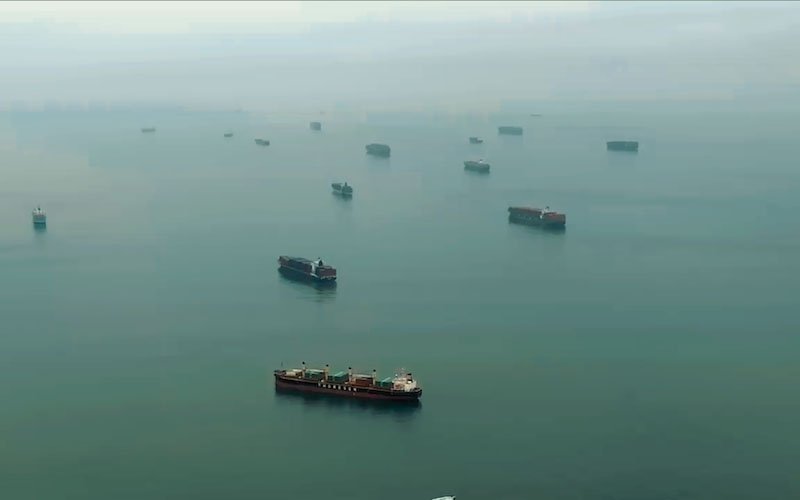
Oil prices rose more than 9% this week, with no short-term solution to the Hormuz stalemate.
2026-05-16 00:13:06
On Friday (May 15), during the US trading session, international oil prices continued their upward trend, with both Brent crude and WTI crude rising by more than 2%, marking their biggest single-day gains this week. The driving force was the same: the increasingly hardline diplomatic stances between the US and Iran further dampened market expectations for the near-term reopening of the Strait of Hormuz.
As of 00:06 Beijing time, Brent crude oil was trading at $109.49 per barrel, up $2.92, or 2.74%, for the day; WTI crude oil was trading at $105.52 per barrel, up $4.35, or 4.3%, for the same period. Looking at a longer weekly timeframe, Brent crude has risen 6.8% cumulatively, while WTI has seen an even larger increase of 9.0%, marking one of the largest weekly gains in recent times.
Geopolitical core
The rise in oil prices on Friday was directly triggered by strong signals released almost simultaneously by the US and Iran.
Iranian Foreign Minister Araqchi stated that Iran "has no trust" in the United States and that negotiations are contingent on Washington demonstrating genuine sincerity. He also indicated that Iran is prepared to return to the battlefield but has not closed diplomatic channels. This "fight-and-talk" stance has been interpreted by the market as Iran waiting for concessions from the other side, rather than actively seeking a compromise.
US President Trump said his patience with Iran was "running out," reiterated that Iran must not possess nuclear weapons and that the Strait of Hormuz must be reopened.
Channel access
In contrast to the diplomatic standoff, actual traffic volume in the Strait of Hormuz has seen a marginal increase.
The Iranian Revolutionary Guard stated that 30 ships passed through the Strait of Hormuz between Wednesday night and Thursday. Independent statistics from shipping data company Kpler show that 10 ships passed through in the past 24 hours, up from the 5 to 7 ships per day in previous weeks. However, the current traffic volume is still less than 10% of the normal daily flow of approximately 140 ships before the conflict.
PVM analyst Tamás Varga remained cautious: "The number of ships passing through is indeed increasing, but at present, this has a far greater impact on market sentiment than on the actual balance of oil supply." In other words, the marginal improvement in the data is not enough to shake the market's pricing logic for supply disruptions.
Institutional voice
Analysts from multiple institutions largely agree that the core variable in the current situation is political will, not prevailing data.
In a research report, Commerzbank pointed out that tensions between the US and Iran have escalated significantly again, and expectations for a swift reopening of the Strait of Hormuz have largely failed, even though the ceasefire agreement remains nominally in effect.
Vandana Hari, founder of Vanda Insights, said that market focus has returned to the stalemate itself and the risk of further escalation of military conflict, and the geopolitical premium is unlikely to subside in the short term.
Saxo Bank analyst Ole Hansen attributed the rise in oil prices to two combined factors: first, the lack of substantial progress on the reopening of the Straits of Hormuz; and second, Ukraine's continued attacks on Russian refining facilities, further compressing the global supply of refined petroleum products.
Risk Matrix
Rabobank conducted scenario-based simulations of the potential impact of a blockade of the Strait of Hormuz, based on a global oil supply chain model.
In the short term, if the lockdown continues for about three months, there is no expectation of a substantial oil shortage in Europe. Market regulation will mainly be achieved through rising oil prices, while demand will remain relatively stable.
If the lockdown continues for a year, the situation will worsen significantly. European reserves will face depletion, and demand will be forced to contract sharply, with the hardest-hit sectors including aviation, logistics, and industrial energy. Rabobank points out that in this scenario, demand for jet fuel, naphtha, and fuel oil will be the first to be affected.
Parts of Asia and Oceania face greater pressure under all scenarios. This is because these regions have low inventory levels, relatively limited refining capacity, and are far more dependent on Middle Eastern crude oil than Europe, leaving them with extremely limited buffer space should a sustained supply chain disruption occur.
The current market pricing reflects a reassessment of the probability of failed diplomatic negotiations, rather than confirmation that supply disruptions have already occurred. The key to future price movements lies in whether the US and Iran possess the political will to restart substantive dialogue.
As of 00:06 Beijing time, Brent crude oil was trading at $109.49 per barrel, up $2.92, or 2.74%, for the day; WTI crude oil was trading at $105.52 per barrel, up $4.35, or 4.3%, for the same period. Looking at a longer weekly timeframe, Brent crude has risen 6.8% cumulatively, while WTI has seen an even larger increase of 9.0%, marking one of the largest weekly gains in recent times.
Geopolitical core
The rise in oil prices on Friday was directly triggered by strong signals released almost simultaneously by the US and Iran.
Iranian Foreign Minister Araqchi stated that Iran "has no trust" in the United States and that negotiations are contingent on Washington demonstrating genuine sincerity. He also indicated that Iran is prepared to return to the battlefield but has not closed diplomatic channels. This "fight-and-talk" stance has been interpreted by the market as Iran waiting for concessions from the other side, rather than actively seeking a compromise.
US President Trump said his patience with Iran was "running out," reiterated that Iran must not possess nuclear weapons and that the Strait of Hormuz must be reopened.
Channel access
In contrast to the diplomatic standoff, actual traffic volume in the Strait of Hormuz has seen a marginal increase.
The Iranian Revolutionary Guard stated that 30 ships passed through the Strait of Hormuz between Wednesday night and Thursday. Independent statistics from shipping data company Kpler show that 10 ships passed through in the past 24 hours, up from the 5 to 7 ships per day in previous weeks. However, the current traffic volume is still less than 10% of the normal daily flow of approximately 140 ships before the conflict.
PVM analyst Tamás Varga remained cautious: "The number of ships passing through is indeed increasing, but at present, this has a far greater impact on market sentiment than on the actual balance of oil supply." In other words, the marginal improvement in the data is not enough to shake the market's pricing logic for supply disruptions.
Institutional voice
Analysts from multiple institutions largely agree that the core variable in the current situation is political will, not prevailing data.
In a research report, Commerzbank pointed out that tensions between the US and Iran have escalated significantly again, and expectations for a swift reopening of the Strait of Hormuz have largely failed, even though the ceasefire agreement remains nominally in effect.
Vandana Hari, founder of Vanda Insights, said that market focus has returned to the stalemate itself and the risk of further escalation of military conflict, and the geopolitical premium is unlikely to subside in the short term.
Saxo Bank analyst Ole Hansen attributed the rise in oil prices to two combined factors: first, the lack of substantial progress on the reopening of the Straits of Hormuz; and second, Ukraine's continued attacks on Russian refining facilities, further compressing the global supply of refined petroleum products.
Risk Matrix
Rabobank conducted scenario-based simulations of the potential impact of a blockade of the Strait of Hormuz, based on a global oil supply chain model.
In the short term, if the lockdown continues for about three months, there is no expectation of a substantial oil shortage in Europe. Market regulation will mainly be achieved through rising oil prices, while demand will remain relatively stable.
If the lockdown continues for a year, the situation will worsen significantly. European reserves will face depletion, and demand will be forced to contract sharply, with the hardest-hit sectors including aviation, logistics, and industrial energy. Rabobank points out that in this scenario, demand for jet fuel, naphtha, and fuel oil will be the first to be affected.
Parts of Asia and Oceania face greater pressure under all scenarios. This is because these regions have low inventory levels, relatively limited refining capacity, and are far more dependent on Middle Eastern crude oil than Europe, leaving them with extremely limited buffer space should a sustained supply chain disruption occur.
The current market pricing reflects a reassessment of the probability of failed diplomatic negotiations, rather than confirmation that supply disruptions have already occurred. The key to future price movements lies in whether the US and Iran possess the political will to restart substantive dialogue.
- Risk Warning and Disclaimer
- The market involves risk, and trading may not be suitable for all investors. This article is for reference only and does not constitute personal investment advice, nor does it take into account certain users’ specific investment objectives, financial situation, or other needs. Any investment decisions made based on this information are at your own risk.