The US dollar index continues to rise, and is on track for its sixth consecutive daily gain, but its foundation is quietly weakening.
2026-05-18 10:42:40
The US dollar index continued its strong performance on Monday (May 18), currently trading at 99.37, up 0.1%, with an intraday high of 99.41, a new high since April 9, 2026. It has risen more than 1% over the past four weeks, achieving five consecutive days of gains and showing a steady upward trend. Renewed tensions in the Middle East have pushed up oil prices, exacerbating inflation concerns, and a sell-off in the global bond market has weakened risk appetite. Furthermore, recent US inflation data has consistently exceeded expectations, completely reversing market expectations for a Federal Reserve rate cut. April's CPI rose 3.8% year-on-year, and PPI surged 6% year-on-year, both reaching new highs in recent years. Against this backdrop, the interest rate futures market has begun pricing in the possibility that the Federal Reserve may resume rate hikes before 2027—the probability of a 25 basis point rate hike by January next year has risen to approximately 60%.
A paradox has recently emerged in the foreign exchange market: despite rising global inflation expectations and downward revisions to economic growth forecasts for 2026—a byproduct of the US attack on Iran—the US dollar has surprisingly withstood the storm. As the world's dominant reserve currency, the dollar benefits from the logic of prioritizing "principal safety" over "investment returns" when capital inflows occur. Ironically, it is precisely the country that has disrupted the global system that has benefited from unexpected changes in its political and economic fundamentals.
But short-term benefits cannot mask long-term costs. This conflict is shaking the very foundations of the dollar's status. This conflict, aimed at preventing Iran from acquiring nuclear weapons, is undermining the intangible assets that have elevated the dollar's status and maintained its uniqueness—assets that make the dollar the world's most trusted and widely used store of value and transaction settlement currency. These assets include: relatively strong long-term growth, an independent central bank, deep and extensive capital markets (with fewer restrictions on capital flows and currency use), strong military power, its status as a reliable protector of Western democracies, a governance system based on the rule of law rather than the rule of men, and a politically stable environment that sustains this image.
To date, the dollar's "privilege" of reserve currency status has withstood some very large market fluctuations, including deep declines. Besides the market's continued belief that "the America of our fathers" will become "the America of our descendants," the dollar has also benefited from the lack of a potential challenger currency—no other currency has met all the prerequisites required for the dollar to attain top-tier reserve currency status and the enormous economic privileges that come with it.
The US dollar's continued dominance in the post-war global monetary system amidst turmoil is well-documented. From its pre-1971 highs to its lows in late October 1978, the dollar generally fell by about half against the German mark and the Japanese yen. The trade-weighted dollar index surged in the first half of the 1980s, peaking at 160.4 in February 1985, before falling to 80.58 by July 1992. It then rebounded 49.4% until February 2002, only to plummet 41.3% in March 2008 (as the financial crisis intensified). By September 2022, the dollar had recovered again, rising 62.3% from its 2008 low. President Trump's first year in office, under the "Make America Great Again" slogan, was not reflected in the dollar's decline, but in this era of fear and high uncertainty, alongside the promise of artificial intelligence, the dollar's trade-weighted value has held firm, currently trading near 100 at 99.27.
Historically, periods of dollar depreciation have typically been associated with relatively high US inflation and/or widening US trade balance and current account deficits. Records suggest that in an era where exchange rates are market-determined, maintaining its position as the preferred currency does not guarantee the dollar will not depreciate. Conversely, it cannot be asserted that a significant loss of the dollar's reserve currency aura will be accompanied by dollar appreciation, or even a stable and strong dollar.
Before the dollar, the pound sterling was the king of all currencies. After World War II, the British pound lost this honor. During the war, it was fixed at $4.03, and in 1949 it was revalued at $2.80. By early 1985, it had fallen to a low of $1.0345, and is currently trading near $1.33. If the US leadership continues to take for granted the factors that make the dollar a valuable store of value, that trust could one day be irretrievably lost. Determining when this "point of no return" will require extreme caution, but this does not mean that such a deteriorating turn will never occur.
Despite the dollar's remarkable resilience in the face of current geopolitical shocks and its continued benefit from the lack of credible competitors, the long-standing foundations supporting its reserve currency status are being eroded by a self-inflicted war. Historical experience shows that reserve currency status is not permanent—the decline of the pound sterling serves as a cautionary tale. Whether the dollar can maintain its privileges depends on whether the US leadership can acknowledge and uphold the intangible assets that make it the "most trusted currency." If these foundations are consistently ignored or weakened, while the timing of a loss of trust is difficult to predict precisely, it is certainly not impossible. In the long run, the fate of the dollar will depend not only on hard economic and military power, but also on the sustainability of soft power such as institutions, the rule of law, and political stability.
Looking at the daily moving averages of the US dollar index, the current moving average system shows a clear entanglement and unclear direction: the 20-day moving average (MA20) (98.81) is lower than the 50-day moving average (99.16) and the 200-day moving average (MA20) (99.13), and only higher than the 100-day moving average (MA100) (98.59). This is neither a bullish nor a bearish alignment, reflecting an inherent contradiction between short-term momentum and medium-term trend. However, the latest price of 99.35 is above all moving averages, a short-term bullish signal indicating that the bulls are temporarily in control. Overall, the US dollar index is in a phase of oscillating upward movement but lacking a clear trend – the price's position above the moving averages provides short-term support, but the disordered arrangement of the moving averages themselves limits the sustainability of the upward potential.
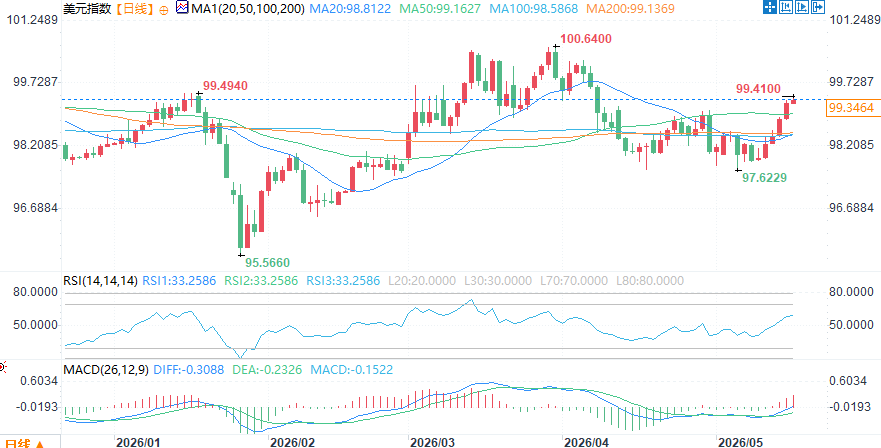
At 10:42 AM Beijing time on May 18, the US dollar index was at 99.34.
A paradox has recently emerged in the foreign exchange market: despite rising global inflation expectations and downward revisions to economic growth forecasts for 2026—a byproduct of the US attack on Iran—the US dollar has surprisingly withstood the storm. As the world's dominant reserve currency, the dollar benefits from the logic of prioritizing "principal safety" over "investment returns" when capital inflows occur. Ironically, it is precisely the country that has disrupted the global system that has benefited from unexpected changes in its political and economic fundamentals.
The foundations supporting the dollar's status are being eroded.
But short-term benefits cannot mask long-term costs. This conflict is shaking the very foundations of the dollar's status. This conflict, aimed at preventing Iran from acquiring nuclear weapons, is undermining the intangible assets that have elevated the dollar's status and maintained its uniqueness—assets that make the dollar the world's most trusted and widely used store of value and transaction settlement currency. These assets include: relatively strong long-term growth, an independent central bank, deep and extensive capital markets (with fewer restrictions on capital flows and currency use), strong military power, its status as a reliable protector of Western democracies, a governance system based on the rule of law rather than the rule of men, and a politically stable environment that sustains this image.
The dollar's reserve status has no real challengers.
To date, the dollar's "privilege" of reserve currency status has withstood some very large market fluctuations, including deep declines. Besides the market's continued belief that "the America of our fathers" will become "the America of our descendants," the dollar has also benefited from the lack of a potential challenger currency—no other currency has met all the prerequisites required for the dollar to attain top-tier reserve currency status and the enormous economic privileges that come with it.
Historical fluctuation trajectory review
The US dollar's continued dominance in the post-war global monetary system amidst turmoil is well-documented. From its pre-1971 highs to its lows in late October 1978, the dollar generally fell by about half against the German mark and the Japanese yen. The trade-weighted dollar index surged in the first half of the 1980s, peaking at 160.4 in February 1985, before falling to 80.58 by July 1992. It then rebounded 49.4% until February 2002, only to plummet 41.3% in March 2008 (as the financial crisis intensified). By September 2022, the dollar had recovered again, rising 62.3% from its 2008 low. President Trump's first year in office, under the "Make America Great Again" slogan, was not reflected in the dollar's decline, but in this era of fear and high uncertainty, alongside the promise of artificial intelligence, the dollar's trade-weighted value has held firm, currently trading near 100 at 99.27.
Historical Patterns and Exceptions to Dollar Depreciation
Historically, periods of dollar depreciation have typically been associated with relatively high US inflation and/or widening US trade balance and current account deficits. Records suggest that in an era where exchange rates are market-determined, maintaining its position as the preferred currency does not guarantee the dollar will not depreciate. Conversely, it cannot be asserted that a significant loss of the dollar's reserve currency aura will be accompanied by dollar appreciation, or even a stable and strong dollar.
The lessons of the British pound
Before the dollar, the pound sterling was the king of all currencies. After World War II, the British pound lost this honor. During the war, it was fixed at $4.03, and in 1949 it was revalued at $2.80. By early 1985, it had fallen to a low of $1.0345, and is currently trading near $1.33. If the US leadership continues to take for granted the factors that make the dollar a valuable store of value, that trust could one day be irretrievably lost. Determining when this "point of no return" will require extreme caution, but this does not mean that such a deteriorating turn will never occur.
Despite the dollar's remarkable resilience in the face of current geopolitical shocks and its continued benefit from the lack of credible competitors, the long-standing foundations supporting its reserve currency status are being eroded by a self-inflicted war. Historical experience shows that reserve currency status is not permanent—the decline of the pound sterling serves as a cautionary tale. Whether the dollar can maintain its privileges depends on whether the US leadership can acknowledge and uphold the intangible assets that make it the "most trusted currency." If these foundations are consistently ignored or weakened, while the timing of a loss of trust is difficult to predict precisely, it is certainly not impossible. In the long run, the fate of the dollar will depend not only on hard economic and military power, but also on the sustainability of soft power such as institutions, the rule of law, and political stability.
Looking at the daily moving averages of the US dollar index, the current moving average system shows a clear entanglement and unclear direction: the 20-day moving average (MA20) (98.81) is lower than the 50-day moving average (99.16) and the 200-day moving average (MA20) (99.13), and only higher than the 100-day moving average (MA100) (98.59). This is neither a bullish nor a bearish alignment, reflecting an inherent contradiction between short-term momentum and medium-term trend. However, the latest price of 99.35 is above all moving averages, a short-term bullish signal indicating that the bulls are temporarily in control. Overall, the US dollar index is in a phase of oscillating upward movement but lacking a clear trend – the price's position above the moving averages provides short-term support, but the disordered arrangement of the moving averages themselves limits the sustainability of the upward potential.
At 10:42 AM Beijing time on May 18, the US dollar index was at 99.34.
- Risk Warning and Disclaimer
- The market involves risk, and trading may not be suitable for all investors. This article is for reference only and does not constitute personal investment advice, nor does it take into account certain users’ specific investment objectives, financial situation, or other needs. Any investment decisions made based on this information are at your own risk.