Senior Analyst: Bearish on gold in the short term, bullish on commodities in the long term.
2026-05-18 11:37:20
Amid rising inflationary pressures and the ongoing global unrest in Iran, gold prices are under pressure and weakening in the short term, while capital flows in emerging markets are also significantly impacted.
A renowned senior analyst in the commodities sector points out that commodities are currently a core sector in the global financial market with significant asymmetric profit opportunities. Industry leaders have publicly called for investment in physical commodities, arguing that while the market is heavily speculating on the artificial intelligence sector, it is severely underestimating the long-term value of physical commodities. They believe the commodities supercycle is still in its early stages, and short-term adjustments in precious metals do not alter the overall upward trend of the commodities market.
Last Friday, Jeff Currie, former head of commodities research at Goldman Sachs and now co-executive chairman of Abax Markets and senior advisor to The Carlyle Group, publicly shared his market views, strongly advocating that investors include commodities in their asset allocation system to diversify their investment structure.
He stated that current market funds are excessively concentrated on AI-related investment targets, while neglecting various physical commodities essential for the development and implementation of the technology industry. Although commodities generally have low market visibility, their performance over the past decade has placed them among the top-performing assets. He advised investors to follow the trend and establish long positions, holding firmly to capitalize on long-term market trends.
The current situation in Iran has triggered a global supply shock, making crude oil the focus of the commodity market. West Texas Intermediate crude oil prices rebounded above $100 per barrel just before the weekend.
While most market attention is focused on short-term oil price fluctuations, Curry stated that even if the current geopolitical turmoil subsides, the deep-seated supply problems underlying the crude oil industry will remain unresolved. Executives from major oil companies have long warned the market that the long-term shortage of crude oil will continue after this round of supply disruptions, but this has consistently failed to garner sufficient attention from the market.
Such supply shortages have long been a problem for all categories of commodities, and as early as 2020, he was the first to predict that a super cycle for commodities was about to begin.
In the early years, those working in the financial sector were generally pessimistic about commodity prices, believing that inflation was temporary and supply chains were stable. However, those deeply involved in the real economy had already perceived the industry's hidden dangers: reduced capital investment, low commodity inventories, and continuous capacity clearing, coinciding with an impending recovery in market demand, had already sown the seeds of a supply-demand imbalance. Even today, those in the real economy maintain a consistent judgment, and the market should place greater trust in the analytical approaches of those working on the front lines of the industry.
Jeff Curry, who has long held a bullish view on the overall commodity market, maintains a bearish stance on gold based on short-term market liquidity conditions. He stated that the current market's demand for liquidity is the dominant factor suppressing gold prices, predicting that gold prices will first fall to $4,000 per ounce, complete a deep correction, and then rebound strongly, with a long-term target of $10,000 per ounce.
He analyzed that high inflation coupled with rising energy procurement costs will force some countries to sell their gold reserves to alleviate fiscal and exchange rate pressures. The Central Bank of Turkey has already sold approximately 120 tons of gold to stabilize its currency and raise funds for energy procurement. Bernard Dahdah also stated in April that many central banks are selling gold to stabilize exchange rates and fill energy procurement gaps. Once central banks shift from long-term gold buyers to passive sellers, the core buying support for gold will disappear. Only if a subsequent energy crisis drags down the economy, prompting central banks to adopt looser policies, will the gold market have a chance to reverse course.
The precious metals market experienced a broad sell-off last Friday, with spot gold closing at $4,538.18 per ounce, a daily drop of 2.45%. Spot silver saw an even more significant decline, falling 9.1% to close at $75.886 per ounce. In Asian trading on Monday, spot gold briefly fell to around $4,480, a new low since March 30th, while spot silver briefly fell to $73.84, a new low since May 6th.
Market concerns that subsequent interest rate hikes will increase the cost of holding non-interest-bearing assets, coupled with the Iranian situation pushing up oil prices, have led to a significant market pricing in the probability of a year-end rate hike. Data from the Chicago Mercantile Exchange's interest rate tool shows that the probability of a Fed rate hike by the end of the year has risen to around 50%, a sharp increase from 1% a month ago.
In summary, short-term interest rate expectations and liquidity factors have led to a significant pullback in gold and silver prices, but this is only a temporary market fluctuation.
The core contradiction of supply and demand imbalance in various commodities has not been resolved, and the situation is continuing to worsen. The mainstream view in the industry is that the commodity supercycle has not yet completed its initial stage. Agricultural products, industrial metals, and energy products all have ample room for upward movement. Since physical commodities cannot be created through increased money supply, their long-term investment value is becoming increasingly apparent. Investors can avoid short-term fluctuations in precious metals and focus on a long-term investment strategy across all commodity categories.
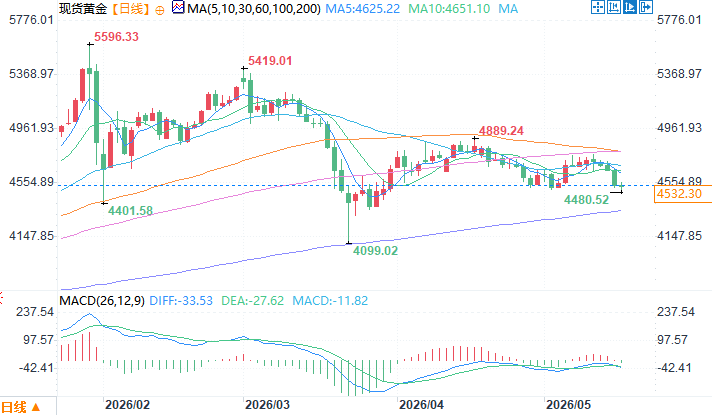
Spot gold daily chart source: EasyForex
At 11:37 AM Beijing time on May 18, spot gold was trading at $4532.30 per ounce.
A renowned senior analyst in the commodities sector points out that commodities are currently a core sector in the global financial market with significant asymmetric profit opportunities. Industry leaders have publicly called for investment in physical commodities, arguing that while the market is heavily speculating on the artificial intelligence sector, it is severely underestimating the long-term value of physical commodities. They believe the commodities supercycle is still in its early stages, and short-term adjustments in precious metals do not alter the overall upward trend of the commodities market.
Industry leaders voice their support for commodity asset allocation
Last Friday, Jeff Currie, former head of commodities research at Goldman Sachs and now co-executive chairman of Abax Markets and senior advisor to The Carlyle Group, publicly shared his market views, strongly advocating that investors include commodities in their asset allocation system to diversify their investment structure.
He stated that current market funds are excessively concentrated on AI-related investment targets, while neglecting various physical commodities essential for the development and implementation of the technology industry. Although commodities generally have low market visibility, their performance over the past decade has placed them among the top-performing assets. He advised investors to follow the trend and establish long positions, holding firmly to capitalize on long-term market trends.
The oil crisis is just the beginning; long-term supply risks are deeply entrenched.
The current situation in Iran has triggered a global supply shock, making crude oil the focus of the commodity market. West Texas Intermediate crude oil prices rebounded above $100 per barrel just before the weekend.
While most market attention is focused on short-term oil price fluctuations, Curry stated that even if the current geopolitical turmoil subsides, the deep-seated supply problems underlying the crude oil industry will remain unresolved. Executives from major oil companies have long warned the market that the long-term shortage of crude oil will continue after this round of supply disruptions, but this has consistently failed to garner sufficient attention from the market.
Such supply shortages have long been a problem for all categories of commodities, and as early as 2020, he was the first to predict that a super cycle for commodities was about to begin.
In the early years, those working in the financial sector were generally pessimistic about commodity prices, believing that inflation was temporary and supply chains were stable. However, those deeply involved in the real economy had already perceived the industry's hidden dangers: reduced capital investment, low commodity inventories, and continuous capacity clearing, coinciding with an impending recovery in market demand, had already sown the seeds of a supply-demand imbalance. Even today, those in the real economy maintain a consistent judgment, and the market should place greater trust in the analytical approaches of those working on the front lines of the industry.
Short-term liquidity pressures on gold prices suggest an initial drop followed by a significant rise.
Jeff Curry, who has long held a bullish view on the overall commodity market, maintains a bearish stance on gold based on short-term market liquidity conditions. He stated that the current market's demand for liquidity is the dominant factor suppressing gold prices, predicting that gold prices will first fall to $4,000 per ounce, complete a deep correction, and then rebound strongly, with a long-term target of $10,000 per ounce.
He analyzed that high inflation coupled with rising energy procurement costs will force some countries to sell their gold reserves to alleviate fiscal and exchange rate pressures. The Central Bank of Turkey has already sold approximately 120 tons of gold to stabilize its currency and raise funds for energy procurement. Bernard Dahdah also stated in April that many central banks are selling gold to stabilize exchange rates and fill energy procurement gaps. Once central banks shift from long-term gold buyers to passive sellers, the core buying support for gold will disappear. Only if a subsequent energy crisis drags down the economy, prompting central banks to adopt looser policies, will the gold market have a chance to reverse course.
Precious metals fell across the board as expectations of interest rate hikes continued to rise.
The precious metals market experienced a broad sell-off last Friday, with spot gold closing at $4,538.18 per ounce, a daily drop of 2.45%. Spot silver saw an even more significant decline, falling 9.1% to close at $75.886 per ounce. In Asian trading on Monday, spot gold briefly fell to around $4,480, a new low since March 30th, while spot silver briefly fell to $73.84, a new low since May 6th.
Market concerns that subsequent interest rate hikes will increase the cost of holding non-interest-bearing assets, coupled with the Iranian situation pushing up oil prices, have led to a significant market pricing in the probability of a year-end rate hike. Data from the Chicago Mercantile Exchange's interest rate tool shows that the probability of a Fed rate hike by the end of the year has risen to around 50%, a sharp increase from 1% a month ago.
Summarize
In summary, short-term interest rate expectations and liquidity factors have led to a significant pullback in gold and silver prices, but this is only a temporary market fluctuation.
The core contradiction of supply and demand imbalance in various commodities has not been resolved, and the situation is continuing to worsen. The mainstream view in the industry is that the commodity supercycle has not yet completed its initial stage. Agricultural products, industrial metals, and energy products all have ample room for upward movement. Since physical commodities cannot be created through increased money supply, their long-term investment value is becoming increasingly apparent. Investors can avoid short-term fluctuations in precious metals and focus on a long-term investment strategy across all commodity categories.
Spot gold daily chart source: EasyForex
At 11:37 AM Beijing time on May 18, spot gold was trading at $4532.30 per ounce.
- Risk Warning and Disclaimer
- The market involves risk, and trading may not be suitable for all investors. This article is for reference only and does not constitute personal investment advice, nor does it take into account certain users’ specific investment objectives, financial situation, or other needs. Any investment decisions made based on this information are at your own risk.