Hawkish expectations from the Federal Reserve and a stronger dollar dampened market sentiment, causing silver to fall to around $75, marking its third consecutive day of decline.
2026-05-18 13:48:58
Silver prices (XAG/USD) continued their pullback during Monday's Asian trading session, falling to around $75.30, marking their third consecutive day of decline. Current market concerns about renewed global inflation are weighing on precious metals, while a continued strengthening US dollar is further diminishing silver's appeal.
The escalating tensions in the Middle East have recently driven a rapid rise in international crude oil prices. Increased shipping risks in the Strait of Hormuz have raised market concerns about further strain on global energy supplies, potentially pushing up global inflation again. Rising international oil prices have intensified global inflation concerns, putting significant pressure on the precious metals market.
As energy costs continue to rise, markets are beginning to reassess the future monetary policy paths of major central banks. In particular, the recent hawkish signals from the Federal Reserve have significantly altered previous optimistic expectations for interest rate cuts. Several Fed officials have recently stated that controlling inflation remains the core policy objective, and emphasized that further interest rate hikes are possible if price pressures persist.
According to data from the CME Group's FedWatch tool, the market now expects the probability of a further rate hike by the Federal Reserve in December to rise to about 48%, compared to only about 14% a week ago. Market bets on a prolonged period of high interest rates have become a significant factor suppressing silver prices. The market has quickly re-priced in expectations of a Fed rate hike, and the dollar index has risen to its highest level since April.
Since silver is a non-interest-bearing asset, its attractiveness typically decreases in a high-interest-rate environment. Meanwhile, rising US Treasury yields and a stronger US dollar index have further weakened demand for dollar-denominated precious metals. Furthermore, heightened global risk aversion has also driven funds into dollar-denominated assets. Currently, the US and Iran have yet to reach an agreement on a ceasefire and the reopening of the Strait of Hormuz, raising market concerns about a further deterioration of the situation in the Middle East.
Rising demand for the US dollar as a safe haven continues to weigh on silver prices. In addition to macroeconomic factors, recent adjustments to institutional forecasts regarding silver supply and demand have also dampened market sentiment. UBS strategists recently lowered their silver investment demand forecasts, reducing their previous estimate of over 400 million ounces to approximately 300 million ounces. The firm believes that slowing industrial demand and increased mining supply are altering the supply and demand structure of the silver market.
Meanwhile, UBS projects the global silver supply deficit to shrink significantly from its previous estimate of approximately 300 million ounces to about 60-70 million ounces. The downward revision of silver demand forecasts by institutions has exacerbated market concerns about an improved supply-demand balance.
Because silver possesses both precious metal and industrial metal attributes, changes in global manufacturing demand have a significant impact on its price. Current market concerns that a global economic slowdown may weaken industrial demand, thereby affecting silver's long-term upward potential.
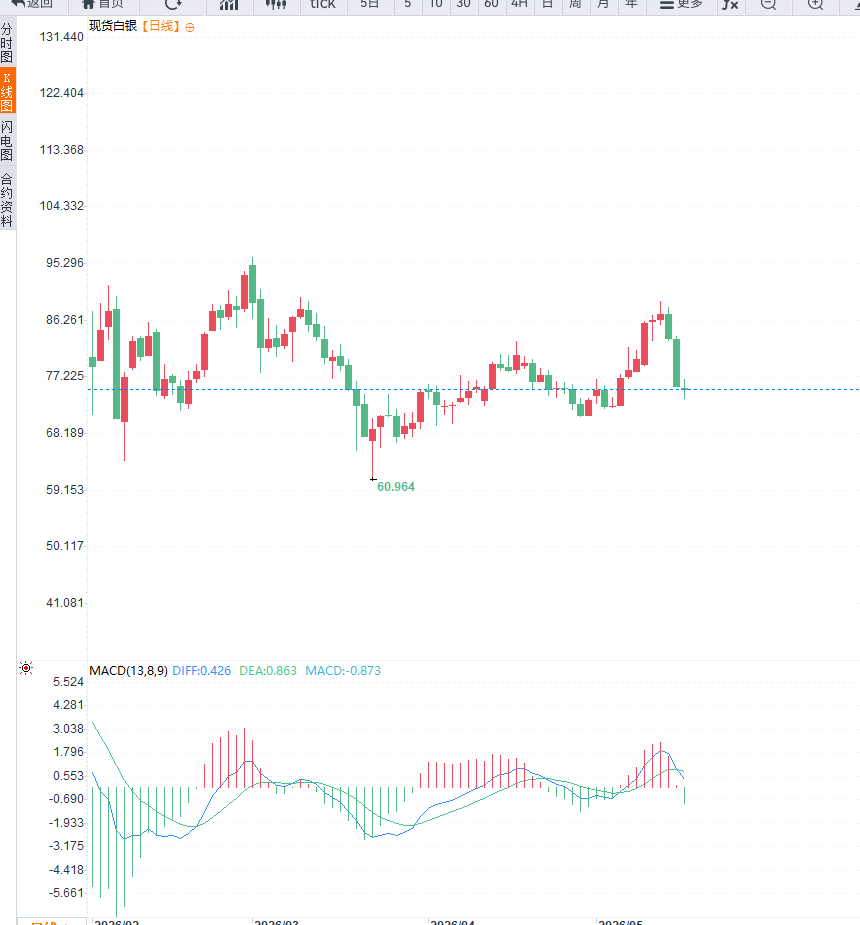
From a technical perspective, silver has broken below short-term moving average support on the daily chart, shifting its overall trend from a strong upward move to a high-level correction. A key short-term support zone is forming around $74; if this level is broken, the market may further test the $72-$70 range.
From the 4-hour chart, short-term bearish momentum still dominates in silver. The MACD indicator continues to run below the zero line, while the RSI indicator is close to the weak zone, indicating that market risk appetite is declining. However, due to the ongoing tensions in the Middle East, there may still be some safe-haven buying support for silver, so it may maintain a highly volatile and volatile trend in the short term.
Editor's Summary:
The silver market is currently being simultaneously impacted by both "high interest rate pressure" and "safe-haven demand support." While geopolitical risks are theoretically beneficial to precious metals, rising energy prices are pushing up inflation expectations, which in turn strengthens market bets that the Federal Reserve will maintain high interest rates, thus weakening silver's attractiveness. Furthermore, downward revisions to silver investment demand forecasts by institutions have further dampened market sentiment. In the short term, the dollar's performance, expectations regarding Federal Reserve policy, and changes in global industrial demand will continue to dominate the direction of the silver market.
The escalating tensions in the Middle East have recently driven a rapid rise in international crude oil prices. Increased shipping risks in the Strait of Hormuz have raised market concerns about further strain on global energy supplies, potentially pushing up global inflation again. Rising international oil prices have intensified global inflation concerns, putting significant pressure on the precious metals market.
As energy costs continue to rise, markets are beginning to reassess the future monetary policy paths of major central banks. In particular, the recent hawkish signals from the Federal Reserve have significantly altered previous optimistic expectations for interest rate cuts. Several Fed officials have recently stated that controlling inflation remains the core policy objective, and emphasized that further interest rate hikes are possible if price pressures persist.
According to data from the CME Group's FedWatch tool, the market now expects the probability of a further rate hike by the Federal Reserve in December to rise to about 48%, compared to only about 14% a week ago. Market bets on a prolonged period of high interest rates have become a significant factor suppressing silver prices. The market has quickly re-priced in expectations of a Fed rate hike, and the dollar index has risen to its highest level since April.
Since silver is a non-interest-bearing asset, its attractiveness typically decreases in a high-interest-rate environment. Meanwhile, rising US Treasury yields and a stronger US dollar index have further weakened demand for dollar-denominated precious metals. Furthermore, heightened global risk aversion has also driven funds into dollar-denominated assets. Currently, the US and Iran have yet to reach an agreement on a ceasefire and the reopening of the Strait of Hormuz, raising market concerns about a further deterioration of the situation in the Middle East.
Rising demand for the US dollar as a safe haven continues to weigh on silver prices. In addition to macroeconomic factors, recent adjustments to institutional forecasts regarding silver supply and demand have also dampened market sentiment. UBS strategists recently lowered their silver investment demand forecasts, reducing their previous estimate of over 400 million ounces to approximately 300 million ounces. The firm believes that slowing industrial demand and increased mining supply are altering the supply and demand structure of the silver market.
Meanwhile, UBS projects the global silver supply deficit to shrink significantly from its previous estimate of approximately 300 million ounces to about 60-70 million ounces. The downward revision of silver demand forecasts by institutions has exacerbated market concerns about an improved supply-demand balance.
Because silver possesses both precious metal and industrial metal attributes, changes in global manufacturing demand have a significant impact on its price. Current market concerns that a global economic slowdown may weaken industrial demand, thereby affecting silver's long-term upward potential.
From a technical perspective, silver has broken below short-term moving average support on the daily chart, shifting its overall trend from a strong upward move to a high-level correction. A key short-term support zone is forming around $74; if this level is broken, the market may further test the $72-$70 range.
From the 4-hour chart, short-term bearish momentum still dominates in silver. The MACD indicator continues to run below the zero line, while the RSI indicator is close to the weak zone, indicating that market risk appetite is declining. However, due to the ongoing tensions in the Middle East, there may still be some safe-haven buying support for silver, so it may maintain a highly volatile and volatile trend in the short term.
Editor's Summary:
The silver market is currently being simultaneously impacted by both "high interest rate pressure" and "safe-haven demand support." While geopolitical risks are theoretically beneficial to precious metals, rising energy prices are pushing up inflation expectations, which in turn strengthens market bets that the Federal Reserve will maintain high interest rates, thus weakening silver's attractiveness. Furthermore, downward revisions to silver investment demand forecasts by institutions have further dampened market sentiment. In the short term, the dollar's performance, expectations regarding Federal Reserve policy, and changes in global industrial demand will continue to dominate the direction of the silver market.
- Risk Warning and Disclaimer
- The market involves risk, and trading may not be suitable for all investors. This article is for reference only and does not constitute personal investment advice, nor does it take into account certain users’ specific investment objectives, financial situation, or other needs. Any investment decisions made based on this information are at your own risk.