The European Central Bank warned of the risk of inflation from a Middle East energy shock, strengthening market expectations for a June rate hike and providing support for the euro.
2026-05-18 15:44:29
During Monday's European trading session, a market survey by Societe Generale's analysis team indicated that the European Central Bank's latest economic communique further strengthened market expectations for a June rate hike. The ECB's communique focused on the potential impact of the escalating situation in the Middle East on the European economy, particularly rising energy prices, changes in household savings behavior, and a deteriorating economic growth outlook.

The report points out that after the Middle East conflict drove up international oil prices, the primary risk facing Europe remains inflation, rather than a short-term economic recession. The European Central Bank believes that the impact of rising energy prices on inflation is significantly greater than their direct impact on economic activity. With international oil prices remaining high, market concerns are that shipping risks in the Strait of Hormuz could further strain global energy supplies. Given Europe's high dependence on energy imports, rising oil prices will directly increase production costs for businesses and living expenses for residents.
From the European Central Bank's perspective, the resurgence of imported inflation may force the central bank to maintain a relatively tight monetary policy. However, the ECB also warned that if household and business confidence deteriorates excessively, the risks to future economic growth could increase significantly. The statement noted that the impact of declining consumer confidence on economic activity is typically lagged, therefore the impact on economic growth in 2026 may be limited, but economic growth in 2027 could be more significantly hampered.
Deteriorating household confidence could delay the impact on the European economy and create more pronounced growth pressures by 2027.
Societe Generale believes that the European Central Bank's primary concern is not the short-term slowdown in growth, but rather whether price pressures in the services sector are resurging. If future business surveys show only a slight decline in economic activity but a continued rise in price indices, then internal support for interest rate hikes within the ECB may strengthen further.
In particular, with inflation in the European service sector remaining high, the European Central Bank may be more inclined to continue raising interest rates to stabilize inflation expectations should energy price increases further spread to the transportation, catering, and consumer services sectors.
Whether inflation in the services sector is rebounding has become a key indicator to watch for the European Central Bank's future policy. The market currently widely expects the ECB to raise interest rates by 25 basis points at its June meeting. Unless there is a significant easing of tensions in the Middle East, market bets on a rate hike are likely to continue to intensify.
From a market perspective, rising expectations for European interest rates are providing some support for the euro. While the EUR/USD exchange rate has recently been pressured by a strong dollar, the overall decline has been relatively limited due to increased hawkish expectations from the European Central Bank. The market is currently trading on the logic of "both European and US central banks adopting a hawkish stance." However, given that the US economy is still performing stronger than the European economy, the dollar's overall advantage remains for the time being.
From a technical perspective, the EUR/USD pair is currently maintaining a slightly bearish, range-bound structure on the daily chart. Although the exchange rate has seen consecutive pullbacks, there is still significant technical support around 1.1600. The 14-day RSI indicator is currently hovering in the neutral-to-bearish zone, indicating that while bearish momentum is dominant, it has not yet reached extreme oversold territory. The MACD indicator is still below the zero line, but the green bars are gradually shortening, suggesting that short-term downward momentum is weakening. 1.1600 has become a key medium-term support level for the EUR/USD pair.
If expectations of further interest rate hikes by the European Central Bank continue to rise, the euro/dollar exchange rate may retest the resistance zone around 1.1700. Conversely, if the dollar continues to be driven by safe-haven flows, the euro's upside potential may be limited.
From the 4-hour chart, the euro/dollar pair has begun to show signs of technical stabilization in the short term. The MACD indicator is consolidating at low levels, while the RSI indicator is gradually rising to around 45, indicating that bearish momentum is weakening. However, the exchange rate is still within a descending channel, so the short-term trend remains biased towards consolidation. If it breaks through the 1.1680-1.1700 area, a more significant rebound structure may form.
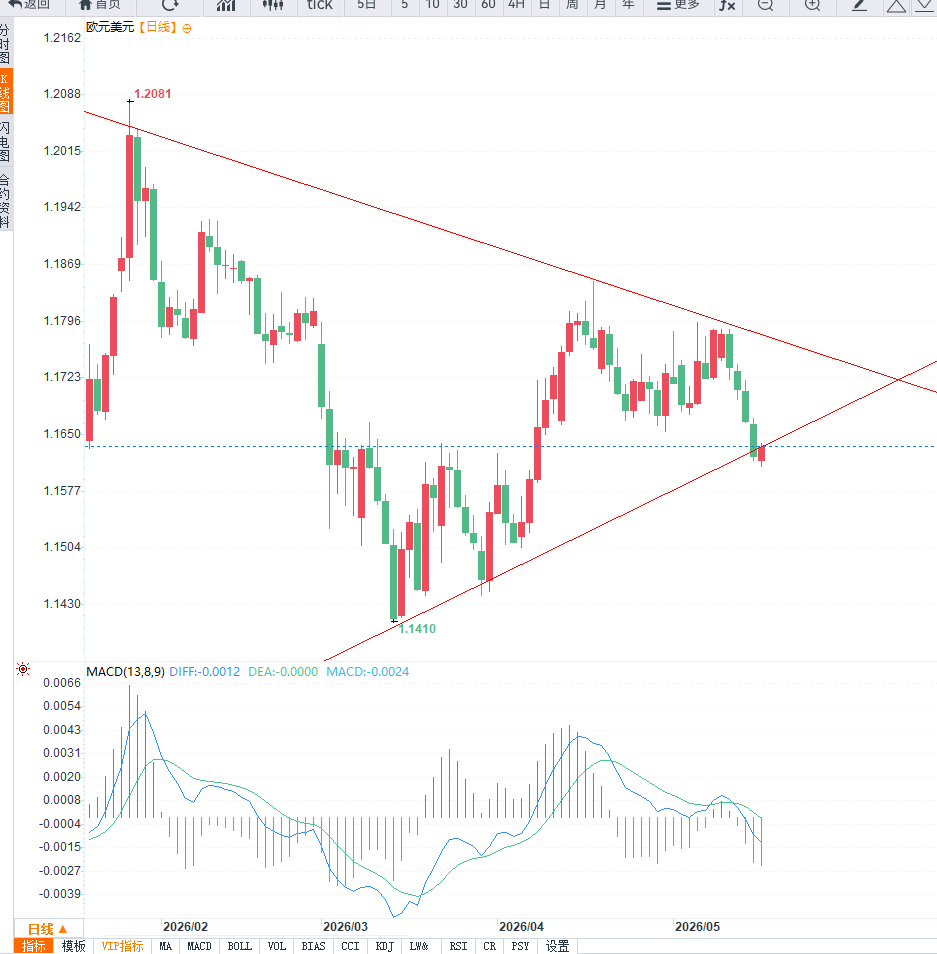
Overall, the European market is currently facing a complex balance between "energy shocks driving up inflation" and "slowing economic growth," while the European Central Bank is more inclined to prioritize controlling inflation risks.
Editor's Summary:
The European Central Bank's latest economic bulletin indicates that rising energy prices triggered by the Middle East situation are reigniting inflation risks in Europe. While deteriorating consumer confidence may drag down future economic growth, the ECB is currently more focused on whether price pressures in the services sector will spread further. From a market perspective, as long as energy prices remain high and inflationary pressures persist, expectations of an ECB rate hike in June are unlikely to cool significantly. However, the high-interest-rate environment may also increase pressure on European economic growth in the future. Going forward, the market will focus on European services inflation, business climate indices, and developments in the Middle East.
The report points out that after the Middle East conflict drove up international oil prices, the primary risk facing Europe remains inflation, rather than a short-term economic recession. The European Central Bank believes that the impact of rising energy prices on inflation is significantly greater than their direct impact on economic activity. With international oil prices remaining high, market concerns are that shipping risks in the Strait of Hormuz could further strain global energy supplies. Given Europe's high dependence on energy imports, rising oil prices will directly increase production costs for businesses and living expenses for residents.
From the European Central Bank's perspective, the resurgence of imported inflation may force the central bank to maintain a relatively tight monetary policy. However, the ECB also warned that if household and business confidence deteriorates excessively, the risks to future economic growth could increase significantly. The statement noted that the impact of declining consumer confidence on economic activity is typically lagged, therefore the impact on economic growth in 2026 may be limited, but economic growth in 2027 could be more significantly hampered.
Deteriorating household confidence could delay the impact on the European economy and create more pronounced growth pressures by 2027.
Societe Generale believes that the European Central Bank's primary concern is not the short-term slowdown in growth, but rather whether price pressures in the services sector are resurging. If future business surveys show only a slight decline in economic activity but a continued rise in price indices, then internal support for interest rate hikes within the ECB may strengthen further.
In particular, with inflation in the European service sector remaining high, the European Central Bank may be more inclined to continue raising interest rates to stabilize inflation expectations should energy price increases further spread to the transportation, catering, and consumer services sectors.
Whether inflation in the services sector is rebounding has become a key indicator to watch for the European Central Bank's future policy. The market currently widely expects the ECB to raise interest rates by 25 basis points at its June meeting. Unless there is a significant easing of tensions in the Middle East, market bets on a rate hike are likely to continue to intensify.
From a market perspective, rising expectations for European interest rates are providing some support for the euro. While the EUR/USD exchange rate has recently been pressured by a strong dollar, the overall decline has been relatively limited due to increased hawkish expectations from the European Central Bank. The market is currently trading on the logic of "both European and US central banks adopting a hawkish stance." However, given that the US economy is still performing stronger than the European economy, the dollar's overall advantage remains for the time being.
From a technical perspective, the EUR/USD pair is currently maintaining a slightly bearish, range-bound structure on the daily chart. Although the exchange rate has seen consecutive pullbacks, there is still significant technical support around 1.1600. The 14-day RSI indicator is currently hovering in the neutral-to-bearish zone, indicating that while bearish momentum is dominant, it has not yet reached extreme oversold territory. The MACD indicator is still below the zero line, but the green bars are gradually shortening, suggesting that short-term downward momentum is weakening. 1.1600 has become a key medium-term support level for the EUR/USD pair.
If expectations of further interest rate hikes by the European Central Bank continue to rise, the euro/dollar exchange rate may retest the resistance zone around 1.1700. Conversely, if the dollar continues to be driven by safe-haven flows, the euro's upside potential may be limited.
From the 4-hour chart, the euro/dollar pair has begun to show signs of technical stabilization in the short term. The MACD indicator is consolidating at low levels, while the RSI indicator is gradually rising to around 45, indicating that bearish momentum is weakening. However, the exchange rate is still within a descending channel, so the short-term trend remains biased towards consolidation. If it breaks through the 1.1680-1.1700 area, a more significant rebound structure may form.
Overall, the European market is currently facing a complex balance between "energy shocks driving up inflation" and "slowing economic growth," while the European Central Bank is more inclined to prioritize controlling inflation risks.
Editor's Summary:
The European Central Bank's latest economic bulletin indicates that rising energy prices triggered by the Middle East situation are reigniting inflation risks in Europe. While deteriorating consumer confidence may drag down future economic growth, the ECB is currently more focused on whether price pressures in the services sector will spread further. From a market perspective, as long as energy prices remain high and inflationary pressures persist, expectations of an ECB rate hike in June are unlikely to cool significantly. However, the high-interest-rate environment may also increase pressure on European economic growth in the future. Going forward, the market will focus on European services inflation, business climate indices, and developments in the Middle East.
- Risk Warning and Disclaimer
- The market involves risk, and trading may not be suitable for all investors. This article is for reference only and does not constitute personal investment advice, nor does it take into account certain users’ specific investment objectives, financial situation, or other needs. Any investment decisions made based on this information are at your own risk.