The Japanese government emphasized its close attention to long-term interest rate and foreign exchange market volatility, with the USD/JPY pair fluctuating around 158.80 at high levels.
2026-05-18 15:48:19
On Monday during the European trading session, Japanese Chief Cabinet Secretary Seiji Kihara stated that the Japanese government is monitoring financial market developments, including long-term interest rate trends, with a "high sense of urgency." However, he declined to comment on potential intervention in the foreign exchange market. This statement indicates that the Japanese government is highly vigilant regarding recent financial market volatility, particularly the continued weakness of the yen and rising yields on Japanese government bonds. The Japanese government is signaling strong concern about market volatility but has not yet explicitly intervened in the foreign exchange market.

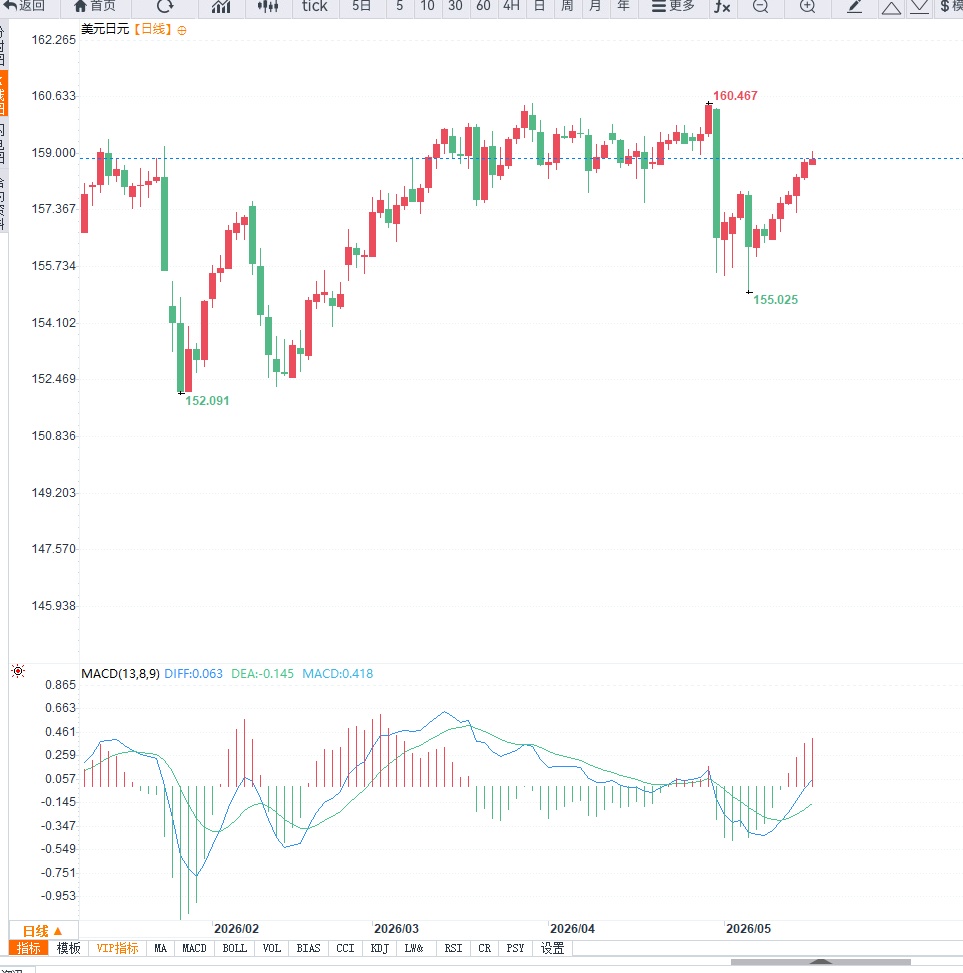
Following the announcement, the USD/JPY pair saw limited short-term volatility, fluctuating around 158.80. Previously, the USD/JPY pair had briefly reached a new high, but subsequently gave back some of those gains. The market generally believes that while the Japanese government has not yet explicitly signaled intervention, it has begun to manage market expectations through verbal statements.
In recent years, the Japanese government has frequently used phrases such as "paying close attention to the market" and "taking appropriate action if necessary" during periods of rapid yen depreciation to warn of potential intervention. The market is reassessing the risks of potential Japanese currency intervention. However, from a current fundamental perspective, the USD/JPY exchange rate remains supported by the widening interest rate differential between the US and Japan.
Recently, several Federal Reserve officials have repeatedly emphasized that controlling inflation remains the core policy objective and hinted at the possibility of further interest rate hikes if price pressures persist. According to data from the CME Group's FedWatch tool, market expectations for further Fed rate hikes this year have clearly intensified, pushing US Treasury yields and the US dollar index to remain high. In contrast, while some voices within the Bank of Japan have recently voiced support for interest rate hikes, its overall monetary policy remains noticeably accommodative.
Bank of Japan officials have previously stated that while rising energy prices may bring imported inflationary pressures, domestic demand and wage growth in Japan are still insufficient to support a rapid tightening of policy. The high interest rate differential between the US and Japan continues to be a core driver of the dollar's appreciation against the yen. Meanwhile, escalating tensions in the Middle East are pushing up international oil prices, further exacerbating economic pressures on Japan.
Given Japan's heavy reliance on energy imports, rising international oil prices will directly increase production costs for Japanese companies and the living burden on residents, further widening the risk of a trade deficit. Currently, shipping risks persist in the Strait of Hormuz, which handles approximately 20% of global seaborne crude oil transport. If energy supply risks continue to escalate, the Japanese economy may face more pronounced imported inflationary pressures.
However, unlike Europe and the United States, Japan's economic growth remains relatively weak, so the Bank of Japan remains cautious about raising interest rates.
From a technical perspective, the USD/JPY pair maintains a clear upward trend on the daily chart. The exchange rate continues to trade above the 20-day and 50-day moving averages, indicating that the medium-term bullish structure remains intact. The 14-day RSI is currently around 68, approaching overbought territory, suggesting strong bullish sentiment, but there is a risk of a short-term technical pullback. The MACD indicator remains above the zero line, and the red bars continue to expand, indicating that upward momentum has not weakened significantly. The area around 160.00 is a key psychological resistance level for USD/JPY. If the exchange rate breaks through the 160 level, concerns about Japanese government intervention in the foreign exchange market may resurface. The areas around 157.20 and 156.50 are the main technical support levels.
From the 4-hour chart, USD/JPY has entered a short-term high-level consolidation phase. The MACD indicator is showing signs of overbought conditions, while the RSI indicator has retreated from the overbought zone, indicating a slowdown in short-term bullish momentum. However, the exchange rate is currently still trading within an upward channel, suggesting that the overall trend remains unchanged. If the US dollar continues to be supported by safe-haven demand and expectations of interest rate hikes, USD/JPY may maintain its high levels. In the short term, the area around 158.30 is the first support zone, while the 159.20 to 160.00 area is the current main resistance zone.
Editor's Summary:
The Japanese government has recently stated that it is paying close attention to long-term interest rates and financial market volatility, indicating that the government is highly vigilant about the continued depreciation of the yen. However, due to the hawkish expectations of the Federal Reserve driving the continued strengthening of the US dollar, while the Bank of Japan's policy remains relatively loose, the interest rate differential between the US and Japan continues to support the dollar's high level against the yen. At the same time, rising international oil prices are further increasing Japan's imported inflation pressure. Going forward, the market will focus on whether the Japanese government strengthens its verbal intervention, changes in Federal Reserve policy, and market performance around the 160 level.
Following the announcement, the USD/JPY pair saw limited short-term volatility, fluctuating around 158.80. Previously, the USD/JPY pair had briefly reached a new high, but subsequently gave back some of those gains. The market generally believes that while the Japanese government has not yet explicitly signaled intervention, it has begun to manage market expectations through verbal statements.
In recent years, the Japanese government has frequently used phrases such as "paying close attention to the market" and "taking appropriate action if necessary" during periods of rapid yen depreciation to warn of potential intervention. The market is reassessing the risks of potential Japanese currency intervention. However, from a current fundamental perspective, the USD/JPY exchange rate remains supported by the widening interest rate differential between the US and Japan.
Recently, several Federal Reserve officials have repeatedly emphasized that controlling inflation remains the core policy objective and hinted at the possibility of further interest rate hikes if price pressures persist. According to data from the CME Group's FedWatch tool, market expectations for further Fed rate hikes this year have clearly intensified, pushing US Treasury yields and the US dollar index to remain high. In contrast, while some voices within the Bank of Japan have recently voiced support for interest rate hikes, its overall monetary policy remains noticeably accommodative.
Bank of Japan officials have previously stated that while rising energy prices may bring imported inflationary pressures, domestic demand and wage growth in Japan are still insufficient to support a rapid tightening of policy. The high interest rate differential between the US and Japan continues to be a core driver of the dollar's appreciation against the yen. Meanwhile, escalating tensions in the Middle East are pushing up international oil prices, further exacerbating economic pressures on Japan.
Given Japan's heavy reliance on energy imports, rising international oil prices will directly increase production costs for Japanese companies and the living burden on residents, further widening the risk of a trade deficit. Currently, shipping risks persist in the Strait of Hormuz, which handles approximately 20% of global seaborne crude oil transport. If energy supply risks continue to escalate, the Japanese economy may face more pronounced imported inflationary pressures.
However, unlike Europe and the United States, Japan's economic growth remains relatively weak, so the Bank of Japan remains cautious about raising interest rates.
From a technical perspective, the USD/JPY pair maintains a clear upward trend on the daily chart. The exchange rate continues to trade above the 20-day and 50-day moving averages, indicating that the medium-term bullish structure remains intact. The 14-day RSI is currently around 68, approaching overbought territory, suggesting strong bullish sentiment, but there is a risk of a short-term technical pullback. The MACD indicator remains above the zero line, and the red bars continue to expand, indicating that upward momentum has not weakened significantly. The area around 160.00 is a key psychological resistance level for USD/JPY. If the exchange rate breaks through the 160 level, concerns about Japanese government intervention in the foreign exchange market may resurface. The areas around 157.20 and 156.50 are the main technical support levels.
From the 4-hour chart, USD/JPY has entered a short-term high-level consolidation phase. The MACD indicator is showing signs of overbought conditions, while the RSI indicator has retreated from the overbought zone, indicating a slowdown in short-term bullish momentum. However, the exchange rate is currently still trading within an upward channel, suggesting that the overall trend remains unchanged. If the US dollar continues to be supported by safe-haven demand and expectations of interest rate hikes, USD/JPY may maintain its high levels. In the short term, the area around 158.30 is the first support zone, while the 159.20 to 160.00 area is the current main resistance zone.
Editor's Summary:
The Japanese government has recently stated that it is paying close attention to long-term interest rates and financial market volatility, indicating that the government is highly vigilant about the continued depreciation of the yen. However, due to the hawkish expectations of the Federal Reserve driving the continued strengthening of the US dollar, while the Bank of Japan's policy remains relatively loose, the interest rate differential between the US and Japan continues to support the dollar's high level against the yen. At the same time, rising international oil prices are further increasing Japan's imported inflation pressure. Going forward, the market will focus on whether the Japanese government strengthens its verbal intervention, changes in Federal Reserve policy, and market performance around the 160 level.
- Risk Warning and Disclaimer
- The market involves risk, and trading may not be suitable for all investors. This article is for reference only and does not constitute personal investment advice, nor does it take into account certain users’ specific investment objectives, financial situation, or other needs. Any investment decisions made based on this information are at your own risk.