One chart: The Baltic Dry Index weakened overall, with freight rates for major vessel types also under downward pressure.
2026-05-18 22:55:11
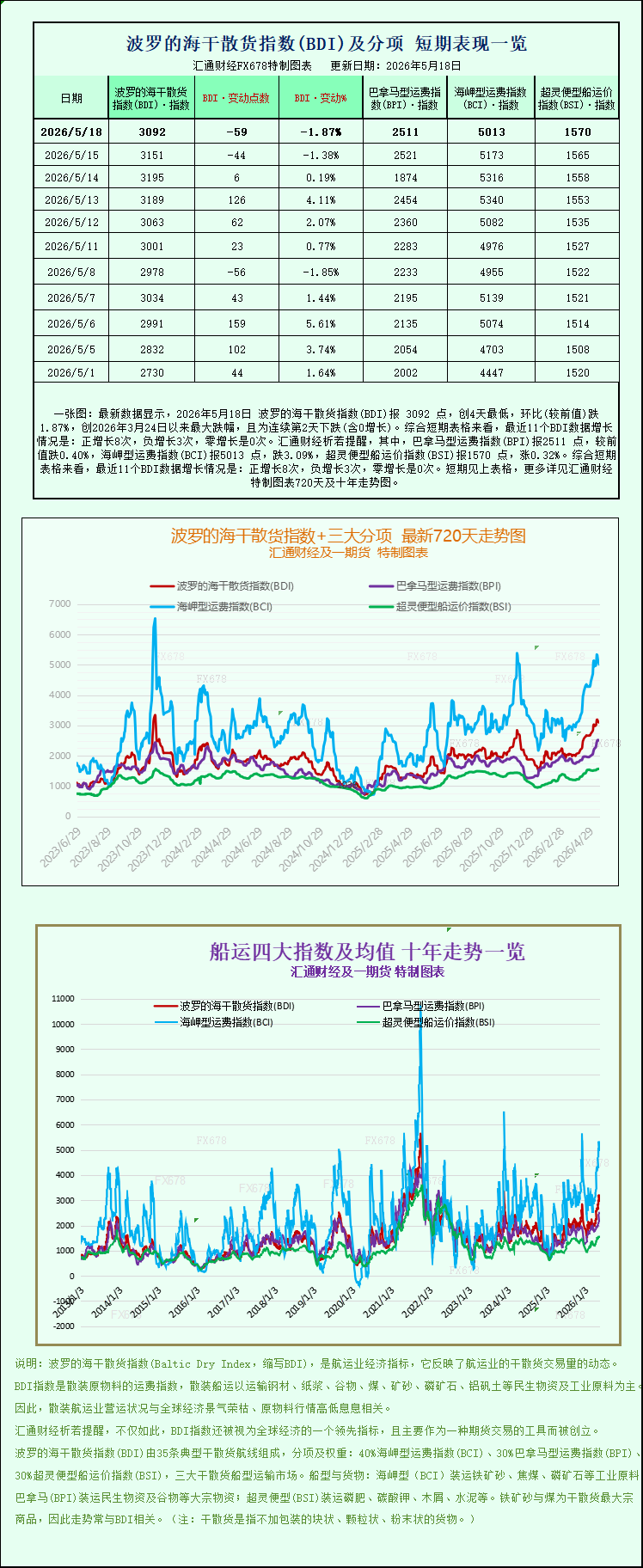
Latest data shows that on May 18, 2026, the Baltic Dry Index (BDI) stood at 3092 points, a four-day low, down 1.87% from the previous day, marking the largest drop since March 24, 2026, and the second consecutive day of decline (including zero growth). Looking at the short-term charts, the recent 11 BDI data points show: 8 positive increases, 3 negative increases, and 0 zero increases. Specifically, the Panamax Freight Index (BPI) was 2511 points, down 0.40% from the previous day; the Capesize Freight Index (BCI) was 5013 points, down 3.09%; and the Supramax Freight Index (BSI) was 1570 points, up 0.32%. For detailed 720-day and 10-year trend charts of the Baltic Dry Index and its three main sub-indices, please refer to the specially designed charts.
The international dry bulk shipping market has been cooling down recently. The Baltic Dry Index, one of the global barometers of shipping, saw a significant decline on Monday. Freight rates for both Capesize and Panamax vessels, the two main types of bulk carriers, fell across the board, with only smaller vessels experiencing a slight recovery. The overall shipping market is showing a growing trend of divergence.
Data shows that the Baltic Dry Index, which integrates freight rates for various major bulk carriers including Capesize, Panamax, and Supramax, fell sharply by 59 basis points on the day, with an overall decline of 1.9%, closing at 3092 points, indicating a continued cooling of bullish sentiment in the market.
Among them, the Capesize vessels, which are the largest in size and mainly transport bulk minerals, saw the most significant drop in freight rates. The dedicated freight rate index for this vessel type plummeted by 160 points in a single day, a drop of 3.1%, bringing the latest level back to 5013 points. These large vessels, capable of carrying 150,000 tons of cargo and primarily handling cross-border transport of industrial bulk raw materials such as iron ore and thermal coal, also experienced a corresponding decline in operating revenue. The average daily operating income decreased significantly by $1454, currently falling to $41959 per day, further narrowing the industry's profit margins.
The sharp decline in Capesize freight rates is primarily due to a shift in the supply and demand dynamics of the upstream raw material market. Currently, shipments from major iron ore supplying regions continue to increase, resulting in ample market supply. This, coupled with declining operating rates and decreasing crude steel production in many downstream steel mills, has led to persistently weak demand for industrial raw materials. The uncertainty surrounding future demand in the industry has directly driven iron ore spot prices to a one-week low, consequently cooling upstream ocean freight demand and severely impacting the large dry bulk shipping market.
The Panamax market, which primarily handles grain and small-to-medium-sized coal shipments, also failed to stabilize, with prices declining slightly. The Panamax freight index fell 10 points, or 0.4%, to close at 2511 points. This type of vessel typically carries 60,000 to 70,000 tons of coal, grain, and other essential consumer and industrial goods. Its average daily operating revenue has decreased by $94, currently stabilizing around $22,597, with weak demand in the freight market driving a steady decline in freight rates.
Amidst the divergence in market trends for large and small vessels, smaller bulk carriers bucked the trend with a slight increase. The Supramax freight rate index rose slightly by 5 basis points, a 0.3% increase, reaching 1570 points. Overall, the global dry bulk shipping market is currently affected by weak demand for commodities and sluggish industrial supply chains. The large ocean freight market is showing signs of weakness, while the short-haul, small-tonnage freight market is relatively more resilient. In the short term, the overall shipping market is likely to maintain a weak and volatile pattern.
The international dry bulk shipping market has been cooling down recently. The Baltic Dry Index, one of the global barometers of shipping, saw a significant decline on Monday. Freight rates for both Capesize and Panamax vessels, the two main types of bulk carriers, fell across the board, with only smaller vessels experiencing a slight recovery. The overall shipping market is showing a growing trend of divergence.
Data shows that the Baltic Dry Index, which integrates freight rates for various major bulk carriers including Capesize, Panamax, and Supramax, fell sharply by 59 basis points on the day, with an overall decline of 1.9%, closing at 3092 points, indicating a continued cooling of bullish sentiment in the market.
Among them, the Capesize vessels, which are the largest in size and mainly transport bulk minerals, saw the most significant drop in freight rates. The dedicated freight rate index for this vessel type plummeted by 160 points in a single day, a drop of 3.1%, bringing the latest level back to 5013 points. These large vessels, capable of carrying 150,000 tons of cargo and primarily handling cross-border transport of industrial bulk raw materials such as iron ore and thermal coal, also experienced a corresponding decline in operating revenue. The average daily operating income decreased significantly by $1454, currently falling to $41959 per day, further narrowing the industry's profit margins.
The sharp decline in Capesize freight rates is primarily due to a shift in the supply and demand dynamics of the upstream raw material market. Currently, shipments from major iron ore supplying regions continue to increase, resulting in ample market supply. This, coupled with declining operating rates and decreasing crude steel production in many downstream steel mills, has led to persistently weak demand for industrial raw materials. The uncertainty surrounding future demand in the industry has directly driven iron ore spot prices to a one-week low, consequently cooling upstream ocean freight demand and severely impacting the large dry bulk shipping market.
The Panamax market, which primarily handles grain and small-to-medium-sized coal shipments, also failed to stabilize, with prices declining slightly. The Panamax freight index fell 10 points, or 0.4%, to close at 2511 points. This type of vessel typically carries 60,000 to 70,000 tons of coal, grain, and other essential consumer and industrial goods. Its average daily operating revenue has decreased by $94, currently stabilizing around $22,597, with weak demand in the freight market driving a steady decline in freight rates.
Amidst the divergence in market trends for large and small vessels, smaller bulk carriers bucked the trend with a slight increase. The Supramax freight rate index rose slightly by 5 basis points, a 0.3% increase, reaching 1570 points. Overall, the global dry bulk shipping market is currently affected by weak demand for commodities and sluggish industrial supply chains. The large ocean freight market is showing signs of weakness, while the short-haul, small-tonnage freight market is relatively more resilient. In the short term, the overall shipping market is likely to maintain a weak and volatile pattern.
- Risk Warning and Disclaimer
- The market involves risk, and trading may not be suitable for all investors. This article is for reference only and does not constitute personal investment advice, nor does it take into account certain users’ specific investment objectives, financial situation, or other needs. Any investment decisions made based on this information are at your own risk.