Crude oil trading alert: With geopolitical tensions volatile and oil prices nearing the upper limit of their consolidation range, will the market break out or fall back?
2026-05-19 09:26:28
On Tuesday during Asian trading hours, WTI crude oil prices retreated after hitting highs, fluctuating around $102.80. This followed US President Trump's announcement that planned military action against Iran on Tuesday had been temporarily postponed because Gulf allies wanted more time to resolve the dispute diplomatically. The news eased market risk aversion in the short term, with some long positions taking profits, causing oil prices to fall from their recent highs.

US President Trump emphasized that the US retains the possibility of military action if an acceptable agreement cannot be reached in the future, but did not provide a specific timetable. This means that although the situation in the Middle East has temporarily eased, market concerns about escalation have not truly subsided. Investors generally believe that current oil prices are still supported by geopolitical risk premiums, especially given the continued restrictions on shipping through the Strait of Hormuz, making global energy supply security a core focus of the market.
The Strait of Hormuz handles approximately 20% of global seaborne crude oil transport and is one of the world's most critical energy shipping routes. Due to the escalating tensions between the United States and Iran, some shipping activities in the region remain significantly affected, raising market concerns about a potential further decline in crude oil exports. Analysts point out that if the Strait of Hormuz remains closed to normal navigation for an extended period, the global crude oil supply chain could tighten further, thereby keeping international oil prices high.
Meanwhile, policy signals from the United States continue to keep the market highly vigilant. Trump plans to hold another meeting with his national security team on Tuesday to discuss a military response to Iran. While the market currently still views diplomatic negotiations as the main direction, investors are concerned that any sudden military action could reignite panic in the oil market.
From a global market perspective, the recent sustained rise in crude oil prices has begun to drive inflation expectations. Rising energy costs may not only affect the future path of US interest rates but also increase the uncertainty surrounding the global economic recovery. Some institutions believe that if WTI crude oil prices remain above $100 for an extended period, global shipping, manufacturing, and air transport costs may further increase, thereby impacting consumer demand and corporate profit margins.
On the supply side, the market will also be watching the inventory data to be released later by the American Petroleum Institute (API). If the data shows a continued decline in U.S. commercial crude oil inventories, it will reflect continued strong refinery demand and could further reinforce market concerns about tight supply. Conversely, if inventories unexpectedly increase, it could alleviate some market pressure and exert short-term downward pressure on oil prices.
The market currently expects U.S. crude oil inventories to continue to decline by approximately 2 million to 3.5 million barrels. With summer driving demand gradually entering its peak season, U.S. fuel consumption expectations remain strong, which is one of the key supporting factors for the recent high oil prices.
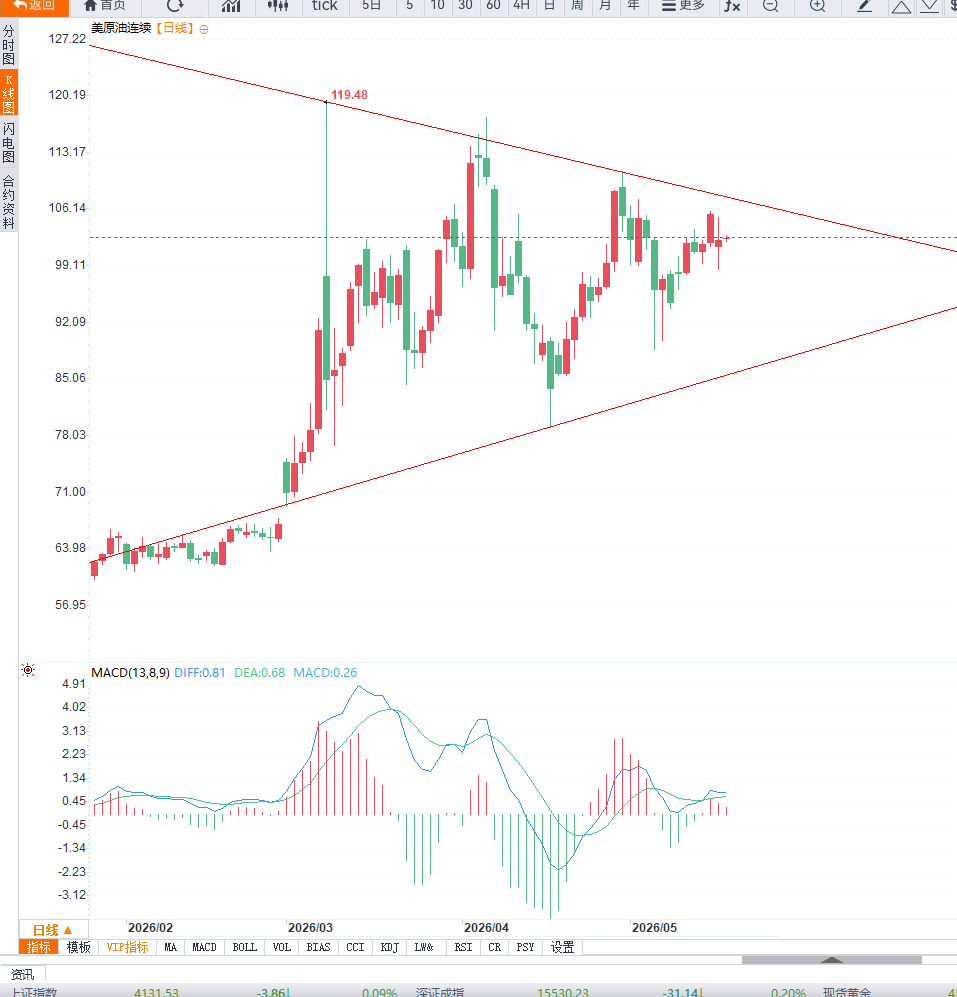
From a technical perspective, WTI crude oil's daily chart structure still maintains a clear bullish trend. After oil prices quickly broke through the key resistance level of $95, market buying momentum further strengthened, and the overall trading range has now clearly shifted upwards. On the daily chart, the $100 level has gradually transformed into an important support area, while the $104-$106 area above constitutes a key short-term resistance. If the situation in the Middle East deteriorates further, oil prices may continue to challenge the $110 area.
In terms of technical indicators, the daily MACD maintains a high-level golden cross structure, and although the RSI indicator has entered the overbought zone, no obvious top divergence has yet appeared, indicating that the market trend is still biased towards strength. However, with the continuous and rapid rise in oil prices, some short-term funds have begun to show signs of taking profits at high levels, and market volatility has increased significantly.
From a 4-hour chart perspective, WTI crude oil has entered a high-level consolidation phase in the short term. The 4-hour MACD histogram has narrowed, indicating that the short-term upward momentum has slowed slightly. Meanwhile, short-term support is gradually forming around $101, while the area around $103.80 has become a key area for short-term breakouts. If subsequent API inventory data continues to be bullish, oil prices may retest recent highs; if inventory data is weak, coupled with a cooling of market risk aversion, a further short-term pullback to around $99 cannot be ruled out.
Overall, the international crude oil market remains in a typical "geopolitical risk-driven" phase. Although Trump's temporary halt to military action has eased market sentiment briefly, the risks in the Middle East have not truly been eliminated, and the Strait of Hormuz shipping issue remains one of the core variables determining the future direction of oil prices. Given the persistent supply chain risks, market expectations for crude oil prices to remain high in the medium to long term remain strong.
Editor's Summary : The international crude oil market has gradually shifted from the traditional supply and demand logic to a "geopolitical risk pricing" model. While Trump's temporary halt to military action against Iran caused a short-term market correction, the disruption of shipping through the Strait of Hormuz still means that global energy supply risks have not been truly eliminated. In the coming period, changes in the Middle East situation, US production data, and inventory changes will continue to dominate market sentiment. From a trend perspective, WTI crude oil remaining above $100 indicates that the market risk premium remains high. If the conflict escalates further, oil prices may continue to challenge higher levels, reigniting global inflationary pressures. However, high oil prices may also gradually suppress some demand growth, thereby increasing future market volatility risks. Investors need to pay close attention to US inventory data, OPEC+ policy moves, and the navigation situation in the Strait of Hormuz, as these factors will determine the medium- to long-term direction of the crude oil market.
US President Trump emphasized that the US retains the possibility of military action if an acceptable agreement cannot be reached in the future, but did not provide a specific timetable. This means that although the situation in the Middle East has temporarily eased, market concerns about escalation have not truly subsided. Investors generally believe that current oil prices are still supported by geopolitical risk premiums, especially given the continued restrictions on shipping through the Strait of Hormuz, making global energy supply security a core focus of the market.
The Strait of Hormuz handles approximately 20% of global seaborne crude oil transport and is one of the world's most critical energy shipping routes. Due to the escalating tensions between the United States and Iran, some shipping activities in the region remain significantly affected, raising market concerns about a potential further decline in crude oil exports. Analysts point out that if the Strait of Hormuz remains closed to normal navigation for an extended period, the global crude oil supply chain could tighten further, thereby keeping international oil prices high.
Meanwhile, policy signals from the United States continue to keep the market highly vigilant. Trump plans to hold another meeting with his national security team on Tuesday to discuss a military response to Iran. While the market currently still views diplomatic negotiations as the main direction, investors are concerned that any sudden military action could reignite panic in the oil market.
From a global market perspective, the recent sustained rise in crude oil prices has begun to drive inflation expectations. Rising energy costs may not only affect the future path of US interest rates but also increase the uncertainty surrounding the global economic recovery. Some institutions believe that if WTI crude oil prices remain above $100 for an extended period, global shipping, manufacturing, and air transport costs may further increase, thereby impacting consumer demand and corporate profit margins.
On the supply side, the market will also be watching the inventory data to be released later by the American Petroleum Institute (API). If the data shows a continued decline in U.S. commercial crude oil inventories, it will reflect continued strong refinery demand and could further reinforce market concerns about tight supply. Conversely, if inventories unexpectedly increase, it could alleviate some market pressure and exert short-term downward pressure on oil prices.
The market currently expects U.S. crude oil inventories to continue to decline by approximately 2 million to 3.5 million barrels. With summer driving demand gradually entering its peak season, U.S. fuel consumption expectations remain strong, which is one of the key supporting factors for the recent high oil prices.
From a technical perspective, WTI crude oil's daily chart structure still maintains a clear bullish trend. After oil prices quickly broke through the key resistance level of $95, market buying momentum further strengthened, and the overall trading range has now clearly shifted upwards. On the daily chart, the $100 level has gradually transformed into an important support area, while the $104-$106 area above constitutes a key short-term resistance. If the situation in the Middle East deteriorates further, oil prices may continue to challenge the $110 area.
In terms of technical indicators, the daily MACD maintains a high-level golden cross structure, and although the RSI indicator has entered the overbought zone, no obvious top divergence has yet appeared, indicating that the market trend is still biased towards strength. However, with the continuous and rapid rise in oil prices, some short-term funds have begun to show signs of taking profits at high levels, and market volatility has increased significantly.
From a 4-hour chart perspective, WTI crude oil has entered a high-level consolidation phase in the short term. The 4-hour MACD histogram has narrowed, indicating that the short-term upward momentum has slowed slightly. Meanwhile, short-term support is gradually forming around $101, while the area around $103.80 has become a key area for short-term breakouts. If subsequent API inventory data continues to be bullish, oil prices may retest recent highs; if inventory data is weak, coupled with a cooling of market risk aversion, a further short-term pullback to around $99 cannot be ruled out.
Overall, the international crude oil market remains in a typical "geopolitical risk-driven" phase. Although Trump's temporary halt to military action has eased market sentiment briefly, the risks in the Middle East have not truly been eliminated, and the Strait of Hormuz shipping issue remains one of the core variables determining the future direction of oil prices. Given the persistent supply chain risks, market expectations for crude oil prices to remain high in the medium to long term remain strong.
Editor's Summary : The international crude oil market has gradually shifted from the traditional supply and demand logic to a "geopolitical risk pricing" model. While Trump's temporary halt to military action against Iran caused a short-term market correction, the disruption of shipping through the Strait of Hormuz still means that global energy supply risks have not been truly eliminated. In the coming period, changes in the Middle East situation, US production data, and inventory changes will continue to dominate market sentiment. From a trend perspective, WTI crude oil remaining above $100 indicates that the market risk premium remains high. If the conflict escalates further, oil prices may continue to challenge higher levels, reigniting global inflationary pressures. However, high oil prices may also gradually suppress some demand growth, thereby increasing future market volatility risks. Investors need to pay close attention to US inventory data, OPEC+ policy moves, and the navigation situation in the Strait of Hormuz, as these factors will determine the medium- to long-term direction of the crude oil market.
- Risk Warning and Disclaimer
- The market involves risk, and trading may not be suitable for all investors. This article is for reference only and does not constitute personal investment advice, nor does it take into account certain users’ specific investment objectives, financial situation, or other needs. Any investment decisions made based on this information are at your own risk.