Warsh vowed on Friday: Will the market's bet on a "policy shift to the right" materialize? Speculating on new variables in dollar pricing.
2026-05-19 17:35:34
On Tuesday, May 19th, the US dollar index remained above the 99 mark. The core of the market movement was no longer solely driven by safe-haven buying, but rather by a re-coupling of energy prices, inflation expectations, long-term yields, and expectations surrounding Federal Reserve communications. The dollar index is currently fluctuating around 99.20, having reached a high of 99.41 in the previous trading day. Brent crude oil remains around $110 per barrel, and WTI crude oil around $104 per barrel. Even with a slight pullback due to expectations surrounding Middle East negotiations, the impact of energy prices on inflation and the yield curve remains unresolved.
The recent strengthening of the US dollar index can be attributed to two main factors. First, the energy risk premium caused by the Middle East situation has led to a repricing of import inflation and global growth divergence in the market. Second, the Federal Reserve's policy has shifted from discussions of interest rate cuts to expectations of a renewed hawkish stance. US April CPI rose 3.8% year-on-year and 0.6% month-on-month, while core CPI rose 2.8% year-on-year; energy prices rose 3.8% month-on-month, and gasoline prices rose 5.4% month-on-month. This data suggests that inflationary pressures are not merely confined to risk appetite in financial assets, but have already entered the monetary policy response function.
On the technical chart, the US dollar index has recovered from around 97.62 to 99.41. The Bollinger Band middle line is around 98.45, and the upper line is around 99.22. The current price is trading near the upper line, indicating that short-term pricing has shifted from a low-level recovery to a pressure testing phase. The MACD indicator shows the DIFF line crossing above the DEA line and the histogram turning positive, indicating that the rebound momentum remains, but the price's proximity to the upper line also means that volatility has significantly increased. For traders, the key is not simply judging strength or weakness, but rather confirming whether this rebound is driven by actual interest rate differentials or by event premiums.
The Federal Reserve's April meeting maintained the target range for the federal funds rate at 3.50% to 3.75%, which forms the policy base for pricing the dollar. Currently, the market is almost fully pricing in a no-fly rate at the June meeting, with interest rate futures indicating a near 98.8% probability of maintaining the current rate in June. However, the probability of a rate hike in December has risen to around 48.5%, and other market pricing indicators suggest a probability of a rate hike this year of about 60%. This suggests that the dollar's support does not come from an immediate rate hike, but rather from a potential rightward shift in policy wording.
Newly appointed Federal Reserve Chairman Warsh is expected to be sworn in this Friday, with market attention focused on his first policy address. Standard Chartered CEO Winters believes Warsh will face the dual constraints of persistent inflation and external pressure to cut interest rates. Macquarie Group's foreign exchange and interest rate strategist, Thierry Wiesman, believes that even if the Fed releases a neutral signal in June, it may not be enough to stabilize inflation expectations and long-term Treasury yields. In other words, the key to the dollar index is not whether a particular meeting takes action, but whether the policy statement acknowledges that the energy shock is altering the path of inflation.
The 10-year US Treasury yield was last seen around 4.61%, after rising to 4.623% in the previous trading session, reaching its highest level since February 2025. Rising long-term yields have a dual impact on the US dollar: on the one hand, they increase the nominal attractiveness of dollar-denominated assets; on the other hand, they weaken the valuation of risk assets and suppress global risk appetite. When energy prices and inflation expectations coexist, the dollar may receive both interest rate differential support and safe-haven support, which explains why it did not weaken rapidly despite a short-term drop in oil prices.
However, this support does not equate to a one-sided trend. Paul Michael, head of FX research at HSBC, points out that the dollar has not returned to its March highs because global risk sentiment has clearly recovered, the overnight dollar index swap market has not yet bet on an aggressive rate hike cycle, and global monthly growth momentum remains positive. This assessment reveals the contradictory structure of the dollar: inflation and yields provide downside support, but a recovery in risk appetite will weaken the safe-haven premium. For the dollar index to continue breaking through the 99.40-99.70 area, we need to see further upward revisions in interest rate expectations, not just repeated geopolitical news.
The strength of the US dollar index is not solely determined by US data; it also depends on the relative pressure on a basket of currencies. When energy prices are high, the terms of trade for energy-importing economies like the Eurozone and Japan are more vulnerable, amplifying the passive support for the dollar index. Regarding the yen, the market remains sensitive to exchange rate fluctuations, but the Bank of Japan's policy path is still constrained by economic growth, imported inflation, and bond market stability. As for the euro, if energy costs remain high, the contradiction between growth expectations and inflationary pressures will limit its upside potential against the dollar.
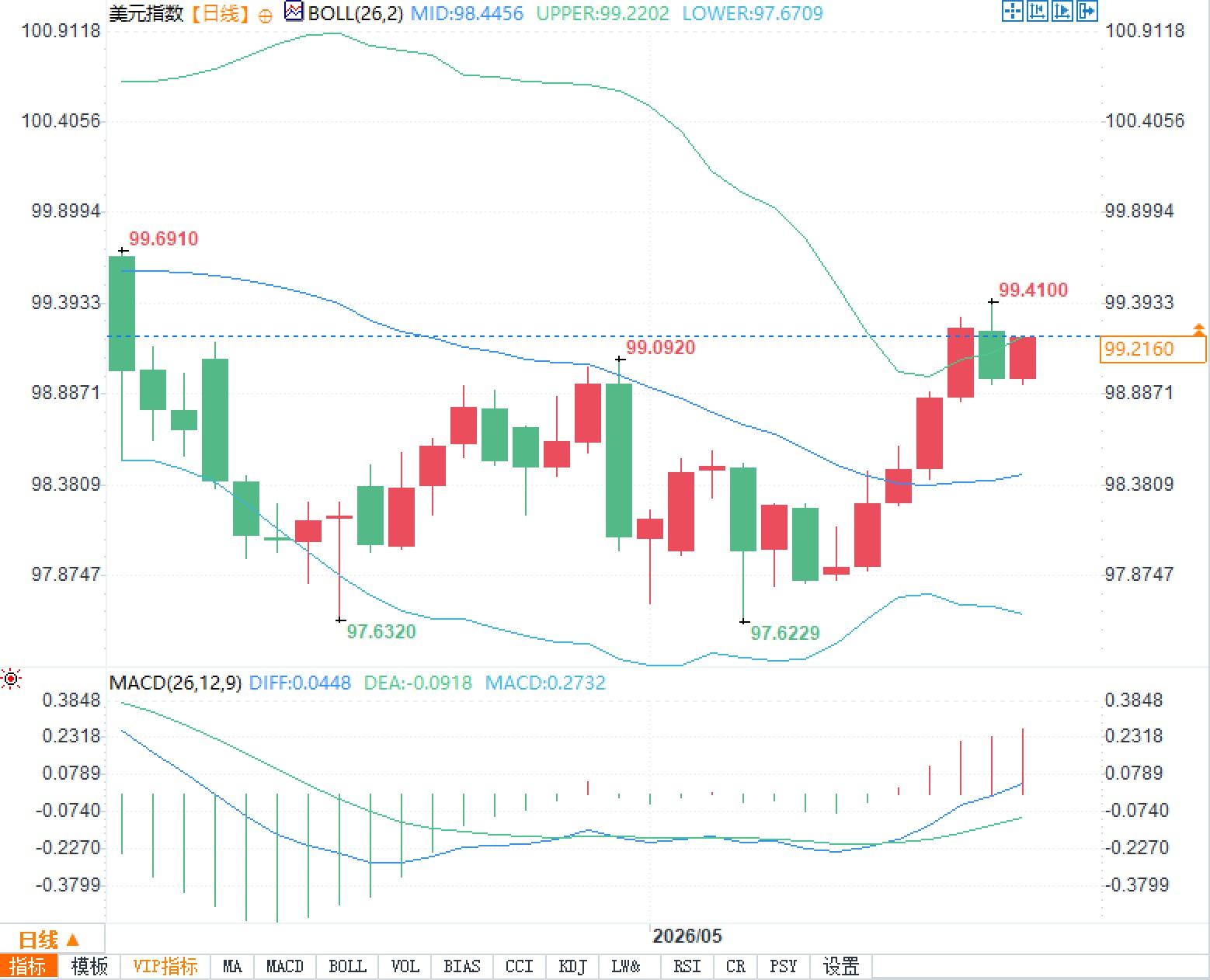
This is also the core of the current US dollar index trend: if the Middle East negotiations progress and lead to a decline in the risk premium for crude oil, the safe-haven support for the US dollar will decrease; however, as long as inflation expectations and US Treasury yields do not decline significantly, the US dollar index may still maintain high-level fluctuations. The upper Bollinger Band near 99.22 and the high of 99.41 form a short-term observation zone, while the middle Bollinger Band at 98.45 is an important reference for judging whether the rebound structure has been broken.
Question 1: Why did the US dollar index remain resilient when oil prices fell?
A: The decline in oil prices only weakened the safe-haven premium, but did not eliminate inflationary pressures. The April CPI rose 3.8% year-on-year, with the energy component remaining strong. US Treasury yields remained high, and the US dollar continued to be supported by interest rate differentials and policy expectations.
Question 2: The Fed is unlikely to raise interest rates in June, so why is the market still focusing on hawkish signals?
A: The current focus of trading is not on the June action, but rather on whether the wording of the statement acknowledges rising inflation risks. If policy communication shifts towards a greater emphasis on energy inflation, the probability of a year-end rate hike could still influence dollar pricing.
Question 3: What is the most critical variable for the US dollar index going forward?
A: The key variables are whether oil prices can continue to cool down, whether the 10-year US Treasury yield will fall, and the tone of communication after the new Fed chair takes office. These three factors will jointly determine whether the upward trend above 99 continues or returns to range-bound trading.
The rebound in the US dollar index is not just a result of safe-haven trading.
The recent strengthening of the US dollar index can be attributed to two main factors. First, the energy risk premium caused by the Middle East situation has led to a repricing of import inflation and global growth divergence in the market. Second, the Federal Reserve's policy has shifted from discussions of interest rate cuts to expectations of a renewed hawkish stance. US April CPI rose 3.8% year-on-year and 0.6% month-on-month, while core CPI rose 2.8% year-on-year; energy prices rose 3.8% month-on-month, and gasoline prices rose 5.4% month-on-month. This data suggests that inflationary pressures are not merely confined to risk appetite in financial assets, but have already entered the monetary policy response function.
On the technical chart, the US dollar index has recovered from around 97.62 to 99.41. The Bollinger Band middle line is around 98.45, and the upper line is around 99.22. The current price is trading near the upper line, indicating that short-term pricing has shifted from a low-level recovery to a pressure testing phase. The MACD indicator shows the DIFF line crossing above the DEA line and the histogram turning positive, indicating that the rebound momentum remains, but the price's proximity to the upper line also means that volatility has significantly increased. For traders, the key is not simply judging strength or weakness, but rather confirming whether this rebound is driven by actual interest rate differentials or by event premiums.
The Federal Reserve's expectations are the true anchor of the dollar.
The Federal Reserve's April meeting maintained the target range for the federal funds rate at 3.50% to 3.75%, which forms the policy base for pricing the dollar. Currently, the market is almost fully pricing in a no-fly rate at the June meeting, with interest rate futures indicating a near 98.8% probability of maintaining the current rate in June. However, the probability of a rate hike in December has risen to around 48.5%, and other market pricing indicators suggest a probability of a rate hike this year of about 60%. This suggests that the dollar's support does not come from an immediate rate hike, but rather from a potential rightward shift in policy wording.
Newly appointed Federal Reserve Chairman Warsh is expected to be sworn in this Friday, with market attention focused on his first policy address. Standard Chartered CEO Winters believes Warsh will face the dual constraints of persistent inflation and external pressure to cut interest rates. Macquarie Group's foreign exchange and interest rate strategist, Thierry Wiesman, believes that even if the Fed releases a neutral signal in June, it may not be enough to stabilize inflation expectations and long-term Treasury yields. In other words, the key to the dollar index is not whether a particular meeting takes action, but whether the policy statement acknowledges that the energy shock is altering the path of inflation.
Rising long-term yields alter the risk structure of the US dollar index.
The 10-year US Treasury yield was last seen around 4.61%, after rising to 4.623% in the previous trading session, reaching its highest level since February 2025. Rising long-term yields have a dual impact on the US dollar: on the one hand, they increase the nominal attractiveness of dollar-denominated assets; on the other hand, they weaken the valuation of risk assets and suppress global risk appetite. When energy prices and inflation expectations coexist, the dollar may receive both interest rate differential support and safe-haven support, which explains why it did not weaken rapidly despite a short-term drop in oil prices.
However, this support does not equate to a one-sided trend. Paul Michael, head of FX research at HSBC, points out that the dollar has not returned to its March highs because global risk sentiment has clearly recovered, the overnight dollar index swap market has not yet bet on an aggressive rate hike cycle, and global monthly growth momentum remains positive. This assessment reveals the contradictory structure of the dollar: inflation and yields provide downside support, but a recovery in risk appetite will weaken the safe-haven premium. For the dollar index to continue breaking through the 99.40-99.70 area, we need to see further upward revisions in interest rate expectations, not just repeated geopolitical news.
Pressure on the euro and yen strengthens the dollar basket effect.
The strength of the US dollar index is not solely determined by US data; it also depends on the relative pressure on a basket of currencies. When energy prices are high, the terms of trade for energy-importing economies like the Eurozone and Japan are more vulnerable, amplifying the passive support for the dollar index. Regarding the yen, the market remains sensitive to exchange rate fluctuations, but the Bank of Japan's policy path is still constrained by economic growth, imported inflation, and bond market stability. As for the euro, if energy costs remain high, the contradiction between growth expectations and inflationary pressures will limit its upside potential against the dollar.
This is also the core of the current US dollar index trend: if the Middle East negotiations progress and lead to a decline in the risk premium for crude oil, the safe-haven support for the US dollar will decrease; however, as long as inflation expectations and US Treasury yields do not decline significantly, the US dollar index may still maintain high-level fluctuations. The upper Bollinger Band near 99.22 and the high of 99.41 form a short-term observation zone, while the middle Bollinger Band at 98.45 is an important reference for judging whether the rebound structure has been broken.
Frequently Asked Questions
Question 1: Why did the US dollar index remain resilient when oil prices fell?
A: The decline in oil prices only weakened the safe-haven premium, but did not eliminate inflationary pressures. The April CPI rose 3.8% year-on-year, with the energy component remaining strong. US Treasury yields remained high, and the US dollar continued to be supported by interest rate differentials and policy expectations.
Question 2: The Fed is unlikely to raise interest rates in June, so why is the market still focusing on hawkish signals?
A: The current focus of trading is not on the June action, but rather on whether the wording of the statement acknowledges rising inflation risks. If policy communication shifts towards a greater emphasis on energy inflation, the probability of a year-end rate hike could still influence dollar pricing.
Question 3: What is the most critical variable for the US dollar index going forward?
A: The key variables are whether oil prices can continue to cool down, whether the 10-year US Treasury yield will fall, and the tone of communication after the new Fed chair takes office. These three factors will jointly determine whether the upward trend above 99 continues or returns to range-bound trading.
- Risk Warning and Disclaimer
- The market involves risk, and trading may not be suitable for all investors. This article is for reference only and does not constitute personal investment advice, nor does it take into account certain users’ specific investment objectives, financial situation, or other needs. Any investment decisions made based on this information are at your own risk.