Japan's economy grew faster than expected, but concerns about energy and pressure for yen depreciation remain.
2026-05-19 17:51:26
Japan's economy grew at an annualized rate of 2.1% in the first quarter of 2026, exceeding analysts' expectations, mainly driven by improved consumption and strong exports. This growth rate was significantly higher than the average analyst forecast of 1.7% and also higher than the 1.3% in the previous quarter, indicating that the Japanese economy showed strong resilience at the beginning of the year.
However, these figures do not fully reflect the full impact of the US-Iran conflict that erupted at the end of February—the conflict's upward effect on energy prices only began to gradually appear from mid-March. Therefore, the first-quarter GDP data is essentially a "pre-war report card." The market is more concerned about the pressure on growth prospects in the second quarter and the second half of the year, given that high oil prices continue to erode corporate profits and household purchasing power.
Data released by the Japanese government on Tuesday (May 19) showed that the seasonally adjusted economy grew by 0.5% quarter-on-quarter in the first quarter, higher than the market expectation of 0.4% and an improvement over the 0.3% projected for the fourth quarter of 2025. Looking at the components of GDP by expenditure approach, personal consumption rose by 0.3% quarter-on-quarter, corporate capital expenditure increased by 0.8%, exports rose by 1.2%, and imports declined by 0.4%. Net exports made a positive contribution to GDP, which is one of the key supporting factors for the better-than-expected performance in the first quarter.
Japan's exports rose 11.5% year-on-year in March, far exceeding market expectations, partly driven by a 29.3% surge in semiconductor equipment shipments. This data reflects strong demand for high-end semiconductor manufacturing equipment driven by global AI infrastructure construction and data center expansion. Japan possesses a significant competitive advantage in materials and equipment upstream of the semiconductor supply chain and is becoming one of the main beneficiaries of the AI hardware investment boom.
However, Norihiro Yamaguchi, chief Japan economist at Oxford Economics, expressed a cautious view to CNBC: "Although Japan's GDP grew healthily by 0.5% in the first quarter, we believe that the first quarter's GDP is now history, and the economy is expected to feel the pressure from high energy costs in the future." He added that while strong IT demand-driven export growth may provide short-term support for the Japanese economy, rising energy prices and increased geopolitical uncertainty will begin to limit consumption and investment. Small and medium-sized enterprises, in particular, are less able to absorb rising energy costs and may face even more severe profit squeezes in the coming quarters.
Following the release of GDP data, the yen weakened slightly against the dollar, trading around 159, still hovering near the level reached when Japanese authorities intervened in late April.
The market remains highly vigilant about another possible intervention by the Japanese Ministry of Finance, especially as the yen approaches the "psychological bottom line" of 160.
Mitsubishi UFJ Bank points out that the continued breakthrough of the USD/JPY exchange rate above 159 and its push towards the 160 level significantly increases the likelihood of Japanese authorities intervening in the exchange rate. At the same time, Mitsubishi UFJ and other institutions are also noting the dilemma facing Japanese intervention – with the 10-year US Treasury yield climbing above 4.6%, the Japanese Ministry of Finance has explicitly stated that it will cautiously avoid intervention that could further push up US Treasury yields.
Even before the release of strong first-quarter GDP data, the Bank of Japan had already made a more pessimistic assessment of the full-year economic outlook. The central bank lowered its fiscal year 2026 growth forecast from 1.0% to 0.5%, while significantly raising its core inflation forecast from 1.9% to 2.8%. This combination of "downward revision of growth and upward revision of inflation" is essentially an institutional response to imported inflationary pressures caused by the US-Iran conflict.
At its latest meeting on May 7, the Bank of Japan explicitly warned that Japan's economic growth may slow this year due to rising oil prices caused by the Middle East crisis, which are expected to compress corporate profits and real household income. Meanwhile, Japan's inflation rate accelerated for the first time in five months in March. The central bank stated, "Rising oil prices are expected to push up prices, primarily energy and commodity prices, while the practice of passing on wage increases to retail prices continues." This indicates that Japan is transitioning from "demand-pull inflation" to "cost-push inflation," the latter presenting a more challenging policy challenge for the central bank—raising interest rates could dampen already fragile consumption, while not raising rates could allow inflation expectations to spiral out of control.
With limited room for monetary policy, fiscal policy is becoming the primary tool for the Japanese government to address downside risks to the economy. According to media reports on Monday, the Japanese government may issue new bonds to supplement the budget, buffering the economic impact of the US-Iran conflict while continuing to subsidize energy bills. This means that after years of fiscal consolidation, Japan may be returning to its old path of relying on debt expansion to support economic growth. For Japan, which already carries the world's highest public debt burden, this is a choice that requires careful consideration. Additional bond issuance could also put upward pressure on Japanese government bond yields, further complicating the Bank of Japan's monetary policy operations.
In summary, Japan's first-quarter GDP growth exceeded expectations, primarily driven by resilient consumption and strong semiconductor exports. However, this "pre-war report card" has not fully factored in the impact of the US-Iran conflict on energy prices and global supply chains. The Bank of Japan has explicitly lowered its full-year growth forecast and significantly raised its inflation forecast, and market concerns about rising energy costs are intensifying. As the government considers issuing new bonds to support the economy, the yen continues to face depreciation pressure, while the possibility of a June rate hike by the Bank of Japan seeks a balance between GDP data and the inflation outlook. Overall, the Japanese economy remains resilient in the short term, but high energy prices and external uncertainties are casting a shadow over the growth prospects for the second half of the year.
For investors, key variables to watch next include: whether the Bank of Japan will hold rates steady after Q1 GDP exceeds expectations, the size of the government's supplementary budget, and whether the yen will trigger a new round of intervention at the 160 level.
From the daily chart, the USD/JPY pair is currently trading around 159.10, above multiple moving averages, and maintains an overall bullish trend.
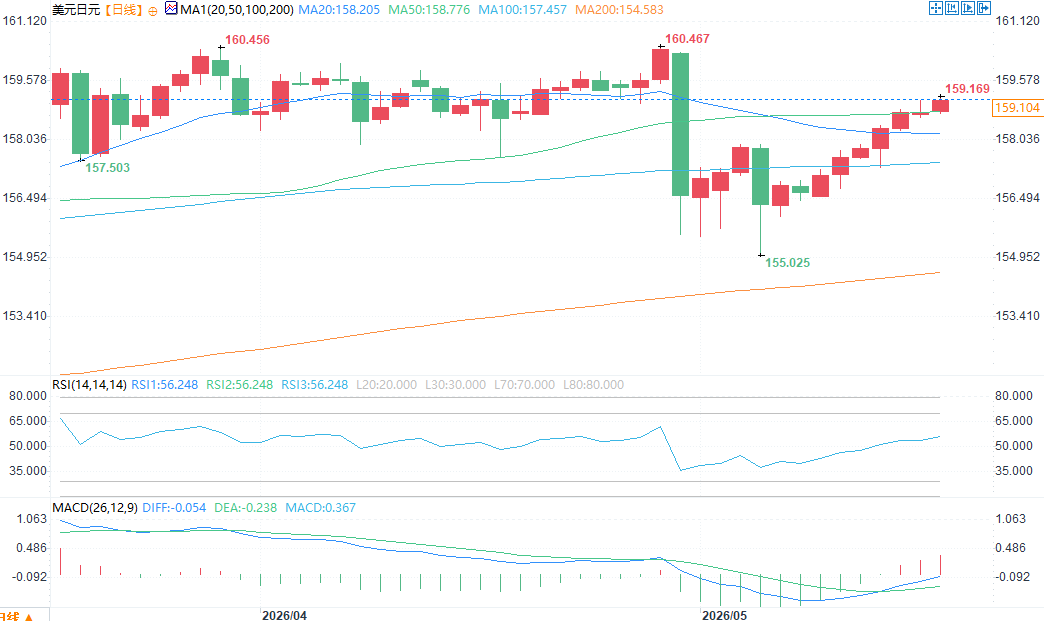
(USD/JPY daily chart, source: FX678)
In terms of moving averages, the 20-day moving average (MA20) (158.21), 50-day moving average (MA50) (158.78), 100-day moving average (MA100) (157.46), and 200-day moving average (MA200) (154.58) are in a bullish alignment, and the current price has stabilized above all major moving averages. It's worth noting that the MA200 (154.58), a long-term bull/bear dividing line, has transformed from a previous resistance level into a support level, indicating that the long-term upward trend remains intact. In the short term, the price has slightly retreated after approaching the 160 psychological level, but it remains above the MA20, and the bullish structure has not been broken.
However, these figures do not fully reflect the full impact of the US-Iran conflict that erupted at the end of February—the conflict's upward effect on energy prices only began to gradually appear from mid-March. Therefore, the first-quarter GDP data is essentially a "pre-war report card." The market is more concerned about the pressure on growth prospects in the second quarter and the second half of the year, given that high oil prices continue to erode corporate profits and household purchasing power.
Both domestic and foreign demand are driving growth.
Data released by the Japanese government on Tuesday (May 19) showed that the seasonally adjusted economy grew by 0.5% quarter-on-quarter in the first quarter, higher than the market expectation of 0.4% and an improvement over the 0.3% projected for the fourth quarter of 2025. Looking at the components of GDP by expenditure approach, personal consumption rose by 0.3% quarter-on-quarter, corporate capital expenditure increased by 0.8%, exports rose by 1.2%, and imports declined by 0.4%. Net exports made a positive contribution to GDP, which is one of the key supporting factors for the better-than-expected performance in the first quarter.
Strong exports: Semiconductor equipment exports surge 29.3%
Japan's exports rose 11.5% year-on-year in March, far exceeding market expectations, partly driven by a 29.3% surge in semiconductor equipment shipments. This data reflects strong demand for high-end semiconductor manufacturing equipment driven by global AI infrastructure construction and data center expansion. Japan possesses a significant competitive advantage in materials and equipment upstream of the semiconductor supply chain and is becoming one of the main beneficiaries of the AI hardware investment boom.
However, Norihiro Yamaguchi, chief Japan economist at Oxford Economics, expressed a cautious view to CNBC: "Although Japan's GDP grew healthily by 0.5% in the first quarter, we believe that the first quarter's GDP is now history, and the economy is expected to feel the pressure from high energy costs in the future." He added that while strong IT demand-driven export growth may provide short-term support for the Japanese economy, rising energy prices and increased geopolitical uncertainty will begin to limit consumption and investment. Small and medium-sized enterprises, in particular, are less able to absorb rising energy costs and may face even more severe profit squeezes in the coming quarters.
Market reaction: Yen weakens
Following the release of GDP data, the yen weakened slightly against the dollar, trading around 159, still hovering near the level reached when Japanese authorities intervened in late April.
The market remains highly vigilant about another possible intervention by the Japanese Ministry of Finance, especially as the yen approaches the "psychological bottom line" of 160.
Mitsubishi UFJ Bank points out that the continued breakthrough of the USD/JPY exchange rate above 159 and its push towards the 160 level significantly increases the likelihood of Japanese authorities intervening in the exchange rate. At the same time, Mitsubishi UFJ and other institutions are also noting the dilemma facing Japanese intervention – with the 10-year US Treasury yield climbing above 4.6%, the Japanese Ministry of Finance has explicitly stated that it will cautiously avoid intervention that could further push up US Treasury yields.
Bank of Japan Outlook: Lowered growth forecast, significantly raised inflation forecast
Even before the release of strong first-quarter GDP data, the Bank of Japan had already made a more pessimistic assessment of the full-year economic outlook. The central bank lowered its fiscal year 2026 growth forecast from 1.0% to 0.5%, while significantly raising its core inflation forecast from 1.9% to 2.8%. This combination of "downward revision of growth and upward revision of inflation" is essentially an institutional response to imported inflationary pressures caused by the US-Iran conflict.
At its latest meeting on May 7, the Bank of Japan explicitly warned that Japan's economic growth may slow this year due to rising oil prices caused by the Middle East crisis, which are expected to compress corporate profits and real household income. Meanwhile, Japan's inflation rate accelerated for the first time in five months in March. The central bank stated, "Rising oil prices are expected to push up prices, primarily energy and commodity prices, while the practice of passing on wage increases to retail prices continues." This indicates that Japan is transitioning from "demand-pull inflation" to "cost-push inflation," the latter presenting a more challenging policy challenge for the central bank—raising interest rates could dampen already fragile consumption, while not raising rates could allow inflation expectations to spiral out of control.
Fiscal Response: Japan Plans to Issue New Bonds to Buffer Economic Shock
With limited room for monetary policy, fiscal policy is becoming the primary tool for the Japanese government to address downside risks to the economy. According to media reports on Monday, the Japanese government may issue new bonds to supplement the budget, buffering the economic impact of the US-Iran conflict while continuing to subsidize energy bills. This means that after years of fiscal consolidation, Japan may be returning to its old path of relying on debt expansion to support economic growth. For Japan, which already carries the world's highest public debt burden, this is a choice that requires careful consideration. Additional bond issuance could also put upward pressure on Japanese government bond yields, further complicating the Bank of Japan's monetary policy operations.
Short-term data is impressive, but headwinds are building ahead.
In summary, Japan's first-quarter GDP growth exceeded expectations, primarily driven by resilient consumption and strong semiconductor exports. However, this "pre-war report card" has not fully factored in the impact of the US-Iran conflict on energy prices and global supply chains. The Bank of Japan has explicitly lowered its full-year growth forecast and significantly raised its inflation forecast, and market concerns about rising energy costs are intensifying. As the government considers issuing new bonds to support the economy, the yen continues to face depreciation pressure, while the possibility of a June rate hike by the Bank of Japan seeks a balance between GDP data and the inflation outlook. Overall, the Japanese economy remains resilient in the short term, but high energy prices and external uncertainties are casting a shadow over the growth prospects for the second half of the year.
For investors, key variables to watch next include: whether the Bank of Japan will hold rates steady after Q1 GDP exceeds expectations, the size of the government's supplementary budget, and whether the yen will trigger a new round of intervention at the 160 level.
From the daily chart, the USD/JPY pair is currently trading around 159.10, above multiple moving averages, and maintains an overall bullish trend.
(USD/JPY daily chart, source: FX678)
In terms of moving averages, the 20-day moving average (MA20) (158.21), 50-day moving average (MA50) (158.78), 100-day moving average (MA100) (157.46), and 200-day moving average (MA200) (154.58) are in a bullish alignment, and the current price has stabilized above all major moving averages. It's worth noting that the MA200 (154.58), a long-term bull/bear dividing line, has transformed from a previous resistance level into a support level, indicating that the long-term upward trend remains intact. In the short term, the price has slightly retreated after approaching the 160 psychological level, but it remains above the MA20, and the bullish structure has not been broken.
- Risk Warning and Disclaimer
- The market involves risk, and trading may not be suitable for all investors. This article is for reference only and does not constitute personal investment advice, nor does it take into account certain users’ specific investment objectives, financial situation, or other needs. Any investment decisions made based on this information are at your own risk.