Where does the "stickiness" of triple-digit oil prices come from? Analyzing the interplay between ceasefire expectations and logistical disruptions to identify turning points.
2026-05-19 18:18:17
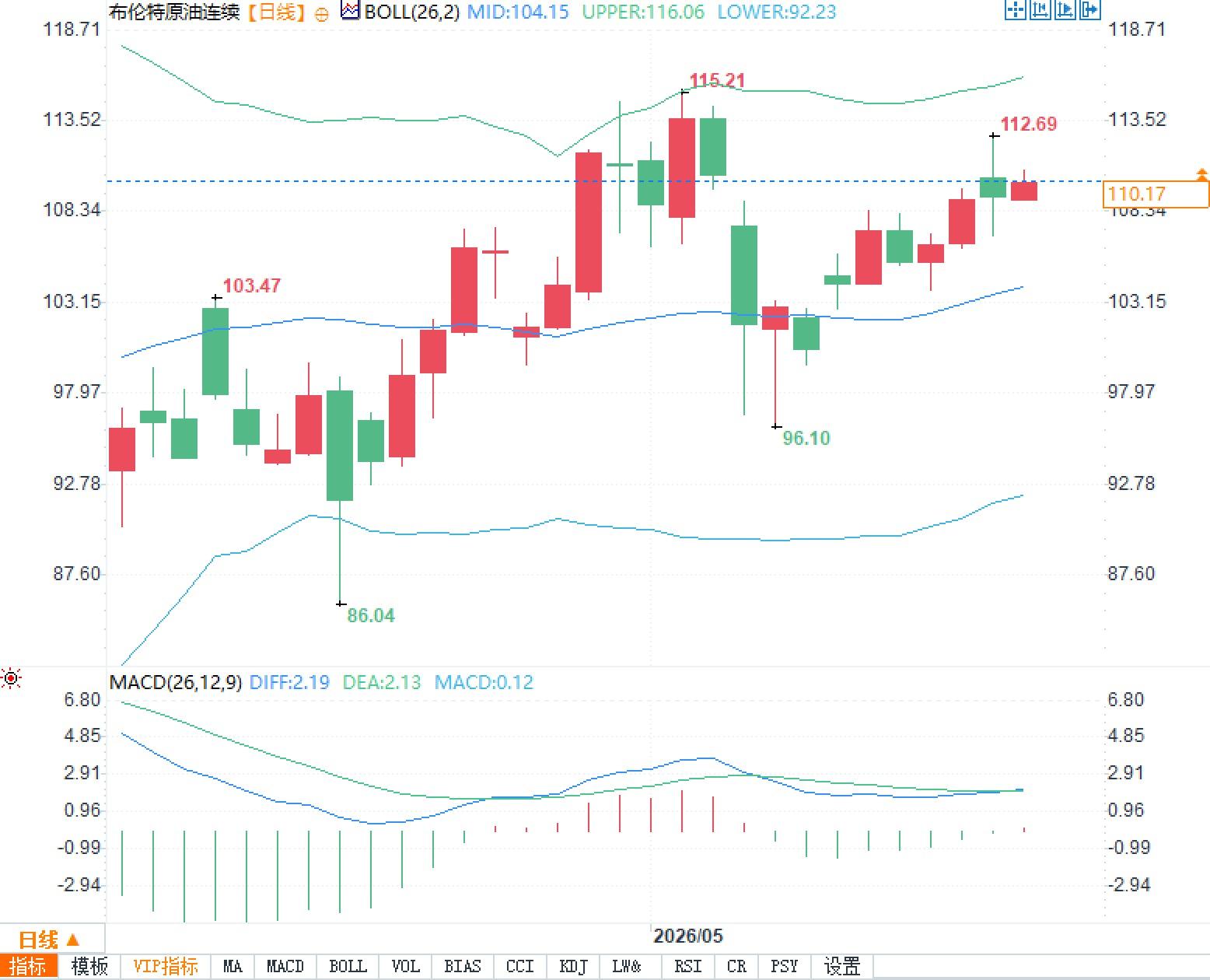
On Tuesday, May 19th, the crude oil market continued to be torn between negotiation signals and supply disruptions. Brent crude traded around $110 per barrel, while WTI crude fell about 0.7% to $103.64 per barrel, but prices remained in the triple digits, indicating that the market had not fully priced in the latest conciliatory statements from the Middle East as a resumption of supply. The current trading focus is not simply on demand pricing, but rather on the rebalancing of three factors: whether the Strait of Hormuz can reopen, whether restricted production can flow back, and whether the rate of inventory depletion can slow down.

Oil prices briefly weakened over the past day due to rumors of temporary sanctions waivers, but quickly recovered after these claims were denied by US officials. Subsequently, the US president stated that the suspension of a planned military strike was to continue "serious negotiations" and that there was a "very good chance" of reaching an agreement. Such statements provide a temporary upper limit for oil prices, as traders reassess the probability of the worst-case scenario.
The problem lies in the fact that there is still a gap between verbal easing and the actual resumption of logistics. As long as passage through the Strait of Hormuz does not substantially resume, the spot market cannot completely eliminate the risk premium. In other words, news of negotiations can lower intraday highs, but it is difficult to fundamentally change the structural tensions before supply flows improve. The current range-bound nature of oil prices stems from the simultaneous existence of "ceasefire expectations" and "logistical disruptions providing a floor."
From a fundamental perspective, the current high oil prices are not entirely driven by market sentiment. The latest weekly data shows that as of May 8th, U.S. commercial crude oil inventories were 452.9 million barrels, a decrease of 4.3 million barrels from the previous week; strategic reserves fell to 384.1 million barrels, a weekly decrease of 8.6 million barrels; and gasoline inventories fell to 215.7 million barrels, a weekly decrease of 4.1 million barrels. Refinery crude oil input rose to 16.399 million barrels per day, with a capacity utilization rate of 91.7%, indicating that the end-user fuel supply chain is still absorbing crude oil at a high intensity.
The implication of this data is that inventory levels have not provided sufficient buffer for short sellers. The coexistence of declining commercial inventories and rising refinery operating rates suggests that high prices have not yet significantly suppressed refinery processing demand, while the continued release of strategic inventories indicates that policymakers are still attempting to smooth out supply shocks. If commercial inventories continue to decline, the market will focus more on the tightness of the longer-term yield curve rather than short-term fluctuations caused by a single day's negotiation headlines.
The latest monthly assessment shows that global crude oil supply further declined by 1.8 million barrels per day to 95.1 million barrels per day in April, bringing the cumulative loss since February to 12.8 million barrels per day; Gulf production, affected by the closure of the Strait of Hormuz, is 14.4 million barrels per day lower than pre-war levels. The agency also estimates that global observable inventories decreased by 129 million barrels in March and another 117 million barrels in April, for a total decrease of approximately 250 million barrels from March to April.
The US energy sector's short-term outlook follows a similar logic. It assumes the Strait of Hormuz will gradually reopen after the end of May, but global inventories will still decrease by an average of 8.5 million barrels per day in the second quarter, with Brent crude oil prices remaining roughly around $106 per barrel in May and June. If the strait's reopening is delayed by a month, near-term prices could be more than $20 per barrel higher than currently projected.
Therefore, the core of crude oil pricing lies not in whether a single positive or negative factor emerges, but in whether the speed of supply recovery outpaces the speed of inventory depletion. If the recovery of strait traffic is only limited, and the restart of shut-down production is slow, triple-digit oil prices may remain volatile. Only if both strait traffic and loading schedules improve simultaneously will prices have the fundamental conditions to fall back to pre-war levels.
High oil prices are suppressing demand through the shipping, refining, aviation, and petrochemical chains. The latest forecasts indicate that global oil demand may decrease by 420,000 barrels per day year-on-year in 2026, falling to 104 million barrels per day, with a projected year-on-year decline of 2.45 million barrels per day in the second quarter. This demand decline suggests that high prices have already had a destructive effect, but the current market gap is still primarily triggered by the supply side.
The U.S. energy sector projects that global oil demand will grow by only 200,000 barrels per day in 2026, lower than previously expected, due to factors including high prices, fuel shortages, and fuel-saving measures. If global financial conditions continue to tighten and equity asset volatility increases, downward revisions to demand could further suppress forward oil prices. However, before the Strait of Hormuz returns to normal, weaker demand is more likely to limit the upward momentum than immediately reverse the supply risk premium.
Fiscal and sanctions policies are also revising supply expectations. U.S. Treasury Secretary Bessant stated that extending some exemptions for maritime Russian oil imports would "provide additional flexibility," indicating an attempt to buffer oil price shocks with alternative supplies. However, these measures are limited in scale, offering more marginal easing than a replacement for the restoration of core supply routes.
Question 1: Why did crude oil prices not fall significantly below three digits after the positive developments in the negotiations?
A: Because market pricing is not based on the negotiations themselves, but on whether physical logistics have resumed. As long as the passage through the Strait of Hormuz, shipping, and shut-down production do not improve in tandem, the risk premium will continue to exist.
Question 2: What does the decline in inventory mean for oil prices?
A: The simultaneous decline in commercial inventories, gasoline inventories, and strategic reserves indicates that the supply buffer is being depleted. The lower the inventory levels, the more sensitive the market is to sudden disturbances, and the greater the volatility triggered by a single piece of news.
Question 3: Will weakening demand cause oil prices to fall rapidly?
A: Cooling demand will limit the upside for oil prices, but before the supply shock is resolved, downward revisions in demand are unlikely to dominate the trend alone. More importantly, the speed of supply recovery will outpace the rate of inventory depletion.
Negotiation noise is suppressing the upper limit, but the risk premium has not yet dissipated.
Oil prices briefly weakened over the past day due to rumors of temporary sanctions waivers, but quickly recovered after these claims were denied by US officials. Subsequently, the US president stated that the suspension of a planned military strike was to continue "serious negotiations" and that there was a "very good chance" of reaching an agreement. Such statements provide a temporary upper limit for oil prices, as traders reassess the probability of the worst-case scenario.
The problem lies in the fact that there is still a gap between verbal easing and the actual resumption of logistics. As long as passage through the Strait of Hormuz does not substantially resume, the spot market cannot completely eliminate the risk premium. In other words, news of negotiations can lower intraday highs, but it is difficult to fundamentally change the structural tensions before supply flows improve. The current range-bound nature of oil prices stems from the simultaneous existence of "ceasefire expectations" and "logistical disruptions providing a floor."
Inventory depletion is confirming a supply gap, rather than simply being driven by sentiment trading.
From a fundamental perspective, the current high oil prices are not entirely driven by market sentiment. The latest weekly data shows that as of May 8th, U.S. commercial crude oil inventories were 452.9 million barrels, a decrease of 4.3 million barrels from the previous week; strategic reserves fell to 384.1 million barrels, a weekly decrease of 8.6 million barrels; and gasoline inventories fell to 215.7 million barrels, a weekly decrease of 4.1 million barrels. Refinery crude oil input rose to 16.399 million barrels per day, with a capacity utilization rate of 91.7%, indicating that the end-user fuel supply chain is still absorbing crude oil at a high intensity.
The implication of this data is that inventory levels have not provided sufficient buffer for short sellers. The coexistence of declining commercial inventories and rising refinery operating rates suggests that high prices have not yet significantly suppressed refinery processing demand, while the continued release of strategic inventories indicates that policymakers are still attempting to smooth out supply shocks. If commercial inventories continue to decline, the market will focus more on the tightness of the longer-term yield curve rather than short-term fluctuations caused by a single day's negotiation headlines.
The path of supply recovery will determine whether Brent crude oil can escape triple digits.
The latest monthly assessment shows that global crude oil supply further declined by 1.8 million barrels per day to 95.1 million barrels per day in April, bringing the cumulative loss since February to 12.8 million barrels per day; Gulf production, affected by the closure of the Strait of Hormuz, is 14.4 million barrels per day lower than pre-war levels. The agency also estimates that global observable inventories decreased by 129 million barrels in March and another 117 million barrels in April, for a total decrease of approximately 250 million barrels from March to April.
The US energy sector's short-term outlook follows a similar logic. It assumes the Strait of Hormuz will gradually reopen after the end of May, but global inventories will still decrease by an average of 8.5 million barrels per day in the second quarter, with Brent crude oil prices remaining roughly around $106 per barrel in May and June. If the strait's reopening is delayed by a month, near-term prices could be more than $20 per barrel higher than currently projected.
Therefore, the core of crude oil pricing lies not in whether a single positive or negative factor emerges, but in whether the speed of supply recovery outpaces the speed of inventory depletion. If the recovery of strait traffic is only limited, and the restart of shut-down production is slow, triple-digit oil prices may remain volatile. Only if both strait traffic and loading schedules improve simultaneously will prices have the fundamental conditions to fall back to pre-war levels.
Demand has begun to come under pressure, but not enough to completely offset the supply shock.
High oil prices are suppressing demand through the shipping, refining, aviation, and petrochemical chains. The latest forecasts indicate that global oil demand may decrease by 420,000 barrels per day year-on-year in 2026, falling to 104 million barrels per day, with a projected year-on-year decline of 2.45 million barrels per day in the second quarter. This demand decline suggests that high prices have already had a destructive effect, but the current market gap is still primarily triggered by the supply side.
The U.S. energy sector projects that global oil demand will grow by only 200,000 barrels per day in 2026, lower than previously expected, due to factors including high prices, fuel shortages, and fuel-saving measures. If global financial conditions continue to tighten and equity asset volatility increases, downward revisions to demand could further suppress forward oil prices. However, before the Strait of Hormuz returns to normal, weaker demand is more likely to limit the upward momentum than immediately reverse the supply risk premium.
Fiscal and sanctions policies are also revising supply expectations. U.S. Treasury Secretary Bessant stated that extending some exemptions for maritime Russian oil imports would "provide additional flexibility," indicating an attempt to buffer oil price shocks with alternative supplies. However, these measures are limited in scale, offering more marginal easing than a replacement for the restoration of core supply routes.
Frequently Asked Questions
Question 1: Why did crude oil prices not fall significantly below three digits after the positive developments in the negotiations?
A: Because market pricing is not based on the negotiations themselves, but on whether physical logistics have resumed. As long as the passage through the Strait of Hormuz, shipping, and shut-down production do not improve in tandem, the risk premium will continue to exist.
Question 2: What does the decline in inventory mean for oil prices?
A: The simultaneous decline in commercial inventories, gasoline inventories, and strategic reserves indicates that the supply buffer is being depleted. The lower the inventory levels, the more sensitive the market is to sudden disturbances, and the greater the volatility triggered by a single piece of news.
Question 3: Will weakening demand cause oil prices to fall rapidly?
A: Cooling demand will limit the upside for oil prices, but before the supply shock is resolved, downward revisions in demand are unlikely to dominate the trend alone. More importantly, the speed of supply recovery will outpace the rate of inventory depletion.
- Risk Warning and Disclaimer
- The market involves risk, and trading may not be suitable for all investors. This article is for reference only and does not constitute personal investment advice, nor does it take into account certain users’ specific investment objectives, financial situation, or other needs. Any investment decisions made based on this information are at your own risk.