One chart: Baltic Shipping Indices collectively weakened, all falling to one-week lows.
2026-05-19 22:22:47
Latest data shows that the Baltic Dry Index (BDI) closed at 3054 points on May 19, 2026, a new low since May 11, 2026, down 1.23% month-on-month, marking the third consecutive day of decline (including zero growth). Looking at the short-term charts, the BDI has seen positive growth 7 times, negative growth 4 times, and zero growth in the last 11 BDI data points. Specifically, the Panamax Freight Index (BPI) closed at 2459 points, down 2.07% from the previous value; the Capesize Freight Index (BCI) closed at 4949 points, down 1.28%; and the Supramax Freight Index (BSI) closed at 1568 points, down 0.13%. For detailed 720-day and 10-year trend charts of the Baltic Dry Index and its three main sub-indices, please refer to the specially designed charts.
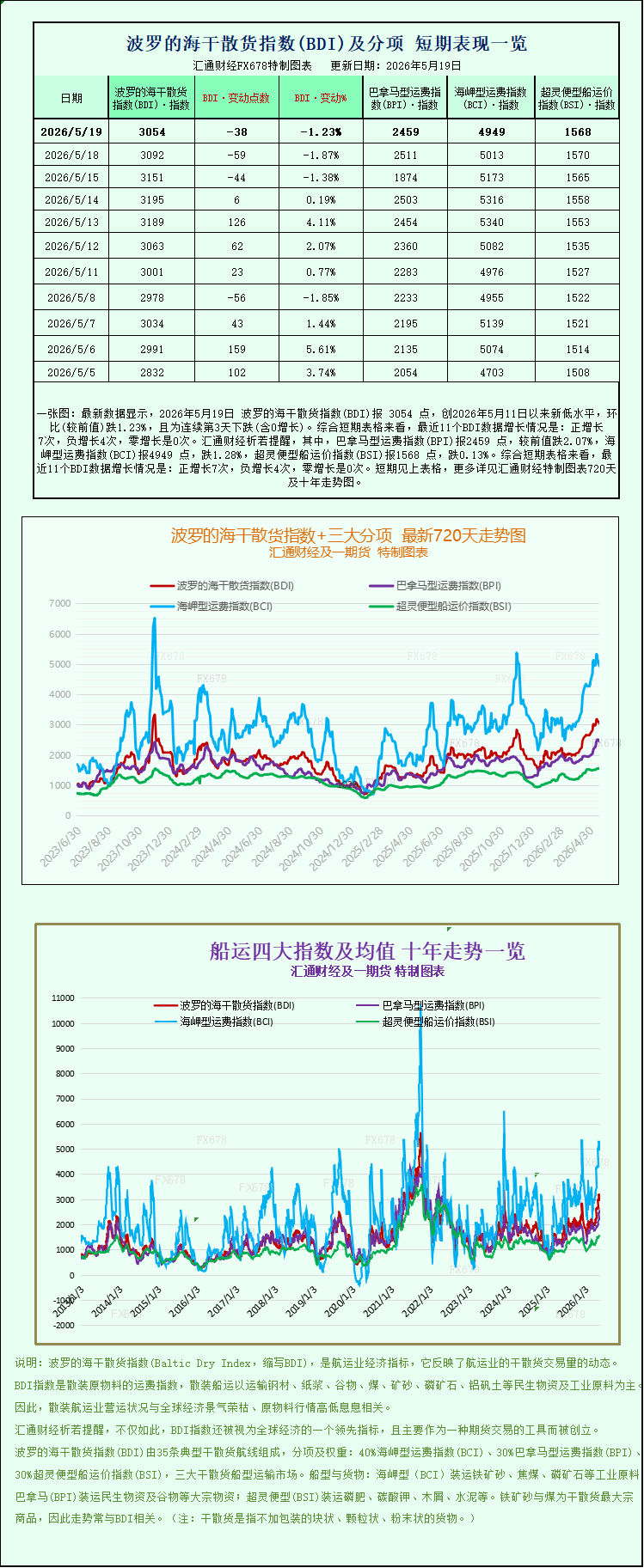
On Tuesday, May 19, according to real-time market data from the Baltic Exchange, the international dry bulk shipping market continued to cool down. The composite dry bulk freight index, which is closely watched by the global trade market, fell sharply to its lowest point in nearly a week. Freight rates for major ship types in the market were generally lowered in tandem, and the profitability of freight transport in the industry continued to decline.
The Baltic Dry Index, a bellwether for the global dry bulk shipping market, fell sharply that day, dropping 38 points throughout the day, a total decline of 1.2%, and finally closing at 3054 points, indicating significant pressure on market freight rates.
Among them, the trend of Capesize vessels, the main type of large ocean-going vessels, was weak, and the corresponding Capesize freight index fell in tandem, dropping 64 points in a single day, a decrease of 1.3%, closing at around 4949 points. These Capesize vessels, capable of carrying 150,000 tons of bulk industrial raw materials such as iron ore and thermal coal, saw their average daily operating revenue shrink again, decreasing by $574 in a single day, with the current average daily revenue dropping to $41,385, further compressing the profit margin of bulk commodity shipping.
The commodity raw material market also dragged down shipping trends, with international iron ore spot prices continuing their previous decline on Tuesday, hitting a new low in more than two weeks. The core influencing factor stemmed from the domestic market. As the world's largest consumer of iron ore, China has continued to implement strict control policies to curb overcapacity in the steel industry. Market expectations for subsequent iron ore procurement and long-term stockpiling have continued to cool, directly suppressing upstream raw material transportation demand. However, current end-user demand remains stable, which has to some extent stabilized the decline in iron ore prices, preventing a sharp drop and slightly mitigating the downward pressure on large bulk carrier freight rates.
The decline in freight rates for medium-sized Panamax vessels, the mainstay of the shipping industry, was even more pronounced. The Panamax freight index fell by 52 points in a single day, a drop of 2.1%, closing at 2459 points. This type of vessel mainly carries 60,000 to 70,000 tons of coal, grain, and other essential and energy commodities. The market's average daily operating revenue decreased by $466, currently averaging only $22,131 per day. Profit margins for long-distance cross-border shipping of grain and energy commodities continue to narrow.
Although the decline in the market price of small and medium-sized bulk carriers was relatively mild, it still failed to buck the trend and strengthen. The Supramax freight index fell slightly by 2 points, down 0.1%, to close at 1568 points. The small and medium-sized short-distance bulk shipping market also lacked upward momentum, and the entire dry bulk shipping market has formed an overall weakening pattern.
On Tuesday, May 19, according to real-time market data from the Baltic Exchange, the international dry bulk shipping market continued to cool down. The composite dry bulk freight index, which is closely watched by the global trade market, fell sharply to its lowest point in nearly a week. Freight rates for major ship types in the market were generally lowered in tandem, and the profitability of freight transport in the industry continued to decline.
The Baltic Dry Index, a bellwether for the global dry bulk shipping market, fell sharply that day, dropping 38 points throughout the day, a total decline of 1.2%, and finally closing at 3054 points, indicating significant pressure on market freight rates.
Among them, the trend of Capesize vessels, the main type of large ocean-going vessels, was weak, and the corresponding Capesize freight index fell in tandem, dropping 64 points in a single day, a decrease of 1.3%, closing at around 4949 points. These Capesize vessels, capable of carrying 150,000 tons of bulk industrial raw materials such as iron ore and thermal coal, saw their average daily operating revenue shrink again, decreasing by $574 in a single day, with the current average daily revenue dropping to $41,385, further compressing the profit margin of bulk commodity shipping.
The commodity raw material market also dragged down shipping trends, with international iron ore spot prices continuing their previous decline on Tuesday, hitting a new low in more than two weeks. The core influencing factor stemmed from the domestic market. As the world's largest consumer of iron ore, China has continued to implement strict control policies to curb overcapacity in the steel industry. Market expectations for subsequent iron ore procurement and long-term stockpiling have continued to cool, directly suppressing upstream raw material transportation demand. However, current end-user demand remains stable, which has to some extent stabilized the decline in iron ore prices, preventing a sharp drop and slightly mitigating the downward pressure on large bulk carrier freight rates.
The decline in freight rates for medium-sized Panamax vessels, the mainstay of the shipping industry, was even more pronounced. The Panamax freight index fell by 52 points in a single day, a drop of 2.1%, closing at 2459 points. This type of vessel mainly carries 60,000 to 70,000 tons of coal, grain, and other essential and energy commodities. The market's average daily operating revenue decreased by $466, currently averaging only $22,131 per day. Profit margins for long-distance cross-border shipping of grain and energy commodities continue to narrow.
Although the decline in the market price of small and medium-sized bulk carriers was relatively mild, it still failed to buck the trend and strengthen. The Supramax freight index fell slightly by 2 points, down 0.1%, to close at 1568 points. The small and medium-sized short-distance bulk shipping market also lacked upward momentum, and the entire dry bulk shipping market has formed an overall weakening pattern.
- Risk Warning and Disclaimer
- The market involves risk, and trading may not be suitable for all investors. This article is for reference only and does not constitute personal investment advice, nor does it take into account certain users’ specific investment objectives, financial situation, or other needs. Any investment decisions made based on this information are at your own risk.