Analysts predict gold prices could reach $5800 by year-end, while silver has better long-term potential.
2026-05-20 13:08:10
Market fluctuations caused by geopolitical tensions have led to a period of divergence in the precious metals market. Senior metals strategists predict that gold will maintain its overall upward trend throughout the year, with ample momentum to reach new historical highs by the end of the year; short-term volatility does not alter the medium- to long-term bullish logic. In contrast, silver is more volatile due to industrial demand disruptions, but its long-term supply shortage gives it greater potential for medium- to long-term gains than gold. Platinum, on the other hand, has benefited from solid fundamentals and is poised for a breakout. This has resulted in a clear divergence in the price trends and investment value of various precious metals.
Nicky Shiels, Head of Research and Metals Strategy at MKS, stated that while geopolitical tensions have altered the underlying drivers of gold's rise, they haven't fundamentally destroyed the overall bullish trend, with gold potentially rising by 30% by 2026. She believes the average gold price this year is likely to remain around $4,500 per ounce, with a strong possibility of reaching a new historical high of $5,800 per ounce in the second half of the year.
In the current market environment, the trading attributes of gold have undergone a significant shift, gradually transforming from a simple hedge against currency devaluation to a safe-haven asset that moves inversely to oil prices. Although the correlation between the two has weakened, the overall stagflationary market environment continues to favor gold prices. The short-term decline in gold prices to below $5,000 per ounce, influenced by oil price fluctuations and the summer off-season for physical consumption, is a reasonable adjustment. Entering the second half of the year, numerous medium- to long-term positive factors will converge, pushing gold prices back into higher ranges.
From a long-term perspective, there is a theoretical possibility that gold prices could reach $10,000 per ounce in the future. Achieving this high price would require both a revaluation of the physical asset and a large-scale shift of US institutional funds from the stock market to the gold market. Calculations based on historical ratios such as total stock market capitalization and US debt indicate significant potential for gold value recovery. However, such extremely high prices are only long-term projections and not current mainstream market expectations.
In terms of year-end market positioning, gold has a stronger short-term performance, while silver, due to its structural supply and demand dynamics, offers more prominent long-term investment value. Silver's previous yearly high has the potential to break through again, but a sustained rally requires gold to first reach a new historical high as a lead. After adjusting for inflation, silver's historical high is significantly higher than its current market price, indicating substantial room for price correction.
Geopolitical tensions have triggered energy price volatility, leading to stagflation expectations in the market. Concerns about a weakening real economy dragging down industrial demand for silver have also put pressure on the silver market, which possesses both financial and industrial attributes. More than half of silver's consumption demand comes from the industrial sector; therefore, if economic growth slows or the expansion of the new energy industry decelerates, its price is highly susceptible to a downturn.
Despite numerous short-term negative factors, the industry remains optimistic about the long-term prospects of silver. Gold is backed by continuous central bank purchases and substantial institutional funding, making it more resilient to risks. Silver, on the other hand, has long been in a state of supply shortage, with production capacity expansion struggling to keep pace with demand growth. Once investment funds and real consumer demand recover in tandem, silver is highly likely to experience a rapid price surge , exhibiting greater price elasticity in a bull market for physical assets.
The overall macroeconomic environment has generally suppressed the prices of platinum and palladium, the two major platinum group metals. The simultaneous upward movement of both at the beginning of the year was driven by multiple substantial factors, including tight supply, adjustments in trade patterns, and strategic reserve purchases, rather than simply speculative activity. Subsequent volatility in the energy market and uncertainty in industry demand have gradually suppressed the price movements of both metals.
Hills stated that a clear difference has emerged in the development patterns of the two types of commodities. Platinum has a more solid fundamental base, maintaining a state of supply shortage for many years. The development of the hybrid vehicle industry continues to drive demand for catalyst materials, while industrial and jewelry consumer demand remains stable. Furthermore, the listing of related domestic futures contracts has attracted new investment funds, making conditions for a volatile upward trend ripe. Palladium prices are highly dependent on the development of the automotive industry and are significantly affected by industrial policies, resulting in greater price volatility and making it difficult to achieve an independent upward trend in the short term.
In summary, geopolitical disturbances will only cause short-term fluctuations in precious metal prices and cannot change the overall trend of the industry. Gold, relying on mature safe-haven logic and capital support, has steadily maintained its upward momentum throughout the year, with a clear target of reaching new highs by the end of the year. Silver is weak in the short term due to drag from industrial demand, but the long-term supply-demand gap gives it huge appreciation potential, making it a preferred target for medium- to long-term investment.
Amid the overall upward trend in commodities and physical assets, various precious metals are showing divergent trends based on their own fundamentals. Investors can rationally allocate different types of precious metal assets according to their holding period.
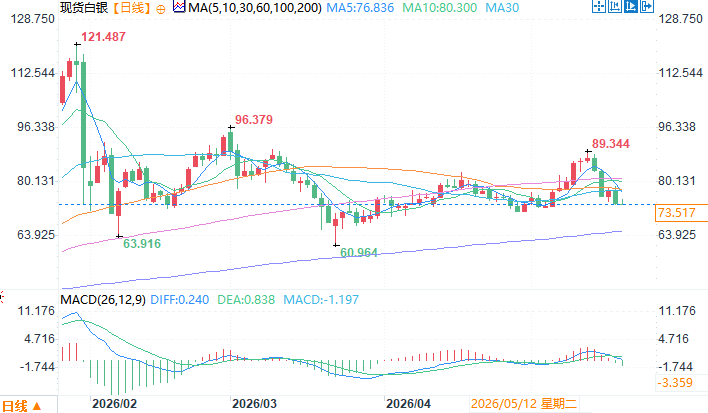
Spot silver daily chart source: EasyForex
At 13:06 Beijing time on May 20, spot silver was trading at $73.96 per ounce.
Gold prices are trending steadily with a clear target for new highs this year.
Nicky Shiels, Head of Research and Metals Strategy at MKS, stated that while geopolitical tensions have altered the underlying drivers of gold's rise, they haven't fundamentally destroyed the overall bullish trend, with gold potentially rising by 30% by 2026. She believes the average gold price this year is likely to remain around $4,500 per ounce, with a strong possibility of reaching a new historical high of $5,800 per ounce in the second half of the year.
In the current market environment, the trading attributes of gold have undergone a significant shift, gradually transforming from a simple hedge against currency devaluation to a safe-haven asset that moves inversely to oil prices. Although the correlation between the two has weakened, the overall stagflationary market environment continues to favor gold prices. The short-term decline in gold prices to below $5,000 per ounce, influenced by oil price fluctuations and the summer off-season for physical consumption, is a reasonable adjustment. Entering the second half of the year, numerous medium- to long-term positive factors will converge, pushing gold prices back into higher ranges.
From a long-term perspective, there is a theoretical possibility that gold prices could reach $10,000 per ounce in the future. Achieving this high price would require both a revaluation of the physical asset and a large-scale shift of US institutional funds from the stock market to the gold market. Calculations based on historical ratios such as total stock market capitalization and US debt indicate significant potential for gold value recovery. However, such extremely high prices are only long-term projections and not current mainstream market expectations.
Silver presents both advantages and disadvantages, but its long-term upward potential is significant.
In terms of year-end market positioning, gold has a stronger short-term performance, while silver, due to its structural supply and demand dynamics, offers more prominent long-term investment value. Silver's previous yearly high has the potential to break through again, but a sustained rally requires gold to first reach a new historical high as a lead. After adjusting for inflation, silver's historical high is significantly higher than its current market price, indicating substantial room for price correction.
Geopolitical tensions have triggered energy price volatility, leading to stagflation expectations in the market. Concerns about a weakening real economy dragging down industrial demand for silver have also put pressure on the silver market, which possesses both financial and industrial attributes. More than half of silver's consumption demand comes from the industrial sector; therefore, if economic growth slows or the expansion of the new energy industry decelerates, its price is highly susceptible to a downturn.
Despite numerous short-term negative factors, the industry remains optimistic about the long-term prospects of silver. Gold is backed by continuous central bank purchases and substantial institutional funding, making it more resilient to risks. Silver, on the other hand, has long been in a state of supply shortage, with production capacity expansion struggling to keep pace with demand growth. Once investment funds and real consumer demand recover in tandem, silver is highly likely to experience a rapid price surge , exhibiting greater price elasticity in a bull market for physical assets.
Platinum group metals showed divergent trends, with platinum leading the way with a chance to break through.
The overall macroeconomic environment has generally suppressed the prices of platinum and palladium, the two major platinum group metals. The simultaneous upward movement of both at the beginning of the year was driven by multiple substantial factors, including tight supply, adjustments in trade patterns, and strategic reserve purchases, rather than simply speculative activity. Subsequent volatility in the energy market and uncertainty in industry demand have gradually suppressed the price movements of both metals.
Hills stated that a clear difference has emerged in the development patterns of the two types of commodities. Platinum has a more solid fundamental base, maintaining a state of supply shortage for many years. The development of the hybrid vehicle industry continues to drive demand for catalyst materials, while industrial and jewelry consumer demand remains stable. Furthermore, the listing of related domestic futures contracts has attracted new investment funds, making conditions for a volatile upward trend ripe. Palladium prices are highly dependent on the development of the automotive industry and are significantly affected by industrial policies, resulting in greater price volatility and making it difficult to achieve an independent upward trend in the short term.
Summarize
In summary, geopolitical disturbances will only cause short-term fluctuations in precious metal prices and cannot change the overall trend of the industry. Gold, relying on mature safe-haven logic and capital support, has steadily maintained its upward momentum throughout the year, with a clear target of reaching new highs by the end of the year. Silver is weak in the short term due to drag from industrial demand, but the long-term supply-demand gap gives it huge appreciation potential, making it a preferred target for medium- to long-term investment.
Amid the overall upward trend in commodities and physical assets, various precious metals are showing divergent trends based on their own fundamentals. Investors can rationally allocate different types of precious metal assets according to their holding period.
Spot silver daily chart source: EasyForex
At 13:06 Beijing time on May 20, spot silver was trading at $73.96 per ounce.
- Risk Warning and Disclaimer
- The market involves risk, and trading may not be suitable for all investors. This article is for reference only and does not constitute personal investment advice, nor does it take into account certain users’ specific investment objectives, financial situation, or other needs. Any investment decisions made based on this information are at your own risk.