Escalating tensions in the Middle East and soaring US Treasury yields pushed the dollar index to a six-week high.
2026-05-20 14:14:31
The US dollar index continued its strength in Asian trading on Wednesday, hovering around 99.40, close to the six-week high of 99.43 reached on Tuesday. The core drivers of the current dollar rally are safe-haven demand fueled by escalating tensions in the Middle East and the continued rise in US Treasury yields.

Market risk sentiment has deteriorated significantly recently. US President Trump stated that the US might resume military action against Iran within the next two to three days to push for a related agreement. Previously, the market had believed there was room for easing tensions between the US and Iran, but Trump's subsequent hardline stance has reignited market concerns about an escalation of tensions in the Middle East.
Meanwhile, Iran continues to maintain a hardline stance. Iranian officials stated that any large-scale military action by the United States will be met with a resolute response, and emphasized that Iran is fully prepared to deal with any military aggression. Amid escalating global geopolitical risks, safe-haven funds continue to flow into dollar assets. As the US dollar remains one of the most important reserve currencies and safe-haven assets in the international market, global capital is flowing back into the dollar and US Treasury markets, thus pushing the dollar index to remain high.
Besides the safe-haven appeal, the inflationary risk posed by rising international oil prices is also a significant supporting factor for the current strength of the US dollar. As the shipping issues in the Strait of Hormuz have not yet been fully resolved, international crude oil prices remain high. The market is concerned that rising energy prices could reignite global inflation and force major central banks to maintain high interest rates for an extended period.
For the United States, rising energy prices mean that inflation is facing renewed upward risks, leading the market to bet again that the Federal Reserve may maintain a hawkish policy stance. Currently, US Treasury yields have risen sharply. The yield on the 30-year US Treasury note rose to 5.20% on Tuesday, reaching its highest level in nearly 19 years. Although it slightly retreated to 5.189% on Wednesday, it remains at a high level overall.
Meanwhile, the yield on the 10-year US Treasury note remained around 4.687%, near a 16-month high; the yield on the 2-year Treasury note remained around 4.139%, also in the 15-month high range. The simultaneous rise in yields on both long-term and short-term Treasury bonds indicates that the market is reassessing the future path of US interest rates, and also reflects a significant increase in investor concerns about the sustainability of inflation. The high-yield environment further enhances the attractiveness of dollar assets. Especially against the backdrop of rising global economic uncertainty, US Treasuries possess the dual advantages of being a safe haven and offering high yields.
Recent statements from Federal Reserve officials have also generally leaned towards a hawkish stance. Philadelphia Fed President Anna Paulson stated that current US monetary policy remains in a "moderately restrictive" position, helping to maintain labor market stability while curbing inflation. She also pointed out that if US economic growth continues to exceed potential levels, or if new inflationary risks emerge, further interest rate hikes may still be an appropriate option.
The market believes that current changes in international energy prices have begun to re-influence expectations regarding the Federal Reserve's policy. Previously, the market widely bet that the Fed would gradually shift towards easing in the future, but the recent simultaneous rise in oil prices and yields has significantly cooled this expectation.
From a technical perspective, the daily chart structure of the US dollar index has shifted back to a bullish bias. After successfully breaking through the key resistance level of 98.50 recently, the bullish momentum has significantly strengthened, further pushing the index to new highs. Currently, the US dollar index has stabilized above both the 50-day and 200-day exponential moving averages. The 50-day EMA is around 97.80, and the 200-day EMA is in the 96.40 area, indicating that the medium- to long-term trend is tilting back towards the bulls.
The daily chart shows that the US dollar index has rebounded steadily after forming a bottom around 96.50, and has now formed a clear upward channel structure. The recent consecutive positive candles indicate that market buying power remains strong. The daily stochastic oscillator is currently in overbought territory, but has not yet formed a clear top divergence structure, suggesting that although the dollar faces some overbought pressure in the short term, the overall upward trend has not yet ended. On the upside, the 99.50 to 100.00 area has become the most critical resistance zone. If the situation in the Middle East continues to deteriorate, and US Treasury yields rise further, the dollar index may retest the 100 level. On the downside, 98.80 has become the first important support level, while 98.50 is a key short-term defense area. If the dollar index falls below this level, the market may re-enter a period of consolidation.
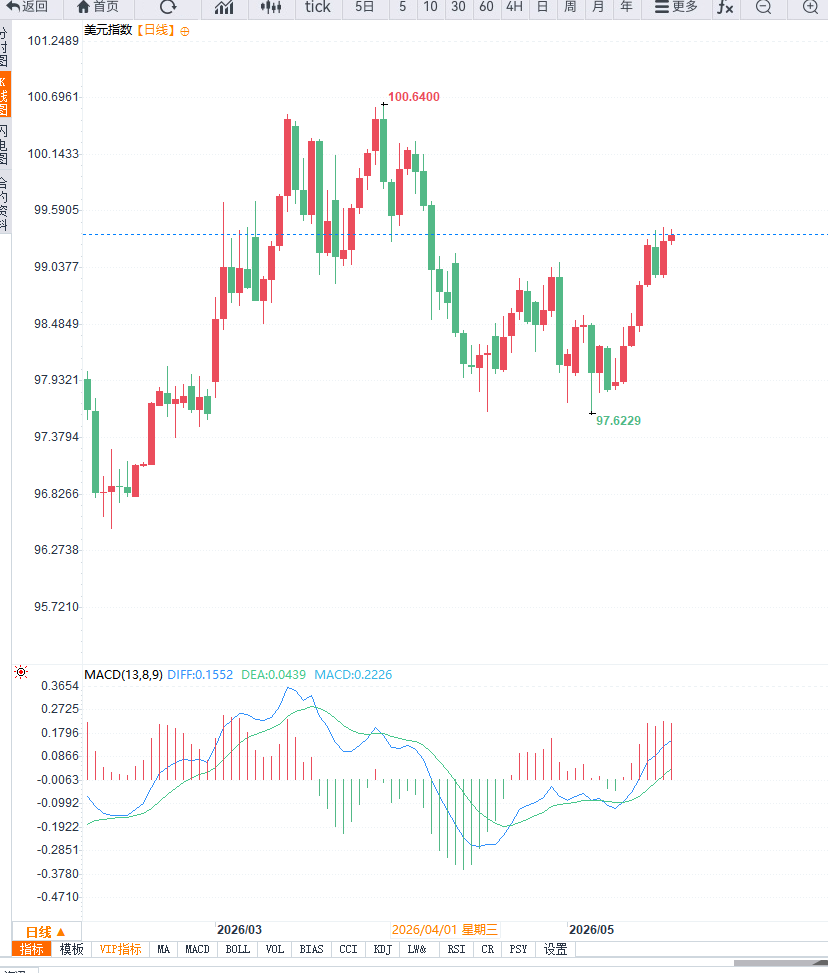
Overall, the current trend of the US dollar index has formed a dual-driven structure of "safe-haven demand + high yields". In the short term, the situation in the Middle East, changes in US Treasury yields, and expectations for Federal Reserve policy will remain the core factors determining the direction of the US dollar index.
Editor's Summary : The US dollar index has re-entered a strong phase. Escalating tensions in the Middle East have driven global capital flows towards the US dollar as a safe-haven asset, while rising international oil prices have further strengthened market expectations that the US will maintain high interest rates for an extended period. From a market structure perspective, the US dollar currently possesses both safe-haven appeal and yield advantages, making it particularly strong against the backdrop of rising global risks. Technically, the US dollar index has broken through a key resistance zone and is approaching the 100 mark. Going forward, the market will focus on developments in the Middle East, the trend of US Treasury yields, and statements from Federal Reserve officials. If energy prices continue to rise and push up inflation expectations, the US dollar index still has room for further upward movement.
Market risk sentiment has deteriorated significantly recently. US President Trump stated that the US might resume military action against Iran within the next two to three days to push for a related agreement. Previously, the market had believed there was room for easing tensions between the US and Iran, but Trump's subsequent hardline stance has reignited market concerns about an escalation of tensions in the Middle East.
Meanwhile, Iran continues to maintain a hardline stance. Iranian officials stated that any large-scale military action by the United States will be met with a resolute response, and emphasized that Iran is fully prepared to deal with any military aggression. Amid escalating global geopolitical risks, safe-haven funds continue to flow into dollar assets. As the US dollar remains one of the most important reserve currencies and safe-haven assets in the international market, global capital is flowing back into the dollar and US Treasury markets, thus pushing the dollar index to remain high.
Besides the safe-haven appeal, the inflationary risk posed by rising international oil prices is also a significant supporting factor for the current strength of the US dollar. As the shipping issues in the Strait of Hormuz have not yet been fully resolved, international crude oil prices remain high. The market is concerned that rising energy prices could reignite global inflation and force major central banks to maintain high interest rates for an extended period.
For the United States, rising energy prices mean that inflation is facing renewed upward risks, leading the market to bet again that the Federal Reserve may maintain a hawkish policy stance. Currently, US Treasury yields have risen sharply. The yield on the 30-year US Treasury note rose to 5.20% on Tuesday, reaching its highest level in nearly 19 years. Although it slightly retreated to 5.189% on Wednesday, it remains at a high level overall.
Meanwhile, the yield on the 10-year US Treasury note remained around 4.687%, near a 16-month high; the yield on the 2-year Treasury note remained around 4.139%, also in the 15-month high range. The simultaneous rise in yields on both long-term and short-term Treasury bonds indicates that the market is reassessing the future path of US interest rates, and also reflects a significant increase in investor concerns about the sustainability of inflation. The high-yield environment further enhances the attractiveness of dollar assets. Especially against the backdrop of rising global economic uncertainty, US Treasuries possess the dual advantages of being a safe haven and offering high yields.
Recent statements from Federal Reserve officials have also generally leaned towards a hawkish stance. Philadelphia Fed President Anna Paulson stated that current US monetary policy remains in a "moderately restrictive" position, helping to maintain labor market stability while curbing inflation. She also pointed out that if US economic growth continues to exceed potential levels, or if new inflationary risks emerge, further interest rate hikes may still be an appropriate option.
The market believes that current changes in international energy prices have begun to re-influence expectations regarding the Federal Reserve's policy. Previously, the market widely bet that the Fed would gradually shift towards easing in the future, but the recent simultaneous rise in oil prices and yields has significantly cooled this expectation.
From a technical perspective, the daily chart structure of the US dollar index has shifted back to a bullish bias. After successfully breaking through the key resistance level of 98.50 recently, the bullish momentum has significantly strengthened, further pushing the index to new highs. Currently, the US dollar index has stabilized above both the 50-day and 200-day exponential moving averages. The 50-day EMA is around 97.80, and the 200-day EMA is in the 96.40 area, indicating that the medium- to long-term trend is tilting back towards the bulls.
The daily chart shows that the US dollar index has rebounded steadily after forming a bottom around 96.50, and has now formed a clear upward channel structure. The recent consecutive positive candles indicate that market buying power remains strong. The daily stochastic oscillator is currently in overbought territory, but has not yet formed a clear top divergence structure, suggesting that although the dollar faces some overbought pressure in the short term, the overall upward trend has not yet ended. On the upside, the 99.50 to 100.00 area has become the most critical resistance zone. If the situation in the Middle East continues to deteriorate, and US Treasury yields rise further, the dollar index may retest the 100 level. On the downside, 98.80 has become the first important support level, while 98.50 is a key short-term defense area. If the dollar index falls below this level, the market may re-enter a period of consolidation.
Overall, the current trend of the US dollar index has formed a dual-driven structure of "safe-haven demand + high yields". In the short term, the situation in the Middle East, changes in US Treasury yields, and expectations for Federal Reserve policy will remain the core factors determining the direction of the US dollar index.
Editor's Summary : The US dollar index has re-entered a strong phase. Escalating tensions in the Middle East have driven global capital flows towards the US dollar as a safe-haven asset, while rising international oil prices have further strengthened market expectations that the US will maintain high interest rates for an extended period. From a market structure perspective, the US dollar currently possesses both safe-haven appeal and yield advantages, making it particularly strong against the backdrop of rising global risks. Technically, the US dollar index has broken through a key resistance zone and is approaching the 100 mark. Going forward, the market will focus on developments in the Middle East, the trend of US Treasury yields, and statements from Federal Reserve officials. If energy prices continue to rise and push up inflation expectations, the US dollar index still has room for further upward movement.
- Risk Warning and Disclaimer
- The market involves risk, and trading may not be suitable for all investors. This article is for reference only and does not constitute personal investment advice, nor does it take into account certain users’ specific investment objectives, financial situation, or other needs. Any investment decisions made based on this information are at your own risk.