Institutions: Major fund reallocation is imminent; silver is poised for significant upside potential.
2026-05-20 13:21:47
Currently, silver prices are fluctuating and consolidating below $80 per ounce, with the market trend appearing somewhat sluggish.
Industry veterans believe that amid a complex geopolitical landscape and accumulating global economic risks, rising inflation is shaking confidence in traditional financial markets. The market is about to witness a large-scale asset reallocation wave, with funds fleeing overvalued technology stocks and pouring into physical assets such as gold and silver. Silver is also poised for a new round of price increases.
Jen Bawden, founder and CEO of Bowden Capital, stated that most investors have failed to fully grasp the escalating economic pressures globally, with significant risks lurking in multiple sectors including energy, agriculture, sovereign debt, and private credit. She bluntly asserted that a major shift of funds from overvalued technology assets to metals and commodities is imminent.

Global stock markets are currently nearing historical highs, and market optimism is high. However, professional investors believe that beneath this apparent prosperity lie hidden dangers. Having long analyzed market risks, she argues that the capital markets are nearing a temporary peak. What ordinary investors perceive as a market breakout is actually a final surge supported by weak fundamentals, and various potential risks could be released at any time.
The situation has disrupted shipping in the Strait of Hormuz, and international energy prices have remained high, becoming the core driver of rising precious metal prices. Although short-term inflation briefly suppressed gold and silver prices, in the long run, economic instability coupled with tightening commodity supply are the key factors dominating market trends.
International oil prices have stabilized above $100, which on the one hand continues to push up overall inflation, and on the other hand significantly increases the production costs of mining and manufacturing. Rising energy prices directly compress the supply of minerals, providing fundamental support for gold and silver prices, while simultaneously exacerbating market risk aversion and attracting continued investment in precious metals, thus stabilizing the overall price floor.
With energy and food prices remaining high, global inflation is unlikely to fall quickly, putting the Federal Reserve in a policy dilemma. Even if economic growth slows down, central banks are unlikely to launch large-scale interest rate cuts, and the overall tightening stance of monetary policy is unlikely to be easily reversed.
Newly appointed Federal Reserve Chairman Kevin Warsh is grappling with a difficult policy balance: he must both implement measures to stabilize the banking sector and tighten overall market liquidity by reducing the Fed's balance sheet. Industry analysts believe the Fed will likely continue to reduce its liabilities, withdrawing funds from the equity market.
Following the implementation of this policy, market liquidity will gradually tighten, and the demand for safe-haven assets will continue to rise. When financial assets such as stocks and bonds experience fluctuations and corrections, and the operational stability of financial institutions is questioned, market funds will abandon various floating-rate assets and instead allocate to physical gold and silver, which possess value-preserving attributes. In the context of high global debt levels, gold and silver, with their independent, debt-free nature, have become the preferred safe-haven asset.
Currently, the yield on 30-year US Treasury bonds remains firmly above 5%, posing a strong challenge to high-growth technology companies. The valuations of these companies are highly dependent on long-term earnings expectations. In a high-interest-rate environment, their long-term earnings value will be significantly discounted, accelerating the bursting of previously inflated valuation bubbles.
In addition, global credit market pressures continue to increase, the operating burden of highly leveraged enterprises is growing heavier, risks in the private lending sector are gradually being exposed, and latent financial risks are beginning to emerge. At the same time, problems such as insufficient supply of fertilizers and rare resources, and disruptions to global trade circulation are emerging one after another, continuously pushing up inflationary pressures and further amplifying market demand for safe-haven assets.
Emerging market currencies are under pressure and sovereign debt risks are rising, leading markets around the world to place increasing importance on the role of precious metals in preserving asset value. Many countries are adjusting their gold and silver import and export policies, which indirectly confirms that the allocation value of physical assets is continuously increasing.
Overall, although silver is currently in a period of consolidation and has not yet started a strong upward trend, multiple medium- to long-term positive factors are already in place.
High interest rates are squeezing the valuations of tech stocks, tightening liquidity is forcing funds to seek safe havens, and the ongoing energy and geopolitical risks are making a shift in capital market style inevitable. As funds gradually withdraw from high-priced financial assets and continue to flow into physical commodities such as gold and silver, silver will eventually break free from its volatile pattern and enter a phase of comprehensive upward movement.
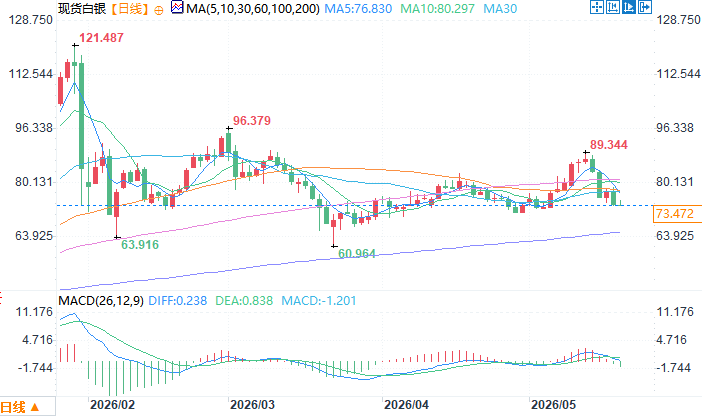
Spot silver daily chart source: EasyForex
At 13:21 Beijing time on May 20, spot silver was trading at $73.99 per ounce.
Industry veterans believe that amid a complex geopolitical landscape and accumulating global economic risks, rising inflation is shaking confidence in traditional financial markets. The market is about to witness a large-scale asset reallocation wave, with funds fleeing overvalued technology stocks and pouring into physical assets such as gold and silver. Silver is also poised for a new round of price increases.
The market harbors multiple hidden dangers; the apparent prosperity cannot conceal the risks.
Jen Bawden, founder and CEO of Bowden Capital, stated that most investors have failed to fully grasp the escalating economic pressures globally, with significant risks lurking in multiple sectors including energy, agriculture, sovereign debt, and private credit. She bluntly asserted that a major shift of funds from overvalued technology assets to metals and commodities is imminent.
Global stock markets are currently nearing historical highs, and market optimism is high. However, professional investors believe that beneath this apparent prosperity lie hidden dangers. Having long analyzed market risks, she argues that the capital markets are nearing a temporary peak. What ordinary investors perceive as a market breakout is actually a final surge supported by weak fundamentals, and various potential risks could be released at any time.
Stronger energy prices lay a solid foundation for long-term positive prospects for precious metals.
The situation has disrupted shipping in the Strait of Hormuz, and international energy prices have remained high, becoming the core driver of rising precious metal prices. Although short-term inflation briefly suppressed gold and silver prices, in the long run, economic instability coupled with tightening commodity supply are the key factors dominating market trends.
International oil prices have stabilized above $100, which on the one hand continues to push up overall inflation, and on the other hand significantly increases the production costs of mining and manufacturing. Rising energy prices directly compress the supply of minerals, providing fundamental support for gold and silver prices, while simultaneously exacerbating market risk aversion and attracting continued investment in precious metals, thus stabilizing the overall price floor.
With energy and food prices remaining high, global inflation is unlikely to fall quickly, putting the Federal Reserve in a policy dilemma. Even if economic growth slows down, central banks are unlikely to launch large-scale interest rate cuts, and the overall tightening stance of monetary policy is unlikely to be easily reversed.
The Federal Reserve faces a policy dilemma: tightening liquidity benefits real assets.
Newly appointed Federal Reserve Chairman Kevin Warsh is grappling with a difficult policy balance: he must both implement measures to stabilize the banking sector and tighten overall market liquidity by reducing the Fed's balance sheet. Industry analysts believe the Fed will likely continue to reduce its liabilities, withdrawing funds from the equity market.
Following the implementation of this policy, market liquidity will gradually tighten, and the demand for safe-haven assets will continue to rise. When financial assets such as stocks and bonds experience fluctuations and corrections, and the operational stability of financial institutions is questioned, market funds will abandon various floating-rate assets and instead allocate to physical gold and silver, which possess value-preserving attributes. In the context of high global debt levels, gold and silver, with their independent, debt-free nature, have become the preferred safe-haven asset.
Rising long-term US Treasury yields have fundamentally shifted the direction of stock market asset allocation.
Currently, the yield on 30-year US Treasury bonds remains firmly above 5%, posing a strong challenge to high-growth technology companies. The valuations of these companies are highly dependent on long-term earnings expectations. In a high-interest-rate environment, their long-term earnings value will be significantly discounted, accelerating the bursting of previously inflated valuation bubbles.
In addition, global credit market pressures continue to increase, the operating burden of highly leveraged enterprises is growing heavier, risks in the private lending sector are gradually being exposed, and latent financial risks are beginning to emerge. At the same time, problems such as insufficient supply of fertilizers and rare resources, and disruptions to global trade circulation are emerging one after another, continuously pushing up inflationary pressures and further amplifying market demand for safe-haven assets.
Emerging market currencies are under pressure and sovereign debt risks are rising, leading markets around the world to place increasing importance on the role of precious metals in preserving asset value. Many countries are adjusting their gold and silver import and export policies, which indirectly confirms that the allocation value of physical assets is continuously increasing.
Summarize
Overall, although silver is currently in a period of consolidation and has not yet started a strong upward trend, multiple medium- to long-term positive factors are already in place.
High interest rates are squeezing the valuations of tech stocks, tightening liquidity is forcing funds to seek safe havens, and the ongoing energy and geopolitical risks are making a shift in capital market style inevitable. As funds gradually withdraw from high-priced financial assets and continue to flow into physical commodities such as gold and silver, silver will eventually break free from its volatile pattern and enter a phase of comprehensive upward movement.
Spot silver daily chart source: EasyForex
At 13:21 Beijing time on May 20, spot silver was trading at $73.99 per ounce.
- Risk Warning and Disclaimer
- The market involves risk, and trading may not be suitable for all investors. This article is for reference only and does not constitute personal investment advice, nor does it take into account certain users’ specific investment objectives, financial situation, or other needs. Any investment decisions made based on this information are at your own risk.