Canada's CPI unexpectedly "cooled down," how long can the USD/CAD rally last?
2026-05-20 13:54:38
Since the beginning of May, the US dollar has been on a continuous upward trend against the Canadian dollar. On Wednesday (May 20) during the Asian session, the US dollar was trading at around 1.3755 against the Canadian dollar, a slight increase of about 0.1%.

Despite the release of Canadian CPI data, buying pressure remains, primarily due to the continued strength of US Treasuries supporting the US dollar. During Wednesday's Asian session, the 10-year US Treasury yield rose to around 4.682%, breaking through the May 2025 high of 4.62%; the 30-year US Treasury yield also climbed to 5.20%, a new high since 2007. If this catalyst remains unchanged, buying pressure on the US dollar against the Canadian dollar is likely to persist in the coming trading days.
On Tuesday, Canada released its inflation data, with the April CPI coming in at 2.8% year-on-year, lower than the market expectation of 3.1%. This suggests that, initially, no significant inflationary pressure has been observed in the short term.
The key point is that although inflation has continued to rise in recent months (reaching 1.8% in February), the acceleration in Canadian inflation has not been as strong as expected. While the data still shows continued growth, it has not yet exceeded the upper limit of the Bank of Canada's inflation target—around 3.00%. Therefore, it does not currently reflect a problem of runaway inflation.
It's worth recalling that the Bank of Canada decided to keep interest rates unchanged at 2.25% in its latest policy decision, stating that as long as inflation data doesn't spiral out of control, there's no need to immediately shift to a fully restrictive monetary policy stance. Therefore, the latest CPI data, which came in lower than expected, tends to reinforce the scenario that the Bank of Canada is likely to maintain a neutral stance with no major adjustments in future interest rate decisions.
TD Securities expects the Bank of Canada to keep interest rates unchanged at 2.25% throughout 2026, arguing that "solid inflation expectations, low inflation breadth, and moderate core inflation momentum" enable the central bank to temporarily ignore rising overall CPI.
The Bank of Canada's current interest rate (2.25%) remains below the Federal Reserve's benchmark rate (3.75%). In the US, the monetary policy outlook has even shifted towards a potential rate hike before the end of the year. If this situation combines with the Bank of Canada's calm stance and no significant changes in interest rates, the interest rate differential could ultimately widen, which would be detrimental to the strength or attractiveness of Canadian dollar-denominated investments.
In fact, the Bank of Canada explicitly maintained its interest rate at 2.25% in its April 29 decision, stating that "there is room for patience at present," but warned that "the situation could change rapidly and monetary policy may need to respond to guard against the risk of inflation expansion and persistence."
Rabobank expects the USD/CAD exchange rate to trade roughly sideways between 1.36 and 1.41 in 2026, believing that the narrowing interest rate gap between the US and Canada will curb the strength of the US dollar, but the persistent "tariff premium" will lead to a weaker Canadian dollar. In the short term, as long as expectations of a Fed rate hike continue to rise and the Bank of Canada remains on the sidelines, buying pressure on the USD/CAD is likely to persist.
According to the daily chart, although the USD/CAD pair has recently rebounded, buying pressure remains insufficient to break out of the wide trading range between 1.3966 and 1.3549. Therefore, if prices continue to fluctuate within this range, a more dominant directional trend may be difficult to establish in the coming weeks. In this context, this wide trading range remains the most important technical factor in the coming trading days.
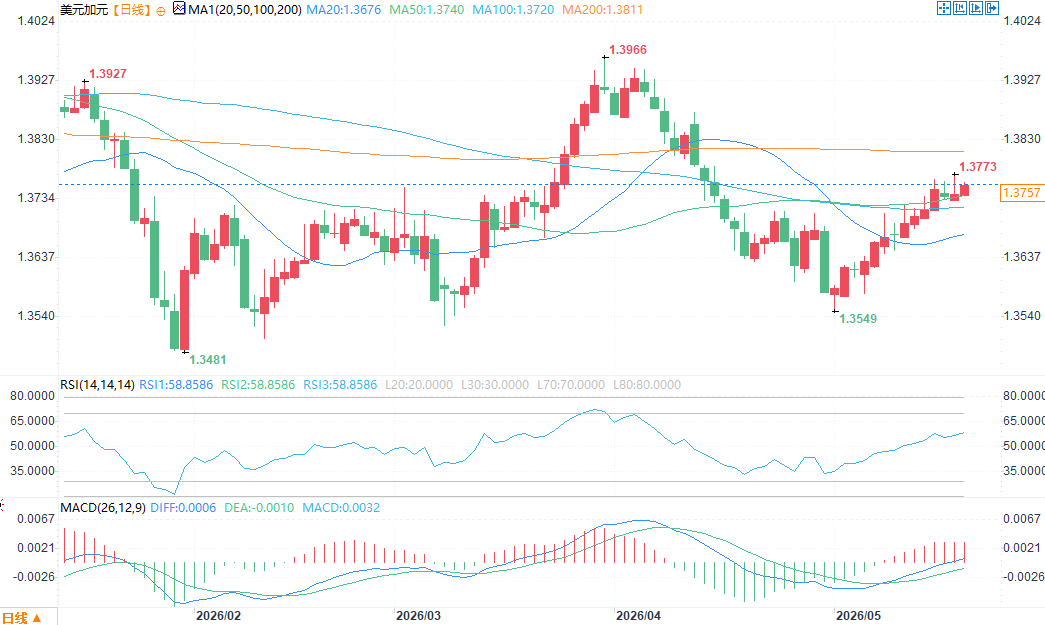
(USD/CAD daily chart, source: EasyForex)
From the RSI perspective, the indicator line has continued to run above the 50 level, indicating that the average momentum over the past 14 trading days still shows a clear bullish bias. If this trend continues, buying pressure may remain significant in the short term.
The MACD shows a similar scenario, with the histogram remaining above the neutral level of the zero axis, indicating that the average strength of the short-term moving averages is still bullish, which may continue to influence the price movement of the USD/CAD pair in the coming trading days.
In summary, Canada's April CPI data came in lower than expected, reinforcing expectations that the Bank of Canada will maintain a neutral stance, while the Federal Reserve may raise interest rates by the end of the year. Technically, the currency pair remains within a wide trading range of 1.3549 to 1.3966. Both the RSI and MACD indicators show bullish signals, but these are not yet sufficient to trigger a breakout from this range.
At 13:54 Beijing time on May 20, the USD/CAD exchange rate was 1.3757/58.
Despite the release of Canadian CPI data, buying pressure remains, primarily due to the continued strength of US Treasuries supporting the US dollar. During Wednesday's Asian session, the 10-year US Treasury yield rose to around 4.682%, breaking through the May 2025 high of 4.62%; the 30-year US Treasury yield also climbed to 5.20%, a new high since 2007. If this catalyst remains unchanged, buying pressure on the US dollar against the Canadian dollar is likely to persist in the coming trading days.
Inflation data becomes the focus: Canadian CPI falls short of expectations
On Tuesday, Canada released its inflation data, with the April CPI coming in at 2.8% year-on-year, lower than the market expectation of 3.1%. This suggests that, initially, no significant inflationary pressure has been observed in the short term.
The key point is that although inflation has continued to rise in recent months (reaching 1.8% in February), the acceleration in Canadian inflation has not been as strong as expected. While the data still shows continued growth, it has not yet exceeded the upper limit of the Bank of Canada's inflation target—around 3.00%. Therefore, it does not currently reflect a problem of runaway inflation.
Bank of Canada's stance: Neutral policy expected to continue
It's worth recalling that the Bank of Canada decided to keep interest rates unchanged at 2.25% in its latest policy decision, stating that as long as inflation data doesn't spiral out of control, there's no need to immediately shift to a fully restrictive monetary policy stance. Therefore, the latest CPI data, which came in lower than expected, tends to reinforce the scenario that the Bank of Canada is likely to maintain a neutral stance with no major adjustments in future interest rate decisions.
TD Securities expects the Bank of Canada to keep interest rates unchanged at 2.25% throughout 2026, arguing that "solid inflation expectations, low inflation breadth, and moderate core inflation momentum" enable the central bank to temporarily ignore rising overall CPI.
The widening interest rate differential between the US and Canada increases the attractiveness of the US dollar.
The Bank of Canada's current interest rate (2.25%) remains below the Federal Reserve's benchmark rate (3.75%). In the US, the monetary policy outlook has even shifted towards a potential rate hike before the end of the year. If this situation combines with the Bank of Canada's calm stance and no significant changes in interest rates, the interest rate differential could ultimately widen, which would be detrimental to the strength or attractiveness of Canadian dollar-denominated investments.
In fact, the Bank of Canada explicitly maintained its interest rate at 2.25% in its April 29 decision, stating that "there is room for patience at present," but warned that "the situation could change rapidly and monetary policy may need to respond to guard against the risk of inflation expansion and persistence."
Rabobank expects the USD/CAD exchange rate to trade roughly sideways between 1.36 and 1.41 in 2026, believing that the narrowing interest rate gap between the US and Canada will curb the strength of the US dollar, but the persistent "tariff premium" will lead to a weaker Canadian dollar. In the short term, as long as expectations of a Fed rate hike continue to rise and the Bank of Canada remains on the sidelines, buying pressure on the USD/CAD is likely to persist.
Technical Outlook: Wide Trading Range Remains Unbroken
According to the daily chart, although the USD/CAD pair has recently rebounded, buying pressure remains insufficient to break out of the wide trading range between 1.3966 and 1.3549. Therefore, if prices continue to fluctuate within this range, a more dominant directional trend may be difficult to establish in the coming weeks. In this context, this wide trading range remains the most important technical factor in the coming trading days.
(USD/CAD daily chart, source: EasyForex)
From the RSI perspective, the indicator line has continued to run above the 50 level, indicating that the average momentum over the past 14 trading days still shows a clear bullish bias. If this trend continues, buying pressure may remain significant in the short term.
The MACD shows a similar scenario, with the histogram remaining above the neutral level of the zero axis, indicating that the average strength of the short-term moving averages is still bullish, which may continue to influence the price movement of the USD/CAD pair in the coming trading days.
Fundamental interest rate differentials support the US dollar, while technical indicators await a breakout from the current range.
In summary, Canada's April CPI data came in lower than expected, reinforcing expectations that the Bank of Canada will maintain a neutral stance, while the Federal Reserve may raise interest rates by the end of the year. Technically, the currency pair remains within a wide trading range of 1.3549 to 1.3966. Both the RSI and MACD indicators show bullish signals, but these are not yet sufficient to trigger a breakout from this range.
At 13:54 Beijing time on May 20, the USD/CAD exchange rate was 1.3757/58.
- Risk Warning and Disclaimer
- The market involves risk, and trading may not be suitable for all investors. This article is for reference only and does not constitute personal investment advice, nor does it take into account certain users’ specific investment objectives, financial situation, or other needs. Any investment decisions made based on this information are at your own risk.