A strong US dollar and a technical breakdown dragged silver prices down, with selling pressure intensifying after silver fell to near a two-week low.
2026-05-20 14:28:09
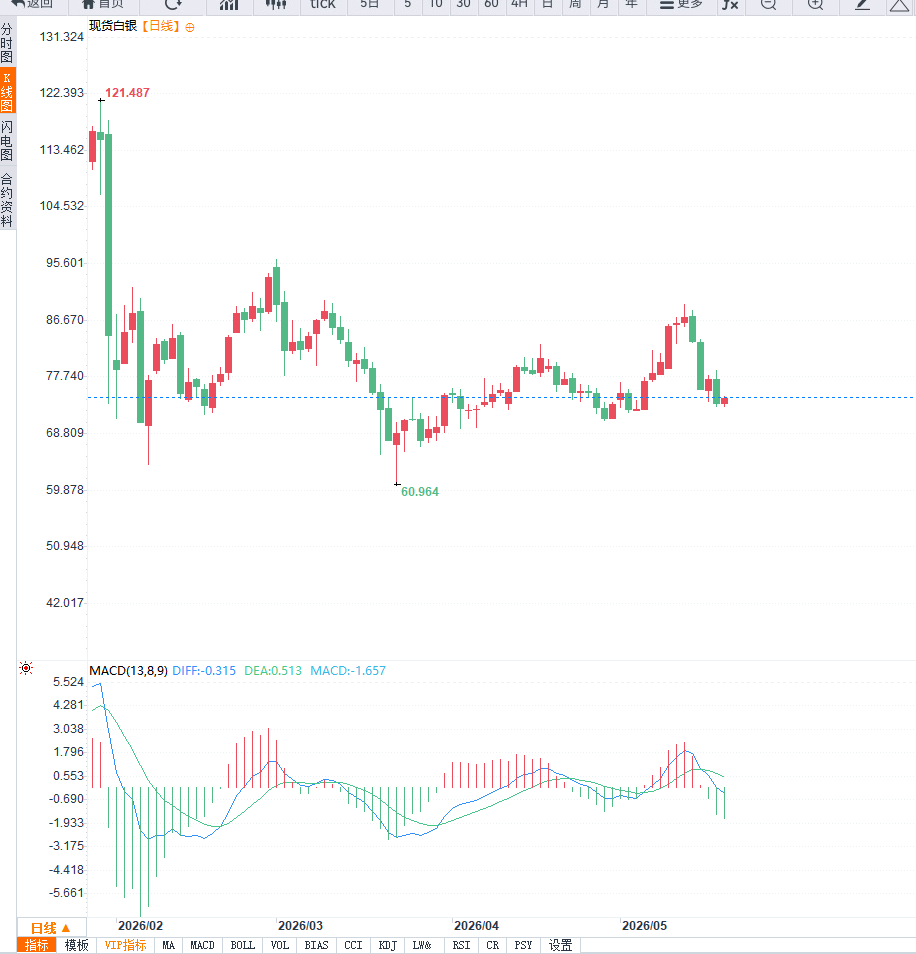
Spot silver rebounded to around $75 during Asian trading hours on Wednesday, but subsequently encountered selling pressure, quickly falling back to around $74, once again approaching the nearly two-week low reached on Tuesday. The market as a whole remains under pressure from a strong dollar and high US Treasury yields, and the short-term bearish trend continues to dominate for silver.
Recently, risk aversion has intensified significantly in global financial markets. Tensions remain high in the Middle East, with negotiations between the US and Iran still lacking substantial breakthroughs. Markets remain highly vigilant regarding shipping issues in the Strait of Hormuz and global energy supply risks. The persistently high international oil prices have reignited concerns about a potential resurgence of global inflation. Against this backdrop, markets are beginning to bet again on the possibility that the Federal Reserve will maintain high interest rates or even raise them further.
According to the latest market interest rate expectations, traders have significantly increased their bets on the Federal Reserve maintaining a hawkish policy stance in the long term, which has directly driven up US Treasury yields. The yield on the 10-year US Treasury note is currently holding above 4.68%, while the yield on the 30-year Treasury note rose to 5.20% at one point, reaching its highest level in nearly 19 years.
A high-yield environment diminishes the appeal of precious metals, as gold and silver do not inherently offer interest income. When bond yields rise consistently, market funds typically flow into dollar-denominated assets and the bond market.
Meanwhile, the US dollar index has risen to near a six-week high. Since silver is priced in US dollars, a stronger dollar typically reduces the willingness of non-dollar investors to buy silver, thus putting pressure on prices. Compared to gold, silver possesses both precious metal and industrial metal attributes, therefore its price volatility is usually greater. Current uncertainties surrounding global economic growth prospects further limit silver demand.
From a technical perspective, the current trend of silver has clearly weakened. Previously, silver prices rebounded to near the 200-period exponential moving average (EMA) on the 4-hour chart but failed to break through effectively, subsequently falling back quickly. This is a significant signal of renewed bearish momentum. More importantly, XAG/USD has broken below the lower rail of the ascending channel that had lasted for nearly a month. This means that the upward structure that had sustained for several weeks has been broken, and the short-term market trend has begun to tilt towards the bears. After the technical breakout, many short-term long positions were stopped out, while short-selling funds re-entered the market, further accelerating the decline in silver. Observing the daily chart, silver's recent highs have continued to move lower, and the price center of gravity has been continuously decreasing, indicating that selling pressure remains significant. The Relative Strength Index (RSI) has now fallen to around 31, approaching the oversold zone. This indicates that short-term bearish momentum is strong, but the market has not yet fully entered an extremely oversold state, therefore, silver prices still have room for further decline.
Meanwhile, the MACD indicator remains below the zero line, and the histogram remains negative, further confirming that the current downtrend in the market has not yet ended. However, it should be noted that the RSI is gradually approaching the oversold zone, which means that silver may experience a technical rebound correction at any time in the short term. But before the overall trend changes, the rebound is more likely to be seen as a new selling opportunity. From the perspective of resistance areas, $76.33 is the first key resistance level, which corresponds to the lower rail of the previously broken ascending channel. Further resistance is located around $78.25, corresponding to the 200-period EMA on the 4-hour chart. This area has now formed a clear technical supply zone. Only when silver regains its footing above the $76.30 to $78.20 area can the bearish pressure in the market be significantly alleviated and a phased rebound structure be restored. On the downside, $74 has become the current key short-term support level. Once this level is broken, the market may further test the $73 or even the $70 psychological area.
Overall, the silver market is currently facing a triple resistance structure: a strong dollar, rising yields, and a technical breakdown. In the short term, expectations regarding Federal Reserve policy, US Treasury yields, and the dollar index will remain the core factors influencing the direction of silver prices.
Editor's Summary : The silver market has entered a clearly weak phase. While the Middle East situation still provides some safe-haven appeal, market funds are flowing more towards the US dollar and high-yield bonds, thus putting continuous pressure on silver. Technically, silver's downtrend has been further strengthened after breaking below the key upward channel and the 4-hour 200-period EMA. Although the RSI is approaching oversold territory, a short-term technical rebound is possible, but given the continued strength of the US dollar and yields, silver is generally expected to consolidate weakly. The market will focus on the Fed meeting minutes, changes in US Treasury yields, and the evolution of global risk sentiment, as these factors will determine whether silver can stabilize and regain upward momentum.
Recently, risk aversion has intensified significantly in global financial markets. Tensions remain high in the Middle East, with negotiations between the US and Iran still lacking substantial breakthroughs. Markets remain highly vigilant regarding shipping issues in the Strait of Hormuz and global energy supply risks. The persistently high international oil prices have reignited concerns about a potential resurgence of global inflation. Against this backdrop, markets are beginning to bet again on the possibility that the Federal Reserve will maintain high interest rates or even raise them further.
According to the latest market interest rate expectations, traders have significantly increased their bets on the Federal Reserve maintaining a hawkish policy stance in the long term, which has directly driven up US Treasury yields. The yield on the 10-year US Treasury note is currently holding above 4.68%, while the yield on the 30-year Treasury note rose to 5.20% at one point, reaching its highest level in nearly 19 years.
A high-yield environment diminishes the appeal of precious metals, as gold and silver do not inherently offer interest income. When bond yields rise consistently, market funds typically flow into dollar-denominated assets and the bond market.
Meanwhile, the US dollar index has risen to near a six-week high. Since silver is priced in US dollars, a stronger dollar typically reduces the willingness of non-dollar investors to buy silver, thus putting pressure on prices. Compared to gold, silver possesses both precious metal and industrial metal attributes, therefore its price volatility is usually greater. Current uncertainties surrounding global economic growth prospects further limit silver demand.
From a technical perspective, the current trend of silver has clearly weakened. Previously, silver prices rebounded to near the 200-period exponential moving average (EMA) on the 4-hour chart but failed to break through effectively, subsequently falling back quickly. This is a significant signal of renewed bearish momentum. More importantly, XAG/USD has broken below the lower rail of the ascending channel that had lasted for nearly a month. This means that the upward structure that had sustained for several weeks has been broken, and the short-term market trend has begun to tilt towards the bears. After the technical breakout, many short-term long positions were stopped out, while short-selling funds re-entered the market, further accelerating the decline in silver. Observing the daily chart, silver's recent highs have continued to move lower, and the price center of gravity has been continuously decreasing, indicating that selling pressure remains significant. The Relative Strength Index (RSI) has now fallen to around 31, approaching the oversold zone. This indicates that short-term bearish momentum is strong, but the market has not yet fully entered an extremely oversold state, therefore, silver prices still have room for further decline.
Meanwhile, the MACD indicator remains below the zero line, and the histogram remains negative, further confirming that the current downtrend in the market has not yet ended. However, it should be noted that the RSI is gradually approaching the oversold zone, which means that silver may experience a technical rebound correction at any time in the short term. But before the overall trend changes, the rebound is more likely to be seen as a new selling opportunity. From the perspective of resistance areas, $76.33 is the first key resistance level, which corresponds to the lower rail of the previously broken ascending channel. Further resistance is located around $78.25, corresponding to the 200-period EMA on the 4-hour chart. This area has now formed a clear technical supply zone. Only when silver regains its footing above the $76.30 to $78.20 area can the bearish pressure in the market be significantly alleviated and a phased rebound structure be restored. On the downside, $74 has become the current key short-term support level. Once this level is broken, the market may further test the $73 or even the $70 psychological area.
Overall, the silver market is currently facing a triple resistance structure: a strong dollar, rising yields, and a technical breakdown. In the short term, expectations regarding Federal Reserve policy, US Treasury yields, and the dollar index will remain the core factors influencing the direction of silver prices.
Editor's Summary : The silver market has entered a clearly weak phase. While the Middle East situation still provides some safe-haven appeal, market funds are flowing more towards the US dollar and high-yield bonds, thus putting continuous pressure on silver. Technically, silver's downtrend has been further strengthened after breaking below the key upward channel and the 4-hour 200-period EMA. Although the RSI is approaching oversold territory, a short-term technical rebound is possible, but given the continued strength of the US dollar and yields, silver is generally expected to consolidate weakly. The market will focus on the Fed meeting minutes, changes in US Treasury yields, and the evolution of global risk sentiment, as these factors will determine whether silver can stabilize and regain upward momentum.
- Risk Warning and Disclaimer
- The market involves risk, and trading may not be suitable for all investors. This article is for reference only and does not constitute personal investment advice, nor does it take into account certain users’ specific investment objectives, financial situation, or other needs. Any investment decisions made based on this information are at your own risk.