Gold Trading Alert: Gold Prices Stage a Dramatic Comeback! US-Iran Talks Ignite 1.5% Surge, Fed Rate Hike Expectations Shift Dramatically, Is Gold Heading Towards $4700?
2026-05-25 07:39:35
Last week, spot gold was under pressure overall, falling 0.69% to close at $4506.82 per ounce on Friday (May 22), with the market initially suppressed by inflation concerns triggered by high oil prices. However, in early Asian trading on Monday (May 25), gold prices suddenly opened higher and continued to rise, surging as much as 1.59% to around $4578 per ounce, demonstrating strong rebound momentum. Behind this dramatic turn of events is the dual driving force of the rapid easing of geopolitical tensions in the Middle East and the weakening of the US dollar. Subtle changes in policy signals within the Federal Reserve have also added more uncertainty and room for imagination to the gold price movement.
Last week's decline in gold prices was mainly due to persistently high energy prices. The conflict in Iran disrupted shipping in the Strait of Hormuz, keeping international oil prices high and directly pushing up global inflation expectations. Interest rate futures showed that the market at one point anticipated a 67% probability of the Federal Reserve raising interest rates by at least 25 basis points this year. Against this backdrop, gold's appeal as a non-yielding asset has significantly diminished.
Federal Reserve Governor Waller's remarks further exacerbated market tensions. Waller, previously considered relatively dovish, suddenly called on the Fed to abandon its "accommodative bias" and open the door to possible interest rate hikes. He bluntly stated that continuing to discuss rate cuts was "simply insane" given that inflation had not only failed to subside but had also spread from goods to services. This hawkish stance quickly pushed up market pricing in monetary tightening, causing gold prices to fall significantly on Friday, briefly dropping below the $4,500 mark.
Since the outbreak of the Middle East conflict at the end of February, gold has fallen by about 14%. Under the triple pressure of high interest rates, high inflation and low growth expectations, investors have been weighing their safe-haven demand against opportunity costs, keeping gold prices in a relatively narrow range of fluctuation.
The sharp rebound in early Asian trading on Monday (May 25) was entirely ignited by news of easing geopolitical tensions. Market optimism that the US and Iran were close to reaching a peace agreement directly led to oil prices opening more than $5 lower, briefly falling to a two-week low of $91.25 per barrel. This change quickly eased investors' concerns about persistently high energy-driven inflation, providing significant upward momentum for gold.
Meanwhile, the US dollar index opened lower and continued to decline, falling as much as 0.35% to 98.97, further providing upward momentum for gold prices. Other precious metals also strengthened, with spot silver rising by more than 4%, and platinum and palladium both rising by more than 2%, indicating a significant recovery in market risk appetite in the short term.
On Saturday (May 23), Trump announced on social media that the United States and Iran had "fundamentally reached" a peace memorandum of understanding, which would facilitate the reopening of the Strait of Hormuz. This news quickly spread globally, and although disagreements remain on key details, the "ray of hope" was enough to boost market sentiment. While Iran emphasized that it would continue to manage the strait, it agreed to restore the number of ships passing through to pre-war levels, a significant positive for the global energy supply chain.
The progress of US-Iran negotiations has not been smooth sailing, but rather fraught with dramatic tension. On the one hand, Trump has released positive signals, stating that the agreement will prevent Iran from acquiring nuclear weapons; on the other hand, he has left the outcome uncertain—either a good deal is reached or a large-scale military strike is launched. This "talking while fighting" strategy has maintained the pressure of negotiations while also leaving room for market speculation.
Iran's response was cautious yet firm. They emphasized that the current focus of negotiations is ending the "imposed war," with core demands including the lifting of sanctions and the release of frozen assets, and made it clear that these would not be linked to the nuclear issue. Iran also remained firm on its control over the Strait of Hormuz, indicating that even if an agreement is reached, the strait will not be fully restored to its pre-war "freedom of navigation" status.
Israel's strong dissatisfaction became a significant variable in the negotiations. Israel worried that the agreement would be detrimental to its security interests and that it continued to face multi-front pressure on the battlefield. Meanwhile, Gulf states were also highly vigilant about Iran's potential establishment of a "Persian Gulf Straits Authority," indicating that the struggle for control of the straits was far from over.
Nevertheless, US Secretary of State Rubio confirmed that the draft agreement has received support from several Middle Eastern countries, and the next round of negotiations may begin on June 5. The preliminary agreement may be named the "Islamabad Declaration." These developments together constitute the core catalyst for the short-term rebound in gold prices.
On the other side of gold's price movement, the Federal Reserve's policy shift remains a key variable. New Chairman Warsh, just sworn in, faces the dual challenges of inflationary pressures and political maneuvering. Warsh urged the removal of the "dodging bias" from the policy statement, opening the door to rate hikes, and the market has already moved up its expectations for the first rate hike to October or even September.
U.S. consumer confidence plummeted to a record low in May, with a significant decline in confidence among Republicans and independent voters, highlighting the heavy impact of high oil prices on ordinary people's lives. While the stock market rallied on progress in negotiations and strong corporate earnings, with the Dow Jones Industrial Average hitting a new high, consumers' actual experience was quite different. High inflation is eroding real income, and long-term inflation expectations have also risen significantly.
Warsh emphasized that the Federal Reserve will adhere to its dual mandate of price stability and full employment, but striking a balance between the Trump administration's growth ambitions and its responsibility to combat inflation remains a significant challenge. This also means that gold will continue to face pressure from changes in the real interest rate environment in the medium term.
In summary, the positive progress in US-Iran peace talks has provided a respite for gold in the short term, with falling oil prices and a weakening dollar contributing to the upward momentum. However, whether this rebound can be sustained depends on the final outcome of the negotiations. If an agreement is ultimately reached and shipping in the Strait of Hormuz resumes rapidly, inflationary pressures will ease significantly, and gold's safe-haven appeal may weaken in the short term.
Conversely, if negotiations break down or relapse, and tensions rise again in the Middle East, gold prices still have a basis to regain their upward momentum. Meanwhile, the Federal Reserve's monetary policy path will be a decisive factor—if persistent inflation leads to a prolonged interest rate hike cycle, gold will continue to be under pressure; if deteriorating economic data triggers a policy shift, gold is expected to see a stronger rebound.
Gold prices are currently finding a new focal point in the $4,500-$4,600 range. Investors need to closely monitor the June Federal Reserve meeting, the next round of US-Iran negotiations on June 5th, and the synchronized changes in oil prices and the US dollar index. Amid the complex tug-of-war between geopolitical easing and monetary policy tightening, gold is entering a critical window of high volatility, where opportunities and risks coexist.
Furthermore, this week is short because Monday is Memorial Day, a day when US stock markets are closed and the gold market will also close early. However, economic data may improve when traders return on Tuesday to review consumer confidence surveys. Market participants will be paying particular attention to this indicator after the disappointing surprise of Friday's University of Michigan consumer confidence survey.
The remaining economic data for this week will be released on Thursday, at which time traders will be focusing on Q1 GDP and preliminary PCE figures, weekly jobless claims, and April durable goods orders and new home sales data. Investors should pay close attention to these data.
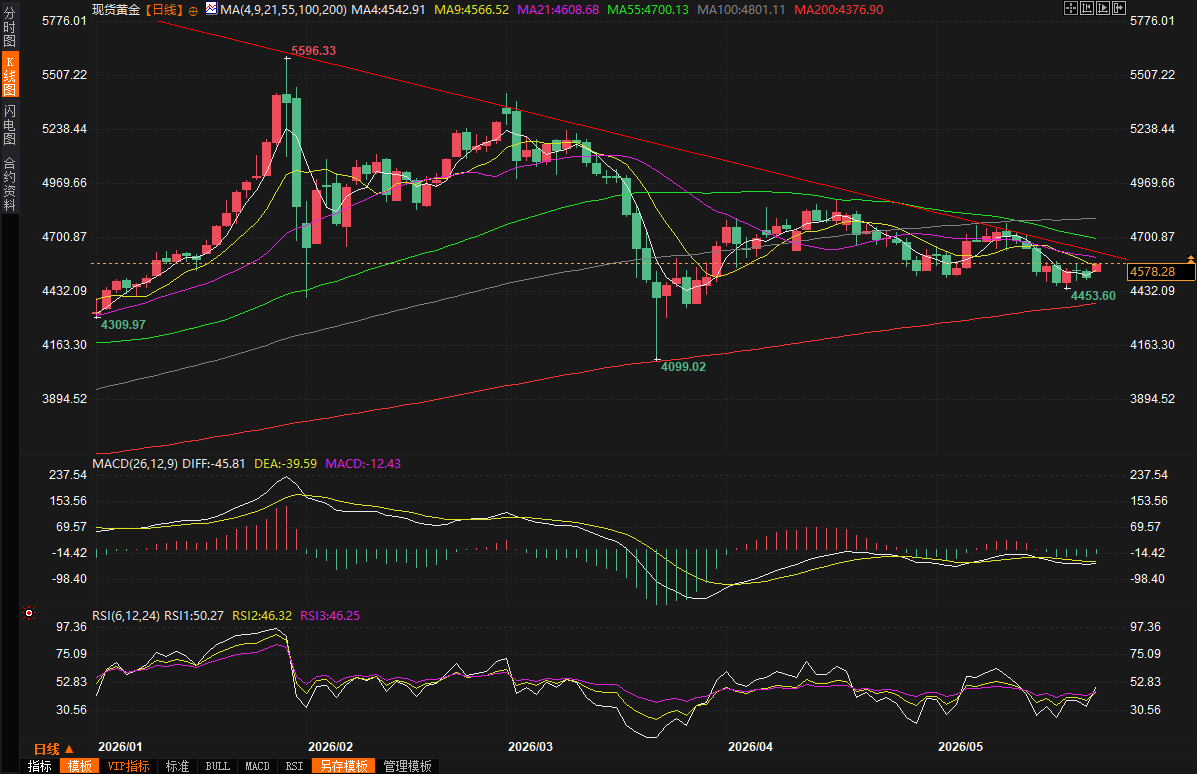
(Spot gold daily chart, source: FX678)
At 07:36 Beijing time, spot gold was trading at $4,577.15 per ounce.
Last week's pullback: Oil price inflation and the Fed's hawkish shift exerted dual pressure.
Last week's decline in gold prices was mainly due to persistently high energy prices. The conflict in Iran disrupted shipping in the Strait of Hormuz, keeping international oil prices high and directly pushing up global inflation expectations. Interest rate futures showed that the market at one point anticipated a 67% probability of the Federal Reserve raising interest rates by at least 25 basis points this year. Against this backdrop, gold's appeal as a non-yielding asset has significantly diminished.
Federal Reserve Governor Waller's remarks further exacerbated market tensions. Waller, previously considered relatively dovish, suddenly called on the Fed to abandon its "accommodative bias" and open the door to possible interest rate hikes. He bluntly stated that continuing to discuss rate cuts was "simply insane" given that inflation had not only failed to subside but had also spread from goods to services. This hawkish stance quickly pushed up market pricing in monetary tightening, causing gold prices to fall significantly on Friday, briefly dropping below the $4,500 mark.
Since the outbreak of the Middle East conflict at the end of February, gold has fallen by about 14%. Under the triple pressure of high interest rates, high inflation and low growth expectations, investors have been weighing their safe-haven demand against opportunity costs, keeping gold prices in a relatively narrow range of fluctuation.
This week's surge: A glimmer of hope in US-Iran peace talks eases inflation concerns.
The sharp rebound in early Asian trading on Monday (May 25) was entirely ignited by news of easing geopolitical tensions. Market optimism that the US and Iran were close to reaching a peace agreement directly led to oil prices opening more than $5 lower, briefly falling to a two-week low of $91.25 per barrel. This change quickly eased investors' concerns about persistently high energy-driven inflation, providing significant upward momentum for gold.
Meanwhile, the US dollar index opened lower and continued to decline, falling as much as 0.35% to 98.97, further providing upward momentum for gold prices. Other precious metals also strengthened, with spot silver rising by more than 4%, and platinum and palladium both rising by more than 2%, indicating a significant recovery in market risk appetite in the short term.
On Saturday (May 23), Trump announced on social media that the United States and Iran had "fundamentally reached" a peace memorandum of understanding, which would facilitate the reopening of the Strait of Hormuz. This news quickly spread globally, and although disagreements remain on key details, the "ray of hope" was enough to boost market sentiment. While Iran emphasized that it would continue to manage the strait, it agreed to restore the number of ships passing through to pre-war levels, a significant positive for the global energy supply chain.
US-Iran Negotiation Game: Hope and Uncertainty Coexist
The progress of US-Iran negotiations has not been smooth sailing, but rather fraught with dramatic tension. On the one hand, Trump has released positive signals, stating that the agreement will prevent Iran from acquiring nuclear weapons; on the other hand, he has left the outcome uncertain—either a good deal is reached or a large-scale military strike is launched. This "talking while fighting" strategy has maintained the pressure of negotiations while also leaving room for market speculation.
Iran's response was cautious yet firm. They emphasized that the current focus of negotiations is ending the "imposed war," with core demands including the lifting of sanctions and the release of frozen assets, and made it clear that these would not be linked to the nuclear issue. Iran also remained firm on its control over the Strait of Hormuz, indicating that even if an agreement is reached, the strait will not be fully restored to its pre-war "freedom of navigation" status.
Israel's strong dissatisfaction became a significant variable in the negotiations. Israel worried that the agreement would be detrimental to its security interests and that it continued to face multi-front pressure on the battlefield. Meanwhile, Gulf states were also highly vigilant about Iran's potential establishment of a "Persian Gulf Straits Authority," indicating that the struggle for control of the straits was far from over.
Nevertheless, US Secretary of State Rubio confirmed that the draft agreement has received support from several Middle Eastern countries, and the next round of negotiations may begin on June 5. The preliminary agreement may be named the "Islamabad Declaration." These developments together constitute the core catalyst for the short-term rebound in gold prices.
The New Federal Reserve Landscape: Warsh's Appointment and the Stubborn Challenge of Inflation
On the other side of gold's price movement, the Federal Reserve's policy shift remains a key variable. New Chairman Warsh, just sworn in, faces the dual challenges of inflationary pressures and political maneuvering. Warsh urged the removal of the "dodging bias" from the policy statement, opening the door to rate hikes, and the market has already moved up its expectations for the first rate hike to October or even September.
U.S. consumer confidence plummeted to a record low in May, with a significant decline in confidence among Republicans and independent voters, highlighting the heavy impact of high oil prices on ordinary people's lives. While the stock market rallied on progress in negotiations and strong corporate earnings, with the Dow Jones Industrial Average hitting a new high, consumers' actual experience was quite different. High inflation is eroding real income, and long-term inflation expectations have also risen significantly.
Warsh emphasized that the Federal Reserve will adhere to its dual mandate of price stability and full employment, but striking a balance between the Trump administration's growth ambitions and its responsibility to combat inflation remains a significant challenge. This also means that gold will continue to face pressure from changes in the real interest rate environment in the medium term.
Gold Outlook: A Tug-of-War Between Geopolitical Easing and Monetary Tightening
In summary, the positive progress in US-Iran peace talks has provided a respite for gold in the short term, with falling oil prices and a weakening dollar contributing to the upward momentum. However, whether this rebound can be sustained depends on the final outcome of the negotiations. If an agreement is ultimately reached and shipping in the Strait of Hormuz resumes rapidly, inflationary pressures will ease significantly, and gold's safe-haven appeal may weaken in the short term.
Conversely, if negotiations break down or relapse, and tensions rise again in the Middle East, gold prices still have a basis to regain their upward momentum. Meanwhile, the Federal Reserve's monetary policy path will be a decisive factor—if persistent inflation leads to a prolonged interest rate hike cycle, gold will continue to be under pressure; if deteriorating economic data triggers a policy shift, gold is expected to see a stronger rebound.
Gold prices are currently finding a new focal point in the $4,500-$4,600 range. Investors need to closely monitor the June Federal Reserve meeting, the next round of US-Iran negotiations on June 5th, and the synchronized changes in oil prices and the US dollar index. Amid the complex tug-of-war between geopolitical easing and monetary policy tightening, gold is entering a critical window of high volatility, where opportunities and risks coexist.
Furthermore, this week is short because Monday is Memorial Day, a day when US stock markets are closed and the gold market will also close early. However, economic data may improve when traders return on Tuesday to review consumer confidence surveys. Market participants will be paying particular attention to this indicator after the disappointing surprise of Friday's University of Michigan consumer confidence survey.
The remaining economic data for this week will be released on Thursday, at which time traders will be focusing on Q1 GDP and preliminary PCE figures, weekly jobless claims, and April durable goods orders and new home sales data. Investors should pay close attention to these data.
(Spot gold daily chart, source: FX678)
At 07:36 Beijing time, spot gold was trading at $4,577.15 per ounce.
- Risk Warning and Disclaimer
- The market involves risk, and trading may not be suitable for all investors. This article is for reference only and does not constitute personal investment advice, nor does it take into account certain users’ specific investment objectives, financial situation, or other needs. Any investment decisions made based on this information are at your own risk.