Is the "warning line" about to be breached? US-Iran reconciliation hits dollar bulls, and the yen's rebound is just a "dead cat bounce"?
2026-05-25 09:12:51
On Monday (May 25) in early Asian trading, the US dollar fell slightly against the Japanese yen to around 158.90.

Progress in negotiations between the US and Iran to end the Middle East conflict put pressure on the dollar and pushed the yen slightly higher. Nevertheless, the two sides have not yet finalized a peace agreement, and markets are still awaiting confirmation that the US will lift its military blockade.
According to reports, a senior U.S. official said last Sunday that the U.S. and Iran are close to reaching an agreement aimed at reopening the Strait of Hormuz. Details of a draft agreement disclosed by the media indicate that the agreement would include the following key points: a 60-day extension of the ceasefire; Iran clearing mines from the strait and reopening it; the U.S. lifting its blockade of Iranian ports, granting partial sanctions waivers, and allowing Iran to freely sell oil. A U.S. official described this arrangement as a "performance-for-waivers" arrangement, stating that the economic deregulation would follow Iran's actual actions, rather than being granted in advance. The agreement also includes Iran's commitment never to develop nuclear weapons and negotiations on suspending its uranium enrichment program and removing its stockpile of highly enriched uranium.
U.S. Secretary of State Marco Rubio stated that the agreement with Iran has gained regional support, but key issues cannot be "hastily resolved in 72 hours." His remarks came after Trump indicated he was "not in a hurry to reach a deal with Iran." Although Trump posted on social media on the 23rd that the agreement was "basically agreed upon," Iran's Fars News Agency immediately questioned this, emphasizing that Trump's statement that the Strait of Hormuz would be open was "incomplete," stating that according to the latest exchanged text, the strait will continue to be "managed" by Iran. Washington and Tehran have agreed in principle to reopen the Strait of Hormuz, and markets are still awaiting confirmation that the U.S. government's military blockade will be lifted.
This progress in US-Iran negotiations, coupled with the easing of tensions in the Middle East reducing demand for the dollar as a safe haven, is pushing the dollar/yen exchange rate slightly lower from its recent highs.
Traders remain highly vigilant as the dollar approaches the key level of 160.00 against the yen. This level is widely seen as a "warning line" for potential intervention by Japanese authorities in the currency market—back on April 30, authorities intervened for the first time in nearly two years, injecting approximately $34.5 billion after the exchange rate broke through 160.72. Japanese Finance Minister Katsunobu Kato reiterated last week after the G7 finance ministers' meeting that Japan is prepared to act on excessive foreign exchange volatility, while emphasizing that any intervention would be carried out in a manner that would not push up US Treasury yields.
Behind this lies the real dilemma faced by the Japanese authorities. Japan's foreign exchange reserves are approximately $1.4 trillion, the majority of which are held in the form of US Treasury bonds. Selling US Treasury bonds to raise funds for intervention could push up US Treasury yields, thereby strengthening the dollar, which contradicts the original intention of the intervention. Japanese Ministry of Finance officials have clearly stated that the authorities have maintained sufficient liquidity through holding cash deposits, maturing assets, and interest income to ensure that intervention does not require the use of US Treasury bond reserves. However, the first two rounds of intervention consumed approximately 10 trillion yen (about $63.3 billion) but only resulted in a brief rebound. As of last week, the yen had given back more than half of its gains since the intervention, indicating that "targeted support" alone cannot reverse the depreciation trend driven by interest rate differentials. Traders generally believe that only if the Bank of Japan raises interest rates and tightens its policy, or if US Treasury yields substantially decline, can the yen truly escape the repeated tests of the 160 level.
In a recent report, Citigroup macro strategists advised traders to short the US dollar and go long the Japanese yen ahead of the Bank of Japan's June policy meeting. Analysts pointed out that USD/JPY has once again touched the intervention level near 160, and the swap market has already priced in a 20 basis point rate hike at the June meeting. Citigroup's judgment is based on two main points: first, 160 is the "warning line" for the Japanese authorities; and second, expectations for a June rate hike are building.
Bloomberg Intelligence's chief Asia FX and interest rate strategist points out that for the yen to strengthen, it currently relies mainly on a weaker dollar; its own fundamentals are unlikely to provide much support. The core issue lies in the excessively large interest rate differential between the US and Japan—a 150-250 basis point spread exists between the two countries for both 2-year and 10-year government bonds, a gap that is difficult to bridge. The Bank of Japan's rate hike frequency is unlikely to keep pace with US Treasury yields, and the likelihood of a rapid rate cut by the Federal Reserve is also decreasing. Zhao Zhixuan further emphasizes that the Bank of Japan's recent intervention tactics are changing: they are no longer confronting the dollar head-on when it is strongest, but instead choosing to "intervene in the same direction" when the dollar shows signs of weakness. They may not be willing to hold the 160 level, and may even tolerate the yen breaking through 160 and entering a new range.
In summary, the USD/JPY exchange rate is currently pressured by the progress of US-Iran negotiations, with the yen strengthening slightly to around 158.90. However, the two sides have not yet reached a final agreement on key issues, and geopolitical uncertainty remains. Meanwhile, the exchange rate is once again approaching the 160 level, and the market remains highly vigilant about possible further intervention by Japanese authorities. In the short term, the yen's movement will depend on the substantial progress of US-Iran negotiations, the navigation status of the Strait of Hormuz, and the intervention actions of the Japanese Ministry of Finance.
From the daily chart, USD/JPY is currently trading around 158.90, in a high-level consolidation phase after a continuous rise. Several technical indicators show bullish signals, but the momentum has slowed down.
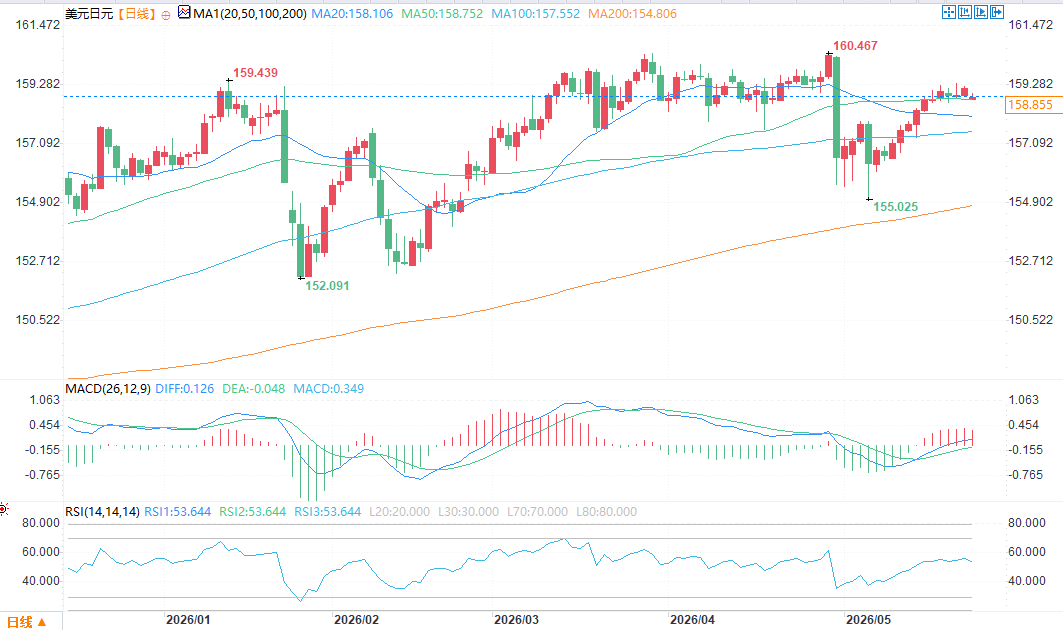
(USD/JPY daily chart, source: FX678)
Regarding the moving average system, the short-term moving averages MA20 (158.11) and MA50 (158.75) are both below the current price, forming short-term support; while MA100 (157.55) and MA200 (154.81) are significantly lower than the current price. This bullish alignment of "price above all major moving averages" suggests that USD/JPY remains in an uptrend. It's worth noting that the price has been steadily trading above the MA50 since breaking through it in early May, indicating that the upward structure remains intact. However, the price has encountered resistance multiple times in the 159.50-160.00 area, indicating that upward resistance is strengthening.
At 9:11 AM Beijing time on May 25, the USD/JPY exchange rate was 158.87/88.
Progress in negotiations between the US and Iran to end the Middle East conflict put pressure on the dollar and pushed the yen slightly higher. Nevertheless, the two sides have not yet finalized a peace agreement, and markets are still awaiting confirmation that the US will lift its military blockade.
Progress in US-Iran negotiations: Agreement nearing completion, but key issues remain.
According to reports, a senior U.S. official said last Sunday that the U.S. and Iran are close to reaching an agreement aimed at reopening the Strait of Hormuz. Details of a draft agreement disclosed by the media indicate that the agreement would include the following key points: a 60-day extension of the ceasefire; Iran clearing mines from the strait and reopening it; the U.S. lifting its blockade of Iranian ports, granting partial sanctions waivers, and allowing Iran to freely sell oil. A U.S. official described this arrangement as a "performance-for-waivers" arrangement, stating that the economic deregulation would follow Iran's actual actions, rather than being granted in advance. The agreement also includes Iran's commitment never to develop nuclear weapons and negotiations on suspending its uranium enrichment program and removing its stockpile of highly enriched uranium.
U.S. Secretary of State Marco Rubio stated that the agreement with Iran has gained regional support, but key issues cannot be "hastily resolved in 72 hours." His remarks came after Trump indicated he was "not in a hurry to reach a deal with Iran." Although Trump posted on social media on the 23rd that the agreement was "basically agreed upon," Iran's Fars News Agency immediately questioned this, emphasizing that Trump's statement that the Strait of Hormuz would be open was "incomplete," stating that according to the latest exchanged text, the strait will continue to be "managed" by Iran. Washington and Tehran have agreed in principle to reopen the Strait of Hormuz, and markets are still awaiting confirmation that the U.S. government's military blockade will be lifted.
Yen's performance: Approaching the warning line, the market remains highly vigilant.
This progress in US-Iran negotiations, coupled with the easing of tensions in the Middle East reducing demand for the dollar as a safe haven, is pushing the dollar/yen exchange rate slightly lower from its recent highs.
Traders remain highly vigilant as the dollar approaches the key level of 160.00 against the yen. This level is widely seen as a "warning line" for potential intervention by Japanese authorities in the currency market—back on April 30, authorities intervened for the first time in nearly two years, injecting approximately $34.5 billion after the exchange rate broke through 160.72. Japanese Finance Minister Katsunobu Kato reiterated last week after the G7 finance ministers' meeting that Japan is prepared to act on excessive foreign exchange volatility, while emphasizing that any intervention would be carried out in a manner that would not push up US Treasury yields.
Behind this lies the real dilemma faced by the Japanese authorities. Japan's foreign exchange reserves are approximately $1.4 trillion, the majority of which are held in the form of US Treasury bonds. Selling US Treasury bonds to raise funds for intervention could push up US Treasury yields, thereby strengthening the dollar, which contradicts the original intention of the intervention. Japanese Ministry of Finance officials have clearly stated that the authorities have maintained sufficient liquidity through holding cash deposits, maturing assets, and interest income to ensure that intervention does not require the use of US Treasury bond reserves. However, the first two rounds of intervention consumed approximately 10 trillion yen (about $63.3 billion) but only resulted in a brief rebound. As of last week, the yen had given back more than half of its gains since the intervention, indicating that "targeted support" alone cannot reverse the depreciation trend driven by interest rate differentials. Traders generally believe that only if the Bank of Japan raises interest rates and tightens its policy, or if US Treasury yields substantially decline, can the yen truly escape the repeated tests of the 160 level.
Institutional Views
In a recent report, Citigroup macro strategists advised traders to short the US dollar and go long the Japanese yen ahead of the Bank of Japan's June policy meeting. Analysts pointed out that USD/JPY has once again touched the intervention level near 160, and the swap market has already priced in a 20 basis point rate hike at the June meeting. Citigroup's judgment is based on two main points: first, 160 is the "warning line" for the Japanese authorities; and second, expectations for a June rate hike are building.
Bloomberg Intelligence's chief Asia FX and interest rate strategist points out that for the yen to strengthen, it currently relies mainly on a weaker dollar; its own fundamentals are unlikely to provide much support. The core issue lies in the excessively large interest rate differential between the US and Japan—a 150-250 basis point spread exists between the two countries for both 2-year and 10-year government bonds, a gap that is difficult to bridge. The Bank of Japan's rate hike frequency is unlikely to keep pace with US Treasury yields, and the likelihood of a rapid rate cut by the Federal Reserve is also decreasing. Zhao Zhixuan further emphasizes that the Bank of Japan's recent intervention tactics are changing: they are no longer confronting the dollar head-on when it is strongest, but instead choosing to "intervene in the same direction" when the dollar shows signs of weakness. They may not be willing to hold the 160 level, and may even tolerate the yen breaking through 160 and entering a new range.
The yen received short-term support, but the risks of intervention and uncertainty surrounding the agreement remain.
In summary, the USD/JPY exchange rate is currently pressured by the progress of US-Iran negotiations, with the yen strengthening slightly to around 158.90. However, the two sides have not yet reached a final agreement on key issues, and geopolitical uncertainty remains. Meanwhile, the exchange rate is once again approaching the 160 level, and the market remains highly vigilant about possible further intervention by Japanese authorities. In the short term, the yen's movement will depend on the substantial progress of US-Iran negotiations, the navigation status of the Strait of Hormuz, and the intervention actions of the Japanese Ministry of Finance.
USD/JPY Daily Technical Analysis
From the daily chart, USD/JPY is currently trading around 158.90, in a high-level consolidation phase after a continuous rise. Several technical indicators show bullish signals, but the momentum has slowed down.
(USD/JPY daily chart, source: FX678)
Regarding the moving average system, the short-term moving averages MA20 (158.11) and MA50 (158.75) are both below the current price, forming short-term support; while MA100 (157.55) and MA200 (154.81) are significantly lower than the current price. This bullish alignment of "price above all major moving averages" suggests that USD/JPY remains in an uptrend. It's worth noting that the price has been steadily trading above the MA50 since breaking through it in early May, indicating that the upward structure remains intact. However, the price has encountered resistance multiple times in the 159.50-160.00 area, indicating that upward resistance is strengthening.
At 9:11 AM Beijing time on May 25, the USD/JPY exchange rate was 158.87/88.
- Risk Warning and Disclaimer
- The market involves risk, and trading may not be suitable for all investors. This article is for reference only and does not constitute personal investment advice, nor does it take into account certain users’ specific investment objectives, financial situation, or other needs. Any investment decisions made based on this information are at your own risk.