Progress in US-Iran negotiations eases supply concerns, causing oil prices to plummet by over 4%.
2026-05-25 08:56:14
Oil prices plunged in Asian trading on Monday (May 25), driven by comments made by President Trump over the weekend. He stated that Washington and Tehran were close to announcing an agreement that would allow peace talks to resume and the Strait of Hormuz to reopen.
International benchmark Brent crude futures fell more than 5% to $98.60 a barrel, after closing at $103.90 on Friday. U.S. benchmark West Texas Intermediate crude futures fell 4.7% to $92.30 a barrel, after closing at $97 a barrel last week.
US President Trump stated on the 24th that the US-Iran agreement is "not fully finalized," and that no one has seen or knows its contents yet, with a "several days" remaining before it is signed. He also accused some uninformed people of "making unwarranted criticisms," emphasizing that "if I reach an agreement with Iran, it will be a good, appropriate agreement." Despite Trump's cautiously optimistic signals, US media reports indicate internal divisions within the White House regarding the draft agreement, with some criticizing it for actually undermining the Trump administration's own objectives. Furthermore, Trump is "increasingly frustrated" with the slow progress of negotiations, and according to Axios, he has begun considering the possibility of resuming military operations.
The US has taken a hard line on three core issues: first, it demands that Iran hand over highly enriched uranium and refrain from developing nuclear weapons; second, it opposes Iran setting tolls or unilaterally controlling the Strait of Hormuz and demands that the strait remain open to free navigation; and third, it has not yet made any clear concessions on the unfreezing of frozen assets.
U.S. Secretary of State Marco Rubio stated that negotiations had made "some progress," but warned that any agreement would be "unworkable" if Iran takes steps to permanently control key waterways. On the military front, U.S. Central Command has maintained "maximum readiness," and the White House warned that it is "prepared for anything" should negotiations fail.
Iranian Foreign Ministry spokesman Baghae stated on the 23rd that both sides were in the "final stage" of finalizing the memorandum of understanding, and that their views had "moved in a more consistent direction" over the past week. However, on the 24th, Iran stated that due to various reasons, including US obstruction of unfreezing Iranian assets, the content of the memorandum has not yet been finalized, and therefore there is a possibility that a consensus cannot be reached. Iran also denied Israeli media reports that "Iran will not receive facilitation to lift the freeze on funds before transferring its enriched uranium reserves," calling the information incorrect.
Regarding its core stance: Iran has clearly drawn three red lines: First, it refuses to link the unfreezing of assets with the nuclear materials issue, demanding that once an understanding is announced, some frozen assets should be unfrozen immediately and that Iran can fully utilize them—failure to unfreeze the assets would cross Iran's red line, making a consensus impossible. Second, at this stage, Iran will not discuss or commit to any details regarding the nuclear issue. While President Pezechzian stated that he "is willing to assure the world that Iran will not seek nuclear weapons," he emphasized that any decision must be approved by the Supreme Leader, and that nuclear materials must not be exported. Third, Iran has established the "Persian Gulf Straits Authority," requiring passing ships to coordinate with Iran.
Although the specific details of the agreement have not yet been made public, Iranian media and sources from the US and Iranian governments have indicated that the agreement may include a comprehensive ceasefire among the conflicting parties, the reopening of the Strait of Hormuz, and the gradual lifting of sanctions on Iranian crude oil sales.
According to multiple media reports, other key issues, such as Tehran's nuclear program and the fate of its stockpiles of near-weapons-grade enriched uranium, will be negotiated later.
In a rare public directive last week, Khamenei stated that Iran's stockpile of nuclear materials must not be shipped out of the country, creating an obstacle to this key red line for the U.S. government. Trump and other senior administration officials have repeatedly stated that Iran cannot be allowed to develop nuclear weapons or enrich uranium.
Since the outbreak of war at the end of February, data from the International Energy Agency shows that the Strait of Hormuz has effectively remained closed to shipping, and the market has lost about 1 billion barrels of oil, pushing the global market into the biggest supply shock on record.
In conclusion, Trump's statement regarding the imminent announcement of a US-Iran agreement put short-term pressure on oil prices, with both Brent and WTI crude falling sharply. However, the Iranian Supreme Leader's firm stance against exporting nuclear materials means that significant uncertainty remains regarding the agreement.
The market will closely monitor the substantive progress of the US-Iran negotiations and the navigation status of the Strait of Hormuz, which will be key variables determining the direction of oil prices in the next stage.
From the daily chart, US crude oil is currently trading around $92.00, in a weak consolidation phase after a recent pullback from highs, with multiple technical indicators showing bearish signals.
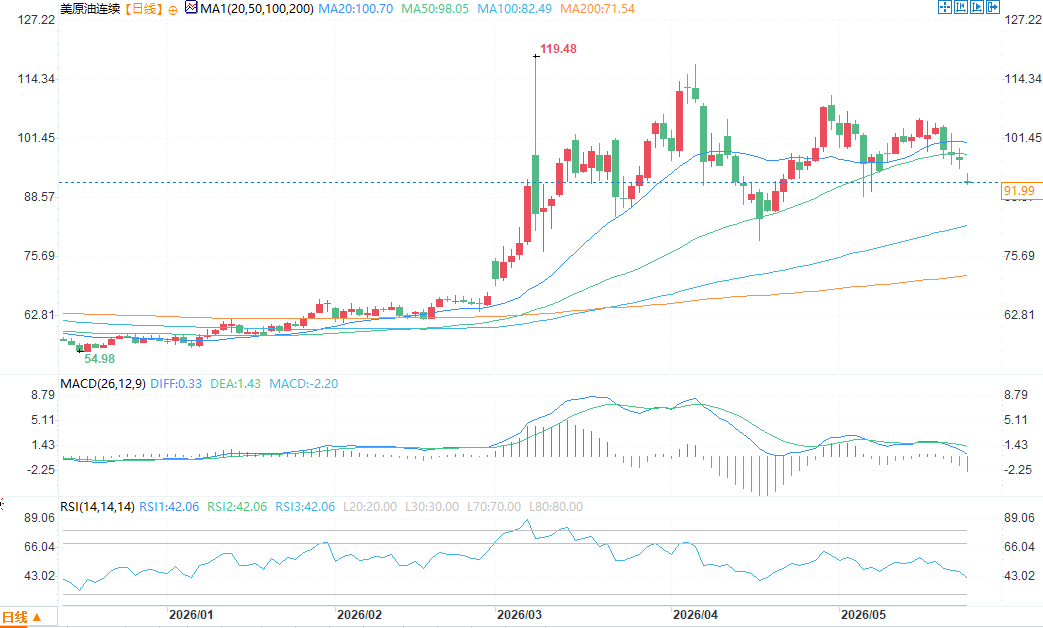
(US crude oil futures daily chart, source: FX678)
Regarding the moving average system, the short-term moving averages MA20 (100.69) and MA50 (98.05) are both above the current price, forming significant resistance. The current price has fallen below MA20 and MA50, indicating a weak short-term trend. MA100 (82.49) and MA200 (71.54) are significantly lower than the current price, suggesting that the long-term upward trend has not been completely broken, but short-term downward pressure is increasing.
At 8:55 a.m. Beijing time on May 25, US crude oil futures were trading at $91.58 per barrel.
International benchmark Brent crude futures fell more than 5% to $98.60 a barrel, after closing at $103.90 on Friday. U.S. benchmark West Texas Intermediate crude futures fell 4.7% to $92.30 a barrel, after closing at $97 a barrel last week.
Latest developments in US-Iran negotiations
US President Trump stated on the 24th that the US-Iran agreement is "not fully finalized," and that no one has seen or knows its contents yet, with a "several days" remaining before it is signed. He also accused some uninformed people of "making unwarranted criticisms," emphasizing that "if I reach an agreement with Iran, it will be a good, appropriate agreement." Despite Trump's cautiously optimistic signals, US media reports indicate internal divisions within the White House regarding the draft agreement, with some criticizing it for actually undermining the Trump administration's own objectives. Furthermore, Trump is "increasingly frustrated" with the slow progress of negotiations, and according to Axios, he has begun considering the possibility of resuming military operations.
The US has taken a hard line on three core issues: first, it demands that Iran hand over highly enriched uranium and refrain from developing nuclear weapons; second, it opposes Iran setting tolls or unilaterally controlling the Strait of Hormuz and demands that the strait remain open to free navigation; and third, it has not yet made any clear concessions on the unfreezing of frozen assets.
U.S. Secretary of State Marco Rubio stated that negotiations had made "some progress," but warned that any agreement would be "unworkable" if Iran takes steps to permanently control key waterways. On the military front, U.S. Central Command has maintained "maximum readiness," and the White House warned that it is "prepared for anything" should negotiations fail.
Iran says it is in the final stages of finalizing a memorandum of understanding with the United States.
Iranian Foreign Ministry spokesman Baghae stated on the 23rd that both sides were in the "final stage" of finalizing the memorandum of understanding, and that their views had "moved in a more consistent direction" over the past week. However, on the 24th, Iran stated that due to various reasons, including US obstruction of unfreezing Iranian assets, the content of the memorandum has not yet been finalized, and therefore there is a possibility that a consensus cannot be reached. Iran also denied Israeli media reports that "Iran will not receive facilitation to lift the freeze on funds before transferring its enriched uranium reserves," calling the information incorrect.
Regarding its core stance: Iran has clearly drawn three red lines: First, it refuses to link the unfreezing of assets with the nuclear materials issue, demanding that once an understanding is announced, some frozen assets should be unfrozen immediately and that Iran can fully utilize them—failure to unfreeze the assets would cross Iran's red line, making a consensus impossible. Second, at this stage, Iran will not discuss or commit to any details regarding the nuclear issue. While President Pezechzian stated that he "is willing to assure the world that Iran will not seek nuclear weapons," he emphasized that any decision must be approved by the Supreme Leader, and that nuclear materials must not be exported. Third, Iran has established the "Persian Gulf Straits Authority," requiring passing ships to coordinate with Iran.
Possible terms of the agreement: ceasefire, reopening of the strait, and gradual lifting of sanctions.
Although the specific details of the agreement have not yet been made public, Iranian media and sources from the US and Iranian governments have indicated that the agreement may include a comprehensive ceasefire among the conflicting parties, the reopening of the Strait of Hormuz, and the gradual lifting of sanctions on Iranian crude oil sales.
According to multiple media reports, other key issues, such as Tehran's nuclear program and the fate of its stockpiles of near-weapons-grade enriched uranium, will be negotiated later.
In a rare public directive last week, Khamenei stated that Iran's stockpile of nuclear materials must not be shipped out of the country, creating an obstacle to this key red line for the U.S. government. Trump and other senior administration officials have repeatedly stated that Iran cannot be allowed to develop nuclear weapons or enrich uranium.
Since the outbreak of war at the end of February, data from the International Energy Agency shows that the Strait of Hormuz has effectively remained closed to shipping, and the market has lost about 1 billion barrels of oil, pushing the global market into the biggest supply shock on record.
Oil prices are under short-term pressure, but uncertainty surrounding the agreement remains.
In conclusion, Trump's statement regarding the imminent announcement of a US-Iran agreement put short-term pressure on oil prices, with both Brent and WTI crude falling sharply. However, the Iranian Supreme Leader's firm stance against exporting nuclear materials means that significant uncertainty remains regarding the agreement.
The market will closely monitor the substantive progress of the US-Iran negotiations and the navigation status of the Strait of Hormuz, which will be key variables determining the direction of oil prices in the next stage.
US crude oil futures daily technical analysis
From the daily chart, US crude oil is currently trading around $92.00, in a weak consolidation phase after a recent pullback from highs, with multiple technical indicators showing bearish signals.
(US crude oil futures daily chart, source: FX678)
Regarding the moving average system, the short-term moving averages MA20 (100.69) and MA50 (98.05) are both above the current price, forming significant resistance. The current price has fallen below MA20 and MA50, indicating a weak short-term trend. MA100 (82.49) and MA200 (71.54) are significantly lower than the current price, suggesting that the long-term upward trend has not been completely broken, but short-term downward pressure is increasing.
At 8:55 a.m. Beijing time on May 25, US crude oil futures were trading at $91.58 per barrel.
- Risk Warning and Disclaimer
- The market involves risk, and trading may not be suitable for all investors. This article is for reference only and does not constitute personal investment advice, nor does it take into account certain users’ specific investment objectives, financial situation, or other needs. Any investment decisions made based on this information are at your own risk.