Crude Oil Trading Alert: Expectations of the Strait of Hormuz reopening eased supply concerns, causing a sharp drop in oil prices; be wary of a breakout.
2026-05-25 09:26:19
The supply risks in the Middle East that have been driving up international oil prices recently have shown clear signs of easing, leading to a sharp sell-off in the international crude oil market during Asian trading hours on Monday. US benchmark WTI crude opened sharply lower, falling nearly 5% at one point during the session, as the market rapidly retraced the risk premium accumulated due to geopolitical tensions. With oil prices falling below the key psychological level of $90, investor concerns about global oil supply disruptions have significantly eased.

The core reason for this round of oil price correction stems from market optimism regarding the potential resumption of normal shipping traffic in the Strait of Hormuz. Previously, due to ongoing tensions in the Middle East, the market was concerned that global crude oil transportation might be severely affected. However, the progress made in peace negotiations has led investors to reassess the level of risk in the energy market. The Strait of Hormuz handles approximately 20% of global seaborne crude oil transportation and is one of the world's most important energy transport routes. Once the shipping route resumes normal operations, the tension in the global crude oil supply chain will be significantly alleviated.
Peace talks between the United States and Iran are progressing steadily, with the market widely expecting a preliminary agreement framework to be reached within the next few hours. This optimism has quickly pushed down risk premiums in the crude oil market, prompting some short-term bullish funds to take profits and exit the market. Previously, international oil prices rose rapidly in a short period due to market concerns about escalating tensions in the Middle East, but the current market logic has begun to shift towards expectations of supply recovery.
However, the market remains cautious. US President Trump stated on Sunday that the agreement is "not yet fully finalized," suggesting that some core differences remain between the two sides. He said on social media that it's premature to judge the outcome of the agreement. Meanwhile, US Secretary of State Rubio also stated that although regional countries generally support the direction of the agreement, complex negotiations involving nuclear issues "cannot be completed quickly in 72 hours." These remarks indicate that while the market is generally optimistic, significant uncertainty remains.
Market reaction indicates that risk sentiment in the international energy market is rapidly cooling. Brent and WTI crude oil prices both fell sharply, putting pressure on energy-related assets and leading to significant capital outflows from safe-haven assets. Some investors believe that if stable shipping resumes in the Strait of Hormuz, global oil supply will return to normal, and the extreme supply shortage risks previously feared by the market may not materialize.
Meanwhile, the US dollar index has remained high recently, also putting additional downward pressure on international oil prices. Due to the Federal Reserve's hawkish policy stance, US Treasury yields have remained high, keeping the dollar strong overall. A strong dollar typically weakens the attractiveness of dollar-denominated commodities, thus putting temporary pressure on oil prices. Under the dual influence of easing supply risks and a strengthening dollar, international oil prices face significant downward pressure in the short term.
From a global economic perspective, the market is also beginning to refocus on the outlook for oil demand. Currently, global manufacturing activity still faces some slowdown pressure, economic growth momentum in Europe and the US is unstable, and industrial demand in some Asian countries has not yet fully recovered. Against this backdrop, if geopolitical risks ease further, market focus may return to global demand performance, which will limit the potential for further significant increases in oil prices.
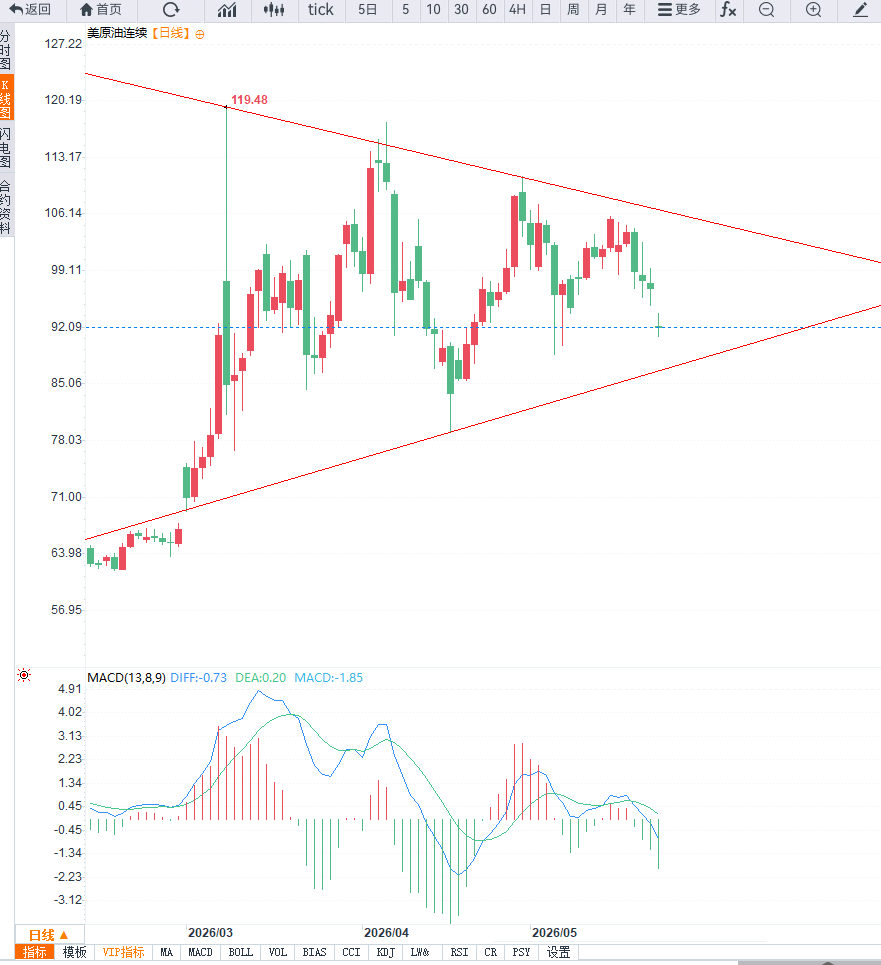
From a technical perspective, the WTI crude oil daily chart has shown clear signs of a high-level pullback. After a continuous rise in oil prices, technical indicators entered overbought territory, and Monday's sharp drop at the open signifies a significant reversal in market sentiment. WTI is approaching the $90 mark on the daily chart, with a key support zone between $87 and $85. If this area is breached, oil prices could fall further to around $82. On the upside, the $95-$98 area has become a significant short-term resistance level; failure to regain this level could increase bearish pressure.
Observing the daily momentum indicators, the MACD shows signs of a death cross at a high level, and the red bars are continuously narrowing, indicating that the upward momentum is weakening significantly. The RSI indicator has also fallen rapidly from its previous near-overbought zone, reflecting that short-term bullish funds are withdrawing from the market. Overall, although the medium-to-long-term trend still maintains a high-level consolidation structure, the short-term downward pressure has significantly increased.
The market's primary focus remains on the outcome of US-Iran negotiations and the ongoing developments in the Strait of Hormuz. If the market confirms a return to normal oil transportation, the substantial risk premium previously accumulated in international oil prices may be further absorbed. However, if negotiations encounter further setbacks and tensions in the Middle East escalate again, energy market volatility could rise rapidly once more.
Editor's Summary : The current international crude oil market is rapidly switching between "geopolitical risk premiums" and "supply recovery expectations." The core logic driving the previous surge in oil prices was market concerns about disruptions to the Middle East supply chain. However, as news of the potential reopening of the Strait of Hormuz continues to circulate, investors are reassessing global energy supply risks, leading to a rapid short-term correction in oil prices. However, from a longer-term perspective, the situation in the Middle East remains highly uncertain, and market sentiment remains susceptible to unforeseen events. Furthermore, the Fed's high-interest-rate environment, the risk of a global economic slowdown, and a strong dollar may continue to suppress expectations for crude oil demand. Therefore, the future trend of international oil prices is likely to enter a highly volatile range, with the market repeatedly oscillating between geopolitical risks and global demand. For investors, in the short term, it is crucial to focus on the latest developments in US-Iran negotiations, the resumption of shipping through the Strait of Hormuz, and global inventory changes. If supply risks continue to ease, WTI crude oil may further test the support level around $85; however, if the situation in the Middle East deteriorates again, oil prices could quickly rebound to above $95.
The core reason for this round of oil price correction stems from market optimism regarding the potential resumption of normal shipping traffic in the Strait of Hormuz. Previously, due to ongoing tensions in the Middle East, the market was concerned that global crude oil transportation might be severely affected. However, the progress made in peace negotiations has led investors to reassess the level of risk in the energy market. The Strait of Hormuz handles approximately 20% of global seaborne crude oil transportation and is one of the world's most important energy transport routes. Once the shipping route resumes normal operations, the tension in the global crude oil supply chain will be significantly alleviated.
Peace talks between the United States and Iran are progressing steadily, with the market widely expecting a preliminary agreement framework to be reached within the next few hours. This optimism has quickly pushed down risk premiums in the crude oil market, prompting some short-term bullish funds to take profits and exit the market. Previously, international oil prices rose rapidly in a short period due to market concerns about escalating tensions in the Middle East, but the current market logic has begun to shift towards expectations of supply recovery.
However, the market remains cautious. US President Trump stated on Sunday that the agreement is "not yet fully finalized," suggesting that some core differences remain between the two sides. He said on social media that it's premature to judge the outcome of the agreement. Meanwhile, US Secretary of State Rubio also stated that although regional countries generally support the direction of the agreement, complex negotiations involving nuclear issues "cannot be completed quickly in 72 hours." These remarks indicate that while the market is generally optimistic, significant uncertainty remains.
Market reaction indicates that risk sentiment in the international energy market is rapidly cooling. Brent and WTI crude oil prices both fell sharply, putting pressure on energy-related assets and leading to significant capital outflows from safe-haven assets. Some investors believe that if stable shipping resumes in the Strait of Hormuz, global oil supply will return to normal, and the extreme supply shortage risks previously feared by the market may not materialize.
Meanwhile, the US dollar index has remained high recently, also putting additional downward pressure on international oil prices. Due to the Federal Reserve's hawkish policy stance, US Treasury yields have remained high, keeping the dollar strong overall. A strong dollar typically weakens the attractiveness of dollar-denominated commodities, thus putting temporary pressure on oil prices. Under the dual influence of easing supply risks and a strengthening dollar, international oil prices face significant downward pressure in the short term.
From a global economic perspective, the market is also beginning to refocus on the outlook for oil demand. Currently, global manufacturing activity still faces some slowdown pressure, economic growth momentum in Europe and the US is unstable, and industrial demand in some Asian countries has not yet fully recovered. Against this backdrop, if geopolitical risks ease further, market focus may return to global demand performance, which will limit the potential for further significant increases in oil prices.
From a technical perspective, the WTI crude oil daily chart has shown clear signs of a high-level pullback. After a continuous rise in oil prices, technical indicators entered overbought territory, and Monday's sharp drop at the open signifies a significant reversal in market sentiment. WTI is approaching the $90 mark on the daily chart, with a key support zone between $87 and $85. If this area is breached, oil prices could fall further to around $82. On the upside, the $95-$98 area has become a significant short-term resistance level; failure to regain this level could increase bearish pressure.
Observing the daily momentum indicators, the MACD shows signs of a death cross at a high level, and the red bars are continuously narrowing, indicating that the upward momentum is weakening significantly. The RSI indicator has also fallen rapidly from its previous near-overbought zone, reflecting that short-term bullish funds are withdrawing from the market. Overall, although the medium-to-long-term trend still maintains a high-level consolidation structure, the short-term downward pressure has significantly increased.
The market's primary focus remains on the outcome of US-Iran negotiations and the ongoing developments in the Strait of Hormuz. If the market confirms a return to normal oil transportation, the substantial risk premium previously accumulated in international oil prices may be further absorbed. However, if negotiations encounter further setbacks and tensions in the Middle East escalate again, energy market volatility could rise rapidly once more.
Editor's Summary : The current international crude oil market is rapidly switching between "geopolitical risk premiums" and "supply recovery expectations." The core logic driving the previous surge in oil prices was market concerns about disruptions to the Middle East supply chain. However, as news of the potential reopening of the Strait of Hormuz continues to circulate, investors are reassessing global energy supply risks, leading to a rapid short-term correction in oil prices. However, from a longer-term perspective, the situation in the Middle East remains highly uncertain, and market sentiment remains susceptible to unforeseen events. Furthermore, the Fed's high-interest-rate environment, the risk of a global economic slowdown, and a strong dollar may continue to suppress expectations for crude oil demand. Therefore, the future trend of international oil prices is likely to enter a highly volatile range, with the market repeatedly oscillating between geopolitical risks and global demand. For investors, in the short term, it is crucial to focus on the latest developments in US-Iran negotiations, the resumption of shipping through the Strait of Hormuz, and global inventory changes. If supply risks continue to ease, WTI crude oil may further test the support level around $85; however, if the situation in the Middle East deteriorates again, oil prices could quickly rebound to above $95.
- Risk Warning and Disclaimer
- The market involves risk, and trading may not be suitable for all investors. This article is for reference only and does not constitute personal investment advice, nor does it take into account certain users’ specific investment objectives, financial situation, or other needs. Any investment decisions made based on this information are at your own risk.