Rising expectations of easing geopolitical tensions put pressure on the US dollar, causing a short-term rebound in gold prices.
2026-05-25 09:55:25
International gold prices continued their strong performance in Asian trading on Monday, with spot gold (XAU/USD) rising to around $4,570 at one point, as market risk aversion remained high. Although there has been some positive progress in peace talks between the United States and Iran, significant uncertainty remains regarding the resumption of shipping through the Strait of Hormuz. Investors' concerns about slowing global economic growth and energy supply risks have not completely subsided, which continues to support the gold market.

The recent surge in gold prices is primarily driven by rising global safe-haven demand and a temporary pullback in the US dollar. As the situation in the Middle East continues to impact global energy transportation markets, investor concerns about global economic stability have significantly increased. The Strait of Hormuz handles approximately 20% of global seaborne crude oil transport; prolonged restrictions on this transport could further escalate global energy prices and inflationary pressures. Against this backdrop, gold, as a traditional safe-haven asset, has once again attracted substantial inflows of funds.
The United States and Iran are close to reaching an agreement that could potentially reopen the Strait of Hormuz. Both sides have recently signaled some positive progress in their negotiations. However, President Trump has stated that he is not in a "rush" to reach an agreement, meaning that disagreements may still exist on some core issues.
Meanwhile, US Secretary of State Marco Rubio previously stated that while there were "positive signs" of an agreement to end the conflict, the agreement would be "unenforceable" if Iran sought permanent control of shipping in the Strait of Hormuz. This statement indicates that even though the market is currently optimistic about the negotiations, geopolitical risks have not truly been completely eliminated.
One of the biggest concerns in the market right now is that prolonged restrictions on shipping through the Strait of Hormuz could further damage the global economic growth outlook. Recent sharp fluctuations in international oil prices have exacerbated concerns about a resurgence of global inflation, and rising energy prices often further increase production costs for businesses and put pressure on consumer spending.
Against this backdrop, some investors are beginning to reallocate their assets to gold to hedge against the risks of future economic slowdown and market volatility. Gold typically performs strongly when global geopolitical risks rise, economic uncertainty increases, and market demand for safe-haven assets grows. Current market uncertainty regarding the future global economic outlook remains a key factor supporting gold's continued high levels.
Furthermore, the recent pullback in the US dollar has also provided support for gold. Previously, due to expectations of the Federal Reserve maintaining a hawkish policy, US Treasury yields remained high, and the overall dollar performed strongly, putting some pressure on gold. However, as the market reassessed the risks of the Middle East situation, safe-haven buying of the dollar cooled down, and gold regained its upward momentum.
However, the market remains highly cautious about the Federal Reserve's future policy direction. The U.S. Personal Consumption Expenditures (PCE) price index, to be released this Thursday, will be a crucial data point influencing gold prices. PCE data is one of the key inflation indicators closely watched by the Federal Reserve, and the market hopes to use this data to determine the future path of U.S. interest rates.
If US PCE inflation data continues to exceed market expectations, it could reinforce market bets that the Federal Reserve will maintain high interest rates or even raise them further. A high-interest-rate environment typically increases the attractiveness of holding dollar-denominated assets and raises the cost of holding gold, thus putting downward pressure on gold prices. Therefore, although gold is currently supported by safe-haven demand, Federal Reserve policy factors may still limit further upside potential for gold.
From a global capital flow perspective, the market is currently exhibiting clear defensive allocation characteristics. Some institutional funds are continuously increasing their gold holdings to cope with potential volatility risks in global markets. Meanwhile, as signs of slowing growth in some global economies begin to emerge, market concerns about the risk of a future economic recession are gradually intensifying.
From a technical perspective, the daily chart for gold still maintains a clear bullish structure. After breaking through the $4,500 mark, gold prices have been consolidating at high levels, and the overall upward trend remains intact. Initial resistance on the daily chart is located in the $4,600 to $4,650 area; a successful break above this level could see gold further challenge the $4,700 level.
On the downside, the $4,500 level has become a key short-term support area, with further support around $4,460. If market risk aversion resurfaces, gold is likely to maintain its strong upward momentum. Looking at the daily chart indicators, the MACD remains bullish, but the growth rate of the red bars has slowed, indicating that short-term upward momentum is becoming more cautious. The RSI indicator is currently still in high territory, suggesting that overall market bullish sentiment remains strong, but there is also some technical downward pressure in the short term.
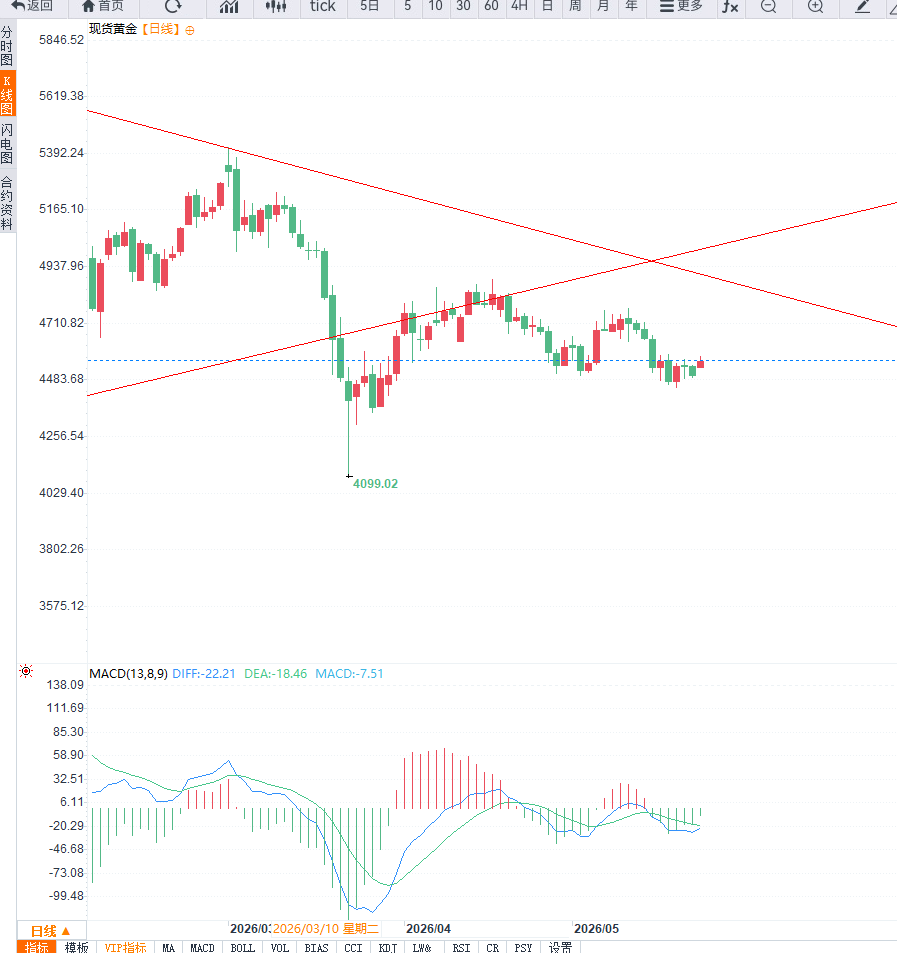
However, if US inflation data strengthens again and US Treasury yields rise rapidly once more, gold may face some profit-taking pressure. Currently, the market as a whole remains in a phase of back-and-forth struggle between "safe-haven demand" and "high interest rate pressure."
Overall, the gold market remains influenced by multiple factors, including the situation in the Middle East, expectations regarding Federal Reserve policy, and concerns about global economic growth. Market volatility is likely to remain high, and this week's US PCE data will be a crucial factor in determining the short-term direction of gold.
Editor's Summary : The current gold market is in a typical "high-level safe-haven trading" phase. Uncertainty surrounding the Middle East, shipping risks in the Strait of Hormuz, and concerns about global economic growth are collectively driving gold prices to remain near historical highs. Meanwhile, a temporary pullback in the US dollar is also providing additional support for gold prices. However, the market still needs to be wary of the potential downward pressure on gold from the Fed's high-interest-rate environment. If US PCE inflation data continues to be strong, market expectations for further Fed tightening may resurface, thus limiting gold's upside potential. In the short term, gold's price movement will remain highly dependent on developments in the Middle East and US economic data. If global risk aversion continues to rise, gold may break through $4,600; however, if hawkish expectations from the Fed strengthen again, gold prices may experience high-level fluctuations or even a temporary pullback.
The recent surge in gold prices is primarily driven by rising global safe-haven demand and a temporary pullback in the US dollar. As the situation in the Middle East continues to impact global energy transportation markets, investor concerns about global economic stability have significantly increased. The Strait of Hormuz handles approximately 20% of global seaborne crude oil transport; prolonged restrictions on this transport could further escalate global energy prices and inflationary pressures. Against this backdrop, gold, as a traditional safe-haven asset, has once again attracted substantial inflows of funds.
The United States and Iran are close to reaching an agreement that could potentially reopen the Strait of Hormuz. Both sides have recently signaled some positive progress in their negotiations. However, President Trump has stated that he is not in a "rush" to reach an agreement, meaning that disagreements may still exist on some core issues.
Meanwhile, US Secretary of State Marco Rubio previously stated that while there were "positive signs" of an agreement to end the conflict, the agreement would be "unenforceable" if Iran sought permanent control of shipping in the Strait of Hormuz. This statement indicates that even though the market is currently optimistic about the negotiations, geopolitical risks have not truly been completely eliminated.
One of the biggest concerns in the market right now is that prolonged restrictions on shipping through the Strait of Hormuz could further damage the global economic growth outlook. Recent sharp fluctuations in international oil prices have exacerbated concerns about a resurgence of global inflation, and rising energy prices often further increase production costs for businesses and put pressure on consumer spending.
Against this backdrop, some investors are beginning to reallocate their assets to gold to hedge against the risks of future economic slowdown and market volatility. Gold typically performs strongly when global geopolitical risks rise, economic uncertainty increases, and market demand for safe-haven assets grows. Current market uncertainty regarding the future global economic outlook remains a key factor supporting gold's continued high levels.
Furthermore, the recent pullback in the US dollar has also provided support for gold. Previously, due to expectations of the Federal Reserve maintaining a hawkish policy, US Treasury yields remained high, and the overall dollar performed strongly, putting some pressure on gold. However, as the market reassessed the risks of the Middle East situation, safe-haven buying of the dollar cooled down, and gold regained its upward momentum.
However, the market remains highly cautious about the Federal Reserve's future policy direction. The U.S. Personal Consumption Expenditures (PCE) price index, to be released this Thursday, will be a crucial data point influencing gold prices. PCE data is one of the key inflation indicators closely watched by the Federal Reserve, and the market hopes to use this data to determine the future path of U.S. interest rates.
If US PCE inflation data continues to exceed market expectations, it could reinforce market bets that the Federal Reserve will maintain high interest rates or even raise them further. A high-interest-rate environment typically increases the attractiveness of holding dollar-denominated assets and raises the cost of holding gold, thus putting downward pressure on gold prices. Therefore, although gold is currently supported by safe-haven demand, Federal Reserve policy factors may still limit further upside potential for gold.
From a global capital flow perspective, the market is currently exhibiting clear defensive allocation characteristics. Some institutional funds are continuously increasing their gold holdings to cope with potential volatility risks in global markets. Meanwhile, as signs of slowing growth in some global economies begin to emerge, market concerns about the risk of a future economic recession are gradually intensifying.
From a technical perspective, the daily chart for gold still maintains a clear bullish structure. After breaking through the $4,500 mark, gold prices have been consolidating at high levels, and the overall upward trend remains intact. Initial resistance on the daily chart is located in the $4,600 to $4,650 area; a successful break above this level could see gold further challenge the $4,700 level.
On the downside, the $4,500 level has become a key short-term support area, with further support around $4,460. If market risk aversion resurfaces, gold is likely to maintain its strong upward momentum. Looking at the daily chart indicators, the MACD remains bullish, but the growth rate of the red bars has slowed, indicating that short-term upward momentum is becoming more cautious. The RSI indicator is currently still in high territory, suggesting that overall market bullish sentiment remains strong, but there is also some technical downward pressure in the short term.
However, if US inflation data strengthens again and US Treasury yields rise rapidly once more, gold may face some profit-taking pressure. Currently, the market as a whole remains in a phase of back-and-forth struggle between "safe-haven demand" and "high interest rate pressure."
Overall, the gold market remains influenced by multiple factors, including the situation in the Middle East, expectations regarding Federal Reserve policy, and concerns about global economic growth. Market volatility is likely to remain high, and this week's US PCE data will be a crucial factor in determining the short-term direction of gold.
Editor's Summary : The current gold market is in a typical "high-level safe-haven trading" phase. Uncertainty surrounding the Middle East, shipping risks in the Strait of Hormuz, and concerns about global economic growth are collectively driving gold prices to remain near historical highs. Meanwhile, a temporary pullback in the US dollar is also providing additional support for gold prices. However, the market still needs to be wary of the potential downward pressure on gold from the Fed's high-interest-rate environment. If US PCE inflation data continues to be strong, market expectations for further Fed tightening may resurface, thus limiting gold's upside potential. In the short term, gold's price movement will remain highly dependent on developments in the Middle East and US economic data. If global risk aversion continues to rise, gold may break through $4,600; however, if hawkish expectations from the Fed strengthen again, gold prices may experience high-level fluctuations or even a temporary pullback.
- Risk Warning and Disclaimer
- The market involves risk, and trading may not be suitable for all investors. This article is for reference only and does not constitute personal investment advice, nor does it take into account certain users’ specific investment objectives, financial situation, or other needs. Any investment decisions made based on this information are at your own risk.