The sharp drop in gold prices may present an opportunity for a reversal; the long-term bullish logic for gold remains unshaken.
2026-05-26 10:15:59
Gold has recently experienced a significant sell-off, with the market generally bearish on its future. However, professional analysis points out that this decline is mainly due to sovereign wealth funds passively selling gold to alleviate liquidity pressures, rather than the end of the long-term upward trend in gold prices. The situation in Iran is pushing up oil prices and inflation, raising bond yields in the short term and putting pressure on gold, which lacks yield-generating properties.
However, the energy shock will eventually drag down economic growth, and global central banks are likely to return to loose policies. Coupled with deeper factors such as global economic structural imbalances and geopolitical divergence, this round of gold price adjustment is more like a market shakeout, and the long-term bull market trend remains solid.
Stephen Innes, managing partner of SPI Asset Management, released an analysis on Monday (May 25) stating that the decline in gold prices triggered by the Strait of Hormuz controversy was not due to a depletion of upward momentum, but rather a passive adjustment caused by tight liquidity in the real market. Soaring oil prices and shipping disruptions have fueled expectations of widespread inflation, prompting central banks of major energy-importing countries to urgently raise dollar liquidity. As a core reserve asset, gold has been temporarily used to liquidate and stabilize the market.
The market's interpretation of sovereign gold sales as a sign that gold prices have peaked is a clear misjudgment. Such sales are part of emergency reserve allocation during a crisis, not a shift in investment logic. In the short term, rising bond yields have suppressed gold's attractiveness, causing many investors to overlook the broader macroeconomic trend. Historical crisis cycles exhibit clear patterns: after the initial inflation panic, rising energy costs gradually erode economic growth. Once the economy weakens significantly, central banks will revert to easing policies, and this phase is often a golden period for gold performance.
As geopolitical tensions gradually ease, oil prices and inflationary pressures will cool down, but the economic damage caused by the energy shock will be difficult to repair quickly. Weak consumer spending, narrowing corporate profits, and tight market liquidity will persist, and the bond market will likely reflect the economic slowdown and expectations of future interest rate cuts in advance. The yield curve, which previously severely impacted gold prices, will then become a positive factor, providing support for gold price increases.
Wall Street commodities analyst Jeffrey Currie also agrees with the short-term profit-taking logic. Under the impact of geopolitical crises, central banks have shifted from net buyers to passive sellers of gold, with Turkey being a prime example. Gold has temporarily become a liquidity tool. However, this short-term situation will not last. Once weak growth forces monetary policy to ease, the gold market will undergo a complete recovery.
The global economy is currently experiencing a severe imbalance in development. Over the past decade, capital has poured into the digital economy, with continuous expansion in fields such as artificial intelligence, semiconductors, and cloud computing. However, there has been a long-term lack of investment in the real economy, including mining, refining facilities, energy pipelines, and commodity supply chains. The operation of the digital industry is highly dependent on various physical goods and industrial infrastructure. The weaknesses of the real economy have been fully exposed in this round of geopolitical crises, and the market has realized that the global industrial chain has almost no risk buffer capacity.
The rise in commodity prices is merely a superficial phenomenon. The root cause lies in the long-term lack of investment in the real economy, coupled with new demands such as the popularization of artificial intelligence, energy security, and the relocation of industrial chains. Gold's role has also been upgraded. Today, it is not only an inflation hedge and safe-haven asset, but also a monetary safeguard against global fragmentation, high debt levels, and increasing geopolitical friction.
This round of passive gold sales has actually made countries more aware of the fragility of the single-currency reserve system. After the crisis, central banks' willingness to purchase gold in the long term and diversify their reserves has further increased. The long-term and steady increase in gold holdings by major Asian countries is precisely aimed at the environment of global monetary system differentiation and increasing sanctions risks, relying on gold to obtain valuable neutral safe-haven attributes.
This recent gold price correction has effectively cleared out highly leveraged short-term speculative funds and eliminated market speculation bubbles. Gold's long-term upward trend remains unchanged, supported by four core factors: central bank gold purchases, weaknesses in the real economy, geopolitical risks, and expectations of future easing . Currently, the market is still judging gold using traditional yield logic, ignoring profound changes in the global macroeconomic and political landscape. With increasing risks and uncertainties, gold, representing market safe-haven demand, will continue to demonstrate its value.
In summary, the current decline in gold prices is a short-term, passive adjustment triggered by a liquidity crisis, not the end of the bull market. Inflationary pressures from the energy shock will eventually transmit to the real economy, forcing global central banks to restart easing policies. Coupled with long-term factors such as global industrial imbalances, complex geopolitical situations, and the restructuring of reserve systems, gold still has considerable upside potential after this round of consolidation, and its medium- to long-term investment value remains prominent.
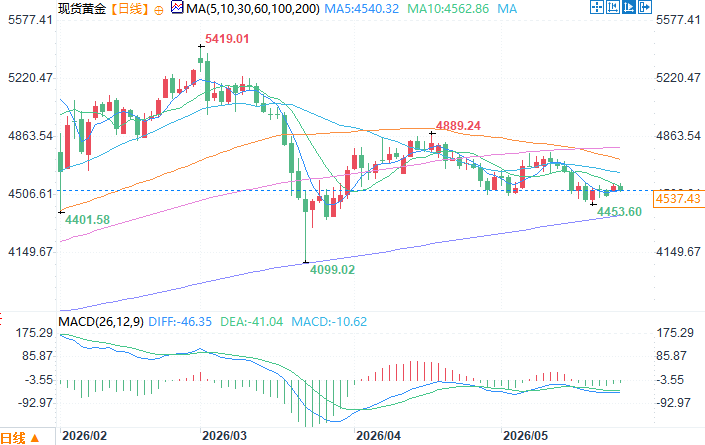
Spot gold daily chart source: EasyForex
At 10:15 AM Beijing time on May 26, spot gold was trading at $4537.43 per ounce.
However, the energy shock will eventually drag down economic growth, and global central banks are likely to return to loose policies. Coupled with deeper factors such as global economic structural imbalances and geopolitical divergence, this round of gold price adjustment is more like a market shakeout, and the long-term bull market trend remains solid.
Deconstructing the Truth Behind the Decline: Passive Profit-Taking Dominates Short-Term Market Trends
Stephen Innes, managing partner of SPI Asset Management, released an analysis on Monday (May 25) stating that the decline in gold prices triggered by the Strait of Hormuz controversy was not due to a depletion of upward momentum, but rather a passive adjustment caused by tight liquidity in the real market. Soaring oil prices and shipping disruptions have fueled expectations of widespread inflation, prompting central banks of major energy-importing countries to urgently raise dollar liquidity. As a core reserve asset, gold has been temporarily used to liquidate and stabilize the market.
The market's interpretation of sovereign gold sales as a sign that gold prices have peaked is a clear misjudgment. Such sales are part of emergency reserve allocation during a crisis, not a shift in investment logic. In the short term, rising bond yields have suppressed gold's attractiveness, causing many investors to overlook the broader macroeconomic trend. Historical crisis cycles exhibit clear patterns: after the initial inflation panic, rising energy costs gradually erode economic growth. Once the economy weakens significantly, central banks will revert to easing policies, and this phase is often a golden period for gold performance.
Anticipating a trend reversal: A weakening economy will force a policy shift.
As geopolitical tensions gradually ease, oil prices and inflationary pressures will cool down, but the economic damage caused by the energy shock will be difficult to repair quickly. Weak consumer spending, narrowing corporate profits, and tight market liquidity will persist, and the bond market will likely reflect the economic slowdown and expectations of future interest rate cuts in advance. The yield curve, which previously severely impacted gold prices, will then become a positive factor, providing support for gold price increases.
Wall Street commodities analyst Jeffrey Currie also agrees with the short-term profit-taking logic. Under the impact of geopolitical crises, central banks have shifted from net buyers to passive sellers of gold, with Turkey being a prime example. Gold has temporarily become a liquidity tool. However, this short-term situation will not last. Once weak growth forces monetary policy to ease, the gold market will undergo a complete recovery.
Delving into the underlying logic: Global structural imbalances support gold prices
The global economy is currently experiencing a severe imbalance in development. Over the past decade, capital has poured into the digital economy, with continuous expansion in fields such as artificial intelligence, semiconductors, and cloud computing. However, there has been a long-term lack of investment in the real economy, including mining, refining facilities, energy pipelines, and commodity supply chains. The operation of the digital industry is highly dependent on various physical goods and industrial infrastructure. The weaknesses of the real economy have been fully exposed in this round of geopolitical crises, and the market has realized that the global industrial chain has almost no risk buffer capacity.
The rise in commodity prices is merely a superficial phenomenon. The root cause lies in the long-term lack of investment in the real economy, coupled with new demands such as the popularization of artificial intelligence, energy security, and the relocation of industrial chains. Gold's role has also been upgraded. Today, it is not only an inflation hedge and safe-haven asset, but also a monetary safeguard against global fragmentation, high debt levels, and increasing geopolitical friction.
Long-term outlook is bright: consolidation and shakeout solidify the foundation for upward movement.
This round of passive gold sales has actually made countries more aware of the fragility of the single-currency reserve system. After the crisis, central banks' willingness to purchase gold in the long term and diversify their reserves has further increased. The long-term and steady increase in gold holdings by major Asian countries is precisely aimed at the environment of global monetary system differentiation and increasing sanctions risks, relying on gold to obtain valuable neutral safe-haven attributes.
This recent gold price correction has effectively cleared out highly leveraged short-term speculative funds and eliminated market speculation bubbles. Gold's long-term upward trend remains unchanged, supported by four core factors: central bank gold purchases, weaknesses in the real economy, geopolitical risks, and expectations of future easing . Currently, the market is still judging gold using traditional yield logic, ignoring profound changes in the global macroeconomic and political landscape. With increasing risks and uncertainties, gold, representing market safe-haven demand, will continue to demonstrate its value.
Summarize
In summary, the current decline in gold prices is a short-term, passive adjustment triggered by a liquidity crisis, not the end of the bull market. Inflationary pressures from the energy shock will eventually transmit to the real economy, forcing global central banks to restart easing policies. Coupled with long-term factors such as global industrial imbalances, complex geopolitical situations, and the restructuring of reserve systems, gold still has considerable upside potential after this round of consolidation, and its medium- to long-term investment value remains prominent.
Spot gold daily chart source: EasyForex
At 10:15 AM Beijing time on May 26, spot gold was trading at $4537.43 per ounce.
- Risk Warning and Disclaimer
- The market involves risk, and trading may not be suitable for all investors. This article is for reference only and does not constitute personal investment advice, nor does it take into account certain users’ specific investment objectives, financial situation, or other needs. Any investment decisions made based on this information are at your own risk.