













The Fed's return to independence and the stability of US Treasury bonds, while gold prices stagnate, remains a mystery.
2026-05-26 18:14:21
Despite recent data falling short of expectations and the Federal Reserve shifting from dovish to hawkish statements, US Treasury yields have not risen significantly.
The Federal Reserve's independence has been well protected, and Governor Christopher Waller has signaled a clear intention to raise interest rates (he was appointed by Trump as a Federal Reserve governor during his term and was previously a leading figure in the dovish camp).
The moment when Kevin Warsh officially became Chairman of the Federal Reserve had a lukewarm reception on Wall Street. Recently, the Federal Reserve has no longer been the focus of market discussion, with the artificial intelligence boom taking center stage in the capital market. The Chicago Board Options Exchange Volatility Index has fallen by 14% in the past month.
The Fed's hawks, combined with Trump's recent statements about reducing intervention, have completed a shift in their stance towards maintaining the Fed's independence.
The current upper limit of the federal funds rate target remains at 3.75%. The Federal Reserve has remained on hold since its interest rate meeting in December last year, and the wait-and-see period has exceeded five months.
Multiple key indicators show that inflation remains sticky, becoming a key constraint on policy easing: the core PCE price index, which is anchored by the Federal Reserve, hit a nearly 12-month high in March, reaching the 91st percentile in nearly a year, indicating that upward pressure on prices has not subsided.
U.S. consumer confidence deteriorated further in May 2026. The final reading of the University of Michigan Consumer Sentiment Index for May was revised down to 44.8 from the initial reading of 48.2, marking the third consecutive month of decline from 49.8 in April.
Inflation expectations for the next year rose to 4.8% from 4.7% in April, well above the 3.4% before the Iranian conflict in February 2026, and also higher than all readings for 2024; long-term inflation expectations rose to 3.9% from 3.5% in April, breaking through the 2.8% to 3.2% fluctuation range for the whole of 2024.
57% of consumers spontaneously mentioned that high prices are eroding their personal finances, up from 50% last month. Joanne Hsu, the survey's lead researcher, stated that "the cost of living remains the primary concern."
Walsh is currently facing a dilemma: geopolitical conflicts, coupled with the AI infrastructure and financing boom, are pushing up inflationary pressures in the short term; however, the widespread adoption of AI technology is expected to improve overall productivity in the long term, becoming a potential force to hedge against inflation.
Leading institutions such as Vanguard and JPMorgan Chase agree that the Federal Reserve's decision-making logic is shifting, with lagging traditional inflation data losing weight and productivity data becoming a core reference for future policy-making.
Warsh's current important task is to persuade the divided FOMC members to develop policies that balance growth, inflation and productivity.
Institutions have also revised their interest rate forecasts, generally believing that the US economy remains resilient, but the room for interest rate declines is limited, and high interest rates will continue for a long time. JPMorgan Chase has even adjusted its view, changing from two rate cuts in 2026 to a possibility of one rate hike in 2027.
The bond market has already completed a new round of risk pricing. On May 21, the yield on the 10-year US Treasury note closed at 4.57%, up 27 basis points in the past month, and at the 98th percentile in the past twelve months.
The spread between the 10-year and 2-year US Treasury yields narrowed to a new low for the year, and the yield curve continued to flatten, reflecting a market consensus that the Federal Reserve will maintain high interest rates for a long time and that the US economic growth rate will gradually slow down.
Goldman Sachs, Barclays, and other investment banks further pointed out that even if the geopolitical situation in the Middle East eases, the upward trend in US Treasury yields will be difficult to reverse due to factors such as the expansion of the US fiscal deficit, the increase in the supply of Treasury bonds, and the rise in the neutral interest rate. At the same time, there is also a narrative in the market that the $72 trillion in technology capital expenditure has led to a supply shortage in the bond market, pushing up yields.
In addition, industry insiders are concerned that if the Federal Reserve's communication mechanism is adjusted and policy guidance becomes more ambiguous, it will amplify market volatility caused by economic data and interest rate meetings.
Since the new management took office, the Federal Reserve's external communication model has become a hot topic in the market, with widespread concerns that changes in the clarity of guidance will disrupt market operations.
Pictet Asset Management bond strategist Mikael Benheim warned that if the Federal Reserve's communication loses its regularity and clarity, the market influence of economic data and interest rate meetings will be amplified, and sudden policy changes will exacerbate market volatility.
Charles Schwab's Colin Martin stated that the market has long been accustomed to the Federal Reserve's high level of transparency, and once the rules are adjusted, there is considerable uncertainty regarding the subsequent trend.
Based on research by the Brookings Institution, the Federal Reserve's current overall communication rating is B+, indicating that the market has a high opinion of Powell's press conferences.
Opinions within the industry are divided on the issue of officials speaking out publicly. Some observers believe that a large number of speeches have limited effect, but Martin believes that such exchanges can directly demonstrate the policy differences and key indicators of concern among committee members.
Former Federal Reserve official Mester suggested that, on the one hand, the public activities of regional Federal Reserve presidents should not be reduced, in order to protect the public's right to know and accountability;
On the other hand, she suggested optimizing the order of speeches, first announcing the FOMC's overall position and then stating individual viewpoints, while also enriching the content of the post-meeting statement. She specifically mentioned that vague wording in previous meeting statements had led to misunderstandings, and there is still considerable room for improvement in the details of communication.
Veteran Federal Reserve observer Ed Yardeni also joked that the change in the Fed's communication style will directly affect the analytical logic of the market analysis industry.
The Federal Reserve's interest rate policy remains the core factor influencing gold prices. Gold is a non-interest-bearing asset, and its price is highly negatively correlated with US Treasury yields and real interest rates.
The Fed's hawkish rhetoric has yielded positive results so far, with the rise in US Treasury yields narrowing and the Fed's independence significantly improved.
Overall, gold prices are likely to remain in a range-bound trading pattern. Subsequent policy statements from the Federal Reserve, inflation data, and changes in closely watched productivity indicators will be key to breaking the current trading pattern and guiding gold price movements.
Moreover, there was a clear correlation between the equity market and precious metals in the past, because AI devices cannot do without the demand for precious metals. However, gold's recent gains have lagged behind, which raises the question of whether US stocks have overbought or gold has stagnated. Traders can keep an eye on this.
From a technical perspective, spot gold remains under pressure from the 5-day moving average and the middle line of the descending channel.
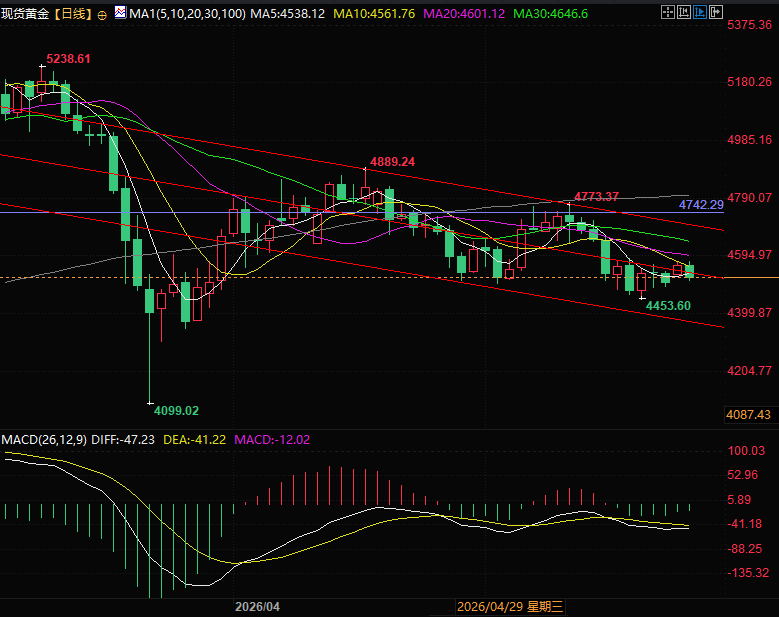
(Spot gold daily chart, source: EasyForex subsidiary)
At 18:11 Beijing time, spot gold was trading at $4,528 per ounce.
The Federal Reserve's independence has been well protected, and Governor Christopher Waller has signaled a clear intention to raise interest rates (he was appointed by Trump as a Federal Reserve governor during his term and was previously a leading figure in the dovish camp).
The moment when Kevin Warsh officially became Chairman of the Federal Reserve had a lukewarm reception on Wall Street. Recently, the Federal Reserve has no longer been the focus of market discussion, with the artificial intelligence boom taking center stage in the capital market. The Chicago Board Options Exchange Volatility Index has fallen by 14% in the past month.
The Fed's hawks, combined with Trump's recent statements about reducing intervention, have completed a shift in their stance towards maintaining the Fed's independence.
Economic data signals that the room for interest rate cuts has largely narrowed.
The current upper limit of the federal funds rate target remains at 3.75%. The Federal Reserve has remained on hold since its interest rate meeting in December last year, and the wait-and-see period has exceeded five months.
Multiple key indicators show that inflation remains sticky, becoming a key constraint on policy easing: the core PCE price index, which is anchored by the Federal Reserve, hit a nearly 12-month high in March, reaching the 91st percentile in nearly a year, indicating that upward pressure on prices has not subsided.
U.S. consumer confidence deteriorated further in May 2026. The final reading of the University of Michigan Consumer Sentiment Index for May was revised down to 44.8 from the initial reading of 48.2, marking the third consecutive month of decline from 49.8 in April.
Inflation expectations for the next year rose to 4.8% from 4.7% in April, well above the 3.4% before the Iranian conflict in February 2026, and also higher than all readings for 2024; long-term inflation expectations rose to 3.9% from 3.5% in April, breaking through the 2.8% to 3.2% fluctuation range for the whole of 2024.
57% of consumers spontaneously mentioned that high prices are eroding their personal finances, up from 50% last month. Joanne Hsu, the survey's lead researcher, stated that "the cost of living remains the primary concern."
The policy logic is shifting, with production efficiency becoming the core of analysis.
Walsh is currently facing a dilemma: geopolitical conflicts, coupled with the AI infrastructure and financing boom, are pushing up inflationary pressures in the short term; however, the widespread adoption of AI technology is expected to improve overall productivity in the long term, becoming a potential force to hedge against inflation.
Leading institutions such as Vanguard and JPMorgan Chase agree that the Federal Reserve's decision-making logic is shifting, with lagging traditional inflation data losing weight and productivity data becoming a core reference for future policy-making.
Warsh's current important task is to persuade the divided FOMC members to develop policies that balance growth, inflation and productivity.
Institutions have also revised their interest rate forecasts, generally believing that the US economy remains resilient, but the room for interest rate declines is limited, and high interest rates will continue for a long time. JPMorgan Chase has even adjusted its view, changing from two rate cuts in 2026 to a possibility of one rate hike in 2027.
The bond market is pricing in the interest rates in advance, and the high-interest-rate environment is unlikely to reverse in the short term.
The bond market has already completed a new round of risk pricing. On May 21, the yield on the 10-year US Treasury note closed at 4.57%, up 27 basis points in the past month, and at the 98th percentile in the past twelve months.
The spread between the 10-year and 2-year US Treasury yields narrowed to a new low for the year, and the yield curve continued to flatten, reflecting a market consensus that the Federal Reserve will maintain high interest rates for a long time and that the US economic growth rate will gradually slow down.
Goldman Sachs, Barclays, and other investment banks further pointed out that even if the geopolitical situation in the Middle East eases, the upward trend in US Treasury yields will be difficult to reverse due to factors such as the expansion of the US fiscal deficit, the increase in the supply of Treasury bonds, and the rise in the neutral interest rate. At the same time, there is also a narrative in the market that the $72 trillion in technology capital expenditure has led to a supply shortage in the bond market, pushing up yields.
In addition, industry insiders are concerned that if the Federal Reserve's communication mechanism is adjusted and policy guidance becomes more ambiguous, it will amplify market volatility caused by economic data and interest rate meetings.
Voices from all sides: The Federal Reserve's communication mechanism sparks heated debate
Since the new management took office, the Federal Reserve's external communication model has become a hot topic in the market, with widespread concerns that changes in the clarity of guidance will disrupt market operations.
Pictet Asset Management bond strategist Mikael Benheim warned that if the Federal Reserve's communication loses its regularity and clarity, the market influence of economic data and interest rate meetings will be amplified, and sudden policy changes will exacerbate market volatility.
Charles Schwab's Colin Martin stated that the market has long been accustomed to the Federal Reserve's high level of transparency, and once the rules are adjusted, there is considerable uncertainty regarding the subsequent trend.
Based on research by the Brookings Institution, the Federal Reserve's current overall communication rating is B+, indicating that the market has a high opinion of Powell's press conferences.
Opinions within the industry are divided on the issue of officials speaking out publicly. Some observers believe that a large number of speeches have limited effect, but Martin believes that such exchanges can directly demonstrate the policy differences and key indicators of concern among committee members.
Former Federal Reserve official Mester suggested that, on the one hand, the public activities of regional Federal Reserve presidents should not be reduced, in order to protect the public's right to know and accountability;
On the other hand, she suggested optimizing the order of speeches, first announcing the FOMC's overall position and then stating individual viewpoints, while also enriching the content of the post-meeting statement. She specifically mentioned that vague wording in previous meeting statements had led to misunderstandings, and there is still considerable room for improvement in the details of communication.
Veteran Federal Reserve observer Ed Yardeni also joked that the change in the Fed's communication style will directly affect the analytical logic of the market analysis industry.
Summary and Technical Analysis:
The Federal Reserve's interest rate policy remains the core factor influencing gold prices. Gold is a non-interest-bearing asset, and its price is highly negatively correlated with US Treasury yields and real interest rates.
The Fed's hawkish rhetoric has yielded positive results so far, with the rise in US Treasury yields narrowing and the Fed's independence significantly improved.
Overall, gold prices are likely to remain in a range-bound trading pattern. Subsequent policy statements from the Federal Reserve, inflation data, and changes in closely watched productivity indicators will be key to breaking the current trading pattern and guiding gold price movements.
Moreover, there was a clear correlation between the equity market and precious metals in the past, because AI devices cannot do without the demand for precious metals. However, gold's recent gains have lagged behind, which raises the question of whether US stocks have overbought or gold has stagnated. Traders can keep an eye on this.
From a technical perspective, spot gold remains under pressure from the 5-day moving average and the middle line of the descending channel.
(Spot gold daily chart, source: EasyForex subsidiary)
At 18:11 Beijing time, spot gold was trading at $4,528 per ounce.
- Risk Warning and Disclaimer
- The market involves risk, and trading may not be suitable for all investors. This article is for reference only and does not constitute personal investment advice, nor does it take into account certain users’ specific investment objectives, financial situation, or other needs. Any investment decisions made based on this information are at your own risk.

