













The situation in the Strait of Hormuz between the US and Iran is fluctuating: limited escalation or a brief interlude in the peace process?
2026-05-26 18:47:59
On Tuesday (May 26), from Sunday evening to Monday local time, crude oil prices initially fell due to news that the United States and Iran had reached a preliminary framework agreement to end the conflict and reopen the Strait of Hormuz. However, subsequent news of clashes between the two sides in the Strait and targeted strikes by the United States caused oil prices to rebound quickly from their intraday lows, significantly narrowing the decline.
On May 26, Iran's Supreme Leader Ali Khamenei issued a strong warning in a written statement commemorating the Hajj pilgrimage to Mecca, stating that the United States "will no longer have a safe haven for committing evil deeds and establishing military bases" in the Middle East, and that Muslim countries "will no longer act as shields for US bases," urging the shaping of a new world order based on shared interests. Amidst the continued tensions, Iran has already retaliated against several US bases and facilities in the Middle East.
The Strait of Hormuz is a crucial passage for approximately one-fifth of global oil transportation, and its navigation status directly impacts the global energy supply chain. The negotiation framework involves extending the 60-day ceasefire, gradually easing sanctions, and reopening the strait, but recent events have temporarily dampened market optimism, causing risk premiums to rise again.
A peaceful interlude or an escalation of conflict?
Historical experience shows that sensitive negotiations between the US and Iran are often accompanied by military friction and tough statements. If this exchange of fire is kept at the level of "limited self-defense" by both sides, the high-level statements are more of a means to consolidate domestic positions and increase bargaining power than to completely close the door to diplomacy. In similar past incidents, both sides have ultimately returned to the negotiating table.
If signs of a cooling down emerge (such as the resumption of actual navigation across the strait, a decline in insurance rates, or a new round of indirect communication), the framework agreement already reached is expected to continue to advance. The market will quickly price in "supply normalization," and oil prices will face downward pressure, potentially testing the current key support level below $88.
If Iran retaliates more forcefully than expected, or if the United States responds more aggressively, the situation could escalate from limited friction into a wider conflict. The Supreme Leader's statement that there is "no longer a safe haven" has significantly tightened Iran's red lines and could undermine existing negotiating gains.
If the actual disruption in the Strait of Hormuz is prolonged, more bases are attacked, or insurance and shipping costs continue to soar, the risk to global oil supply will rise sharply, and oil prices are expected to return to previous highs, even potentially exceeding $110. Hardliners within Iran and opposition within the United States could both contribute to the escalation of the situation.
The market currently leans more towards the former, but the uncertainty surrounding geopolitical events is extremely high, and any unexpected event could quickly reverse expectations.
Fundamental and technical analysis
Fundamentals: Uncertainty surrounding the Strait of Hormuz remains the dominant factor in the short term. Global crude oil inventories, OPEC+ spare capacity, and demand prospects provide a buffer, but the resumption of navigation through the strait, logistical bottlenecks, and tanker capacity will be key variables. Even if an agreement is ultimately reached, full supply normalization will take time, and oil prices may remain volatile within a relatively high range.
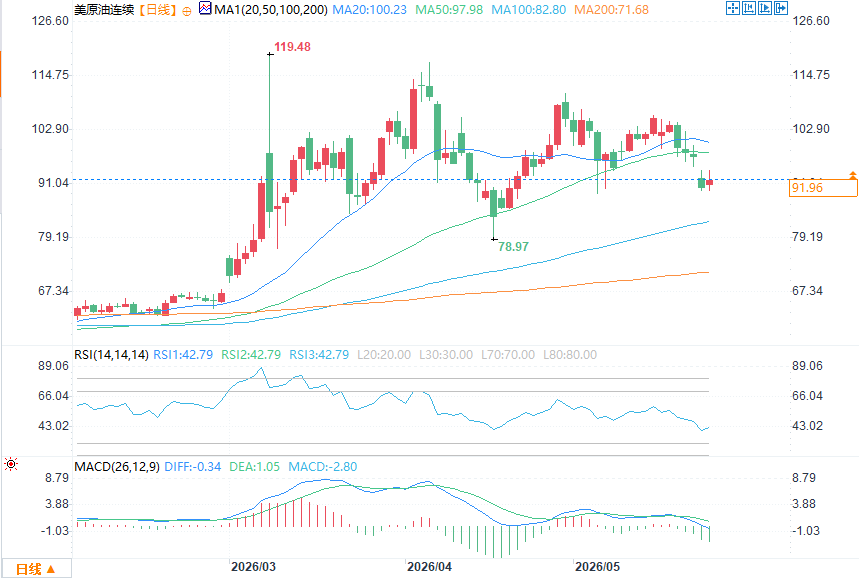
(WTI crude oil daily chart source: FX678)
Technical Analysis: Oil prices found strong support around $88, a level where the cost curve, historical lows, and multiple technical indicators converge. Influenced by this support, short-term oil prices are expected to fluctuate widely between $90 and $105, with $90 as the lower limit of the range. Geopolitical news will be the primary catalyst.
Risk Warnings and Investment Outlook
The crude oil market is currently in a highly volatile environment, and investors need to prepare for two scenarios:
Upside risks: escalation of conflict, large-scale Iranian retaliation, and prolonged substantial disruption of the Strait of Hormuz.
Downside risks: rapid de-escalation of diplomatic tensions, implementation of limited agreements, and substantial resumption of air traffic.
Baseline Scenario: The event is treated as an interlude in the peace process, with a limited ceasefire and delayed negotiations, and oil prices remain high with significant geopolitical premiums.
This incident once again highlights the amplifying effect of geopolitical factors on the energy market. The negotiation process is destined to be tortuous and protracted, and the tough statements from high-level officials have added new variables to the market, but there is still room for further progress on the overall framework. Traders should closely monitor actual flow data from the Strait of Hormuz, official statements, inventory reports, and OPEC activities, adopting range trading strategies and strictly controlling position sizes.
At 18:38 Beijing time, WTI crude oil was trading at $91.93 per barrel, down 4.83%.
On May 26, Iran's Supreme Leader Ali Khamenei issued a strong warning in a written statement commemorating the Hajj pilgrimage to Mecca, stating that the United States "will no longer have a safe haven for committing evil deeds and establishing military bases" in the Middle East, and that Muslim countries "will no longer act as shields for US bases," urging the shaping of a new world order based on shared interests. Amidst the continued tensions, Iran has already retaliated against several US bases and facilities in the Middle East.
The Strait of Hormuz is a crucial passage for approximately one-fifth of global oil transportation, and its navigation status directly impacts the global energy supply chain. The negotiation framework involves extending the 60-day ceasefire, gradually easing sanctions, and reopening the strait, but recent events have temporarily dampened market optimism, causing risk premiums to rise again.
A peaceful interlude or an escalation of conflict?
Historical experience shows that sensitive negotiations between the US and Iran are often accompanied by military friction and tough statements. If this exchange of fire is kept at the level of "limited self-defense" by both sides, the high-level statements are more of a means to consolidate domestic positions and increase bargaining power than to completely close the door to diplomacy. In similar past incidents, both sides have ultimately returned to the negotiating table.
If signs of a cooling down emerge (such as the resumption of actual navigation across the strait, a decline in insurance rates, or a new round of indirect communication), the framework agreement already reached is expected to continue to advance. The market will quickly price in "supply normalization," and oil prices will face downward pressure, potentially testing the current key support level below $88.
If Iran retaliates more forcefully than expected, or if the United States responds more aggressively, the situation could escalate from limited friction into a wider conflict. The Supreme Leader's statement that there is "no longer a safe haven" has significantly tightened Iran's red lines and could undermine existing negotiating gains.
If the actual disruption in the Strait of Hormuz is prolonged, more bases are attacked, or insurance and shipping costs continue to soar, the risk to global oil supply will rise sharply, and oil prices are expected to return to previous highs, even potentially exceeding $110. Hardliners within Iran and opposition within the United States could both contribute to the escalation of the situation.
The market currently leans more towards the former, but the uncertainty surrounding geopolitical events is extremely high, and any unexpected event could quickly reverse expectations.
Fundamental and technical analysis
Fundamentals: Uncertainty surrounding the Strait of Hormuz remains the dominant factor in the short term. Global crude oil inventories, OPEC+ spare capacity, and demand prospects provide a buffer, but the resumption of navigation through the strait, logistical bottlenecks, and tanker capacity will be key variables. Even if an agreement is ultimately reached, full supply normalization will take time, and oil prices may remain volatile within a relatively high range.
(WTI crude oil daily chart source: FX678)
Technical Analysis: Oil prices found strong support around $88, a level where the cost curve, historical lows, and multiple technical indicators converge. Influenced by this support, short-term oil prices are expected to fluctuate widely between $90 and $105, with $90 as the lower limit of the range. Geopolitical news will be the primary catalyst.
Risk Warnings and Investment Outlook
The crude oil market is currently in a highly volatile environment, and investors need to prepare for two scenarios:
Upside risks: escalation of conflict, large-scale Iranian retaliation, and prolonged substantial disruption of the Strait of Hormuz.
Downside risks: rapid de-escalation of diplomatic tensions, implementation of limited agreements, and substantial resumption of air traffic.
Baseline Scenario: The event is treated as an interlude in the peace process, with a limited ceasefire and delayed negotiations, and oil prices remain high with significant geopolitical premiums.
This incident once again highlights the amplifying effect of geopolitical factors on the energy market. The negotiation process is destined to be tortuous and protracted, and the tough statements from high-level officials have added new variables to the market, but there is still room for further progress on the overall framework. Traders should closely monitor actual flow data from the Strait of Hormuz, official statements, inventory reports, and OPEC activities, adopting range trading strategies and strictly controlling position sizes.
At 18:38 Beijing time, WTI crude oil was trading at $91.93 per barrel, down 4.83%.
- Risk Warning and Disclaimer
- The market involves risk, and trading may not be suitable for all investors. This article is for reference only and does not constitute personal investment advice, nor does it take into account certain users’ specific investment objectives, financial situation, or other needs. Any investment decisions made based on this information are at your own risk.

