A 7.86 million barrel drop in inventories couldn't save oil prices? Demand is quietly shifting.
2026-05-26 19:59:07
On Tuesday, May 26, the crude oil market returned to pricing in geopolitical risks. Brent crude was last quoted at $98.86 per barrel, rebounding from the previous trading day. Market focus was concentrated on key variables such as the resumption of passage through the Strait of Hormuz, the pace of releasing frozen Iranian assets, the extension of the ceasefire, and the mechanism for disposing of highly enriched uranium stockpiles. Latest publicly available information indicates that the main obstacle in related negotiations has shifted from the issue of nuclear material cooperation to arrangements for unfreezing funds, meaning that an agreement framework may have taken shape, but the order of asset releases remains the core point of contention in the negotiations.

This round of oil price rebound is not simply driven by inventory or demand, but rather a typical reassessment of the risk premium of transportation corridors. The Strait of Hormuz carries a significant portion of global maritime energy traffic; once its passage efficiency is restricted, spot procurement, insurance rates, shipping schedules, and refinery feedstock matching will all be disrupted simultaneously. For traders, the key at present is not to determine whether the conflict has ended, but whether the restoration of the corridor can translate from political statements into actual shipping recovery.
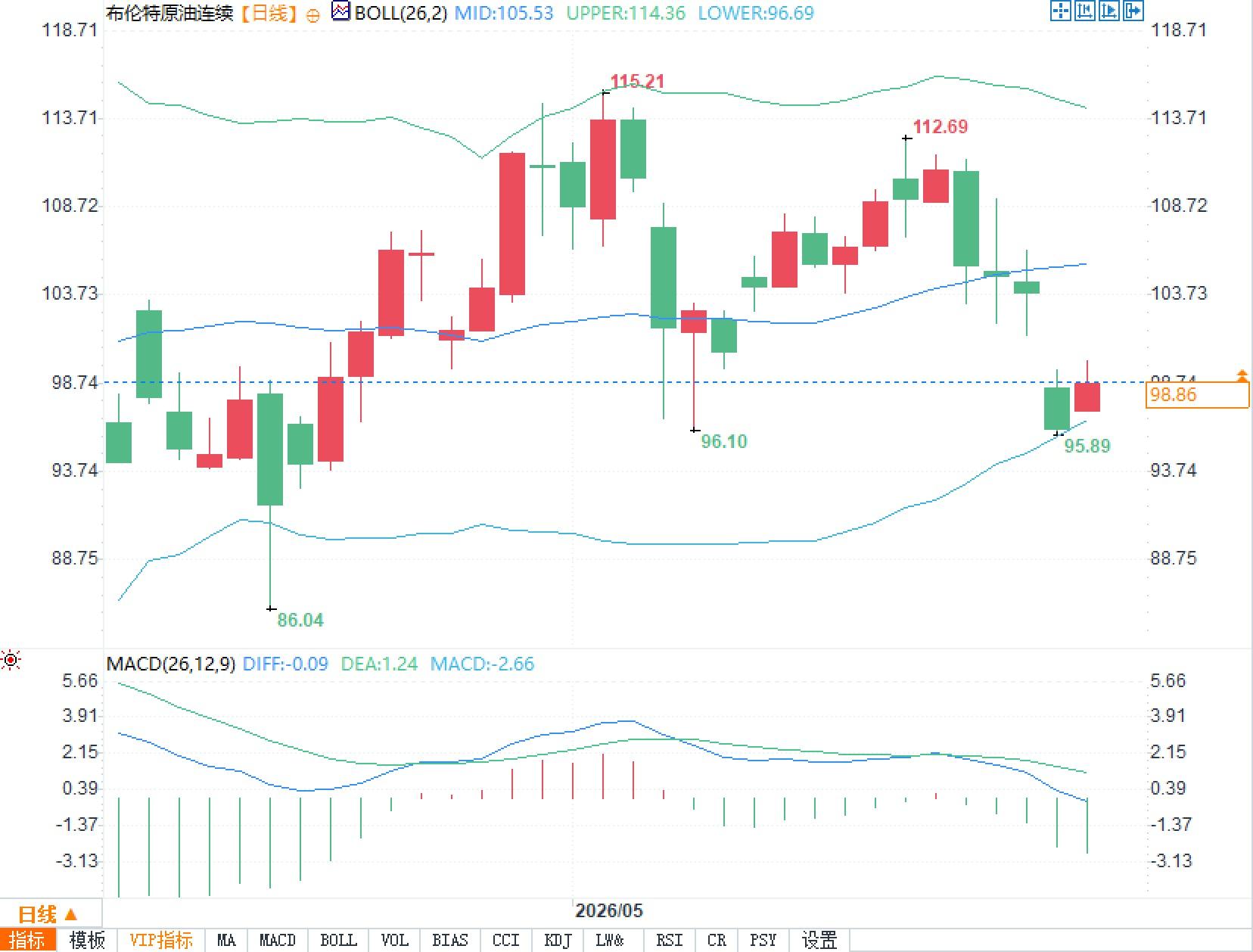
From the daily chart of Brent crude oil, prices previously encountered resistance near $112.69/barrel and fell back, reaching a low of around $95.89/barrel before finding support in the lower Bollinger Band area. Currently, prices have returned above $98/barrel, but remain below the middle Bollinger Band at approximately $105.53/barrel, indicating that the rebound is more of a repricing after risk correction than a strong upward trend. The MACD remains in the weak zone, showing that momentum has not fully reversed, and the market is still awaiting clearer signals regarding the implementation of the trade agreement.
According to the latest reports, Iran is demanding guaranteed access to $12 billion in frozen assets in the first phase of the agreement, of which approximately $6 billion was previously held in the Qatari banking system. The US, however, prefers to link the release of funds to the final comprehensive agreement. The disagreement centers on whether to release the funds first or complete the agreement first. This is crucial for the oil market, as the funding arrangement will determine Iran's incentive to maintain the ceasefire, cooperate with nuclear material arrangements, and push for the reopening of the Strait of Hormuz.
Market analysts believe that if the focus of negotiations has shifted from nuclear material cooperation to details of asset release, it indicates that the overall framework of the agreement has likely been thoroughly discussed, including a 60-day extension of the ceasefire and the establishment of a mechanism for managing or disposing of highly enriched uranium stockpiles. The problem is that the energy market won't simply pay for the framework; what prices truly need to verify is whether ship traffic, insurance quotes, loading windows, and port queues have returned to normal. As long as the timetable for unfreezing funds remains unclear, Brent crude will find it difficult to fully squeeze out the geopolitical risk premium.
Rabobank believes the Strait of Hormuz could take up to three months to return to normal operations, highlighting risks such as mine clearance delays, further conflict, and external intervention. The core of this view is not simply a prediction of rising oil prices, but rather an indication of physical constraints on supply chain recovery. Even with an extended ceasefire, potential mines in the strait, ship backlogs, shipping company risk assessments, and energy buyers' restocking activities will keep the market highly uncertain in the short term.
The report also mentioned that if a large number of stranded ships were to sail out simultaneously, it could lead to a one-off release of energy supply, but this would weaken Iran's bargaining power. This means the market faces two distinct paths: one is that the agreement progresses but traffic resumption is slow, resulting in high oil price volatility; the other is that traffic resumes rapidly, releasing pent-up demand and compressing short-term risk premiums. For the market, the $98 to $105/barrel range may become the core battleground between sentiment recovery and real-world constraints.
On the fundamental front, the latest weekly report from the U.S. Energy Information Administration shows that for the week ending May 15, U.S. refinery crude oil processing volume was 16.3 million barrels per day, a decrease of 80,000 barrels per day from the previous week, with a refinery utilization rate of 91.6%. During the same period, gasoline production fell to 9.3 million barrels per day, while distillate fuel production rose to 5 million barrels per day, indicating that the refined product mix is still adjusting, and refineries have not yet released a consistent signal of strong demand.
Inventory events also amplified price volatility. The US crude oil inventory change announced on May 20th showed a decrease of 7.863 million barrels, larger than the market expectation of a 2.5 million barrel decrease and also larger than the previous decrease of 4.306 million barrels. Inventory reduction provides a floor for oil prices, but in a high oil price environment, demand elasticity may gradually change. The International Energy Agency's May report projects global oil demand in 2026 to be 104 million barrels per day, a decrease of 420,000 barrels per day year-on-year, and a downward revision of 1.3 million barrels per day from the previous forecast. This means that while geopolitical premiums are strong, demand cannot unconditionally absorb high prices.
Therefore, crude oil is currently not simply being traded due to a supply shortage, but rather a combination of factors including "channel risk, inventory reduction, cooling demand, and negotiation." If the recovery of the Strait of Hormuz continues to be delayed, the Brent crude oil risk premium may persist; however, if there is a breakthrough in funding arrangements and verifiable resumption of shipping, the market may shift towards squeezing the premium.
The main driver of crude oil pricing: Risk premium shifts from "whether there is a conflict" to "when will the flow be restored".
This round of oil price rebound is not simply driven by inventory or demand, but rather a typical reassessment of the risk premium of transportation corridors. The Strait of Hormuz carries a significant portion of global maritime energy traffic; once its passage efficiency is restricted, spot procurement, insurance rates, shipping schedules, and refinery feedstock matching will all be disrupted simultaneously. For traders, the key at present is not to determine whether the conflict has ended, but whether the restoration of the corridor can translate from political statements into actual shipping recovery.
From the daily chart of Brent crude oil, prices previously encountered resistance near $112.69/barrel and fell back, reaching a low of around $95.89/barrel before finding support in the lower Bollinger Band area. Currently, prices have returned above $98/barrel, but remain below the middle Bollinger Band at approximately $105.53/barrel, indicating that the rebound is more of a repricing after risk correction than a strong upward trend. The MACD remains in the weak zone, showing that momentum has not fully reversed, and the market is still awaiting clearer signals regarding the implementation of the trade agreement.
Asset unfreezing became the final hurdle in the agreement, with oil prices highly sensitive to cash flow arrangements.
According to the latest reports, Iran is demanding guaranteed access to $12 billion in frozen assets in the first phase of the agreement, of which approximately $6 billion was previously held in the Qatari banking system. The US, however, prefers to link the release of funds to the final comprehensive agreement. The disagreement centers on whether to release the funds first or complete the agreement first. This is crucial for the oil market, as the funding arrangement will determine Iran's incentive to maintain the ceasefire, cooperate with nuclear material arrangements, and push for the reopening of the Strait of Hormuz.
Market analysts believe that if the focus of negotiations has shifted from nuclear material cooperation to details of asset release, it indicates that the overall framework of the agreement has likely been thoroughly discussed, including a 60-day extension of the ceasefire and the establishment of a mechanism for managing or disposing of highly enriched uranium stockpiles. The problem is that the energy market won't simply pay for the framework; what prices truly need to verify is whether ship traffic, insurance quotes, loading windows, and port queues have returned to normal. As long as the timetable for unfreezing funds remains unclear, Brent crude will find it difficult to fully squeeze out the geopolitical risk premium.
The supply shock has not been fully absorbed, and the three-month window has become a watershed for prices.
Rabobank believes the Strait of Hormuz could take up to three months to return to normal operations, highlighting risks such as mine clearance delays, further conflict, and external intervention. The core of this view is not simply a prediction of rising oil prices, but rather an indication of physical constraints on supply chain recovery. Even with an extended ceasefire, potential mines in the strait, ship backlogs, shipping company risk assessments, and energy buyers' restocking activities will keep the market highly uncertain in the short term.
The report also mentioned that if a large number of stranded ships were to sail out simultaneously, it could lead to a one-off release of energy supply, but this would weaken Iran's bargaining power. This means the market faces two distinct paths: one is that the agreement progresses but traffic resumption is slow, resulting in high oil price volatility; the other is that traffic resumes rapidly, releasing pent-up demand and compressing short-term risk premiums. For the market, the $98 to $105/barrel range may become the core battleground between sentiment recovery and real-world constraints.
Inventory and demand data provide a baseline constraint; macroeconomic conditions do not support unilateral optimism.
On the fundamental front, the latest weekly report from the U.S. Energy Information Administration shows that for the week ending May 15, U.S. refinery crude oil processing volume was 16.3 million barrels per day, a decrease of 80,000 barrels per day from the previous week, with a refinery utilization rate of 91.6%. During the same period, gasoline production fell to 9.3 million barrels per day, while distillate fuel production rose to 5 million barrels per day, indicating that the refined product mix is still adjusting, and refineries have not yet released a consistent signal of strong demand.
Inventory events also amplified price volatility. The US crude oil inventory change announced on May 20th showed a decrease of 7.863 million barrels, larger than the market expectation of a 2.5 million barrel decrease and also larger than the previous decrease of 4.306 million barrels. Inventory reduction provides a floor for oil prices, but in a high oil price environment, demand elasticity may gradually change. The International Energy Agency's May report projects global oil demand in 2026 to be 104 million barrels per day, a decrease of 420,000 barrels per day year-on-year, and a downward revision of 1.3 million barrels per day from the previous forecast. This means that while geopolitical premiums are strong, demand cannot unconditionally absorb high prices.
Therefore, crude oil is currently not simply being traded due to a supply shortage, but rather a combination of factors including "channel risk, inventory reduction, cooling demand, and negotiation." If the recovery of the Strait of Hormuz continues to be delayed, the Brent crude oil risk premium may persist; however, if there is a breakthrough in funding arrangements and verifiable resumption of shipping, the market may shift towards squeezing the premium.
- Risk Warning and Disclaimer
- The market involves risk, and trading may not be suitable for all investors. This article is for reference only and does not constitute personal investment advice, nor does it take into account certain users’ specific investment objectives, financial situation, or other needs. Any investment decisions made based on this information are at your own risk.