Why has the euro only risen so little despite the European Central Bank's announcement of an interest rate hike?
2026-05-27 08:50:38
On Wednesday (May 27) during Asian trading hours, the euro traded at 1.1638 against the US dollar, slightly higher than the previous day's close.
Despite the limited rebound in the exchange rate, the latest statements from European Central Bank officials have provided potential bottom support for the euro.
François Villeroy de Gallo, one of the top policymakers at the European Central Bank and governor of the Bank of France, said in a media interview on Tuesday (May 26) that the European Central Bank "will take the necessary measures" to bring inflation back to its target.
The impact of the Iran war has become apparent, with the Eurozone inflation rate jumping to 3%. Just before the war broke out, the inflation rate had fallen below the European Central Bank's 2% target. The market widely expects the ECB to raise interest rates at its next meeting.
In a media interview, Villeroy stated that the European Central Bank will "take all necessary measures as an independent central bank to bring inflation back to its target."
He emphasized, "In the medium term, this means taking the necessary measures to bring inflation back to 2%. The market can rest assured about this." The surge in oil prices caused by the de facto closure of the Strait of Hormuz has exacerbated market concerns that the energy crisis could trigger a resurgence of inflation in multiple markets.
Villeroy acknowledged that the short-term impact of the Middle East conflict was evident, with energy prices experiencing significant upward pressure in the first round. However, he stated that the European Central Bank's responsibility—and even commitment—is to prevent a second wave of effects.
Eurozone inflation had fallen to 1.9% before the outbreak of war triggered by the US-Israel joint strike on Iran on February 28, below the European Central Bank's target. The inflation rate jumped to 3% in April from 2.6% in March.
As a major net energy importer, Europe is particularly vulnerable to energy shocks. The sharp rise in petrol, diesel, and jet fuel prices in recent months has forced interventions by some governments and raised warnings of potential summer flight cancellations.
Villeroy stated that concerns exist about inflation seeping into financial markets, particularly in the government bond market. Global government bonds have been volatile since the outbreak of the war. The German 10-year bond—the eurozone benchmark—has risen by about 32 basis points, with other eurozone bonds experiencing even greater volatility. The rise in yields is due to investors pricing in higher inflation and a more hawkish monetary policy.
Villeroy stated that the ECB kept its key interest rate steady at 2% last month because officials lacked sufficient data regarding the risk of a so-called second round of inflation effects. This data includes core inflation excluding energy and food, household and business inflation expectations, and wage growth. "The data so far suggests that this is primarily a first-round effect, but we should remain highly vigilant about a potential second round. Therefore, there is no doubt that we will take all necessary actions."
The market widely expects the European Central Bank to raise interest rates at its June meeting, with most traders anticipating at least a 50 basis point increase by the end of the year.
In late March, European Central Bank President Christine Lagarde stated that the central bank was prepared to raise interest rates even if the expected rise in inflation proved to be temporary.
On Sunday (May 24), European Central Bank President Christine Lagarde revealed that the ECB may raise its inflation forecast at its June policy meeting. She stated on Sunday that there is a high probability the central bank will revise its inflation forecast at next month's policy meeting.
She pointed out that the 2.6% inflation rate forecast for this year, which was made in March, "may be adjusted," and that the situation has changed since the forecast was published.
When asked whether adjustments to inflation expectations would prompt the central bank to announce an interest rate hike on June 11, Lagarde did not give a specific answer. She stated, "The current situation presents numerous uncertainties. We need to comprehensively consider all available data, analyze and assess economic development trends over the next few quarters, study whether it is necessary to introduce relevant policy measures, and evaluate the medium-term impact of these measures. Our medium-term inflation target is 2%."
Economists and market investors generally predict that the European Central Bank will raise interest rates by 25 basis points. Several central bank officials have also stated that if the United States and Iran cannot reach a long-term and effective peace agreement, then an interest rate hike will likely be inevitable.
German central bank president Nagel said last month that oil price volatility has put the European Central Bank "between our baseline scenario and the adverse scenario."
Latvian central bank governor Kazaks warned of a potential "layered" economic shock.
In summary, European Central Bank (ECB) officials have recently made a series of statements, clearly pledging to take necessary measures to curb inflation. Against the backdrop of soaring energy prices and April inflation reaching 3%, the market widely expects the ECB to raise interest rates at its June meeting.
While current inflation is primarily a first-round effect, the European Central Bank remains highly vigilant about a second-round effect and is prepared to take further action if necessary. Volatility in the Eurozone bond market reflects investors pricing in higher inflation and a more hawkish policy stance.
In the short term, the ECB's interest rate hike path is basically set, but the strength of subsequent actions will depend on whether inflation spreads to wages and core prices.
From the daily chart, the euro is currently trading around 1.1635 against the US dollar, in a consolidation phase after rebounding from recent lows, with multiple technical indicators showing neutral to weak signals.
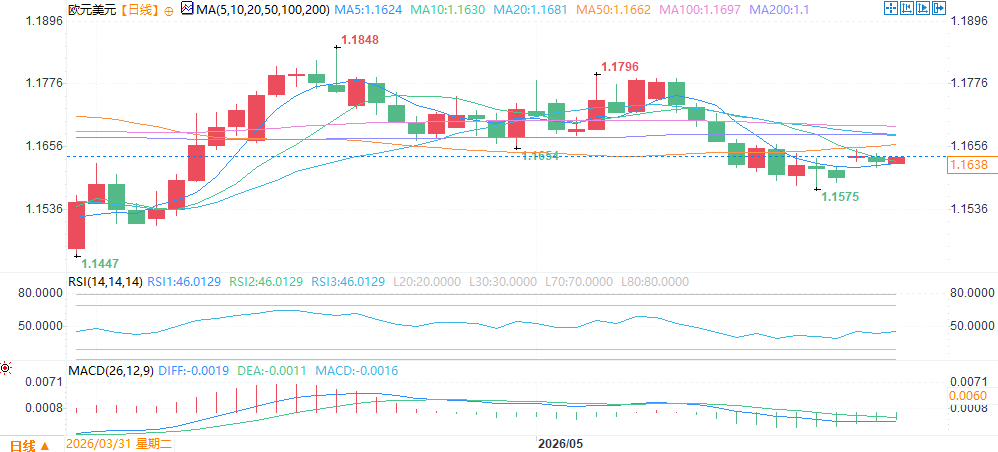
(Euro/USD daily chart, source: FX678)
Regarding the moving average system, the 5-day moving average (MA5) (1.1624) and 10-day moving average (MA10) are slightly below the current price, while the 20-day moving average (MA20) (1.1681), 50-day moving average (MA50) (1.1662), and 100-day moving average (MA100) (1.1697) are all above the current price, forming short-term resistance. This arrangement of "price below or near major moving averages" indicates that the euro/dollar exchange rate is under significant short-term pressure and is in a weak consolidation pattern.
At 8:50 AM Beijing time on May 27, the euro was trading at 1.1639/40 against the US dollar.
Despite the limited rebound in the exchange rate, the latest statements from European Central Bank officials have provided potential bottom support for the euro.
François Villeroy de Gallo, one of the top policymakers at the European Central Bank and governor of the Bank of France, said in a media interview on Tuesday (May 26) that the European Central Bank "will take the necessary measures" to bring inflation back to its target.
The impact of the Iran war has become apparent, with the Eurozone inflation rate jumping to 3%. Just before the war broke out, the inflation rate had fallen below the European Central Bank's 2% target. The market widely expects the ECB to raise interest rates at its next meeting.
Energy shocks trigger inflation concerns; European Central Bank pledges action
In a media interview, Villeroy stated that the European Central Bank will "take all necessary measures as an independent central bank to bring inflation back to its target."
He emphasized, "In the medium term, this means taking the necessary measures to bring inflation back to 2%. The market can rest assured about this." The surge in oil prices caused by the de facto closure of the Strait of Hormuz has exacerbated market concerns that the energy crisis could trigger a resurgence of inflation in multiple markets.
Villeroy acknowledged that the short-term impact of the Middle East conflict was evident, with energy prices experiencing significant upward pressure in the first round. However, he stated that the European Central Bank's responsibility—and even commitment—is to prevent a second wave of effects.
Inflation data and market reaction: Inflation rose to 3% in April, and bond market volatility intensified.
Eurozone inflation had fallen to 1.9% before the outbreak of war triggered by the US-Israel joint strike on Iran on February 28, below the European Central Bank's target. The inflation rate jumped to 3% in April from 2.6% in March.
As a major net energy importer, Europe is particularly vulnerable to energy shocks. The sharp rise in petrol, diesel, and jet fuel prices in recent months has forced interventions by some governments and raised warnings of potential summer flight cancellations.
Villeroy stated that concerns exist about inflation seeping into financial markets, particularly in the government bond market. Global government bonds have been volatile since the outbreak of the war. The German 10-year bond—the eurozone benchmark—has risen by about 32 basis points, with other eurozone bonds experiencing even greater volatility. The rise in yields is due to investors pricing in higher inflation and a more hawkish monetary policy.
The second round of effects has not yet materialized, and the European Central Bank has pledged further action if necessary.
Villeroy stated that the ECB kept its key interest rate steady at 2% last month because officials lacked sufficient data regarding the risk of a so-called second round of inflation effects. This data includes core inflation excluding energy and food, household and business inflation expectations, and wage growth. "The data so far suggests that this is primarily a first-round effect, but we should remain highly vigilant about a potential second round. Therefore, there is no doubt that we will take all necessary actions."
The market widely expects the European Central Bank to raise interest rates at its June meeting, with most traders anticipating at least a 50 basis point increase by the end of the year.
Other officials have also issued statements: Lagarde, Nagel, and Kazzak have all issued warnings.
In late March, European Central Bank President Christine Lagarde stated that the central bank was prepared to raise interest rates even if the expected rise in inflation proved to be temporary.
On Sunday (May 24), European Central Bank President Christine Lagarde revealed that the ECB may raise its inflation forecast at its June policy meeting. She stated on Sunday that there is a high probability the central bank will revise its inflation forecast at next month's policy meeting.
She pointed out that the 2.6% inflation rate forecast for this year, which was made in March, "may be adjusted," and that the situation has changed since the forecast was published.
When asked whether adjustments to inflation expectations would prompt the central bank to announce an interest rate hike on June 11, Lagarde did not give a specific answer. She stated, "The current situation presents numerous uncertainties. We need to comprehensively consider all available data, analyze and assess economic development trends over the next few quarters, study whether it is necessary to introduce relevant policy measures, and evaluate the medium-term impact of these measures. Our medium-term inflation target is 2%."
Economists and market investors generally predict that the European Central Bank will raise interest rates by 25 basis points. Several central bank officials have also stated that if the United States and Iran cannot reach a long-term and effective peace agreement, then an interest rate hike will likely be inevitable.
German central bank president Nagel said last month that oil price volatility has put the European Central Bank "between our baseline scenario and the adverse scenario."
Latvian central bank governor Kazaks warned of a potential "layered" economic shock.
A June rate hike by the European Central Bank is almost certain; subsequent actions will depend on the second-round effect.
In summary, European Central Bank (ECB) officials have recently made a series of statements, clearly pledging to take necessary measures to curb inflation. Against the backdrop of soaring energy prices and April inflation reaching 3%, the market widely expects the ECB to raise interest rates at its June meeting.
While current inflation is primarily a first-round effect, the European Central Bank remains highly vigilant about a second-round effect and is prepared to take further action if necessary. Volatility in the Eurozone bond market reflects investors pricing in higher inflation and a more hawkish policy stance.
In the short term, the ECB's interest rate hike path is basically set, but the strength of subsequent actions will depend on whether inflation spreads to wages and core prices.
EUR/USD Daily Technical Analysis
From the daily chart, the euro is currently trading around 1.1635 against the US dollar, in a consolidation phase after rebounding from recent lows, with multiple technical indicators showing neutral to weak signals.
(Euro/USD daily chart, source: FX678)
Regarding the moving average system, the 5-day moving average (MA5) (1.1624) and 10-day moving average (MA10) are slightly below the current price, while the 20-day moving average (MA20) (1.1681), 50-day moving average (MA50) (1.1662), and 100-day moving average (MA100) (1.1697) are all above the current price, forming short-term resistance. This arrangement of "price below or near major moving averages" indicates that the euro/dollar exchange rate is under significant short-term pressure and is in a weak consolidation pattern.
At 8:50 AM Beijing time on May 27, the euro was trading at 1.1639/40 against the US dollar.
- Risk Warning and Disclaimer
- The market involves risk, and trading may not be suitable for all investors. This article is for reference only and does not constitute personal investment advice, nor does it take into account certain users’ specific investment objectives, financial situation, or other needs. Any investment decisions made based on this information are at your own risk.